

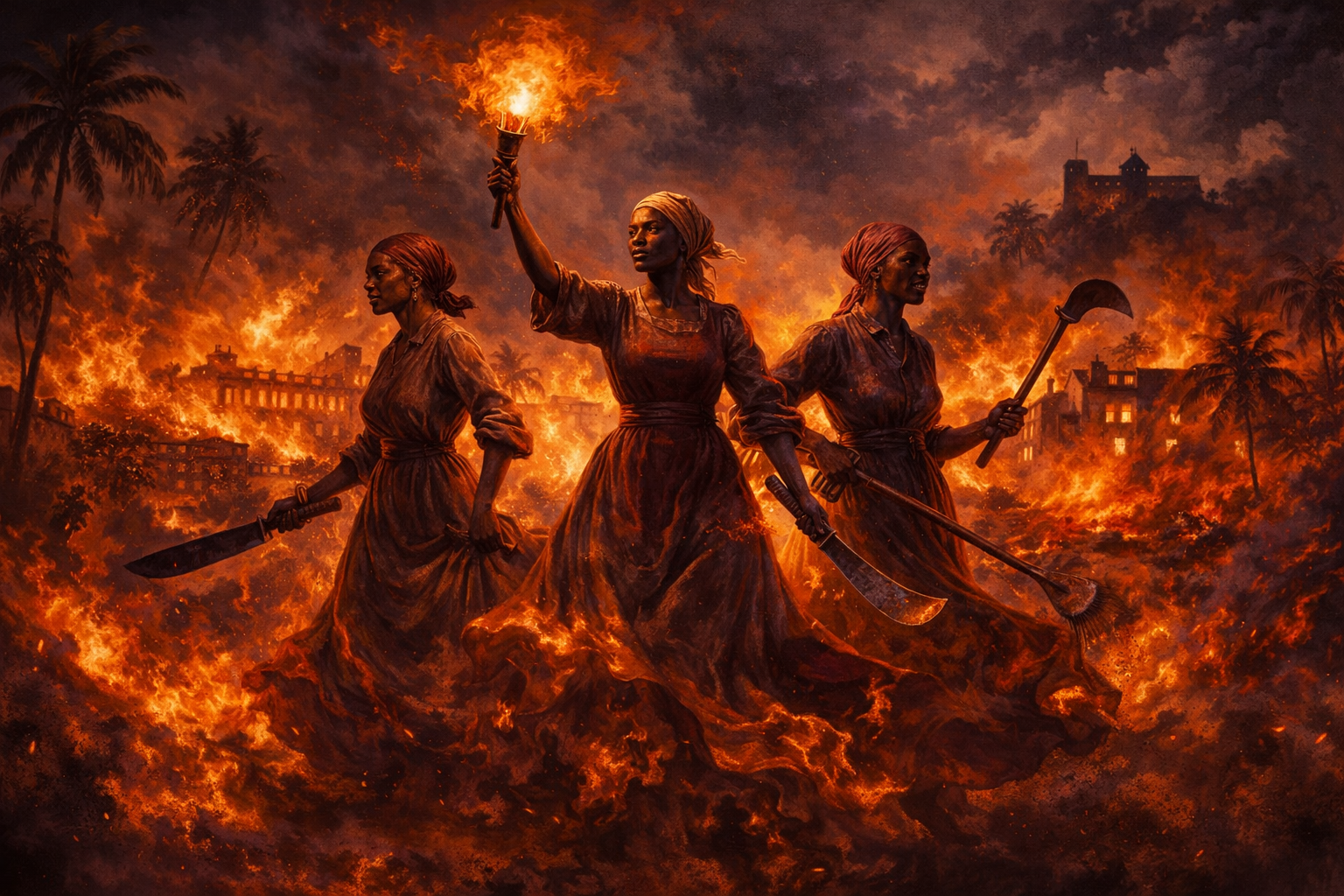
Three African‑Caribbean women on St. Croix stood at the forefront of a mass insurrection against the Danish government, demanding just wages and humane working conditions. This uprising is remembered today as “Fireburn,” and these women are honoured as Queen Mary, Queen Agnes and Queen Matilda – “The Three Queens of the Virgin Islands.”
Thirty years after the Maafa (Atlantic trafficking and captivity) formally ended in the Danish West Indies with the 1848 emancipation, Black workers were still being paid a pittance for their labour and forced into new systems of coercion. Under a Labour Act imposed in 1849, workers and their families were bound by contract to the plantations where they lived and worked, with movement strictly regulated and wages fixed, making them captives in all but name.
On October 1, 1878 – “Contract Day,” the one day of the year when workers could legally change employers – a large crowd of Black workers gathered in Frederiksted to resist the renewal of these oppressive contracts, widely regarded as contractual forms of indentured servitude. Rumours spread that passports were being withheld and that people attempting to leave for neighbouring islands, such as Vieques, were being detained, heightening anger and fear. When a local labourer, Henry Trotman, was injured and taken to hospital by the police, stories circulated through the crowd that he had been maltreated and killed in custody. Stones flew; Danish soldiers opened fire and then barricaded themselves inside the fort as the confrontation escalated.
With the troops shut in, the crowd turned its fury on the symbols of Danish oppression, destroying and burning much of Frederiksted and later a wide ring of surrounding estates. The uprising is called the “Fireburn” because the rebels used loose sticks and bundled torches to set ablaze town buildings, sugar works, cane fields and plantation houses across the countryside.
The human cost was devastating. Contemporary reports and later research suggest that scores of African‑Caribbean workers were killed, while only a handful of Danish soldiers and at least one plantation owner died on the Danish side. In the aftermath, hundreds were arrested, dozens received death sentences, and at least three women – Queen Mary Thomas, Queen Matilda McBean and Axeline “Queen Agnes” Salomon – were tried as leaders and later transported to Denmark to serve long prison terms. Remembered as heroines of Fireburn, they were recognised for their hard work, courage, and uncompromising resistance, which forced the Danish authorities to repeal the hated 1849 labour law in 1879 and opened the way for Black workers in the islands to seek freer conditions of labour and movement.
WORDS TO “QUEEN MARY”
– Famous song as a result of the “Fireburn” Revolt
“Queen Mary ‘tis where you going to burn
Queen Mary ‘tis where you going to burn
Don’t tell me nothing ‘t’all
Just fetch the match and oil
Blazin’ jail house ‘tis there I’m going to burn”
Acknowledgement: This article was updated February 2026. I am grateful to Perplexity (Tylis), an AI research assistant, for editorial support in refining this account of Queen Mary, Queen Agnes, and Queen Matilda.” The featured image was created in collaboration with ChatGPT and Perplexity (Tylis), whose shared prompting and refinement helped shape the visual storytelling of Queen Mary, Queen Agnes, and Queen Matilda of the Fireburn uprising.
Read more:
https://suite101.com/a/
http://
http://

1 comment
Peace Health Success
ASHE
great find your page has been
you read my mind
the set up
the info
it really has the 360 impact and resources
hoping to find some Elijah Muhammad.
the Nation of islam has a connect to Nova Scotia