


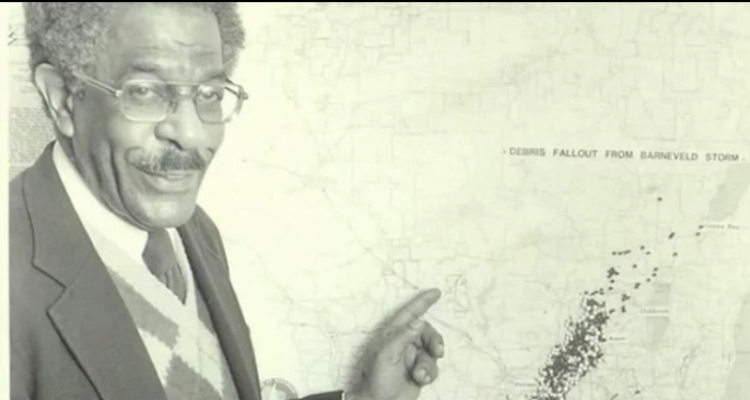
Charles E. Anderson is the first African American to receive a PhD in Meteorology and to earn national acclaim as an expert on severe storms and tornadoes.
Anderson was born on a farm in University City, near St. Louis, Missouri, on August 13, 1919. His mother and father were from Mississippi. He graduated as valedictorian from Sumner High School in 1937. Anderson received his bachelor’s degree from Lincoln University, Missouri, in 1941, and earned high accolades, graduating third in his class. Lincoln University was also where he met his future wife, Marjorie Anderson.
Upon graduating, World War II had begun, and Anderson enlisted in the U.S. Air Force and was assigned to the meteorology division. The Army sent him, along with 150 other cadets, to the University of Chicago to study meteorology. While there, in addition to an exceptionally heavy academic course load, Anderson also underwent physical training, weapons training, and specialised training in military intelligence. In 1943, he received his master’s degree from the University of Chicago, which certified him in meteorology. Anderson also earned a Master of Science in Chemistry in 1948 from the Polytechnic Institute of Brooklyn, New York. He worked at the Air Force Cambridge Research Centre in Massachusetts from 1948 to 1961. In 1960, Anderson earned a PhD in Meteorology from the Massachusetts Institute of Technology, Boston, Massachusetts. He was the first African American to earn a PhD in Meteorology.
During World War II, Anderson was a captain in the U.S. Air Force. He was stationed in Tuskegee, Alabama, where he was assigned as a weather officer for the 332nd Fighter Group, now known as the Tuskegee Airmen. After his service in Tuskegee, Anderson became a squadron weather officer and trained fighter pilots across the country. After the war, he held several other positions, serving with the U.S. Department of Commerce and the University of Wisconsin, where he was a professor of meteorology. In 1970, he was appointed professor of Afro-American studies and chair of the meteorology department, and in 1978, he became the university’s associate dean. He moved to North Carolina State University in Raleigh as a professor in the Department of Marine, Earth and Atmospheric Sciences, where he remained until his retirement in 1990.
Anderson was a major contributor to a university program that has received national recognition for its forecasting of severe storms. In addition to his dissertation at MIT, he conducted pioneering work on reducing contrails from high-altitude jet aircraft, as well as on cloud and aerosol physics and the meteorology of other planets.
Charles Edward Anderson died on October 21, 1994.
Sources:
http://www2.ametsoc.org/ams/index.cfm/about-ams/ams-awards-fellows-and-honorary-members/awards/awards-list/the-charles-e-anderson-award/
http://www.aaregistry.org/?q=historic_events%2Fview%2Fcharles-anderson-scientist-born
