



“Ever since they left Thies, the women had not stopped singing. As soon as one group allowed the refrain to die, another picked it up, and new verses were born at the hazard of chance or inspiration, one word leading to another and each finding, in its turn, its rhythm and its place. No one was very sure any longer where the song began, or if it had an ending. It rolled out over its own length, like the movement of a serpent. It was as long as a life.”
― Ousmane Sembène, God’s Bits of Wood
Amelia’s song is one of the most fascinating narratives in the African American drama of the Maafa (Atlantic trafficking and captivity). A Mende woman, captured, transported, and held in captivity in the American South, carried within her a song of mourning. This Mende song was a funeral dirge sung by women during a ceremony called Tenjami, or “crossing the river.”
In crossing the Atlantic, the Mende woman may well have felt that she had died, for everything she had known and loved had been taken away. She must have sung this song many times during the Time of Sorrow (as some ancestors name this tragic era), mourning the social death she herself endured, grieving the loved ones she had lost, and perhaps passing the bones of those who had perished on the long forced march to the coast—a true “Trail of Death.” She must have sung it often and with such insistence that it lived on through the centuries, remembered and cherished, until a daughter would one day become the fulfilment of a dream and a prophecy.
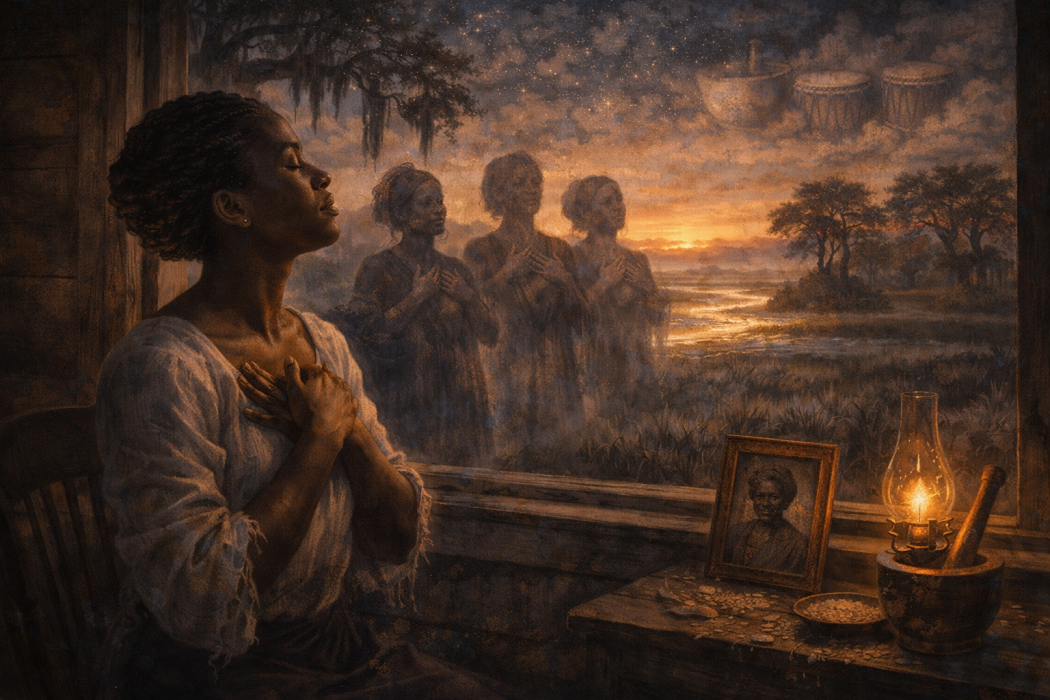
In a Gullah home along the coastal marsh, a woman sits by lamplight, hands crossed over her chest as she sings the fragment of a children’s rhyme learned from her mother and grandmother. Outside the window, spectral foremothers—Mende women from long ago—stand above the wetlands, accompanied by the faint outlines of drums and a mortar and pestle, showing how a funeral dirge in an unknown language survived in the “language you cry in.”
In the early 1930s, as an African-American linguist, Dr. Lorenzo Turner, was conducting seminal research on the Gullah language of the Low Country of coastal South Carolina and Georgia, he discovered that some Gullah people could recite texts in Afrikan languages, with the longest being a five-line song he had learned from Amelia Dawley, who was living in a remote Georgia fishing village. Although Amelia did not know the meaning of the song’s syllables, a Sierra Leonean graduate student in the USA recognised them as Mende, his native tongue.
Amelia’s song was traced to a Sierra Leonean village after Joseph Opala, a Euro-American anthropologist, joined ethnomusicologist Cynthia Schmidt and Sierra Leonean linguist Tazieff Koroma in an arduous search to determine whether it was still remembered anywhere in Sierra Leone.
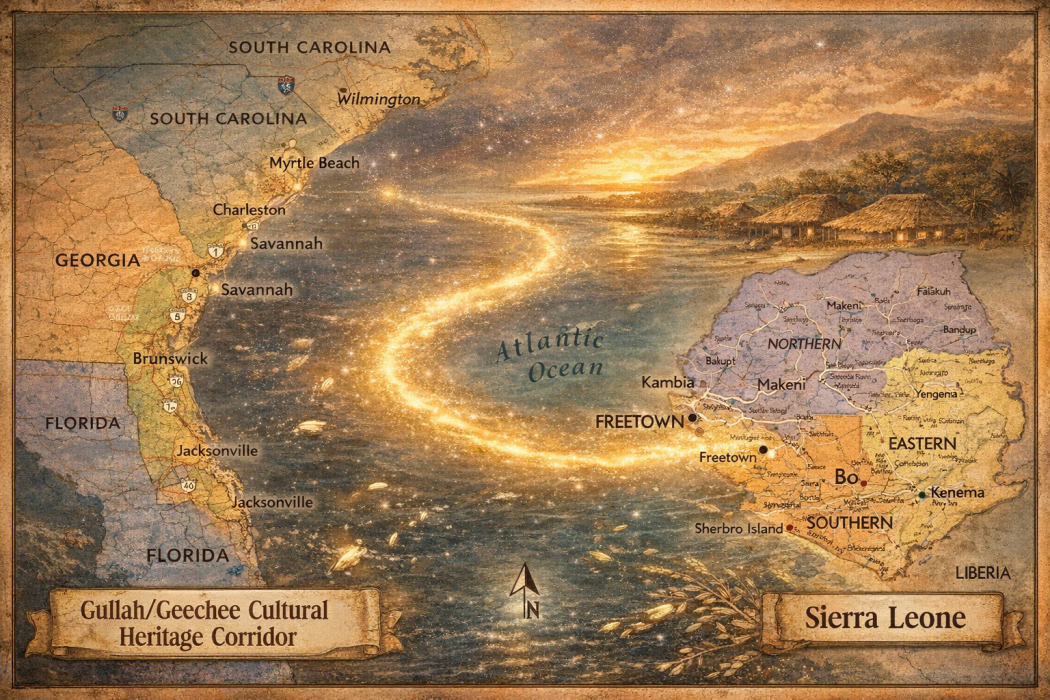
The Gullah/Geechee Cultural Heritage Corridor and Sierra Leone face each other across a glowing “river” of light, transforming the routes of the Atlantic into a path of return. The map visually traces the journey of Amelia’s Mende funeral song—from Senehun Ngola in southern Sierra Leone to the sea islands and marshlands of Georgia and South Carolina—reimagining the Middle Passage as a conduit of ancestral remembrance rather than a void.
Schmidt discovered a woman, Baindu Jabati, living in the remote interior village of Senehum Ngola, in far southern Sierra Leone, who had preserved a song with strikingly similar lyrics; a dirge performed during a ceremony called Tenjami or “crossing the river.” Her grandmother taught her the song because birth and death rites are women’s responsibilities in Mende culture. The song was a typical Mende funeral song –Finya Wulo – usually performed by women as they pound rice into flour for a sacrifice to the dead. Mende women traditionally remained in town preparing for the sacrifice while the men were in the cemetery preparing the grave.
Baindu’s grandmother also made a prediction that there would be a return of lost kinsman and that Baindu would recognise them through this song.
Schmidt and Opala then went to Georgia, where they found Amelia Dawley’s daughter, Mary Moran, age 69, who remembered her mother singing the song. Though transformed by African-American culture into a children’s rhyme, there was also continuity since the song was passed down by women on both sides.
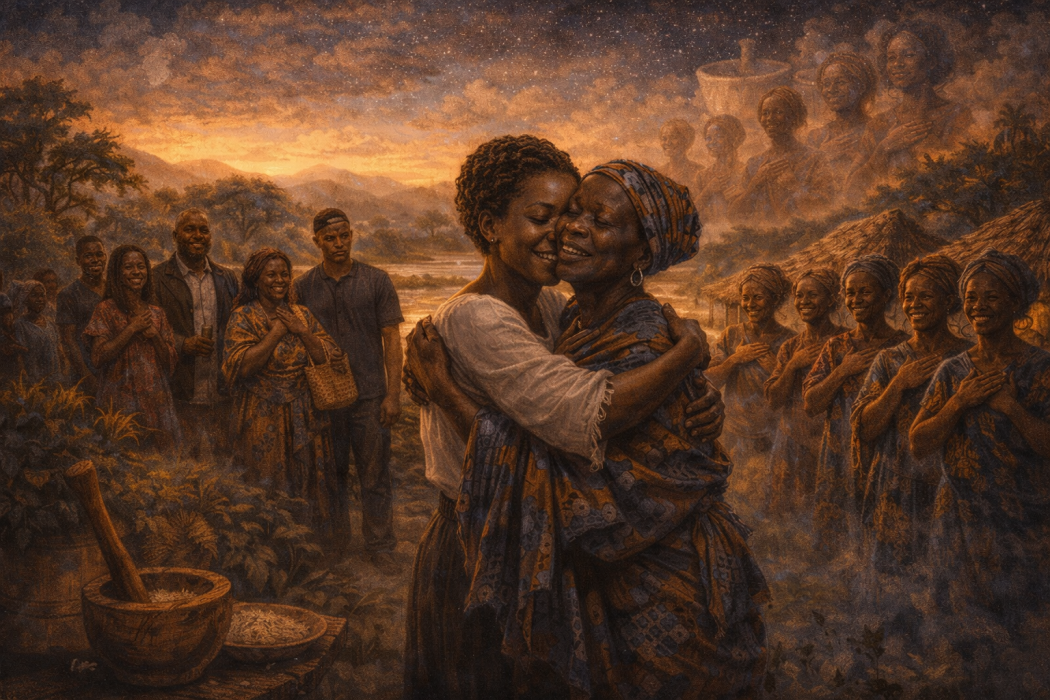
On the banks of a Sierra Leonean river, Mary Moran embraces Baindu Jabati, the Mende woman whose family kept the same funeral song that Mary’s mother and grandmother had sung in Georgia. Around them, village women stand with hands over their hearts, beside the rice mortar and pestle of Finya Wulo, while ancestral figures rise in the background, suggesting that the Tenjami “crossing” is finally reversed as stolen kin return home.
In 1997, Mary Moran and her family travelled to Sierra Leone and, after a painful visit to Bunce Island, were received with jubilation in Senehum Ngola. The village’s blind, 90-year-old leader, Nabi Jah, organised a Teijami ceremony for Mary, even though it had been in desuetude (a state of disuse) since the introduction of Christianity and Islam earlier in the century. Thus, Mary’s homecoming became a catalyst for the Mende people to rediscover a part of their own past.
When Opala asked Nabi Jah why a Mende woman exiled two hundred years ago would have preserved this particular song, he replied that the answer was obvious. “That song would be the most valuable thing she could take. It could connect her to all her ancestors and to their continued blessings.” Then he quoted a Mende proverb, “You know who a person really is by the language they cry in.”
The original version of the song contained ten lines, with some repeated once or twice. Over the years, the Gullah women who preserved the song slightly altered the pronunciation and deleted several one-syllable words, but the text remains intelligible to a modern Mende speaker.
Amelia’s song
Gullah Version
A wohkoh, mu mohne; kambei ya le; li leei tohmbe.
A wohkoh, mu mohne; kambei ya le; li leei ka.
Ha sa wuli nggo, sihan; kpangga li lee.
Ha sa wuli nggo; ndeli, ndi, ka.
Ha sa wuli nggo, sihan; huhan ndayia.
Modern Mende
A wa kaka, mu mohne; kambei ya le’i; lii i lei tambee.
A wa kaka, mu mohne; kambei ya le’i; lii i lei ka.
So ha a guli wohloh, i sihan; yey kpanggaa a lolohhu lee.
So ha a guli wohloh; ndi lei; ndi let, kaka.
So ha a guli wohloh, i sihan; kuhan ma wo ndayia ley.
English
Come quickly, let us work hard;
the grave is not yet finished; let his heart be perfectly cool (at peace).
Come quickly, let us work hard:
the grave is not yet finished; let his heart be cool at once.
Sudden death commands everyone’s attention,
like a firing gun.
Sudden death commands everyone’s attention,
oh elders, oh heads of family
Sudden death commands everyone’s attention,
like a distant drum beat.
(Translated by Tazieff Koroma, Edward Benya and Joseph Opala)
See also The Gullah Creole Art of Diane Britton Dunham
Acknowledgement: Updated February 2026, the ‘Amelia’s Song’ artwork series was conceived and directed by Meserette using AI image‑generation tools as part of the creative process. Visual concepts and prompts were developed in collaboration with Perplexity (GPT‑5.1) and ChatGPT; final image selection, curation, and narrative framing are the author’s original work.
Source:
Enslaved Women in America: An Encyclopedia edited by Daina Ramey Berry
https://glc.yale.edu/sites/default/files/files/Gullah%20Song.pdf
http://www.newsreel.org/nav/title.asp?tc=CN0053
http://www.dianesart.com/biography.html

4 comments
Mary Moran is my great grandmother . I remember her going to Sierra Leone when I was 6 years old. She passed away last year at the age of 100. I am writing a diversity statement for school and I am blessed to know where my ancestors came from. It is truly a privilege and an honor! Thank you for capturing the story of my ancestors!
This is amazing. I just watched the documentary of your family visiting Sierra Leone. I am also from the Mende tribe based on African Ancestry DNA. I’m doing a search for the audio of the song so I can learn it.
This is a valuable gem of history that should be part of history. God is awesome and powerful. Those who engaged in the slave trade were never able to completely sever the connection between those who were captured and sent throughout the diaspora from their African roots.
This story was captured in a documentary titled “The Language You Cry In”, that I saw about 8 out 9 years ago. I saw it in s movie theater; not on television and have never seen reference to it again. Thank you for capturing the story in print here for others to read about as well.