
Thomas Fuller was an Afrikan man in captivity in North America, who became known as the Virginia Calculator. Although illiterate, he was able to perform the most difficult mathematical calculations in his head. Late in his life, Fuller was encountered by antislavery campaigners, who used his feats as evidence against racist claims of Black intellectual inferiority, and he briefly became a cause célèbre on both sides of the Atlantic.
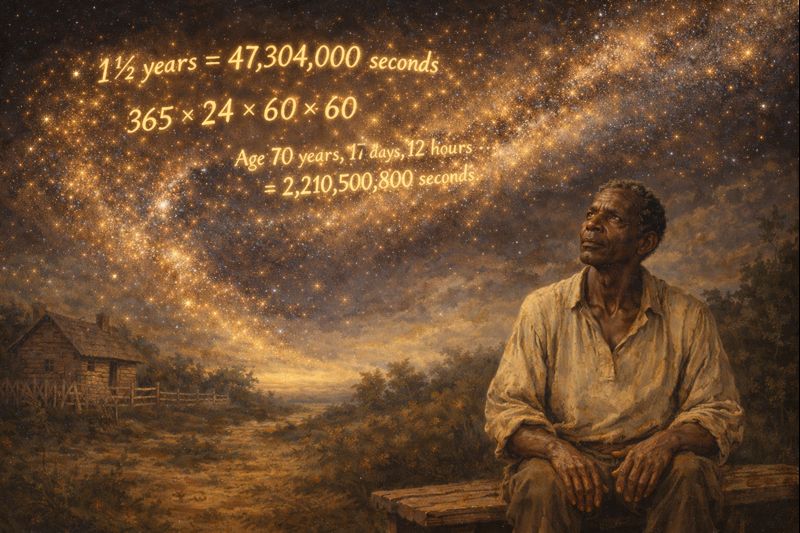
Fuller was born somewhere between the “Bight of Benin” of West Africa (present-day Liberia) and the Kingdom of Dahomey (modern-day Benin). He was kidnapped and shipped to America in 1724 at the age of about fourteen. Fuller was in bondage to Presley and Elizabeth Cox of Alexandria, Virginia, who farmed a 232-acre plantation outside the town. Both Fuller and the Coxes were illiterate, but the Coxes appear to have valued him highly because of his unusual talent for solving complex arithmetic problems in his head. His skill was put to practical use in every phase of managing the farm—for example, calculating how many shingles were needed for a roof, how many posts and rails were required to enclose a meadow, or how much corn would seed a particular field—and his answers were said to be immediate and unfailingly accurate.
As the years passed, stories of his abilities spread along the Eastern seaboard. In 1777, a Philadelphia Quaker merchant, William Hartshorne, moved his family to Alexandria. Hartshorne and two other Quakers from Pennsylvania, including Samuel Coates, arranged to meet Fuller to test his arithmetic feats. One visitor took notes and performed calculations on paper while the others rapidly asked questions of Fuller, who was then about seventy years old.
The first question was: How many seconds are there in a year and a half? Fuller took about two minutes to reply: 47,304,000. Next, he was asked: How many seconds has a man lived who is seventy years, seventeen days, and twelve hours old? His answer—2,210,500,800—came in about a minute and a half. The recorder, working on paper, initially objected that Fuller’s figure was too large, but Fuller pointed out that the man had failed to include the leap years. When the leap years were added, the written calculation and Fuller’s mental result agreed exactly.
A final problem was then proposed: Suppose a farmer has six sows, and each sow has six female pigs the first year, and they all increase in the same proportion each year; how many sows will the farmer have at the end of the eighth year? Fuller at first misinterpreted the question, which led to a brief delay, but once the statement was clarified, he gave his answer—34,588,806—in about ten minutes. Filled with awe, the visiting Quakers gathered their notes and took their leave. As they departed, one remarked what a pity it was that Fuller had been denied an education; Fuller disagreed and replied that it was just as well he had not learned to read and write, “for many learned men be great fools.”
Back in Philadelphia, Hartshorne’s colleagues consulted Dr Benjamin Rush, a leading physician and abolitionist. They gave him a written account of their encounter with Fuller, describing him as grey-headed and showing the weaknesses of old age, but also as a man who had laboured hard on a farm his whole life, without intemperance in alcohol. They noted that he spoke with great respect for his captor, especially recalling his obligations to Mrs Cox for refusing offers of large sums of money to sell him. Rush turned their report into a letter that was read to the Pennsylvania Society for the Abolition of Slavery and then transmitted to abolitionists in London, briefly making Tom Fuller a transatlantic symbol of African intellectual capacity.
“He was gray-headed, and exhibited several other marks of the weakness of old age. He had worked hard upon a farm during the whole of life but had never been intemperate in the use of spirituous liquors. He spoke with great respect of his [CAPTOR], and mentioned in a particular manner his obligations to her for refusing to sell him, which she had been tempted to by offers of large sums of money from several persons. One of the gentlemen, Mr. Coates, having remarked in his presence that it was a pity he had not an education equal to his genius…”
Present-day scholarship tends to think Fuller probably learned at least some methods of calculation in Africa before he was kidnapped. A favorite piece of supporting evidence is a passage written in 1788 by Thomas Clarkson, describing African brokers calculating prices during the purchase of captives: “It is astonishing with what facility the African brokers reckon up the exchange of European goods for [people]… He reduces them immediately by the head to bars, coppers, ounces… and immediately strikes the balance,” while the European trader, despite “all the advantage of arithmetic and letters,” needs pen and paper and still makes mistakes. At the same time, Rush emphasized Fuller’s own explanation that he had sharpened his mind through practical experiments on the farm—first counting the hairs in a cow’s tail, then counting by hand the grains in a bushel of wheat and a bushel of flaxseed, and from there endlessly applying his mental arithmetic to tasks such as estimating shingles for houses and fencing posts and rails for fields. Later writers also credit him with devising his own ways of multiplying distances and tackling problems that verge on what are now handled by astronomical and other scientific computations.
In 1790, Thomas Fuller died on the Cox farm near Alexandria at about eighty years of age. The Columbian Centinel, a Boston newspaper, published a brief obituary that ended with a striking tribute: “Thus died ‘…Tom,’ this self-taught arithmetician, this untutored Scholar! — Had his opportunities of improvement been equal to those of thousands of his fellow-men, neither the Royal Society of London, the Academy of Science at Paris, nor even Newton himself, need have been ashamed to acknowledge him a Brother in Science.”
Source:
https://www.csmonitor.com/1980/0212/021207.html/
https://en.wikipedia.org/wiki/Thomas_Fuller_(mental_calculator)
https://www.blackpast.org/african-american-history/fuller-thomas-1710-1790/
Acknowledgement: This post was revised with the support of Perplexity “Tylis”, an AI assistant that has accompanied my ongoing research and writing on the Maafa, African women’s histories and diasporic memory. The featured image of Thomas Fuller was created with AI assistance (ChatGPT / OpenAI) under the author’s direction.