
Joseph Antonio Emidy (c. 1775–23 April 1835) was an Afro‑Portuguese violinist, composer, and teacher who became one of the most prominent musical figures in early nineteenth‑century Cornwall. Today, he is celebrated as one of Britain’s earliest known composers of African descent—a “lost” voice of the Black Atlantic whose music has vanished, even as his remarkable story continues to resonate.
Origins and contested beginnings
According to the traditional narrative, Emidy was born around 1775 in Guinea, captured as a child, and sold to Portuguese traffickers who took him first to Brazil and then to Lisbon. In this account, he spent his formative years on Brazilian plantations before being brought to Europe, where his captor recognised his musical gift.
Recent scholarship, however, points to a more nuanced—and in some respects more illuminating—origin. Emidy’s headstone in Kenwyn Churchyard, erected by his family in 1835, explicitly describes him as a “native of Portugal,” and musicologist Berta Joncus has argued that his remarkable musical skill by the mid‑1790s is more plausibly explained if he had been born and raised in Lisbon rather than spending his childhood on Brazilian plantations.
In eighteenth‑century Lisbon, Africans and people of African descent comprised an estimated one‑fifth of the city’s population, with many residing in or near the Macambo quarter. Young Black boys in affluent households were often both exploited as fashionable attendants and, through systems of patronage, trained as musicians, artists, or servants. It was within this milieu—where West African traditions and European court culture intertwined—that Emidy likely received his first violin and teacher, beginning the disciplined training that would eventually lead him to the orchestra of the Lisbon Opera House.
From Lisbon Opera to the gun‑deck
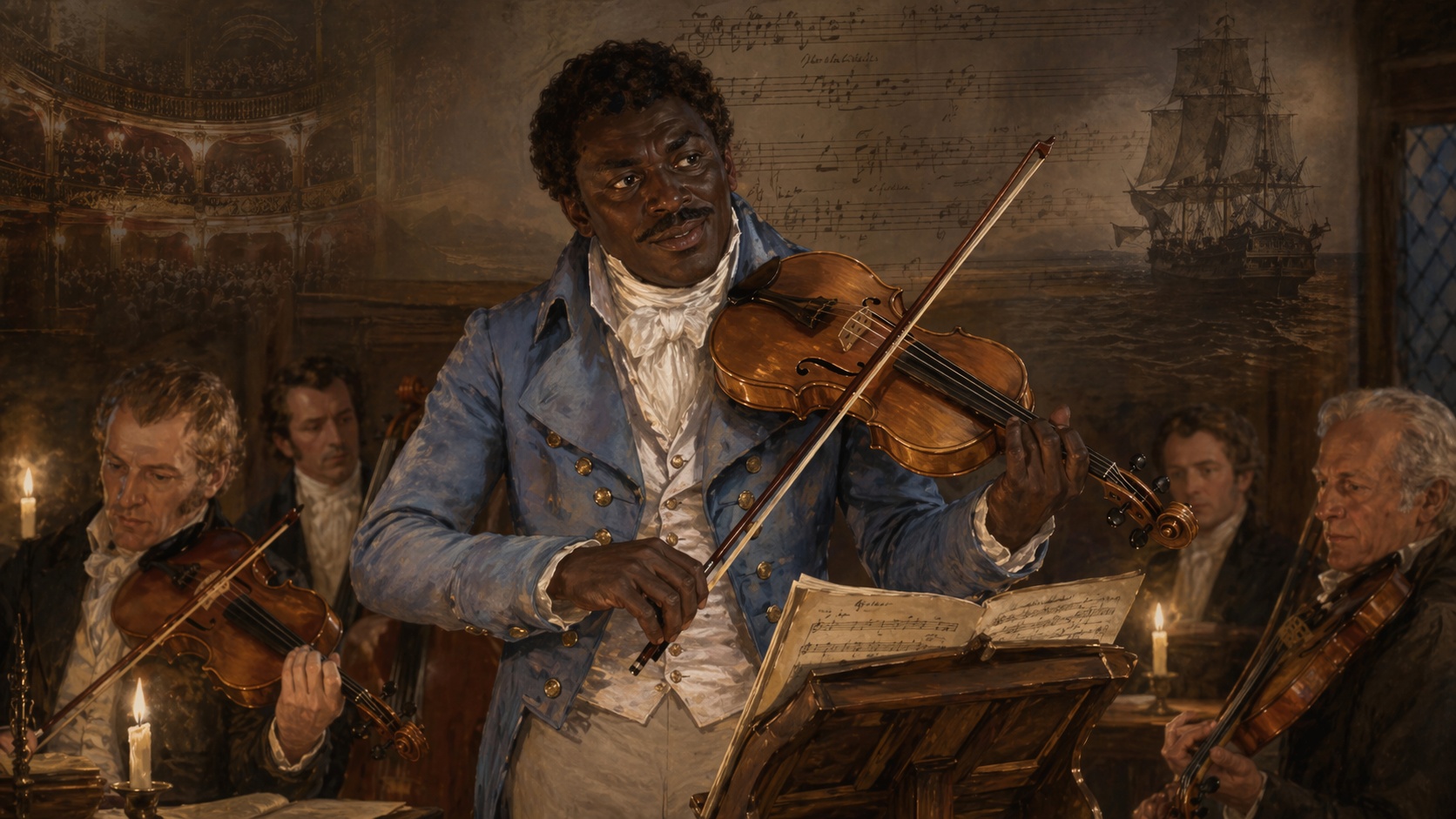
By the 1790s, Emidy had ascended to the role of second violinist at the Lisbon Opera House, performing challenging works by composers such as Gluck, Haydn, and Mozart. His presence in this prestigious musical setting reflected both his exceptional skill and the intricate pathways through which African and African‑descended musicians found their place in European art music.
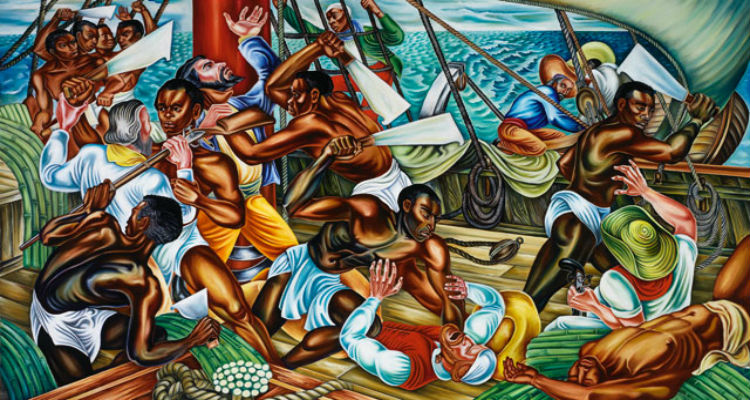
This remarkable rise was abruptly halted in 1795, when Emidy was seized—press‑ganged—into service aboard the British frigate HMS Indefatigable under Captain Sir Edward Pellew. Pellew required a skilled musician to amuse his crew, and Emidy was compelled to play hornpipes, jigs, and reels that he reportedly “loathed and detested,” kept at sea for years and denied shore leave for fear he might escape.
Most accounts state that Emidy was discharged at Falmouth on 28 February 1799, after Pellew assumed a new command and left him effectively stranded in Cornwall. Naval records add complexity, indicating that Emidy may have briefly followed Pellew as an “able seaman,” earning better pay and a share of prize money before finally coming ashore for good in 1802. Regardless of the precise timeline, by the early nineteenth century Emidy had transitioned from forced maritime service to an independent, albeit precarious, civilian life in Britain.
A Black maestro in Cornwall
After settling in Cornwall, Emidy built a distinguished career as a musician, teacher, and instrument repairer, working primarily in Falmouth, Truro, and the surrounding areas. He mastered and taught violin, piano, cello, clarinet, and flute, establishing himself as a cornerstone of the region’s musical life and mentoring generations of amateurs and professionals.
His reputation flourished. Emidy became leader of the Truro Philharmonic Orchestra, directing concerts that brought sophisticated orchestral music to provincial audiences far from London’s metropolitan stages. Contemporary observers hailed him as a genius, with some comparing his talents to those of Mozart and Haydn.
Emidy also composed symphonies, violin concertos, and smaller pieces that were performed in Cornish concerts and admired in local circles. None of his compositions, however, are known to survive. Efforts by friends to advance his career in London were reportedly obstructed by professional musicians who claimed his race would bar him from success—laying bare the racism that constrained his opportunities even as his artistry thrived in Cornwall.
Family, memory, and the shaping of his story
In 1802, Emidy married Jenefer (or Jane) Hutchins, a white Cornish woman, and together they had eight children, further entangling him in local kinship networks and anchoring his Black Atlantic story in the fabric of Cornish life. Emidy died on 23 April 1835 and was laid to rest in Kenwyn Churchyard near Truro, where his Grade II listed headstone endures as a vital record of how his family wanted him to be remembered.
Much of the influential “Guinean‑born” narrative stems from the autobiography of Emidy’s former pupil, the abolitionist James Silk Buckingham. Scholars such as Berta Joncus have argued that Buckingham’s account may have exaggerated or reinterpreted Emidy’s African origins to serve abolitionist aims, constructing a narrative of captivity that resonated with British audiences while downplaying the more complex realities of Afro‑Portuguese life and agency in Lisbon.
Press notices for Emidy’s own concerts in Cornwall, by contrast, portray him as a consummate professional, highlighting his wide‑ranging abilities rather than exoticising his racial identity. The tension between these competing portrayals—family memorial, self‑representation, and abolitionist biography—remains central to contemporary efforts to reconstruct his life and legacy.
Legacy and the work of remembrance
Today, Joseph Antonio Emidy is increasingly recognised as a foundational figure in Black British and Afro‑diasporic music history. Frequently cited as Britain’s earliest known composer of African descent, Emidy’s lost scores serve as a poignant reminder of how many Black musical voices have been erased from the European archive.
His memory is celebrated in Truro Cathedral and through an expanding array of musical projects, academic studies, and public commemorations that aim to restore his rightful place in the histories of European classical music and the Black Atlantic. Meanwhile, ongoing research into eighteenth‑century Lisbon, the Macambo quarter, and Afro‑Portuguese culture continues to shed light on the cosmopolitan world that nurtured his talent.
In tracing Emidy’s journey—from Afro‑Portuguese child of the Atlantic world, to Lisbon virtuoso, to press‑ganged naval musician, to Cornish maestro—we witness both the brutalities and the creative survivals that shaped the Maafa. His story compels us to listen anew for the “lost” notes of Black genius that once resounded in European concert halls, only to be silenced by racism, neglect, and the erasures of history.
Source:
Another History is Possible (Website) – “Joseph Antonio Emidy (c.1775 – 1835) – Another History is Possible”.
Burr, Hilary – “Black History Month 2021 – The story of Joseph Antonio Emidy – ShelterBox”.
Davis, Miles – “Joseph Emidy: From slave fiddler to classical violinist – BBC News”.
Jegede, Tunde – “The Emidy Project – A Musical Odyssey of a Guinean Slave Who Dared to Dream”.
Joncus, Berta – “Joseph Antonia Emidy: Encounters, not Silhouettes”.
Kapo, Remi – “Joseph Antonio Emidy – Remi Kapo”.
Mansell, Tony – “Joseph Antonia Emidy – Cornish National Music Archive”.
Wikipedia – “Joseph Antonio Emidy – Wikipedia”.
Wood, Gayle – “Joseph Emidy: the incredible story of Britain’s first black composer | Classical Music”.