


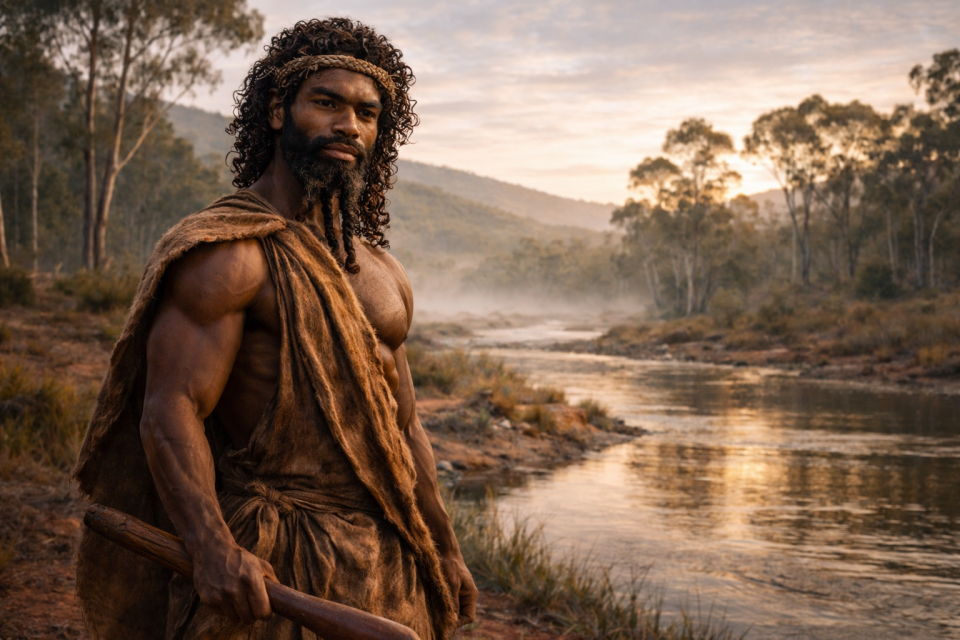
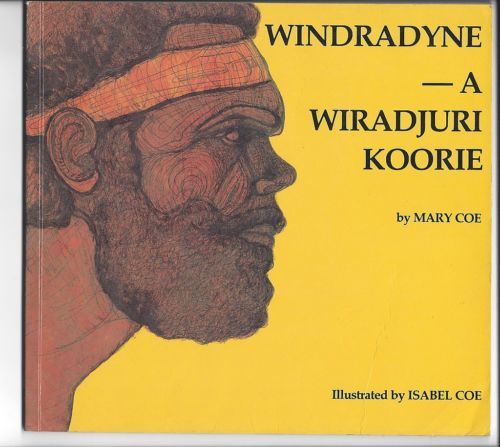
When Windradyne visited Parramatta to meet with Governor Thomas Brisbane in December 1824, the Sydney Gazette wrote that: “He is one of the finest-looking natives we have seen in this part of the country. He is not particularly tall, but is much stouter and more proportionally limbed than the majority of his countrymen, which, combined with a noble-looking countenance and piercing eye, is calculated to impress the beholder with other than disagreeable feelings towards a character who has been so much dreaded by the Bathurst [occupier]. Saturday is, without doubt, the most manly black native we have ever beheld—a fact pretty generally acknowledged by the numbers that saw him…”
The Wiradjuri Buudhang (People) are one of the oldest continuous cultures in Australia. While it is often overlooked that they first settled the interior of New South Wales, archaeological evidence shows the Wiradjuri have occupied their lands—covering about a quarter of the state, or roughly the size of England—for at least 10,000 years. Some estimates suggest their presence stretches back 15,000 to 30,000 years. For the Wiradjuri, their connection to country dates back to the Dreamtime and has never been broken.
Like other Indigenous peoples, the Wiradjuri shared certain beliefs and customs, but outsiders—particularly the British in Sydney—failed to recognise distinctions among nations. As the British expanded into the interior, these differences became significant. Perhaps the most important was the sheer size of the Wiradjuri population. Although exact numbers were unknown in the early 1800s, estimates suggest Australia was home to about 3.3 million Indigenous people, with at least 500,000 Wiradjuri. This made them the largest Indigenous nation in Australia at the time, including when compared to the British settlers.
Another important aspect of Wiradjuri society was the role of warriors. All men—especially the young—were expected to be capable fighters. Although the Wiradjuri were generally peaceful and maintained good relations with their neighbours, a tradition of warrior skills persisted. Many scholars note that the distinction between hunter and warrior in Wiradjuri society was far less pronounced than in European societies; hunting skills naturally translated into abilities valued in conflict.
Trouble soon unfolded in Bathurst. Until 1821, the settlement remained a modest outpost with a small garrison of the 39th Regiment, a handful of public servants, and a few private citizens. Even after Governor Brisbane reversed Macquarie’s policies on territorial expansion, Bathurst’s population rarely exceeded 100. This changed in 1821, when government incentives prompted several hundred colonists to settle in the region. Initially, the Wiradjuri were not overly concerned, but as colonial numbers grew and the intent to take land became clear, attitudes shifted. Among the Wiradjuri, Windradyne emerged as a key figure. He questioned the elders’ acceptance of previous informal agreements with Macquarie—agreements he had not helped negotiate, yet initially accepted.
But circumstances changed, and Windradyne was the first to recognize the shift. Despite his warnings, Wiradjuri leadership clung to their agreement with Macquarie. As more settlers arrived and began farming, tensions escalated. The Wiradjuri, who had no concept of private land ownership, found themselves in increasing conflict with the newcomers.
Windradyne, hearing that some colonists had begun acts of violence against fellow Wiradjuri, began to see for himself what was happening. With a small band of fellow warriors, Windradyne’s group swept through the Bathurst region, gaining intelligence. He noted two things. First, the older occupiers who had been in the district for some time maintained cordial relations with the Wiradjuri and never challenged them. The recent arrivals, however, refused access to the land and were prepared to use violence when their demands were not followed. Windradyne declared these to be Wandang (bad spirits).
Windradyne decided upon a campaign of intimidation against the Wandang. The occupiers who had accepted Wiradjuri customs would be left in peace. Although it was never Windradyne’s intention to kill anyone, he knew that the occupiers had powerful weapons. Instead, he wanted either to make the Wandang accept Wiradjuri ways, especially regarding the land, or to make them leave Wiradjuri territory. However, the Wandang did not see things this way.
It did not take long before small-scale skirmishes took place. At this point, this involved only about ten Wiradjuri, including Windradyne, and one or two Wandang. The Wiradjuri seldom attacked beyond chasing the Wandang off the farm, which they had established. Yet this very process meant that the ejected occupiers arrived in Bathurst with tall tales of escaping massive Indigenous attacks. As these escapees grew in number, Commandant Morrisett, the man in charge of Bathurst, began sending patrols to confirm reports of attacks.
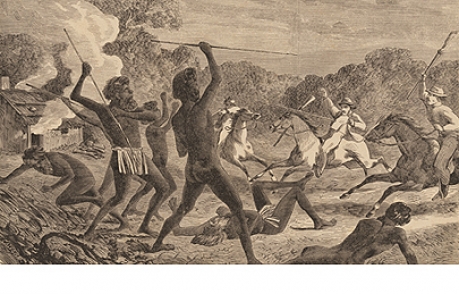
The Wiradjuri began to strike back, and conflict escalated as stations were attacked and cattle speared. Lives were lost on both sides. European occupiers’ reports in the Sydney Gazette record over 13 stock keepers killed by mid-1824. There are no records of the Wiradjuri men, women and children killed in reported retaliatory attacks and poisoning.
In December 1823, Windradyne was put in irons for a month by the commandant of Bathurst, Major Morissett, for killing two bullocks. He reported: “One of the chiefs (named Saturday) of a desperate tribe, took six men to secure him, and they had actually to break a musket over his body before he yielded, which he did at length with broken ribs…”
As conflict came closer to the fledgling town, another report describes the shooting of Windradyne’s family by a farmer on the potato fields on the banks of the Macquarie, across from the early settlement. Windradyne survived this encounter and, in May 1824, mounted a campaign of guerrilla warfare, with detachments on several stations in the Bathurst area.
Early occupier, William Suttor, described his narrow escape from the inflamed warriors, thanks to the lasting friendship he had established with the Wiradjuri. When they arrived at his place, he spoke with Windradyne in Wiradjuri and saved himself and his family. Attacks were recorded at Millah Murrah, The Mill Post and Warren Gunyah.
The killing of a Wiradjuri woman and two girls at Raineville near O’Connell in May 1824 led to the arrest of five stockmen. The prosecution of the case drew the ire of occupiers, who called for military intervention against the Wiradjuri. The accused were not convicted.
Governor Brisbane proclaimed Martial Law on 14 August 1824 and dispatched 75 soldiers to Bathurst, with magistrates permitted to administer summary justice. A reward of 500 acres (203.3 ha) was offered for the capture of Windradyne. Official records of engagement and losses were scant, but W.H. Suttor, one of the few occupier advocates for the Wiradjuri, described their suffering at the hands of the forces assembled under Major Morisset: “When martial law had run its course, extermination is the word that most aptly describes the result. As the old Roman said, ‘they made a solitude and called it peace.”
Soldiers, mounted police, and stockmen carried out numerous attacks on Indigenous people. The attack continued for two months, but no record of casualties was kept. By October, groups of Wiradjuri were reported to be coming into Bathurst to surrender. Martial Law was repealed on 11 December, 1824.
Seventeen days later, Windradyne led a group of Wiradjuri to Parramatta, where, with a dignity acknowledged by European observers, he made an entreaty for peace at the Governor’s Annual Feast. On the same day, the Colonial Secretary, Early Bathurst, sent a dispatch from England rebuking Governor Brisbane for providing insufficient justification for his declaration of martial law. Brisbane was later recalled to England.
Windradyne was reported to have been mortally wounded in a fight on the Macquarie River, and to have died a few hours later on 21 March 1829 at Bathurst hospital. The Suttor family disputed earlier accounts of Windradyne’s death and burial, claiming that he had in fact departed from Bathurst hospital to join his people at nearby Brucedale, and that he died on the property in 1835.
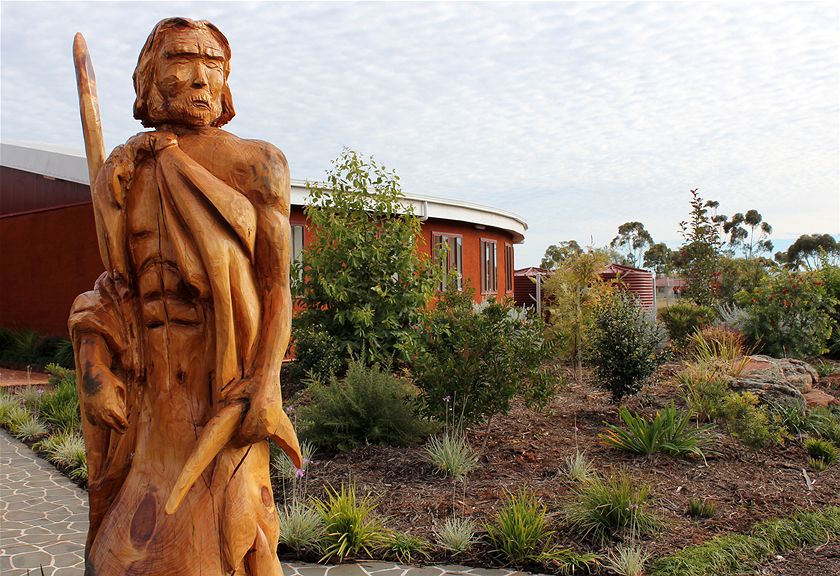
Windradyne has become a national figure of importance as a resistance hero. In 1954, the Bathurst District Historical Society erected a monument beside a Wiradjuri burial mound at Brucedale, attaching a bronze plaque commemorating. A suburb at Bathurst and a student accommodation village at Charles Sturt University, Wagga Wagga, are named after him. Windradyne’s grave is listed on the State Heritage Register and is protected through a voluntary conservation order.
Acknowledgement: This post has been refined (Feb 2026) by Meserette Kentake and ‘Quill’ (a Grammarly AI assistant) while preserving the integrity and intent of the original content. Feature image of Windradyne by the Macquarie River at Dawn was co‑created by Meserette Kentake in collaboration with two AI assistants: Perplexity (Tylis), which helped research Wiradjuri history, Windradyne’s life, and develop the narrative-visual prompt, and ChatGPT, which interpreted that prompt to generate the final artwork.
Sources:
http://www.alternatehistory.com/discussion/showthread.php?t=37043
http://adb.anu.edu.au/biography/windradyne-13251
http://heritagebathurst.com/history-matters/indigenous-history/
https://en.wikipedia.org/wiki/Windradyne
