


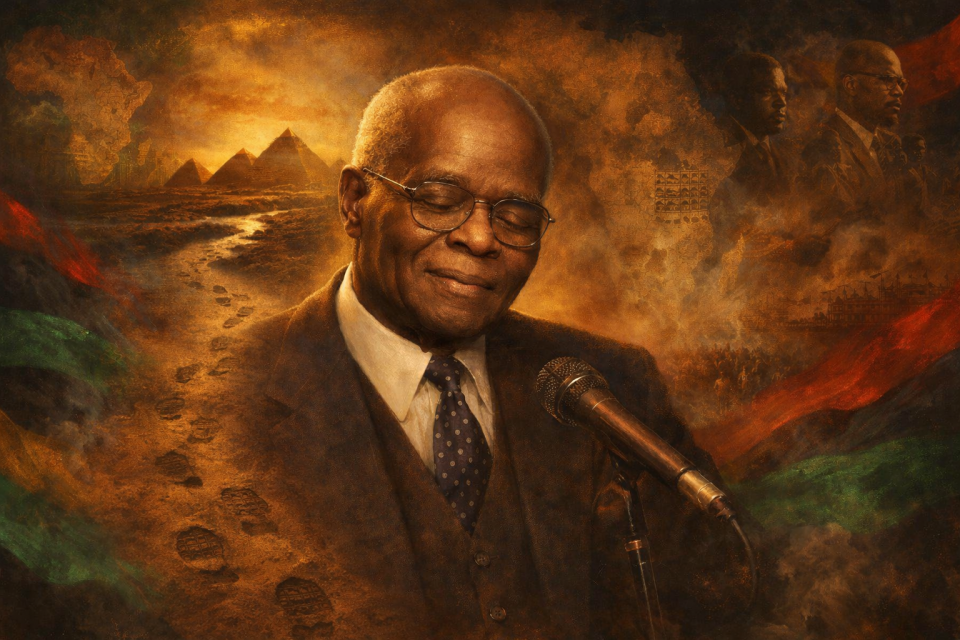
“History is a clock that people use to tell their political and cultural time of day. It is a compass they use to find themselves on the map of human geography. It tells them where they are but, more importantly, what they must be.”
In the documentary John Henrik Clarke: A Great and Mighty Walk (1996), produced and directed by documentarian St. Clair Bourne and narrated by Wesley Snipes, Dr. John Henrik Clarke tells his own legendary story in his own soulful style. At once a biography and a historical lesson, the film invites viewers to journey with Clarke from his childhood in the U.S. South to his emergence as one of the pioneering scholars of Afrocentric and Pan-African thought.
Film overview
- Title: John Henrik Clarke: A Great and Mighty Walk
- Year: 1996
- Director/Producer: St. Clair (St. Claire) Bourne
- Narrator/Executive Producer: Wesley Snipes
- Running time: Approximately 90 minutes
- Country: United States
The film was screened at the 1997 Sundance Film Festival and received the Best Documentary Award at the 1997 UrbanWorld Film Festival, underscoring its importance within Black independent cinema and the wider tradition of political documentary.
Clarke tells his own story
For much of the documentary, an elderly Clarke – nearly blind from glaucoma – sits and speaks directly to the camera, often with his eyes closed, as if reaching inward for ancestral memory. He recounts his early life in Alabama and Georgia, his migration to Harlem, his service in the U.S. Air Force, and his long journey toward becoming a historian and teacher outside the traditional academy.
Clarke situates his personal narrative inside the broader story of twentieth-century Black struggle, reflecting on the Harlem Renaissance, the civil rights and Black Power movements, and his close friendship with Malcolm X. His tone is both intimate and uncompromising, moving between reminiscence, critique, and instruction.
Afrocentric history and the walk through time
Bourne structures the film as a “walk” through roughly 5,000 years of African and world history, using Clarke’s lecture-style narration alongside archival newsreel footage and images of African art and civilisation. Clarke challenges the Eurocentric claim that Europe “brought civilization” to Africa; instead, he insists that conquering powers often destroyed sophisticated African societies they did not understand, later appropriating African ideas into Greek and Roman culture.
Key historical themes include:
- The Nile Valley and the systematic removal of Black Africans from the history of Kemet/ancient Egypt.
- The rise and fall of classical African civilizations and their influence on world history.
- The Maafa: the transatlantic trafficking in African human beings and the creation of the African diaspora.
- The long continuity of African ideas into the modern era, despite conquest, enslavement, and colonization.
Here, Clarke’s Afrocentric method becomes clear: he reads global history from the vantage point of Africa and the African diaspora, exposing the “systematic and racist suppression and distortion” of African history in traditional scholarship.
Pan‑Africanism, struggle, and critique
The film gives significant attention to Pan-Africanism as both a political theory and a practical strategy. Clarke discusses the work of Marcus Garvey, W.E.B. Du Bois, and Kwame Nkrumah, showing how their ideas helped forge a global African consciousness. He defines Pan‑Africanism as the building of an African world community, uniting African people on the continent and in the diaspora, including those in the Americas, the Caribbean, India, and the Pacific.
At the same time, Clarke offers sharp assessments of the limitations of the civil rights and Black Power movements and a critical reading of Louis Farrakhan’s Million Man March, questioning what lasting institutions and structures emerged from such symbolic moments. His reflections insist that political awakenings must be matched by organizational and institutional development.
Clarke also underscores that excluding women means excluding half of a people’s spirituality and strength, indicating his recognition of women’s central role in liberation, even within male-dominated movements.
Bourne’s filmmaking and the documentary’s legacy
Stylistically, Bourne’s approach is relatively straightforward: a long, sustained conversation with Clarke, intercut with historical images, newsreel segments, and artwork. Critics have sometimes described the visual style as conventional, yet they consistently praise the intellectual power of Clarke’s testimony and the film’s function as an accessible introduction to Afrocentric and Pan-African thought.
John Henrik Clarke: A Great and Mighty Walk has since become a staple in classrooms, study groups, and community spaces, especially for those seeking an entry point into Clarke’s writings and into the broader tradition of African‑centered historiography. It stands as both a cinematic tribute to Clarke himself and a pedagogical tool – a reminder that, in Clarke’s words, history is not merely about the past, but about what we “must be.”
Acknowledgement: (Updated Feb 2026) I would like to acknowledge Dr. John Henrik Clarke, whose life and work continue to guide our great and mighty walk toward historical clarity and African liberation. This post was developed with research support and drafting assistance from Perplexity (Tylis), as part of my ongoing commitment to using digital tools in the service of Afrikan memory and ancestral remembrance. The featured image for “John Henrik Clarke: A Great and Mighty Walk” was created in collaboration with Perplexity (Tylis) and ChatGPT, using AI‑assisted illustration to honour Dr. Clarke’s great and mighty walk through Afrikan history.
