
“It was my good fortune to lend a helping hand to the weary travelers flying from the land of bondage.”
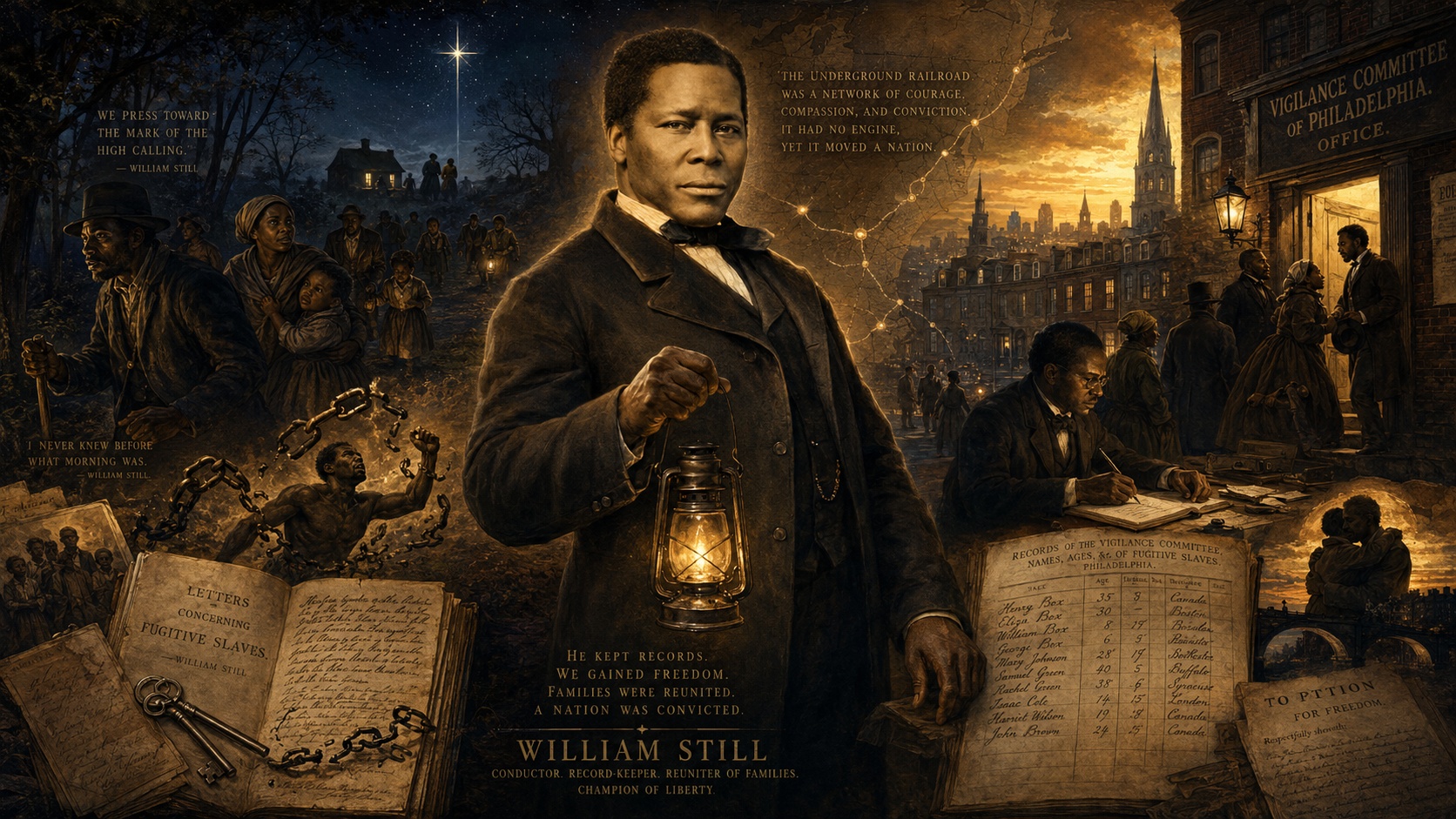
William Still was an African American abolitionist, Underground Railroad conductor, writer, historian, and civil rights activist. As chair of the Vigilance Committee of the Pennsylvania Anti-Slavery Society, he directly aided freedom seekers and kept records of their lives to help families reunite after the Maafa (Atlantic trafficking and captivity) was abolished. After the American Civil War, he published his meticulously kept notes as The Underground Railroad (often cited as The Underground Railroad Records) in 1872. He also became one of the most successful Black businessmen in Philadelphia.
William Still was born on October 7, 1821, in Burlington County, New Jersey, to Charity (née Sidney) and Levin Still. Both of his parents had been born into the Maafa and changed their names after leaving Maryland. His father was known as Levin Steel but changed his last name to Still, and his mother, originally Sidney, changed her first name to Charity to protect herself from re-enslavement.
Still’s parents came to New Jersey separately. First, his father bought his freedom in 1798 from his enslaver in Caroline County, Maryland. Charity escaped twice from Maryland; the first time, she fled with their four children, but they were all recaptured and returned to captivity. A few months later, Charity escaped again, taking only her two younger daughters with her, and this time succeeded in reaching her husband in New Jersey. Following her escape, Charity and Levin had fourteen more children, of whom William was the youngest. Although these children were born in the free state of New Jersey, under Maryland and federal slave law, they were still legally enslaved because their mother was an escapee, but under New Jersey law, they were free. Charity and Levin could do nothing for their older sons left behind in Maryland.
William Still grew up with vivid images of the horrors of the Maafa. His parents instilled in him strong family and work values as well as pride and self-determination. He worked on his family’s farm until he was 20, when he began working for neighboring farmers. He had little formal education and was largely self-taught. In 1844, he left for Philadelphia, where he worked for several years at various odd jobs. In 1847, he married Letitia George, with whom he had four children, and that same year, he was hired as a clerk for the Pennsylvania Anti-Slavery Society (often known as the Pennsylvania Society for the Abolition of Slavery). Three years later, he was named chair of the Philadelphia Vigilance Committee, the clandestine wing of the society that organized the city’s Underground Railroad operations. The committee sheltered self-emancipating people who stopped in Philadelphia on their way to other free communities, often including Canada. One of those he helped was his brother, Peter Still, who had been left behind by their mother during her escape.
Levin Jr. and Peter had been sold from Maryland to enslavers in Lexington, Kentucky, and later resold to enslavers in Alabama in the Deep South. Levin Jr. died from a brutal whipping, while Peter and most of his family escaped slavery when he was about fifty. After reaching Philadelphia, Peter sought help at the Pennsylvania Anti-Slavery Society to find his parents or other members of his birth family. When they first met, he and William did not realize they were related; however, as William listened to Peter’s story, he recognized the history his mother had told him many times. On learning that his older brother Levin had been whipped to death for visiting his wife without permission, William is reported to have cried out that he might be Peter’s brother, leading to the recognition of their kinship, and later Peter and his mother were reunited after forty-two years apart.
“The heroism and desperate struggle that many of our people had to endure should be kept green in the memory of this and coming generations.”
Often called the “Father of the Underground Railroad,” Still helped as many as 800 African Americans escape enslavement and reclaim their natural rights and freedom. He was still a boy when he first helped a man fleeing slave catchers, whose name he never learned but whose pursuit left a lasting impression. Determined that the stories of emancipated people would not be forgotten, he interviewed each person who passed through his care and kept careful records, including a brief biography, the destination for each, and any aliases adopted. He hid these records securely, aware that they could endanger the people they described, but he also knew that they would be critical for future reunions of families separated under the Maafa.
Still worked with other Underground Railroad agents operating in the South and in many counties in southern Pennsylvania. His network also included agents in New Jersey, New York, New England, and Canada. Conductor Harriet Tubman passed through his office with fellow passengers on several occasions in the 1850s, and Still maintained connections with other militant abolitionists, including the circle around John Brown. He provided material aid to John Brown’s campaign and, after the Harpers Ferry raid, gave shelter to Brown’s widow.
During the Civil War, Still continued to devote himself to business ventures. He opened a store that sold stoves, supplied provisions to Black soldiers stationed at nearby Camp William Penn, and established a successful coal business. In the late 1860s, he led a successful campaign to end racial discrimination on Philadelphia streetcars, wrote an account of this struggle, helped organize a research organization to collect data about African Americans, and supported one of the earliest Black baseball clubs, the Philadelphia Pythians. The Pythians were denied entry into white-controlled leagues, reflecting the broader color line in organized sport.
After the Civil War, Still published his account of the Underground Railroad, The Underground Railroad (1872), based on the secret notes he had kept in diaries during those years. His book, the only first-person account of Black-led Underground Railroad activities written and self-published by an African American of his generation, went through multiple editions and was displayed at the Philadelphia Centennial Exhibition in 1876. It portrays fugitives as courageous, even heroic figures, and represents their escape to freedom as an act of self-determination. The text is now widely available, including as a free e-text on platforms such as Project Gutenberg.
In the late nineteenth century, Still developed several successful businesses while continuing to devote himself to Black social causes. In the 1870s and 1880s, he supported local reform candidates, organized a YMCA branch for Black youth, served on the Freedmen’s Aid Commission, and helped manage homes for elderly African Americans and orphans. In the early 1880s, Still was among a group of older Black leaders in the Northeast who broke with the Republican Party to encourage Black political independence and to strategically support Democratic candidates when that support advanced African American interests. Despite his extensive political activities, Still advocated economic self-improvement over electoral politics as the most reliable route to Black advancement.
In 1888, Still and his son-in-law, Matthew Anderson, a prominent Black minister and businessman in Philadelphia, founded the Berean Building and Loan Association, which provided loans to Black home buyers. Still served as the association’s first president. From 1896 to 1901, he also served as president of the Pennsylvania Society for the Abolition of Slavery, which, after 1865, continued to work for African American rights and added “and for Improving the Condition of the African Race” to its title. William Still died in Philadelphia in 1902.
Brothers Peter, James, and William Still moved with their families to Lawnside, New Jersey, a community developed and governed by African Americans. For more than a century, their descendants have held an annual family reunion there every August, often described as one of the oldest continuously held African American family reunions in the United States. Notable members of the extended Still family include composer William Grant Still, former WNBA player Valerie Still, NFL defensive end Art Still, and NFL defensive tackle Devon Still.
Sources:
http://stillfamily.library.temple.edu/historical-perspective/william-still-significance
http://www.encyclopedia.com/topic/William_Still.aspx