
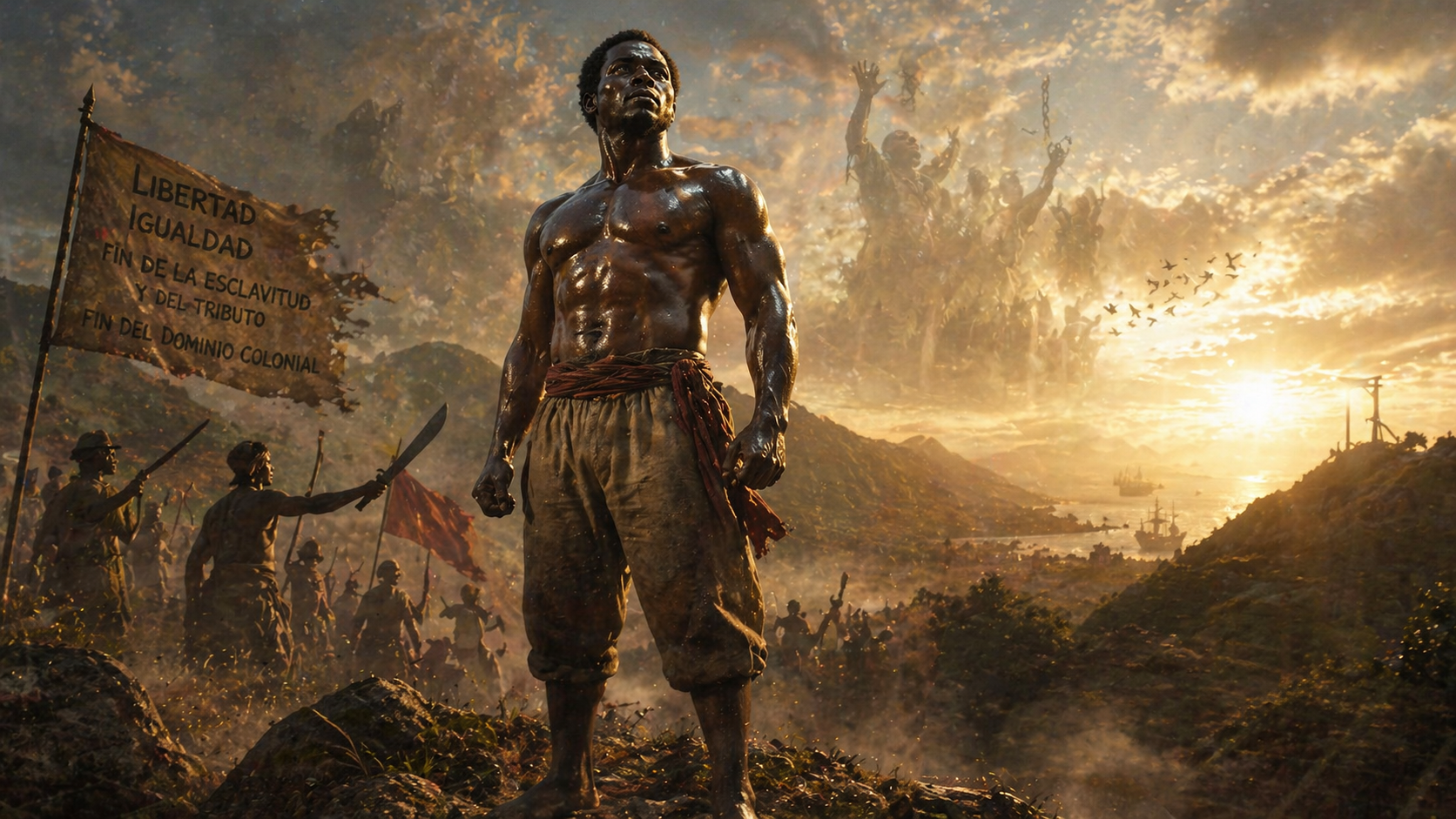
José Leonardo Chirino (25 April 1754 – 10 December 1796) stands as one of the most significant anti-Maafa freedom fighters in eighteenth-century Venezuelan history. A legally free man of African and Indigenous descent, he helped lead the 1795 uprising in Coro, Venezuela, one of the earliest and clearest revolutionary challenges to Spanish colonial oppression in the region. Inspired in part by the Haitian Revolution, Chirino and his fellow revolutionists called for the abolition of slavery, the ending of oppressive taxation, relief from burdens imposed on Indigenous communities, and the creation of a new political order grounded in equality rather than colonial privilege.
Chirino was born legally free in 1754, the son of an enslaved Black father and a free Indigenous mother. His roots in the Ajagua town of Pedregal place him within the rural world of Coro, where African-descended and Indigenous communities lived under the constant pressures of plantation labor, colonial oppression, and increasing demands on land and tribute. He later married María de los Dolores, an enslaved woman, and they had children together—a family history that reveals how closely freedom and bondage could coexist within a single household.
Like many people in the Caribbean world, Chirino’s political imagination was shaped by movement. He worked with the merchant José Tellera and travelled through the region, including to Haiti in 1794, where he witnessed the transformative force of the Haitian Revolution. There he encountered a world in which enslaved and freed people were fighting to overthrow oppression. When he returned to Coro, he came back to a society already burdened by enslaved labour, heavy taxation, colonial privilege, and growing pressure on land, conditions that had generated deep anger among the region’s African-descended and Indigenous poor.
Chirino did not fight alone. Among the key figures around him was José Caridad González, a Congolese man who had escaped captivity in Curaçao and became a respected leader within Coro’s Loango community. González had already fought for his community’s land rights and appears to have helped shape the political direction of the uprising. Another important figure was Cocofo, remembered as a Loango spiritual leader who spread reports that the Spanish monarchy had already abolished the Maafa and that local colonialists were concealing the truth. Together, these men were part of a broader political world where freedom was envisioned as a complete reordering of society.
That vision emerged openly in May 1795. Chirino led an uprising that attacked plantations and confronted the city of Coro under the banner of what witnesses called the “Law of the French.” The revolutionists demanded abolition of the Maafa, an end to oppressive taxes such as the alcabala, relief from burdens imposed on Indigenous communities, and the destruction of European privilege.
The uprising was brutally suppressed. Colonial forces, supported by armed townsmen and loyalist Caquetío allies, defeated the revolutionists outside Coro, launching a campaign of execution and terror in the aftermath. González was killed soon after, most likely murdered under the pretense of an escape attempt. Chirino managed to evade capture for a time, but was eventually apprehended, imprisoned, and sent to Caracas.
On 10 December 1796, José Leonardo Chirino was executed in the Plaza Mayor of Caracas. After his death, his body was mutilated, and his head and hands were displayed in and around Coro as a warning to others. This punishment was intended to erase the memory of uprising through fear. It did not succeed.
Today, Chirino is commemorated as a freedom fighter whose courage foreshadowed later struggles against captivity and oppression. His life reminds us that the creation of freedom in the Americas was never the achievement of one individual alone—it arose from networks of leadership, workers, spiritual leaders, migrants, peasants, and families who dared to envision a different world. Remembering Chirino is honouring the collective Black and Indigenous struggle against colonial oppression in the Caribbean borderlands of South America. In contemporary Venezuela, Chirino stands as a revolutionary symbol of anti-Maafa and anticolonial resistance; an airport in Coro now bears his name.
Source:
Aizpurua, Ramón. “Revolution and politics in Venezuela and Curaçao, 1795-1800”.
Azzellini, Dario. “Chirino, José Leonardo” (contained within the document Chirino, José Leonardo.docx).
Rivera, Enrique Salvador. “Social Control on the Eve of a Slave Revolt: The Case of Coro, 1795” (Master of Arts Thesis, 2013).
Rivera, Enrique Salvador. “The Political Economy of Anti-Slavery Resistance: An Atlantic History of the 1795 Insurrection at Coro, Venezuela” (Doctor of Philosophy Dissertation, 2019).
Vos, Tico. “José Caridad González: From Slavery in Curaçao to Freedom”.
Wikipedia. “José Leonardo Chirino” (Authoritative entry with no individual surname provided)