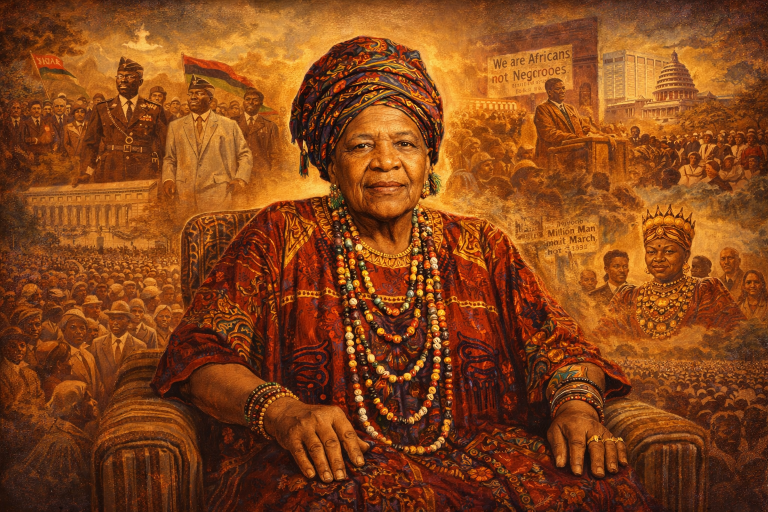

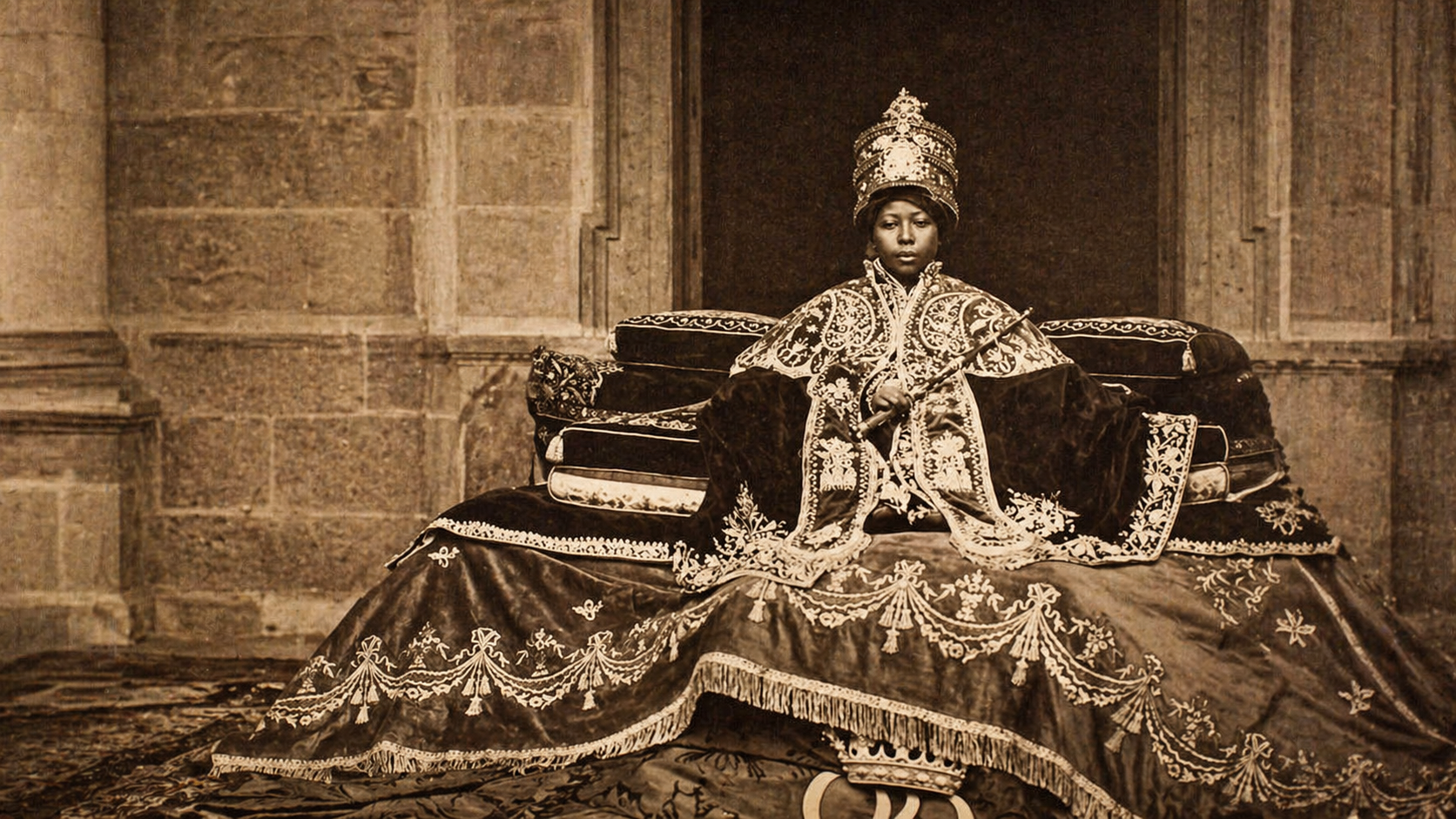
In the early twentieth century, when almost the entire African continent had been carved up under European oppression, an African woman sat on a sovereign throne and ruled an unconquered Black empire. Empress Zewditu of Ethiopia — born Askala Maryam on 29 April 1876 in Harar, was the first and only empress regnant of the Ethiopian Empire, and the first female head of an internationally recognised state in modern Africa. Her very regnal name, Zewditu, can be read as “She is the Crown,” and she bore that crown at a moment when African sovereignty itself was under siege.
Daughter of Menelik, Child of the Solomonic Line
Zewditu was born into the house of Shewa at a time when the Ethiopian state was still being made and defended in blood. Her father, Menelik of Shewa — the future Emperor Menelik II — would lead Ethiopia to victory at Adwa in 1896, shattering the Italian invasion attempt and affirming Ethiopia’s place as a symbol of African resistance. Her mother, Abechi (or Abegetchew), was a noblewoman from Wollo, linking Zewditu to the complex tapestry of Ethiopian regional elites and lineages.
Through Menelik, Zewditu belonged to the Solomonic dynasty, which claimed descent from the union of King Solomon of Israel and Makeda, the Queen of Sheba. She thus inherited not only political legitimacy but also a sacred genealogy in which rulership was imagined as covenantal, a trust received from God and anchored in Orthodox Christian cosmology. When she eventually ascended the throne, she stood as the last reigning monarch descended agnatically from that line; after her, the Solomonic claim would continue, but through more indirect ties.
A Life Shaped by Empire and Marriage
Around the age of ten, she was married to Ras Araya Selassie Yohannes, the son and heir of Emperor Yohannes IV. This marriage sealed a precarious peace between Menelik and the northern emperor, binding Shewa to the imperial centre through a young girl’s life. Araya Selassie died in 1888; the union was childless, and the widowed Zewditu returned to her father’s court.
She would be married several more times, each union reflecting shifting political currents. Two shorter-lived marriages preceded her final and most enduring one to Ras Gugsa Welle, the nephew of her stepmother, the formidable Empress Taytu Betul. Gugsa connected Zewditu to the powerful Betul–Yejju network of northern aristocrats, a conservative bloc deeply invested in protecting the old order, Orthodox hegemony, and regional autonomy. These marriages inscribed Zewditu’s life into the wider story of Ethiopian state formation.
From Exile to Empress
Menelik II’s death in 1913 opened a succession crisis. Power passed not to Zewditu but to Lij Iyasu, the grandson of Menelik through Zewditu’s half-sister Shewa Regga. Iyasu saw Zewditu as a potential rival and ordered her and Gugsa Welle into internal exile in the countryside, away from the political centre at Addis Ababa. Her apparent marginalisation, however, would become a source of later legitimacy: when Iyasu became entangled in allegations of “flirting with Islam” and alienated the Orthodox Church and key nobles, Zewditu emerged as a pious alternative.
On 27 September 1916, Iyasu was deposed by a coalition of nobles and church leaders. They turned to the exiled princess — a royal daughter, deeply Orthodox, and free of Iyasu’s religious ambiguities. Zewditu was proclaimed Negiste Negest, “Queen of Kings,” and her cousin Ras Tafari Makonnen (the future Haile Selassie I) was named heir and regent. On 11 February 1917, in the Cathedral of St George in Addis Ababa, she was crowned Empress of Ethiopia. Forty years old and childless, she ascended the throne of an African empire that had never been colonised, at the height of European aggression.”
A Crown Between Two Worlds
Zewditu’s reign unfolded at the fault line between an older, cosmologically grounded order and a new, externally pressured modernity. She embodied the conservative pole of this tension: deeply committed to the Ethiopian Orthodox Tewahedo Church, wary of rapid reform, and attentive to the fears of nobles and clergy who felt the ground shifting beneath them. Her court was marked by fasting, prayer, the sponsoring of liturgy, and the patronage of church building; she is remembered for founding or supporting numerous churches and religious institutions across the empire.
At the same time, the empire faced mounting pressure from European nations who demanded reforms as a condition of recognition and non-interference. Ras Tafari, as regent, became the agent of that modernising impulse: reorganising administration, expanding diplomacy, and pushing Ethiopia toward international institutions. Under Zewditu’s nominal rule and Tafari’s active diplomacy, Ethiopia joined the League of Nations in 1923, declaring a commitment to suppress systems of bondage and align with international norms. Zewditu did not author these reforms, but she allowed them to pass in her name, even as they unsettled her conservative supporters.
Ras Tafari and the Politics of the Shadow Throne
The relationship between Empress Zewditu and Ras Tafari Makonnen has often been reduced to a simple opposition: pious conservative queen versus visionary moderniser. The reality was more entangled. Tafari’s power was real but always mediated by Zewditu’s symbolic and legal sovereignty; his reforms needed the stamp of an empress whose legitimacy flowed from Menelik and the church. For much of her reign, they were bound together in a delicate choreography: she ruled, he governed.
This arrangement, however, carried built‑in tensions. As Tafari accumulated titles, foreign recognition, and internal allies, he increasingly overshadowed the Empress whose name still headed the prayers. His travels abroad, his mastery of European diplomatic language, and his willingness to negotiate Ethiopia’s place in the colonial regime contrasted sharply with Zewditu’s inward-facing piety and reluctance to break with tradition too abruptly.
By 1928, a conservative uprising opposed to Tafari’s growing influence attempted to block his ascent. When it failed, Zewditu was compelled to formally elevate him to the title of Negus (King), effectively creating a co‑monarchy. She remained Empress and head of state in liturgical and legal terms, but the balance of power leaned increasingly toward the regent-king. In these years, Zewditu withdrew more deeply into spiritual practice, while Tafari tightened his grip on state machinery.
Zewditu’s personal spirituality shaped the character of her court. She was famed for rigorous fasting and for the generosity with which she supported monasteries, churches, and religious scholars. In the Ethiopian Orthodox imagination, a ruler’s legitimacy was inseparable from their fidelity to the faith.
Her conservatism was born of a deeply held fear that rapid change — particularly that which loosened aristocratic and ecclesiastical authority — would unleash forces beyond control. She worried that modern reforms might fuel broader popular demands and destabilise the empire’s delicate balance of regions, classes, and confessions. From the vantage point of Ethiopian elites, “modernity” was never neutral; it arrived wearing the face of empire, missionary intrusion, and international scrutiny. Zewditu’s resistance, then, can be seen as an attempt to protect a sacred order under siege.
Gugsa Welle’s Rebellion and a Mysterious Death
The end of Zewditu’s reign came as dramatically as its beginning. In 1930, her husband Ras Gugsa Welle led a rebellion in Begemder, rallying conservative forces against Tafari’s ascendancy. The Empress, according to multiple accounts, pleaded with Gugsa not to rise against her heir and regent. She understood that a clash between her consort and her designated successor would tear the fragile fabric of her rule.
Nevertheless, Gugsa marched. On 31 March 1930, his forces were defeated at the Battle of Anchem; he was killed in the fighting. Two days later, on 2 April 1930, Empress Zewditu died in her palace in Addis Ababa.
The cause of her death has never been definitively settled. Some contemporaries reported that she died of shock and grief upon learning of Gugsa’s demise. Others suggested she succumbed to a sudden illness; diplomatic sources described her being immersed in ice-cold holy water in an attempt to break a fever, a ritual treatment that may itself have thrown her body into fatal shock. Rumours have long circulated that Ras Tafari had a hand in removing her, given the convenience of the timing, but conclusive evidence has never surfaced.
What is certain is that her passing cleared the path. With Zewditu gone and Gugsa defeated, Tafari stood unchallenged. Later that year he would be crowned Emperor Haile Selassie I, inaugurating a new chapter in Ethiopian and African diasporic imagination.
Burial, Afterlives, and Historical Memory
Empress Zewditu was buried in Menelik’s Mausoleum in Addis Ababa, alongside her father Menelik II and her stepmother Empress Taytu. The mausoleum itself is a stone archive of Ethiopian resistance: within its crypt lie the remains of those who kept the empire intact through the scramble for Africa and beyond.
After Zewditu, no woman would occupy Ethiopia’s highest office until Sahle‑Work Zewde became president in 2018, almost ninety years later. In this long interval, Zewditu’s memory often lived in the shadow of Haile Selassie’s towering international profile. Yet, as recent scholarship and African‑centred platforms have emphasised, she was the first modern female head of state on the continent and the last empress regnant in world history.
For the African diaspora, Zewditu’s story complicates the easy binaries through which we often narrate Black modernity. Here is a sovereign African woman who ruled an independent empire while Europe claimed dominion over “Africa”; a deeply Christian monarch who resisted certain forms of change even as her government engaged the League of Nations and pledged to abolish bondage. Her life invites us to think about the costs and contradictions of protecting a sacred order in a world structured by colonial violence.
Sources and Further Reading:
Tesfu, J. “Empress Zewditu (1876–1930).” BlackPast.org, 2008.
“Zewditu.” Wikipedia.
Rubinkowska, Hanna. Ethiopia on the Verge of Modernity: The Transfer of Power During Zewditu’s Reign 1916–1930. Agade, 2010.
Rubinkowska, Hanna. “New Structure of Power: The Message Revealed by the Coronation of Zawditu (1917).” In African Studies: Forging New Perspectives and Directions, 2016.
“Gugsa Wale’s Rebellion.” Wikipedia.
Queenship Studies Reference Database entry on Zewditu.
“Empress Zewditu – Ethiopia’s First Female Head of State.” AllAfrica, 2018.
“The History of Ethiopia – Part III.” Soul-O-Travels.
“Solomonic Dynasty (1889–1936).” RasTafari TV.
“Queen Zewditu I Ethiopia 1916 to 1930.” Queen Mothers of Africa and Their Daughters.