
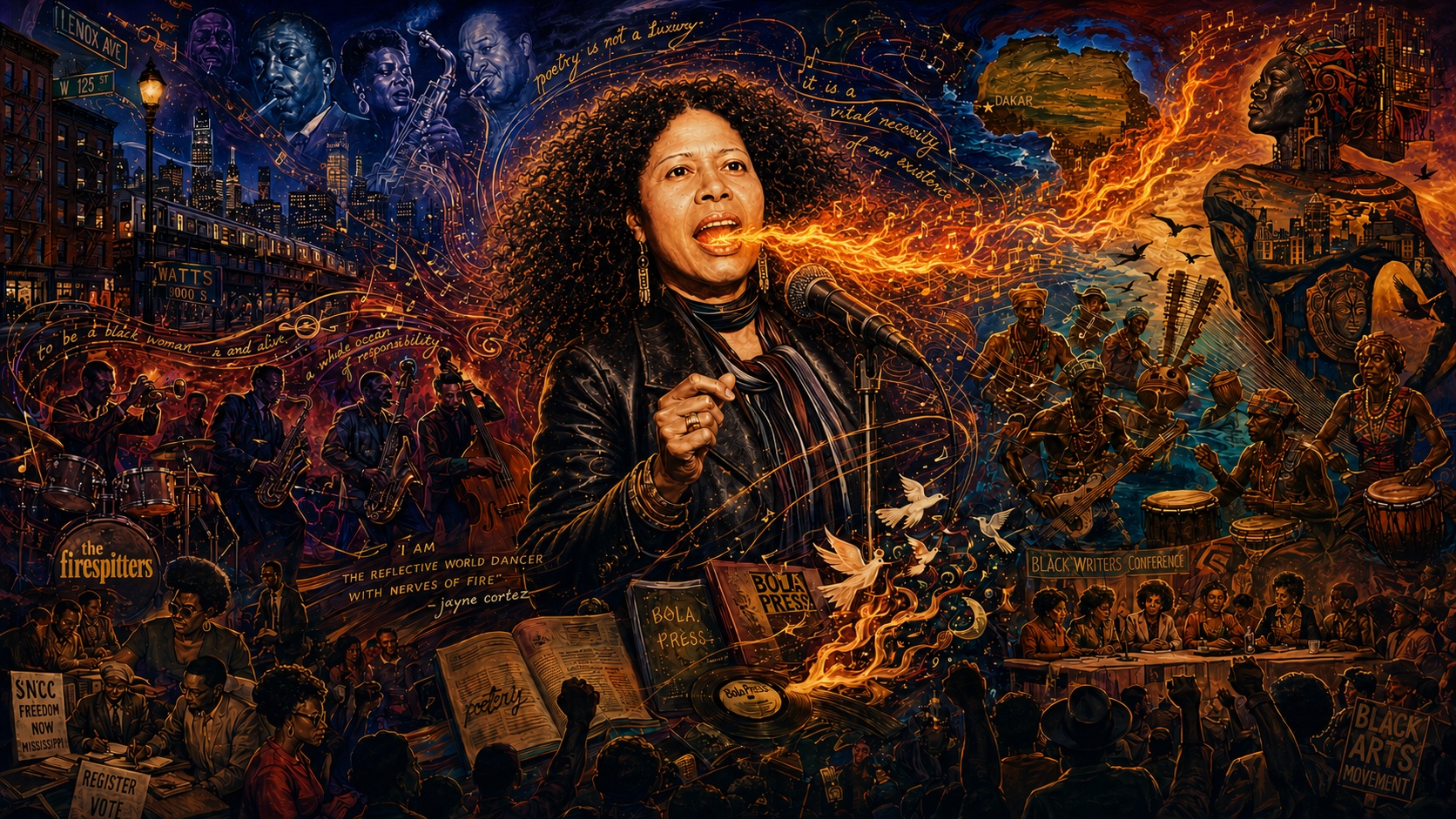
Jayne Cortez (born Sallie Jayne Richardson) was a visionary African American poet, performer, and cultural activist whose fierce, music‑driven poetics made her a defining voice of the Black Arts Movement and a lifelong advocate for Black liberation. Her work fused surrealist imagery with the rhythms of jazz, blues, and African drumming to create a distinctive “word music” aesthetic that was both artistically experimental and uncompromisingly political.
Early life and formation
Cortez was born on May 10, 1934, at Fort Huachuca, an Army base in Arizona, the second of three children of a career soldier and a secretary. At seven, she moved with her family to Los Angeles and grew up in the Watts district, where the city’s racial tensions and vibrant Black cultural life would leave an enduring imprint on her imagination. Her parents’ extensive collection of jazz, blues, and Latin records—voices such as Bessie Smith, Dinah Washington, Charlie Parker, and Duke Ellington—placed her “under the spell” of improvisation and rhythm, laying the groundwork for her later performance style. In high school, she studied art, music (playing bass), and drama, and briefly attended Compton Community College before financial pressure forced her to withdraw. Early in her artistic life, she adopted the surname Cortez, the maiden name of her Filipino maternal grandmother, signalling her commitment to self‑definition.
Marriage, family, and artistic partnerships
In 1954, at the age of twenty, Cortez married the avant‑garde saxophonist Ornette Coleman, whose radical approach to jazz paralleled the formal experimentation she would later pursue in poetry. Their son, Denardo Coleman, born in 1956, began playing drums with his father as a child and went on to become a renowned jazz drummer in his own right. Ornette Coleman’s influence on her early work was profound: he named a track “Jayne” on his first album, and he was among the subjects in her debut poetry collection, Pissstained Stairs and the Monkey Man’s Wares (1969), while later contributing saxophone to her 1986 album Maintain Control. After their divorce in 1964, she maintained independent artistic and political trajectories while still musically intersecting with him over the years.
In 1975, Cortez married sculptor and painter Melvin Edwards, forging a cross‑disciplinary partnership that linked poetry, music, and visual art. The couple kept homes in New York City and Dakar, Senegal—a city she said “really feels like home”—embodying her dual commitment to African and African diasporic cultural spaces. Edwards’s drawings and sculptures appeared throughout her books and on many of her album covers; in projects like Fragments (1994), her poems were published alongside works from Edwards’s “Lynch Fragment” series, generating a shared visual‑verbal meditation on Black history and resistance. Their son Denardo became the “axis” between his parents’ musical worlds, serving for decades as the drummer and key collaborator in Cortez’s band, The Firespitters, while also anchoring Ornette Coleman’s group, Prime Time.
Emergence as activist and poet
Cortez’s development as an artist was inseparable from the upheavals of the Civil Rights era and the urban rebellions of the 1960s. Between 1963 and 1964, she worked in Mississippi with the Student Nonviolent Coordinating Committee (SNCC), registering Black voters and collaborating with Fannie Lou Hamer; this work, she later reflected, taught her how to transform the “material of struggle” into art. For Cortez, art was never separate from politics: she insisted that “art is a part of protest” and a “weapon of life” used to expose and alter reality.
In 1964, she founded the Watts Repertory Theater Company in Los Angeles and served as its artistic director until 1970, giving her first public poetry readings within this community‑based institution. The Watts Uprising of August 1965, which erupted in the very neighborhood where she had grown up, sharpened her awareness of systemic racism and confirmed her belief that “the problem is the system” and that people could organize and unify to challenge it. By the late 1960s, she had relocated to New York, published Pissstained Stairs and the Monkey Man’s Wares (1969), and was emerging as one of the Black Arts Movement’s most distinctive poetic voices.
Black Arts Movement and “word music” aesthetic
Cortez became widely recognized as a defining figure of the Black Arts Movement, the cultural counterpart to Black Power that sought to build an autonomous African American aesthetic rooted in Black history and community needs. Within this context, she developed a “word music aesthetic” of Black African origin, using jazz and blues orality to release poetry from the confines of the printed page and transform it into a communal, interactive performance. She often wrote in free verse and stripped away conventional punctuation to emulate natural breath and the fluid phrasing of improvising musicians.
Critics and peers described her performance style as “firespitting”: confrontational, politically outspoken, and cathartic, driven by rhythmic repetition and chant‑like phrases that echoed African and Caribbean drumming. Her delivery used call‑and‑response, improvisation, and “blues poetics” to address themes of racism, sexism, state violence, addiction, and loneliness while maintaining a fierce, secular‑priestess energy on stage. She identified herself not simply as a poet who liked music but specifically as a jazz poet, seeing jazz as an umbrella that covered the continuum of Black expressive culture—from African drumming and field hollers to the blues and modern improvisation.
Independent publishing and musical projects
Committed to self‑determination, Cortez founded her own press, Bola Press, in 1971 to retain full control over her work and circumvent the “publishing whiteouts” and “conspiracies of neglect” she encountered in mainstream literary culture. Through Bola Press, she published most of her twelve books of poetry and nine recordings, ensuring that her work remained “unruly, uncompromising & persistent” rather than shaped by elite expectations of taste. She supplemented this independence with grants and fellowships—including support from the Rockefeller Foundation, the National Endowment for the Arts, Arts International, and the New York Foundation for the Arts—as well as teaching English at Rutgers University between 1977 and 1983.
In 1980, Cortez formed The Firespitters, a jazz‑funk‑blues ensemble in which her poetry functioned as the centerpiece, with Denardo Coleman’s drums and other musicians’ improvisations providing a “jazz‑funk‑blues response.” The group’s name echoed her 1982 collection Firespitter, a title that came to symbolize her uncompromising, incendiary voice; both the band and the book became central to her reputation as a “firespitter.” Over the years, she also recorded with independent and avant-garde labels such as Strata-East and Harmolodic/Verve, integrating African instruments like the kora into works such as her 1994 album Cheerful & Optimistic.
Major works and “super‑surrealism”
Cortez’s poems are frequently cited for their “confrontational political outspokenness” and their radical reworking of urban and historical experience through what critics have called “super‑surrealism.” In poems such as “I am New York City,” she personifies the city as a dismembered Black female body—a “confetti of flesh” scattered through grotesque, unsettling images—to expose how racism, sexism, and exploitation inscribe themselves onto Black flesh. Her super‑surrealism relies on startling juxtapositions—festive against violent, formal address against vulgar invitation—to jolt readers into recognizing that oppression is not abstract but brutally material.
Among her most celebrated works are “I am New York City,” “If the Drum Is a Woman,” “US/Nigerian Relations,” “I See Chano Pozo,” “There It Is,” “Find Your Own Voice,” “Jazz Fan Looks Back,” “For the Brave Young Students in Soweto,” and politically charged pieces like “Economic Love Song,” “War Devoted to War,” and “New York City Pigeons.” In “If the Drum Is a Woman,” she responds to Duke Ellington’s allegory by turning the drum into a defiant female figure whose loudness and centrality to African culture make her impossible to ignore, using graphic rhetorical questions to indict domestic and sexual violence while insisting on communal solidarity between Black women and men. The poem exemplifies her Black feminist orality: unpoliced, “improper,” and insistent on linking gendered violence to the broader structures of racism and capitalism.
Her later collections continued to develop these themes and techniques, culminating in Firespitter: The Collected Poems of Jayne Cortez (2025), which gathers decades of work and affirms her status as a central figure in twentieth‑ and twenty‑first‑century Black poetics.
Transnational vision and African alliances
Cortez’s career was marked by a sustained effort to forge intellectual and artistic connections across Africa and its diasporas. In 1991, she co‑founded the Organization of Women Writers of Africa (OWWA) with Ghanaian writer Ama Ata Aidoo, creating a network for women of African descent that included board members such as Maya Angelou, Margaret Busby, and Maryse Condé. As OWWA’s long‑time president, she organized influential conferences that brought together writers and scholars from Africa, the Caribbean, Europe, and the Americas.
At New York University, she directed landmark gatherings including “Yari Yari: Black Women Writers and the Future” (1997), “Slave Routes: The Long Memory” (2000), and “Yari Yari Pamberi” (2004), events that helped institutionalize a global conversation around women’s writing of African descent. Shortly before her death, she was planning Yari Yari Ntoaso, an OWWA symposium in Accra, Ghana, which ultimately took place in 2013 in her honor and further extended the network she had envisioned. Her own residence in Dakar, her use of African and Caribbean drum patterns, and poems directly engaging African struggles—such as “US/Nigerian Relations” and work dedicated to the students of Soweto—made her a “diatopic link” connecting urban Black life in the West to anticolonial and postcolonial realities on the continent.
Character, reputation, and honors
Peers and fellow artists consistently describe Cortez as an unyielding, transformative presence in contemporary literature. Poet and critic Haki Madhubuti called her a “reflective world dancer with nerves of fire,” “our drum,” and “our Blues,” emphasizing both her musicality and her role as a cultural carrier of an African‑centered tradition. Maya Angelou remarked that “no ravine is too perilous, no abyss too threatening for Jayne Cortez,” speaking to the fearlessness with which she approached both subject matter and performance.
Others have praised her as “bawdy, lively, funny, and bold,” a “pre‑rapper rapper” whose work remains “unruly, uncompromising & persistent,” and a “secular priestess” whose incantatory readings moved between militancy, lyricism, dynamic surrealism, and raw emotion. She became recognized as a definitive authority on the Black word‑music aesthetic and as a “carrier and promoter” of an African‑centered lineage, achieving world‑class stature despite chronic neglect from mainstream cultural institutions. Her achievements were acknowledged with honors such as the American Book Award (1980), the Fannie Lou Hamer Award (1994), and the Langston Hughes Medal (2001), alongside major grants and fellowships.
Final years and legacy
Jayne Cortez died of heart failure in Manhattan on December 28, 2012, at the age of seventy‑eight. She was survived by her husband, Melvin Edwards, and her son, Denardo Coleman, who has continued to perform her work, including at a 2025 celebration of her collected poems, where he appeared with The Firespitters. In the years since her death, her reputation has only deepened, with critics, scholars, and fellow artists recognizing her as one of the most accomplished and visionary figures to emerge from the Black Arts Movement and as a foundational influence on subsequent generations of poets and spoken‑word performers.
Her legacy lives on in multiple registers: in the sound of her recordings, where jazz‑inflected cadences bear witness to struggle and joy; in the pages of her books, where super‑surreal images force readers to confront the material violence of racism and sexism; and in the organizational infrastructures she helped build for African and diasporic women writers. Above all, she is remembered as a “firespitter”—a poet who refused to “buck dance” for the mainstream and instead used her art as a weapon of life, insisting on intellectual and cultural liberation for Black people worldwide.
Source:
An Evening with Poets Honoring the Lives of Poets Jayne Cortez & Amiri Baraka Haki R Madhubuti. A tribute event uploaded by the NYU Institute of African American Affairs (IAAA) on YouTube.
Jayne Cortez – Improvising and Experimenting. An interview and performance with Jayne Cortez and the Firespitters, uploaded by the channel Furious Flower.
Jayne Cortez – Wikipedia. https://en.wikipedia.org/w/index.php?title=Jayne_Cortez&oldid=1346544980.
Jayne Cortez Poems My poetic side – https://mypoeticside.com/poets/jayne-cortez-poems.
Jayne Cortez: The Rhythmic Voice of Jazz Poetics. This biographical text details her career as an American poet and her work with the band the Firespitters.
Jayne Cortez: The Rhythmic Voice of Resistance and Revelation. https://www.theguardian.com/books/2013/jan/04/jayne-cortez
www.poetryfoundation.org.
The Significance of Orality and Performativity in Jayne Cortez’s Poetry. An essay by Evgenia Kleidona. https://www.poeticanet.com/significance-orality-performativity-jayne-a-271.html?category_id=112#:~:text=In%20this%20light%2C%20it%20becomes,or%20Blues%20music%20of%20her
https://archives.nypl.org/scm/23834. .
https://teachersandwritersmagazine.org/wp-content/uploads/2023/02/nothing-is-off.pdf. This is a PDF article titled “Nothing Is Off-Limits: On Teaching Jayne Cortez” by Joanna Fuhrman for Teachers & Writers Magazine.