
William Davidson (c.1781–1 May 1820) was a Jamaican‑born, Black British radical in early nineteenth-century Britain. His execution for the Cato Street Conspiracy places him at the nexus of inequality, political repression and working‑class revolt in Georgian London. His story threads Jamaica, Scotland and Marylebone into a single, combustible life.
Origins in Jamaica and Scotland
Davidson was born in Jamaica, the illegitimate son of the Scottish Attorney General of Jamaica, Robert Sewell, and a local Black Caribbean woman. Sent to Britain around the age of fourteen, he was placed in Glasgow to study law, arriving just as the city seethed with the aftershocks of the French Revolution and demands for parliamentary reform. In this world “soaked” in revolutionary ideas, he encountered the language of rights, representation and resistance that would shape his later politics.
After time in Glasgow, he was apprenticed to a Liverpool lawyer but left and went to sea, eventually being press‑ganged into the Royal Navy — a common fate for poor and racialized men. On discharge, his father arranged further study in Scotland (some accounts say mathematics in Aberdeen), but Davidson abandoned this route and moved to Birmingham, where he tried to establish himself as a cabinet maker using money from his mother’s legacy.
Love, Racism and Collapse in Birmingham
In Birmingham, Davidson fell in love with the daughter of a prosperous merchant. Her father, suspicious of a Black suitor and protective of a substantial dowry, reportedly conspired to have Davidson arrested on false charges; by the time he was released, the young woman had been married off to another man. Devastated and disgraced, Davidson attempted suicide by taking poison. The episode shows how racial prejudice, class anxiety and legal power combined to close the doors of opportunity around him.
London, Family and Peterloo
Davidson eventually settled in London. He married Sarah Lane, a working‑class widow with four children, and together they had two more, creating a blended family of six in conditions of economic insecurity. He returned to his trade as a cabinet maker and became a Wesleyan Methodist. In 1819 he reportedly went months with little or no work, pawning his tools and at times relying on charity.
The turning point was the Peterloo Massacre of August 1819, when cavalry charged a peaceful mass reform meeting in Manchester. Davidson was present, and the brutality shook his faith in both the established church and the possibility of peaceful reform; when the radical publisher Richard Carlile was later jailed for blasphemy and sedition, Davidson is said to have declared that he had lost his belief in God.
Radicalisation: Reading Rooms and the Spenceans
Back in London, Davidson channelled his disillusion into organised politics. He joined the Marylebone Union Reading Society, a cheap subscription club where artisans and labourers could read radical newspapers such as The Republican and the Manchester Observer and study banned works by Tom Paine. This reading room was more than a library; it was a political school for the underclass.
There he met Robert Wedderburn, another Jamaican‑Scot of mixed African and Scottish heritage, a Wesleyan turned incendiary preacher and fierce critic of the Maafa and the British ruling class. Wedderburn was associated with the Spencean Philanthropists, followers of Thomas Spence, who demanded common ownership of land and the overthrow of aristocratic property. Davidson entered this world of ultra‑radicals, where debates over land, labour and captivity intertwined.
By the time Davidson moved fully into the orbit of Arthur Thistlewood — the man who would lead the Cato Street plot — he had become known as a political radical, influenced by Scottish democratic agitation, Caribbean enslavement and English working‑class hardship.
The Road to Cato Street
The broader context was one of repression. After Peterloo, Lord Liverpool’s government passed the Six Acts, a package of laws to crush mass meetings, radical presses and drill societies. Reformers were treated as potential traitors. Within this climate, elements of the London underground moved from petitioning to conspiracy.
In early 1820, a government spy, George Edwards, infiltrated the Spencean circle. Edwards presented what appeared to be a golden opportunity for decisive action: a notice that the Cabinet would dine at the home of Lord Harrowby in Grosvenor Square, providing a single moment to kill the prime minister and his ministers and trigger a nationwide rising. The dinner, however, was a fiction planted as bait; the plot was, in effect, structured by the state from the outset.
Davidson’s role in this “West End Job” was significant. Thistlewood selected him as one of an “Executive of Five” charged with organising the assassinations. Because Davidson had previously worked for Lord Harrowby, he was sent to reconnoitre the house and question servants about the supposed dinner; when a servant insisted there was no such event planned, Thistlewood dismissed this as a lie and pushed ahead. Davidson also helped secure arms and ammunition and, on the night itself, was posted as lookout and guard at the conspirators’ base — a hayloft in Cato Street, just off Edgware Road.
The Raid on Cato Street
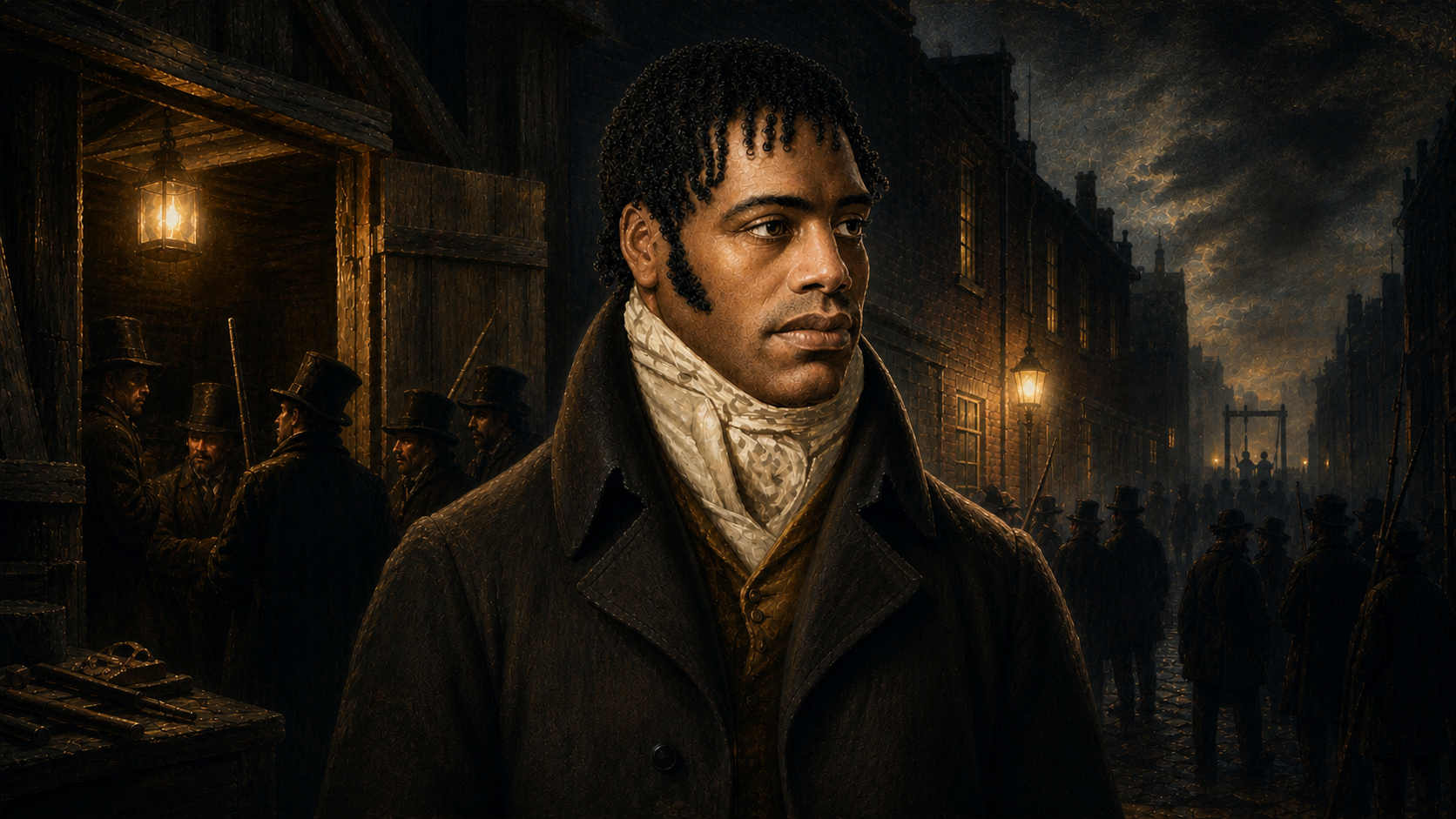
On the evening of 23 February 1820, roughly twenty men gathered in the cramped, poorly lit loft, believing they were hours away from striking a decisive blow against the government. Outside, Bow Street officers waited, backed by troops. Acting before the soldiers arrived, the police stormed the loft; in the melee Arthur Thistlewood fatally stabbed officer Richard Smithers, candles were extinguished, and several conspirators scrambled to escape over roofs and through back windows. Davidson, posted as lookout, was seized and arrested at the scene.
Over the following days the authorities rounded up the rest. Thirteen men were indicted. Five — Thistlewood, Davidson, James Ings, Richard Tidd and John Brunt — would be sentenced to death.
Trial, Defence and Condemnation
The trial at the Old Bailey in April 1820 was as much political theatre as legal process. The prosecution’s case leaned heavily on the testimony of George Edwards and other informers, who had helped shape the very conspiracy they now described. Davidson pleaded not guilty and mounted a robust defence from the dock.
He challenged the impartiality of the court, accusing the judge of hostility and insisting that the jury had been guided toward a verdict rather than left free to weigh the evidence. Drawing on a radical reading of English constitutional history, he cited Magna Carta and argued that the people had a right to resist ministers who violated their liberties, casting his actions — or alleged actions — as political redress rather than personal treason.
Davidson also contested eyewitness identifications, suggesting that witnesses were confusing him with another man of colour — an argument that implicitly exposed how racist assumptions could turn Black bodies into interchangeable suspects. He claimed that an ex‑employer, working with Edwards, had lured him to Cato Street, further emphasising the degree of provocation involved. None of this persuaded the court. He was convicted of high treason and sentenced to be hanged and decapitated.
Execution at Newgate
On 1 May 1820, William Davidson and his four condemned comrades were led onto the scaffold outside Newgate Prison before a vast crowd. The public hanging was a ritualised display of state power. After they were hanged, their bodies would be decapitated. This was the last public beheadings in England.
Contemporary accounts describe Davidson as composed and dignified in his final hours. Unlike some of the others, he accepted the ministrations of the prison chaplain and spent his last moments in prayer. His reported final words drew a sharp distinction between the monarch and the ministers whose policies he had opposed, praying for the king’s prosperity while withholding any blessing from the government.
After the drop, the executioner severed the heads in turn and held them up to the crowd as “traitors.” Many spectators reportedly groaned or remained silent, a muted response to a spectacle meant to inspire fear.
Afterlives: Erasure and Recovery
In the immediate aftermath, many accounts portrayed Davidson through racial stereotypes: as violent, neglectful and brutish, with little attention to his intellectual formation or political convictions. Such depictions served to marginalise both his Blackness and his radicalism, folding his story into a wider narrative that pathologised Black presence in Britain.
Recent scholarship and public history work have begun to reclaim him. Historians and community projects now emphasise his Jamaican–Scottish background, his engagement with radical print culture, his connections to Robert Wedderburn and the Spenceans, and the role of government entrapment in the Cato Street affair. The site of the conspirators’ meeting in Cato Street is marked, and institutions such as the London Museum and the National Portrait Gallery hold images and materials that speak to his life.
William Davidson emerges from this new work not as a footnote to a failed plot but as a key figure in Black Atlantic and British radical history: a Jamaican‑born artisan who confronted the British government, and who paid with his life on a scaffold built at the heart of that nation’s capital.
Source:
Wikipedia – William Davidson (conspirator)
https://en.wikipedia.org/wiki/William_Davidson_(conspirator)
Cato Street Conspiracy project – Cato Street Conspirator: William Davidson
https://www.catostreetconspiracy.org.uk/new-contributions/cato-street-conspirator-william-davidson
IBHM‑UK – William Davidson the political radical
https://www.ibhm-uk.org/post/william-davidson
Scottish Legal News – Our Legal Heritage: William Davidson
https://www.scottishlegal.com/articles/our-legal-heritage-william-davidson
Layers of London – William Davidson (1786–1820)
https://www.layersoflondon.org/map/records/william-davidson-1786-1820
Layers of London – Jamaican revolutionary William Davidson
https://www.layersoflondon.org/map/records/jamaican-revolutionary-william-davidson
London Museum – An authentic history of the Cato Street conspiracy (object record)
https://www.londonmuseum.org.uk/collections/v/object-487218/an-authentic-history-of-the-cato-street-conspiracy-with-the-trials-and-execution-of-the-conspirators
London Museum – The Cato Street Conspiracy: A failed revolution
https://www.londonmuseum.org.uk/collections/london-stories/cato-street-conspiracy-failed-revolution
Cato Street Conspiracy project – The West End Job: A brief outline of the Cato Street Conspiracy 1820
https://www.catostreetconspiracy.org.uk/about/the-west-end-job-bicentenary-of-the-cato-street-conspiracy-1820-2020
Cato Street Conspiracy project – The Cato Street Conspiracy (main site)
https://www.catostreetconspiracy.org.uk
The National Archives (Education) – Cato conspirators charged
https://www.nationalarchives.gov.uk/education/resources/protest-democracy-1818-1820/cato-conspirators-charged
Westminster Archives / digital:works – William Davidson and the West End Job: Cato Street Conspiracy (video)
https://www.youtube.com/watch?v=LhZVLkNj028
Westminster Archives / digital:works – William Davidson and the West End Job: Part One HD 1080p (video)
https://www.youtube.com/watch?v=HA60IZWENXs
National Portrait Gallery – William Davidson – Person page
https://www.npg.org.uk/collections/search/person/mp122367/william-davidson
Wikimedia Commons – File:William Davidson conspirator.JPG (engraving image)
https://commons.wikimedia.org/wiki/File:William_Davidson_conspirator.JPG