
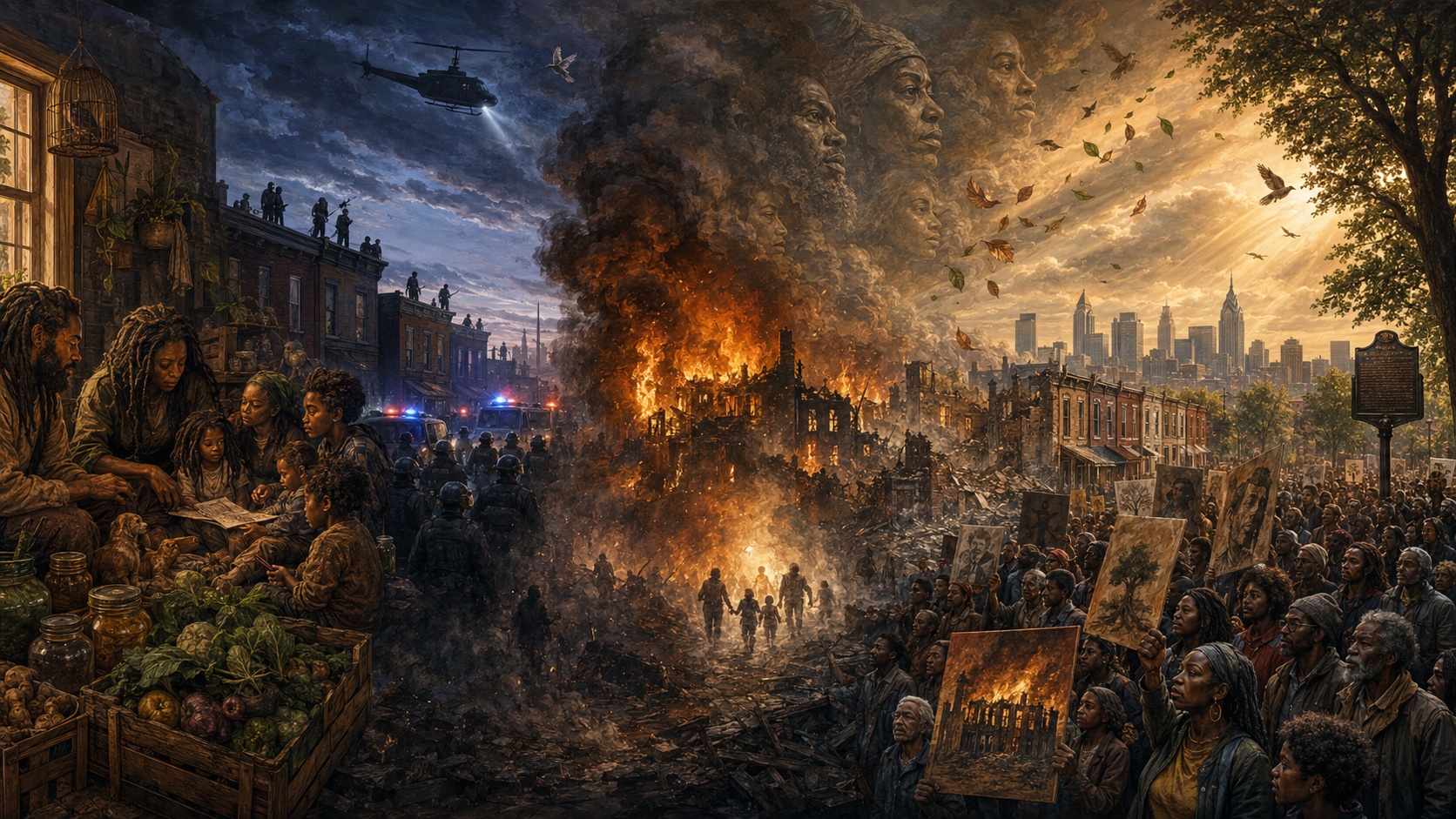
On 13 May 1985, the City of Philadelphia carried out a military-style aerial bombing on a residential row house at 6221 Osage Avenue, in the Cobbs Creek section of West Philadelphia. The target was not a foreign enemy, but a Black family-based liberation organization called MOVE. By the time the flames died, eleven people were dead, including five children, and sixty-one homes across two city blocks lay in ashes, leaving some 250 Black residents homeless.
This atrocity has come to be summarized in a chilling phrase: Philadelphia became “the city that bombed itself.” Yet to understand what happened that day, and why it matters, the bombing must be seen not as an “unfortunate mistake,” but as the culmination of years of escalating state violence against a Black radical community that refused to bow.

Origins: MOVE and the Theology of Life
MOVE emerged in Philadelphia in the early 1970s under the leadership of Vincent Leaphart, who renamed himself John Africa. MOVE was not an acronym but a statement of principle: everything that lives and moves is part of one interdependent creation. In a set of writings known as The Guidelines, John Africa denounced industrial civilization, animal exploitation, prisons, and the police, and called for a return to a life rooted in nature and truth.
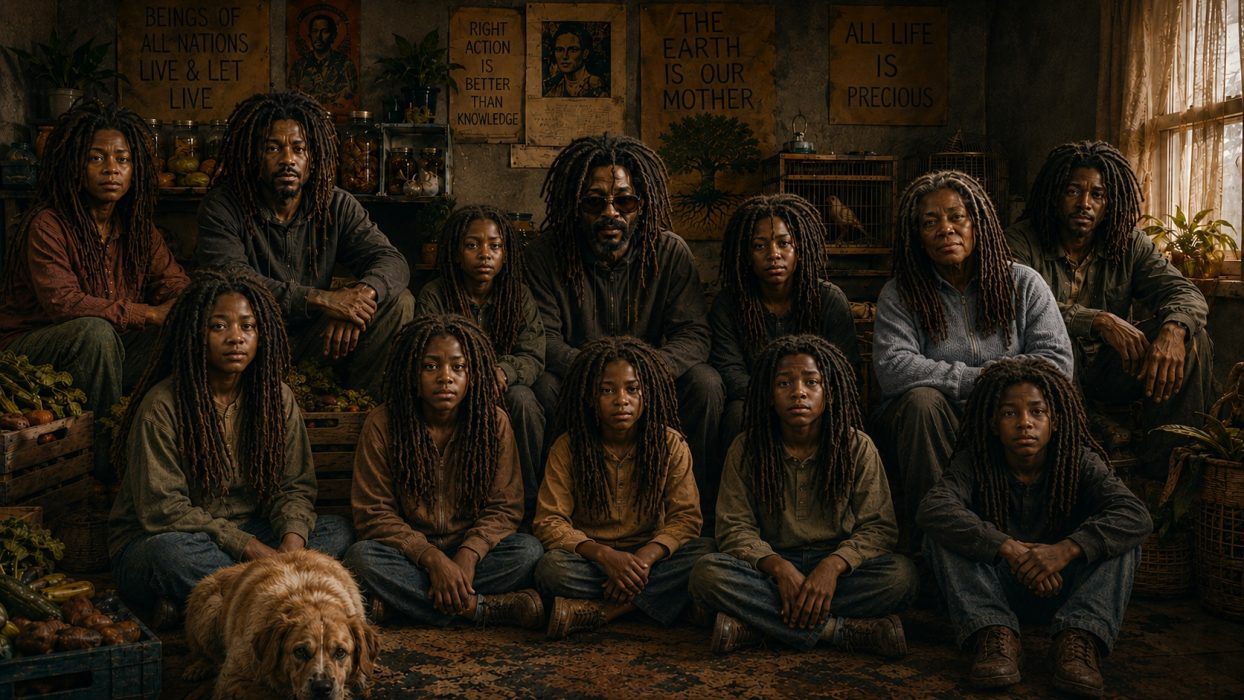
In practice, MOVE’s way of life was a radical rejection of Western norms. Members lived communally, wore their hair in long, uncombed locks, refused modern medicine and processed foods, and often went naked in their yard to absorb what they described as the life-giving energy of the sun. They adopted the surname Africa as a declaration of Black identity and kinship, insisting that they were one extended family in a lineage stretching back to the continent.
MOVE’s activism was confrontational and public. They held loud demonstrations outside zoos, pet shops, and government offices; they condemned police brutality and the prison system; they spoke unapologetically about white supremacy and state violence. In a city whose police department had been shaped by the openly racist mayor Frank Rizzo, MOVE’s defiant Blackness and rejection of respectability politics were experienced by authorities and many neighbors as a direct affront.
1978: Powelton Village and the MOVE 9
The road to the 1985 bombing runs through a siege seven years earlier. By the mid‑1970s MOVE was based in a house in Powelton Village, a West Philadelphia neighborhood where they had fortified their home and vowed not to submit to further police harassment.
For more than a year, tensions mounted. Neighbors complained about noise, trash, and the presence of animals; police complaints focused on weapons and alleged threats. In August 1978, under Mayor Frank Rizzo, the city moved to evict MOVE by force. The assault turned Powelton Village into a war zone. Hundreds of police, armed with rifles and heavy weaponry, surrounded the house. Amid the chaos, Officer James Ramp was killed by a single bullet.
MOVE always insisted that Ramp was struck by police “friendly fire,” noting that he was shot from above while MOVE members were in a basement. The courts, however, placed the blame squarely on MOVE. Nine members—later known as the MOVE 9—were convicted of third-degree murder and given sentences of 30 to 100 years in what was then Pennsylvania’s longest and most expensive trial.
The aftermath was symbolic. Police pulled MOVE member Delbert Africa from the house and beat him mercilessly in front of television cameras, images that burned themselves into the city’s consciousness as a stark display of police brutality. The city then demolished the house with bulldozers, erasing the physical site of the confrontation almost immediately.
For MOVE, the MOVE 9 became political prisoners, and their freedom a central demand of the organization. For the city, Powelton Village was a trauma it was determined never to repeat—at least not on its own terms.
Osage Avenue: Black Neighbors, Black Mayor, and a Growing Siege
In 1981, MOVE members who were not imprisoned moved into a row house at 6221 Osage Avenue, owned by Louise James, John Africa’s sister, in Cobbs Creek, a largely Black working- and middle-class neighborhood. By 1983 they had launched a loud, constant campaign demanding the release of the MOVE 9.
Using bullhorns mounted on their home, MOVE poured out hours of profanity-laced political speeches day and night, condemning the police, the courts, and the city government. Piles of rubbish, human waste, and animal remains accumulated around the property, attracting rats and dogs. The construction of a heavy timber rooftop bunker, complete with gun ports, deepened neighbors’ anxiety and the city’s sense of threat.
The people on Osage Avenue were not wealthy white suburbanites but Black professionals and working families who had struggled to buy and maintain their homes. They complained repeatedly to the city that MOVE had become a “clear and present danger” to their safety and quality of life. Yet the Goode administration—led by W. Wilson Goode, Philadelphia’s first Black mayor—hesitated to move decisively, haunted by the ghost of Powelton Village and wary of another bloody confrontation with a group that had already become a national symbol of police abuse.
The breaking point came on 30 April 1985, when Osage residents held a press conference appealing directly to the governor, warning that the city had abandoned them. Public and media pressure forced Mayor Goode’s hand. Arrest warrants were obtained for four MOVE members on charges including parole violations, illegal weapons possession, and terroristic threats. A tactical plan was drawn up to remove MOVE once and for all.
May 13, 1985: “Attention MOVE: This Is America”
On the night of Sunday 12 May, Mother’s Day, police went door to door evacuating roughly 200 residents around Osage Avenue, assuring them they could return in twenty-four hours. In reality, most would never come home again.
At 5:35 a.m. on Monday 13 May, nearly 500 officers—SWAT teams, sharpshooters, bomb technicians—took positions around the MOVE house. Police Commissioner Gregore Sambor stepped to a bullhorn and delivered a now infamous command:
“Attention MOVE: This is America. You have to abide by the laws of the United States.”
He gave the occupants fifteen minutes to surrender. Inside the house were seven adults and six children. MOVE did not respond. The siege began.
A Domestic War Zone: 10,000 Rounds in a Black Neighborhood
The city’s “tactical plan” was nothing short of a military assault on a family home. Police pumped tear gas canisters into the building through holes blown in adjoining walls and blasted the property with deluge guns—high-pressure water cannons meant to flood basements. MOVE members, huddled in the basement with their children, fired back.
For ninety minutes, police poured more than 10,000 rounds of ammunition into the row house. Officers were armed with M16 semi-automatic rifles, Uzis, Thompson submachine guns, Browning automatic rifles, shotguns, and high-calibre sharpshooter rifles—an arsenal more appropriate to a battlefield than a residential block.
By contrast, only five firearms were later recovered from the ruins: two pistols, two shotguns, and a .22 calibre rifle. The asymmetry reveals the truth behind the language of “exchange of fire”: this was overwhelmingly a one-sided barrage unleashed on a building known to contain children.
Despite this, MOVE remained inside, largely protected by the basement and the structure of the house. By early afternoon, the siege had reached a stalemate. It was at this point that the city made the decision that would define its legacy.
The Bomb from the Sky
Around 5:27 p.m., Lieutenant Frank Powell, head of the bomb disposal unit, boarded a Pennsylvania State Police helicopter carrying an army-green satchel. Inside were two “explosive entry devices”: 1.5‑pound Tovex dynamite charges combined with two pounds of C‑4 plastic explosive supplied by the FBI.
Hovering over 6221 Osage, Powell lit a 45-second fuse and dropped the satchel onto the rooftop bunker. The blast tore through the structure and ignited a gasoline-powered generator and fuel containers stored on the roof. Flames leapt into the evening sky.
The bomb was justified as a tactical measure to destroy a fortified position. But in reality, it was the moment Philadelphia became the first U.S. city to bomb its own citizens from the air in peacetime.
“Let the Fire Burn”
What transformed an outrageous bombing into a full-blown urban holocaust was not only the explosion itself, but what came next. As fire spread across MOVE’s roof, city officials faced a choice: extinguish the blaze immediately, or use it as another weapon.
Commissioner Sambor and Fire Commissioner William Richmond chose the latter. Firefighters on the scene were ordered to let the fire burn. Officials later claimed that allowing the blaze to consume the bunker would force MOVE members out, where they could be met with tear gas and arrest.
The houses of Osage Avenue were connected by shared attics and wooden rooflines. Once the flames took hold and no effort was made to cut firebreaks or saturate adjoining roofs, the fire raced down the block. When firefighters were finally directed to attack the blaze—more than an hour later—it was already out of control.
By the time the fire was declared under control, sixty-one homes on Osage Avenue and nearby Pine Street had been destroyed. Entire life savings, family photos, and histories disappeared overnight into smoke. Philadelphia had not just bombed a house; it had burned down a Black neighborhood.
Escape, Death, and Silence
Inside the inferno, the thirteen people in the MOVE house struggled to breathe as the basement filled with smoke. Ramona Africa, the only adult survivor, later recalled realizing that this was not tear gas but fire; she and others decided they had to attempt an escape.
According to Ramona, MOVE members shouted, “We’re coming out! We’re bringing the children out!” and tried to exit through a basement hatch. As they emerged into the alleyway, she testified, police opened fire, driving many back into the flames. Police denied this, insisting they only returned fire at armed MOVE members. The Philadelphia Special Investigation Commission later concluded that police gunfire did prevent some occupants from escaping the burning house, although one commissioner dissented.
Only two people made it out alive: Ramona Africa and a 13-year-old boy, Michael “Birdie” Ward, who emerged naked, body covered in burns, in an image that would haunt the city for decades.
Eleven others died:
Adults
- John Africa (Vincent Leaphart)
- Conrad Hampton Africa
- Frank James Africa
- Raymond Foster Africa
- Rhonda Ward Africa
- Theresa Brooks Africa
Children
- Tree Africa (Katricia Dotson), 14
- Netta (Zanetta) Africa, 13
- Delisha Africa (Delisha Orr), 12
- Little Phil Africa (Phil), 10
- Tomaso (Tomasa) Africa, 9
The children died of smoke inhalation and burns. Their bodies were pulled from the waterlogged rubble in the days that followed. For decades, even their names were rarely spoken together in public discourse. Their deaths were treated less as individual losses than as collateral damage in a conflict the state itself had defined.
The MOVE Commission: “Unconscionable”
Public outrage forced Mayor Goode to appoint a Special Investigation Commission, chaired by attorney William H. Brown III, to investigate the disaster. Over five weeks, the commission heard testimony from more than ninety witnesses in televised hearings.
In March 1986, the commission issued a 500-page report whose conclusions were unusually blunt for an official document. It stated plainly:
“Dropping a bomb on an occupied row house was unconscionable.”
The commission found that the city had used clearly excessive force, that the decision to let the fire burn was “reckless,” and that there had been opportunities to extinguish the blaze before it spread to neighboring homes. It condemned Mayor Goode’s leadership as one of “appeasement” before the siege and “gross negligence” on the day itself, noting that he knew gasoline was present on the roof when he signed off on the bombing.
Importantly, the commission highlighted the role of race, stating that such extreme measures would likely never have been employed in a white neighborhood. It described the deaths of the five children as “unjustified homicides” and urged further investigation.
Yet the commission lacked judicial authority. Its work was a moral indictment, not a legal one.
Grand Juries, Qualified Immunity, and the Absence of Justice
In 1986, District Attorney Ronald Castille convened a grand jury to consider criminal charges against city officials. Two years later, he quietly announced that there would be no indictments. The grand jury report described the bombing as an “epic of governmental incompetence” and “morally reprehensible,” but argued that prosecutors could not prove a “clear intent to harm” MOVE members under existing statutes.
A delegation of commissioners and allies later appealed to the U.S. Department of Justice to pursue federal charges, but the DOJ also declined to prosecute. No official—local or federal—was ever charged with a crime in connection with the bombing.
In civil suits, courts found that city officials were shielded by qualified immunity, even as juries concluded that the city had used excessive force and violated constitutional rights. In 1996, a federal jury awarded Ramona Africa and relatives of two victims $1.5 million in damages. In 2005, another jury granted $12.83 million to displaced Osage Avenue residents for the destruction of their homes.
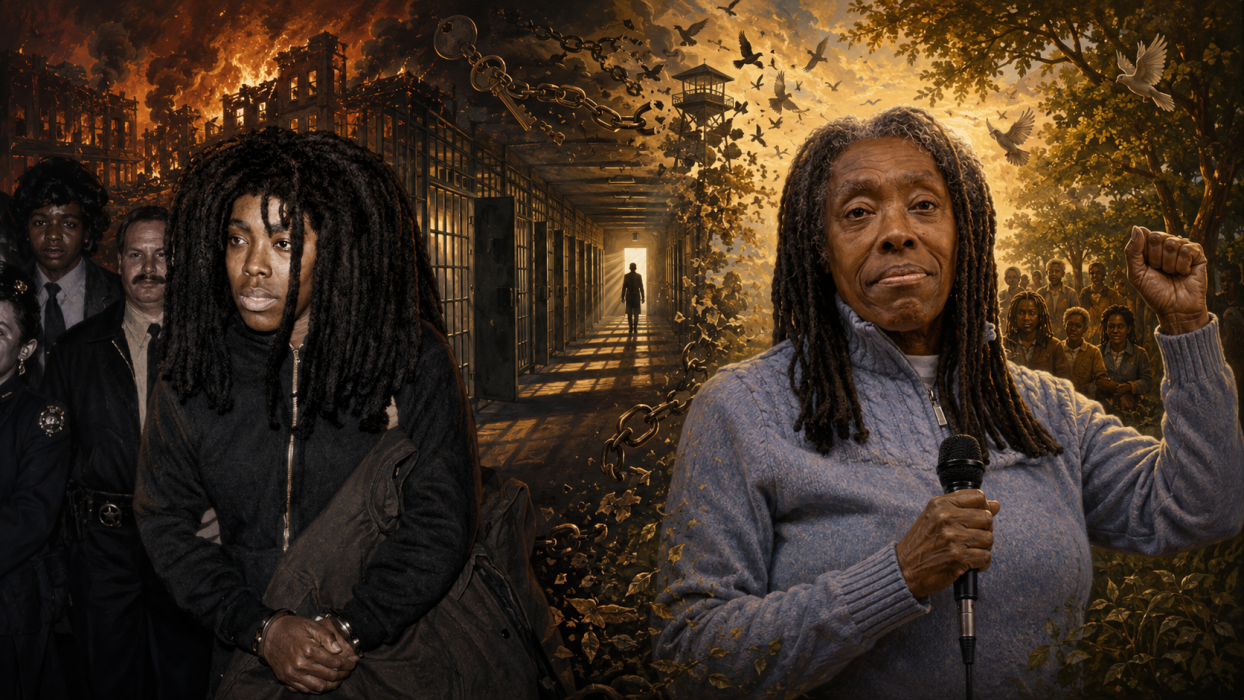
By the mid‑1990s, the financial cost of the bombing to Philadelphia had already reached tens of millions of dollars; the moral debt remains incalculable. The only person who ever served prison time for events connected to 13 May 1985 was Ramona Africa herself, convicted of riot and conspiracy and forced to serve the full seven years of her sentence.
The Second Disaster: Shoddy Reconstruction, Long Shadows
After the bombing, Mayor Goode promised to rebuild all sixty-one destroyed homes in time for Christmas 1985. The rush to redeem the city’s image produced a new catastrophe. The private developer hired to reconstruct the houses delivered homes with sinking foundations, leaky roofs, faulty wiring, and chronic structural problems.
In 1995, the U.S. Army Corps of Engineers concluded that all sixty-one houses were not up to code. By 2000, the city abandoned efforts to fix them and instead offered residents $150,000 to vacate. Many accepted; those who refused sued the city and won damages in 2005.
Each replacement house cost the city more than $570,000 to build, only to be condemned. Osage Avenue remained scarred for decades—a visible reminder that the city, having destroyed a Black neighborhood, could not or would not repair the damage it had done.
The Human Remains Scandal: “Now You Wanna Keep Their Bones”
As if the bombing and its immediate aftermath were not enough, a final, grotesque chapter unfolded more than thirty years later. In 2021, it emerged that the bones of two children killed in the fire—Tree (Katricia Dotson) and Delisha Orr Africa—had been held for decades by the University of Pennsylvania Museum of Archaeology and Anthropology and used as teaching materials in an online forensic anthropology course titled “Real Bones: Adventures in Forensic Anthropology.”
The Africa family had never been told. There had been no consent, no consultation. Their murdered children’s remains had been turned into academic specimens.
At almost the same time, Philadelphia’s Health Commissioner, Thomas Farley, admitted that in 2017 he had ordered the cremation and disposal of other MOVE victims’ remains without identifying them or informing their families, claiming he did not want to cause further pain. He resigned in 2021. The very next day, workers at the Medical Examiner’s Office discovered a box labeled “MOVE” in a refrigerated area, containing remains that were supposed to have been destroyed.
Public outcry forced the city to commission a new investigation. In 2022, the death certificates of the eleven victims were amended to list their deaths as homicides rather than accidents. In 2022 and 2024, remains were finally returned to surviving family members after decades in institutional custody.
This scandal made visible what Black communities have long known: the disregard for Black life that allows a city to bomb children also shows itself in how those children’s bodies are handled in death.
Memory, Erasure, and the Politics of Forgetting
For decades, the MOVE bombing remained strangely absent from national memory. Even as the city paid out settlements, even as the name “the city that bombed itself” circulated among activists, many people in the United States had never heard of it.
Scholars point to several reasons: MOVE’s philosophy and confrontational style made them easy to demonize; the conflict was framed as a local matter rather than a federal scandal; and in the pre-internet era, there was no infrastructure to preserve and circulate the story widely.
It was not until works like Jason Osder’s 2013 documentary Let the Fire Burn, the HBO film 40 Years a Prisoner, and the podcast MOVE: Untangling the Tragedy that the bombing began to enter broader public consciousness. A Pennsylvania Historical Marker was installed near the site in 2017 at the urging of Black middle school students, though its cautious, passive language has been criticized for obscuring responsibility.
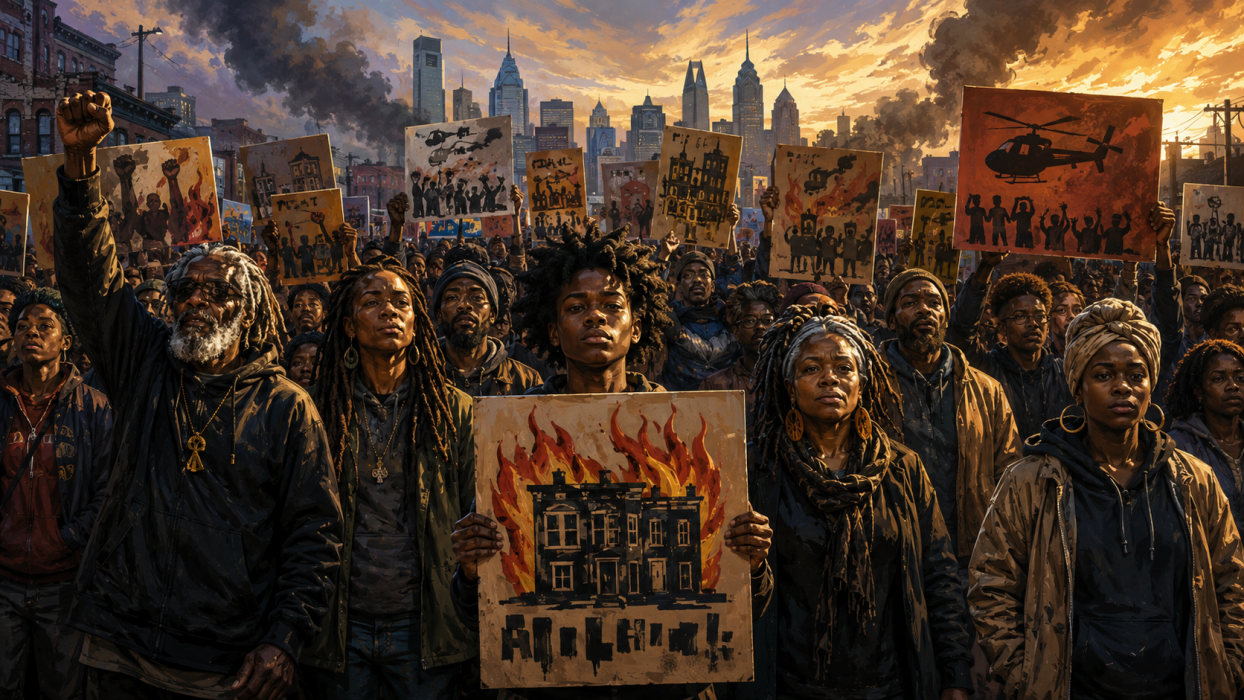
In 2020, amid the George Floyd uprisings, activists in Philadelphia connected the MOVE bombing to ongoing police violence and pushed successfully for the removal of the statue of Frank Rizzo. That same year, the Philadelphia City Council issued a formal apology for the bombing and, in 2025, declared May 13 a permanent day of reflection and remembrance. MOVE members, including Ramona Africa, have rejected these apologies as hollow gestures that neither free political prisoners nor undo decades of trauma.
In 2023, Mike Africa Jr., son and nephew of MOVE members, purchased 6221 Osage Avenue with plans to create a memorial and museum at the site. Meanwhile, the surrounding blocks have been redeveloped and marketed with hardwood floors and quartz countertops, a “renaissance” that some critics see as yet another effort to bury the neighborhood’s history beneath the aesthetics of gentrification.
Legacy: What the MOVE Bombing Tells Us
The 1985 bombing of MOVE stands alone in U.S. history as the clearest example of a city deploying military force against its own Black residents, then choosing to let their homes burn. But it is not an isolated aberration. It is a concentrated expression of patterns that run through the history of Black life in the Americas:
- State violence and impunity: No city official or police officer was ever criminally charged, despite multiple investigations confirming “unconscionable” and “reckless” decisions. Only the survivor, Ramona Africa, went to prison.
- Racialized dehumanization: The readiness to bomb a Black household and then to treat the bodies of Black children as specimens exposes how Black life is continually positioned as expendable, even in death.
- Community destruction: Osage Avenue’s Black homeowners had their lives obliterated in a single day and then were subjected to a second wave of displacement through shoddy reconstruction and condemnation.
- Erasure and resistance: Official forgetting has been resisted by survivors, family members, filmmakers, students, and activists who insist on naming the dead and refusing to let the story disappear.
To speak the names—John, Conrad, Frank, Raymond, Rhonda, Theresa, Tree, Netta, Delisha, Little Phil, and Tomaso—is to insist that what happened on 13 May 1985 was not a regrettable “incident,” but a crime against a people and a community.
References:
- 1985 MOVE bombing – The 1985 MOVE bombing, locally known by its date, May 13, 1985, was the aerial bombing of a house, a…
- May 13, 1985: Philadelphia Police Bomb MOVE – On May 13, 1985, the Philadelphia Police Department dropped a C-4 bomb on the home of the MOVE organ…
- Why Have So Many People Never Heard Of The MOVE … – A common reader response to our look back at the shocking 1985 bombing of the MOVE compound in West …
- Philadelphia Marks 30th Anniversary Of MOVE Bombing – On May 13, 1985, the Philadelphia Police Department dropped a bomb on the home of a group of African…
- Black Lives Matter: MOVE and the Bombing of Philadelphia – On May 13, 1985, after a long standoff, Philadelphia municipal authorities dropped a bomb on a resid…
- MOVE (political group) | History | Research Starters – MOVE is a political group founded in 1972 by John Africa (born Vincent Leaphart), primarily known fo…
- MOVE’s Philosophy: Militant Blend of Anti-Materialism, … – Over 13 years, the group’s philosophy has been a militant pastiche of anti-materialism, back-to-natu…
- The MOVE Bombing and the Callous Handling of Black … – The 1985 MOVE bombing by the Philadelphia Police shocked and devastated a city, leaving destruction …
- MOVE – West Philadelphia Collaborative History – In 1973, MOVE formed around the principles of John Africa (formerly Vincent Leaphart), which called …
- Philly must apologize for MOVE bombing 35 years ago – Former Philadelphia Mayor W. Wilson Goode Sr. is calling on the city to issue a “formal apology” 35 …
- MOVE member freed after 1978 shootout that killed officer – Nine MOVE members were convicted of third-degree murder in the August 1978 death of officer James Ra…
- Police Officer James J. Ramp – Police Officer James Ramp was shot and killed during a standoff with a radical group known as MOVE. …
- Who is the MOVE 9? Powelton Village, 1978 Osage … – On August 8, 1978,. Philadelphia police attempted to clear the house by force. The inhabitants of th…
- Last member of MOVE freed on parole in death of officer – Africa was the last of the so-called MOVE 9 to be paroled after being convicted of third-degree murd…
- EXCERPTS FROM COMMISSION’S REPORT ON BOMBING – Five children were killed during the confrontation on May 13, 1985. Their deaths appear to be unjust…
- “MOVE/Philadelphia Bombing ” by Paul Wahrhaftig … – In 1985 police bombed the Philadelphia headquarters occupied by members of the black counterculture …
- Philadelphia marks 40th anniversary of MOVE bombing – May 13, 2025 – News … The three blocks on either side of Osage Street in West Philly, which were b…
- FBI agent suspended for role in MOVE incident – UPI Archives – The FBI has suspended an agent for withholding information from investigators about explosives he su…
- The Long Shadow of the MOVE Fire – Despite two investigations into the circumstances of the event, the effects of the 1985 MOVE fire st…
- Let the Fire Burn – A brooding, disturbing documentary about an inferno that becomes an enigma. It earns its considerabl…
- Ramona Africa | Say Their Names – Spotlight Exhibits – Ramona Africa was an active member of the Black liberation group MOVE, and is now the only survivor …
- ‘Birdie Africa,’ Child Icon Of 1985 Philly MOVE Bombing, Dies – Michael Ward, who was 13 when police bombed the MOVE compound, ran naked out of the burning house, h…
- Statement on the MOVE bombing human remains – The standing faculty of the Anthropology Department wish to declare our support for the Africa famil…
- Philadelphia & MOVE: MOVE Commission – LibGuides – “The violent confrontation of May 13, 1985 between the MOVE organization and Philadelphia’s city gov…
- Philadelphia Special Investigation Commission: Key Findings – Philadelphia’s investigation commission called dropping a bomb on MOVE ‘unconscionable.’ Key finding…
- The Bombing of MOVE: a Neglected Atrocity – When Ramona Africa sued city officials for the bombing and firestorm nearly 10 years after May 13, 1…
- MOVE bombing | Social Sciences and Humanities – The MOVE bombing refers to a tragic incident that occurred in Philadelphia on May 13, 1985, involvin…
- MOVE Survivor Ramona Africa Recounts Traumatic … – Ramona Africa, the sole adult survivor of the 1985 police bombing of the home occupied by members of…
- Philadelphia & MOVE: Rebuilding the Neighborhood – Residents of Osage Avenue move back into their reconstructed homes, 1986. The homes rebuilt by the c…
- Philadelphia MOVE bombing victims death certificates … – After nearly four decades, Philadelphia has acknowledged that it was no accident when six adults and…
- BIRDIE… – The Black Body Curve – Michael Moses Ward, formerly known as Birdie Africa, one of two survivors of the 1985 MOVE bombing i…
- Michael Ward, Survivor of ’85 Bombing by Philadelphia … – Mr. Ward was one of two survivors of a bombing in which police officers touched off a fire that kill…
- 35 years after MOVE, homes that Philly bombed for sale – Thirty-two of the 36 split-level homes on Osage Avenue and nearby Pine Street, which was also damage…
- 15 Years and Millions Later, Bombing Plagues Philadelphia – … MOVE group of armed radicals who had turned their house at 6221 Osage Avenue into a fortress. Ho…
- Controversy flares over how Penn and Princeton treated a … – More than 35 years after 11 bodies were found in the rubble of the MOVE rowhome, new questions have …
- Penn, Princeton Apologize for Treatment of MOVE … – Earlier this month, it was revealed that two bones from a young, still unidentified victim of the bo…
- Timeline: MOVE bombing victims’ remains discovered … – The following timeline illustrates how the revelations surrounding the remains of MOVE bombing victi…
- Penn museum discovers human remains from MOVE … – An ongoing inventory uncovered more unaccounted remains believed to be those of 12-year-old Delisha …
- The 1985 MOVE Bombing: A Study in Perspectives – This paper reconstructs different perspectives on these events to expose how the MOVE bombing was th…
- City, community members honor MOVE bombing victims on … – City, community members honor MOVE bombing victims on 40th Anniversary. May 12, 2025. City officials…
- MOVE denounces city apology on the eve of its TV doc … – The group has responded to the City of Philadelphia’s official apology for the 1985 bombing of the M…
- The Battle of 1978 – MOVE: Untangling the Tragedy – Conflict between MOVE and the Philadelphia Police escalates. Former … 1978 Powelton Village shooto…
- Let the Fire Burn – Let the Fire Burn is a 2013 documentary film about the events leading up to and surrounding the 1985…
- The MOVE bombing was traumatic. Learning … – After the MOVE bombing, the city of Philadelphia held some of the remains for 36 years. Then the ans…