
Afonso Henriques de Lima Barreto (1881–1922) was a distinguished Brazilian novelist, journalist, and short-story writer renowned for his incisive social criticism and satirical depictions of Rio de Janeiro society. Born on 13 May 1881 in the bairro of Laranjeiras, Rio de Janeiro, during a period of profound national transformation, Barreto emerged as a leading Afro-Brazilian intellectual. His works vividly chronicled the early Brazilian Republic, relentlessly exposing the era’s cynicism, incompetence, and entrenched racism and class prejudice. Barreto’s prophetic voice continues to resonate as a testament to his courage and vision.
Family Origins and the Shadow of Captivity
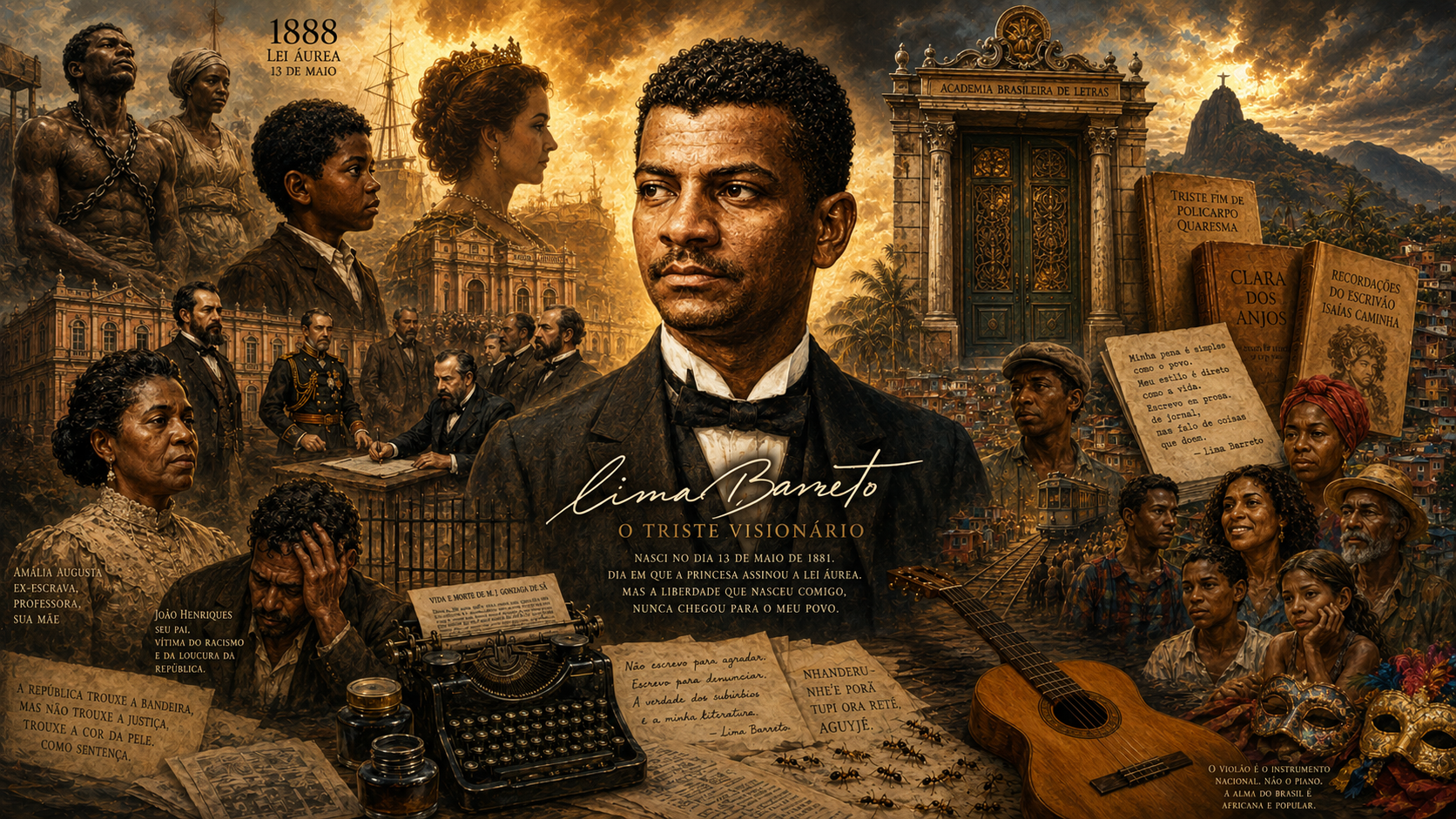
Lima Barreto was born seven years before the abolition of the Maafa in Brazil—a near-mythic coincidence, as his birthday, 13 May, would later mark the signing of the Golden Law (Lei Áurea) in 1888. Both sides of his family traced their roots to ancestors who were captives. His father, João Henriques de Lima Barreto, was a typographer and a monarchist, known for his influential connections to the Viscount of Ouro Preto, Afonso Celso de Assis Figueiredo, who became Lima Barreto’s godfather and sponsored his early education. His mother, Amália Augusta, was a formerly captive woman who became a schoolteacher. She died when Barreto was only six, leaving him in his father’s care.
At age seven, Barreto witnessed a defining moment in Brazilian history: he stood alongside his father at the Imperial Palace when Isabel signed the Golden Law before a crowd—an event that happened on his birthday, 13 May 1888. Historians emphasize that this unique experience, living through Brazil’s transition from slavery to a still-incomplete freedom for Black citizens, profoundly shaped his worldview and literary legacy.
Education and the Collapse of Family Fortune
After his mother’s death, Barreto was enrolled in a private school run by Teresa Pimentel do Amaral. Thanks to the ongoing support of his godfather, he attended the Liceu Popular Niteroiense, graduating in 1894, and then the esteemed Colégio Pedro II in 1895. Upon completion of his secondary studies, he entered the Escola Politécnica do Rio de Janeiro to pursue engineering.
However, the family’s fortunes collapsed during the transition from the Brazilian Empire to the Republic. They lost all they had and endured intense persecution. The mounting political and racial pressures took a severe toll on João Henriques’s mental health, ultimately leading to his psychological breakdown. In 1904, Barreto was forced to abandon his engineering studies to support his siblings. He took a minor civil service position in the Ministry of War—a post he held for much of his life, despite his deep aversion to bureaucracy.
A Militant Writer in a Hostile Society
Lima Barreto began his journalistic career in 1902, gaining his first major recognition in 1905 through a series of articles for the Correio da Manhã. He saw himself as a militant writer, driven by a passionate commitment to confronting the injustices he both witnessed and endured. Unlike many contemporaries who favored ornate, baroque prose to assert social status, Barreto purposefully embraced clear, journalistic language to reach a wider readership. His writings vividly captured the struggles and daily lives of residents in Rio’s subúrbios (impoverished outskirts), giving voice to the city’s most marginalized communities.
Barreto’s dedication to accessible language was a deliberate political act: he wanted his work to be understood by ordinary people, not just the educated elite. This approach drew sustained criticism from literary circles, who dismissed his style as unsophisticated and degrading to literature. Historian Lilia Moritz Schwarcz, whose landmark 2017 biography Lima Barreto: Triste Visionário (Sad Visionary) reignited interest in his legacy, describes him as a Black intellectual who asserted his identity and sought literary prominence while maintaining a principled stance of opposition.
Race, Racism, and the Politics of Exclusion
Lima Barreto was born into, and consistently wrote against, a society entrenched in scientific racism and Social Darwinism. He understood that much of his hardship was a legacy of the Maafa and its enduring aftermath. His writings launched unflinching critiques of Brazil’s plutocracy, bureaucratic machinery, patriarchal oppression, and the structural racism underlying the Republic’s so-called racial democracy. Remarkably for his era, Barreto affirmed his African heritage through literature: he created Black characters who defied stereotypes and portrayed Rio’s Afro-descendant communities with nuance and dignity. He employed a broad vocabulary to accurately render the region’s complex racial landscape.
Throughout his life, Barreto was often—almost always unfavorably—compared to the canonical writer Machado de Assis, a comparison deeply shaped by racial prejudice. Although he was a vocal critic of the Brazilian Academy of Letters and its institutional ambitions, Barreto applied for membership three times, only to be rejected on each occasion. These failures underscored his position as a literary outsider: too modern and critical for the conservative establishment, yet too unyielding to accommodate their expectations. His debut novel, Recordações do Escrivão Isaías Caminha, was met with a frosty reception from the literary community, as many influential figures saw themselves reflected and satirized in his characters.
Major Literary Works
Lima Barreto’s most acclaimed works reveal his biting social critique, innovative style, and deep empathy for oppressed Brazilians. Among his most notable books are:
Recordações do Escrivão Isaías Caminha (1909): Barreto’s debut novel is a semi-autobiographical satire chronicling the journey of a dark-skinned young man from the countryside whose intellect and aspirations are systematically stifled by Rio de Janeiro’s racial and social hierarchies. The book incisively critiques the press’s racial barriers and provoked hostility from the affluent class upon publication.
Triste Fim de Policarpo Quaresma (1915): Widely regarded as Barreto’s magnum opus, this novel—first serialized in 1911—offers a scathing satire of extreme nationalism. Its protagonist, Policarpo Quaresma, is an idealistic nationalist convinced that reviving Brazil’s indigenous roots will transform the country into a great nation. Quaresma petitions Parliament to make Tupi, an indigenous language, the official language; adopts indigenous customs; and learns the guitar, which he deems Brazil’s true national instrument. His earnest actions, interpreted as patriotism by himself but madness by society, ultimately result in his commitment to a psychiatric asylum. His dreams are shattered by the brutality and cynicism of the young Republic. Scholars have noted that Barreto, an admirer of Gustave Flaubert, crafted Quaresma in a manner reminiscent of the protagonists in Flaubert’s Bouvard et Pécuchet.
Clara dos Anjos (published posthumously, 1923): This novel tells the story of a young Black woman from Rio’s suburbs who is seduced and abandoned by a European man. Barreto examines Cassi Jones not merely as a villain, but as a social predator—calculating, careless, and emblematic of structural injustice. The narrative stands as a profound meditation on race, gender, and vulnerability, with a particular focus on the exploitation faced by poor women.
Os Bruzundangas: This satirical collection presents Bruzundanga, a fictional nation serving as a transparent allegory for Brazil. Barreto uses this setting to lampoon the country’s corruption, literary pretensions, and mediocrity. Through the invented Samoiedas—a parody of elitist Parnassian and Symbolist schools—he ridicules the literary establishment he so often opposed.
Diário do Hospício (Loony Bin Diary, posthumous, 1953): This work offers a vivid and unsettling account of Barreto’s experiences in a psychiatric asylum, artfully blurring the lines between memoir and fiction. In parts of the diary, he signs as Vicente Mascarenhas, a character from his own literary universe.
Cemitério dos vivos (Cemetery of the Living): Published posthumously in 1956, this unfinished novella also draws on Barreto’s time in psychiatric confinement. In a playful reversal of his diary approach, Barreto refers to himself as Lima Barreto within the fiction, alluding to the character Vicente Mascarenhas.
Madness, Alcoholism, and Personal Struggles
The trauma of his father’s mental illness, coupled with Barreto’s own battles against alcoholism and depression, rendered madness and psychiatric confinement recurring themes throughout his work. This deeply personal history echoes in his fiction, where protagonists such as Isaías Caminha and Policarpo Quaresma are shaped by their experiences as clerks amidst the chaos of bureaucracy. Barreto’s narratives often center on melancholic, quixotic figures—mirroring his father’s struggles—who find themselves ill-equipped to withstand the relentless pressures of a rapidly modernizing society. This perspective earned Barreto the epithet “Sad Visionary,” capturing the disillusionment and stubborn resilience of his characters, whom society frequently regards as mad.
Barreto’s final years were overshadowed by severe depression, alcoholism, and multiple involuntary stays in psychiatric institutions. He died of a heart attack on 1 November 1922, at only 41 years old—the same year as Brazil’s landmark Semana de Arte Moderna (Modern Art Week), which heralded the arrival of Modernism in the country. Scholars note that Barreto died largely alone and forgotten, his genius unrecognized by the literary establishment during his lifetime.
Paradoxes and Contradictions
Barreto was a figure of profound paradoxes. Despite being a determined advocate for the oppressed residents of the subúrbios and a champion of popular culture in his writing, he paradoxically disliked iconic Brazilian pastimes such as soccer, samba, and Carnival. His personality combined a libertarian spirit with a strict moralism and monarchist sympathies. He was outspoken in his contempt for civil servants and bureaucratic dysfunction, yet spent his whole career as a clerk in the War Department. While his fiction denounced the oppression of women, he controversially dismissed feminism as a shallow, foreign import.
Legacy and Rediscovery
For decades following his death, Lima Barreto was excluded from the Brazilian literary canon—his marginalization perpetuated by the very racism he fought to expose. The first significant revival of his reputation occurred in the 1950s, when historian Francisco de Assis Barbosa published Barreto’s complete works in 17 volumes, rescuing him from obscurity. Barbosa’s interviews with Barreto’s surviving friends and relatives helped reintroduce his literature to the national consciousness. In the 21st century, a second, more profound wave of recognition emerged, as scholars foregrounded race and resistance as central elements of his legacy. Recently, Barreto was honored at the International Literary Party of Paraty (FLIP), igniting renewed interest and scholarship around his life as the Sad Visionary.
Today, Barreto is recognized as one of the most significant Black voices in the history of the Brazilian Republic, celebrated in academic circles from Princeton to King’s College London and throughout Brazil. He stands as a key figure of Brazilian Pre-Modernism, though many scholars now regard him as a forerunner of Modernism, owing to the orality and immediacy of his prose. Increasingly, his legacy is seen as foundational to Modernism itself, especially for his use of spoken language and lived experience as literary material—a view that challenges older labels like ‘pre-Modernist,’ which scholars such as Lilia Moritz Schwarcz have dismissed. The coincidence of his birth with Brazil’s Abolition Day is seen as symbolically charged: Barreto is remembered as a herald of the abolition of prejudices that legal emancipation failed to eradicate.
Source:
https://en.wikipedia.org/wiki/Lima_Barreto
https://revistapesquisa.fapesp.br/en/lima-barreto-as-a-chronicler-of-post-abolition-brazil/
https://www.theguardian.com/books/2014/jul/15/sad-end-policarpo-quaresma-lima-barreto-review
https://jorgesette.com/2020/02/10/four-of-brazilian-writer-lima-barretos-main-works-as-modern-and-relevant-as-ever/