
On 13 May 1888, a brief law signed in Rio de Janeiro brought a formal end to centuries of organised African captivity in Brazil. Known as the Lei Áurea — the Golden Law — it contained only two articles, declaring that from that day the institution was extinguished and revoking all earlier provisions that had sustained it. What appeared on paper as a simple act of legislation was, in reality, the culmination of nearly four hundred years of forced African labour, continuous resistance, and painstaking political struggle within a society built on racial hierarchy and coerced work.
To understand the end of the Maafa in Brazil, you must recognize its breadth. From the early sixteenth century, Brazil became the largest destination for trafficked Africans in the Americas. Portuguese and Brazilian traffickers transported more than five million African men, women, and children across the Atlantic, an estimated forty percent of all those forcibly carried to the New World. At its height in the mid‑nineteenth century, the captive population in Brazil was estimated at between two and two and a half million people, providing the backbone of an export economy centered first on sugar and later on coffee, as well gold mining. The state, ecclesiastical institutions, and public officials participated fully in this system, owning and controlling African labor on a massive scale.
Formal abolition in 1888 followed a series of partial measures that sought to manage, rather than dismantle, the existing order. Under international pressure, particularly from Britain, Brazil passed the Eusébio de Queirós law of 1850, which suppressed the transatlantic traffic and cut off the external supply of African laborers. This did not alter the legal status of those already in bondage, but it placed the regime on a path of gradual demographic decline. In 1871, the Law of the Free Womb declared that children born to women in captivity after that date would eventually be considered free, created a registry that recorded around 1.5 million captive people, and established an emancipation fund. In practice, however, many owners falsified records, marking children as born before the law took effect. The 1885 Sexagenarian Law, which freed those over sixty, was widely condemned as cynical: few captives survived to that age, and those who did were often no longer able to work.
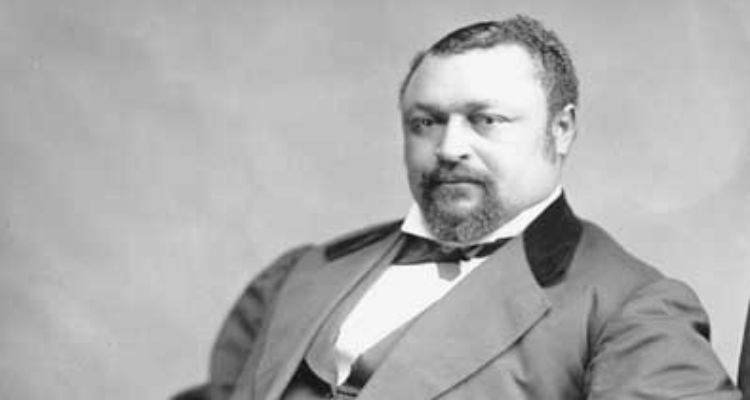
If the legislative steps were hesitant and compromised, the movement against the Maafa was anything but. A powerful abolitionist current emerged from the 1860s onward, drawing energy from Black intellectuals, journalists, lawyers, and organisers. Figures such as Luiz Gama, once held in bondage himself, used the courts to secure the liberation of hundreds of people and developed innovative legal strategies that challenged the very foundations of hereditary captivity. José do Patrocínio, a Black journalist and gifted orator, became one of the loudest public voices for immediate abolition, coordinating campaigns through the press and mass meetings. André Rebouças, a Black engineer with access to elite circles, worked tirelessly to build alliances across employers, students, artists, and political leaders. Alongside these men, Joaquim Nabuco and others carried the debate into parliament and to audiences abroad.
The Brazilian Abolitionist Confederation, founded in 1883, brought together local anti‑Maafa societies from multiple regions. Through newspapers, theatre, conferences, and local emancipation funds, these groups worked to undermine the system from within and without. Some provinces, notably Ceará and Amazonas, ended the practice on their own initiative before the Golden Law. In Ceará, jangadeiros — the raftsmen who transported goods along the coast — refused to carry captive people, effectively disrupting the coastal trafficking in human beings. As the 1880s advanced, more and more African and Afro‑Brazilian people asserted their own freedom, fleeing rural estates, establishing autonomous communities, and pushing urban authorities to their limits. Sections of the military refused to hunt freedom seekers, and in many areas the regime was collapsing before the law caught up.
Economic transformations also weakened the old order. Planters in São Paulo and other coffee‑growing regions increasingly turned to European immigrant labour, especially from Italy, as an alternative to tightly controlled African work forces. Many large landholders concluded that free, contracted workers could be more easily disciplined and, over time, more cost‑effective than maintaining coerced labour. Meanwhile, Brazil’s international partners, particularly Britain, had long since condemned the traffic and pressed for reform. By the late 1880s, the system that had once generated immense wealth was seen by influential sectors as a political liability and an obstacle to integration into a changing global economy.
The Brazilian monarchy shaped the political moment of abolition. Pedro II had traveled to Europe for medical treatment, leaving his daughter, Isabel, as regent for the third time. In early 1888, police repression of a pro‑abolition demonstration in Rio provoked public outrage. Isabel dismissed the conservative prime minister, the Baron of Cotegipe, and appointed João Alfredo Correia de Oliveira, who supported immediate abolition. The new cabinet moved quickly. A bill declaring an end to captivity without conditions passed through the legislature, and on 13 May 1888, Isabel signed it, making itlaw.
The Golden Law was striking in its minimalism. With just two articles, it proclaimed that captivity ceased to exist within Brazil and annulled all conflicting provisions. Notably, it offered no financial compensation to those who had held Africans in bondage, unlike many earlier emancipation acts elsewhere in the Atlantic world. At the same time, it provided no land, resources, or institutional support to those emerging from generations of forced labour. Suddenly, hundreds of thousands of Afro‑Brazilians were legally free but without guaranteed access to land, formal employment, education, or political power.
The aftermath of abolition revealed the limits of a purely juridical ending to the Maafa. Many freed people remained on the same plantations and rural estates where they had laboured before, now as insecure wage workers or sharecroppers under deeply unequal conditions. In 1889, the new republican finance minister Rui Barbosa ordered the destruction of records documenting the regime of captivity, a move that foreclosed future compensation claims and symbolically erased a vast archive of African presence. Racist ideologies persisted in law, culture, and everyday life, and the Brazilian state made no serious attempt to redistribute land or restructure the rural economy. Formal freedom did not bring structural transformation.
The Golden Law also contributed to the downfall of the very monarchy that enacted it. Brazil’s great coffee planters and large landowners had been central pillars of imperial power. Their fury at losing legally recognised control over African labour without compensation fuelled disaffection with the monarchy. Within eighteen months of the 1888 decree, a civil‑military coup toppled Pedro II and proclaimed the republic. In this sense, the ending of the Maafa in Brazil and the end of the monarchy were intertwined, marking the close of one long chapter of Portuguese‑rooted rule and the beginning of another era whose institutions nevertheless continued to reproduce racial hierarchy.
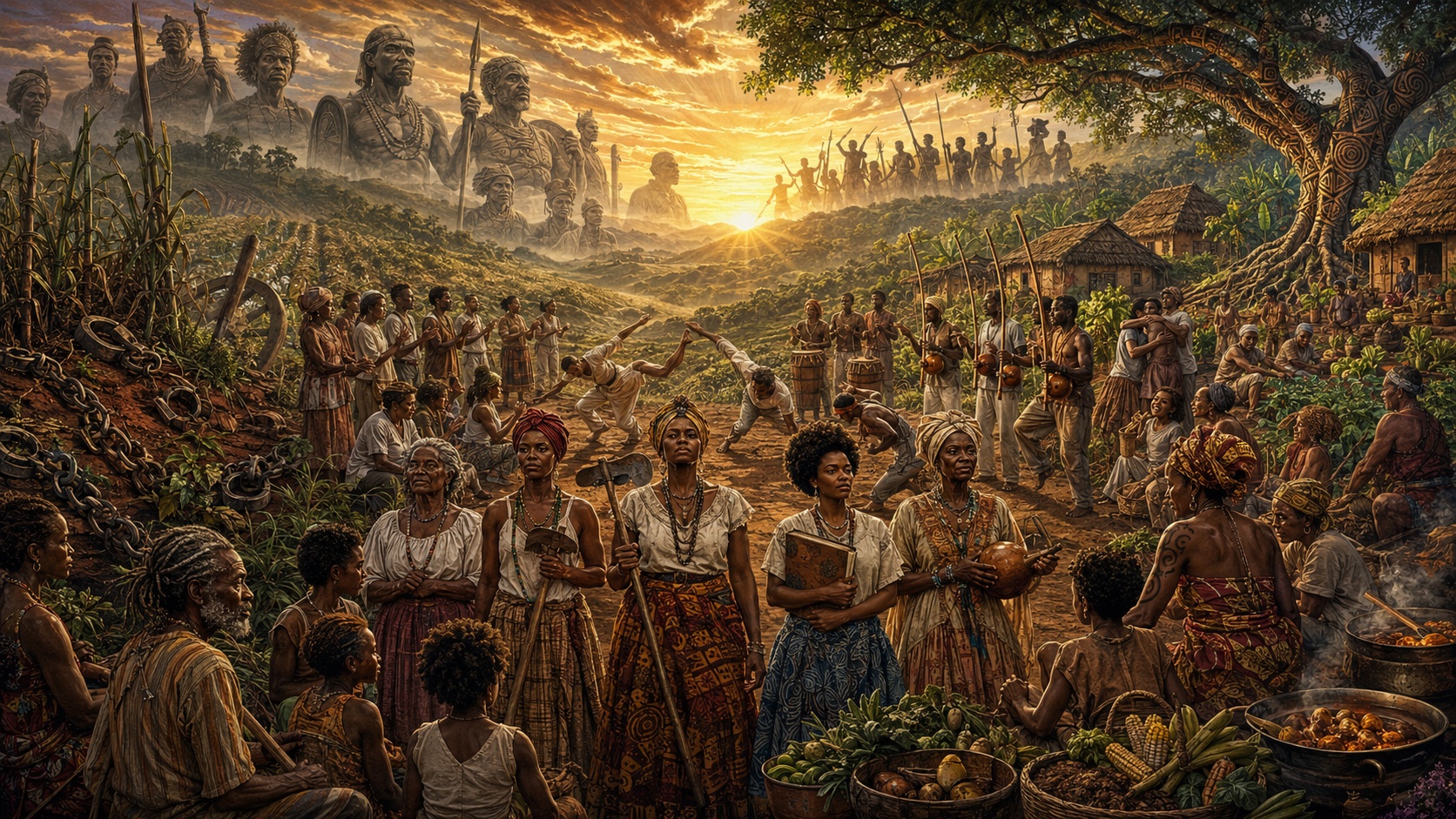
The memory of 13 May remains contested. For some, it is celebrated as a national milestone, the day when a long injustice was corrected. For many Afro‑Brazilian movements, however, it is a date of unfinished business — the moment when legal bondage ended, but the deeper structures of dispossession and anti‑Blackness were left untouched. In this counter‑memory, other dates and symbols carry more emancipatory meaning: the maroon communities that resisted domination for centuries, the uprisings and everyday acts of refusal, and the ongoing struggles for land, dignity, and recognition. The ending of the Maafa in Brazil, therefore, is not a closed story; it is a hinge in a longer history of African presence and resistance in the Americas.
Source:
https://en.wikipedia.org/wiki/Slavery_in_Portugal
https://www.projectmanifest.eu/portugal-and-the-invention-of-the-atlantic-trade-of-enslaved-people-15-16th-centuries/
https://www.statista.com/statistics/1150477/number-slaves-taken-by-national-carriers/
https://lewisrhystwiby.wordpress.com/2024/07/28/the-making-of-today-portugal-abolishes-slavery-but-not-in-its-colonies-july-september-1761/
https://www.dw.com/en/portugal-commemoration-transatlantic-slave-trade/a-56976093
https://contestedhistories.org/early-atlantic-slave-trade-in-portugal/