
Regina M. Anderson was an African-American librarian, playwright, patron of the arts, and organizer whose quiet labor helped shape Black literary and theatrical modernity. Born on 21 May 1901 in Chicago, Illinois, she lived almost the entire span of the twentieth century, spanning the early Jim Crow era, the high tide of the Harlem Renaissance, the civil rights and women’s movements, and the rise of international institutions such as the United Nations and UNESCO. Across these shifting landscapes, she used the tools of her trade—books, performance, and the careful curation of space—to give Black communities access to knowledge, to each other, and to a sense of living historical continuity.
Early life and formation
Regina M. Anderson was born into a family whose ancestry complicated the rigid racial categories of early twentieth-century America. Her parents, William Grant Anderson, an attorney, and Margaret Simons Anderson, raised her in Chicago, where she attended Normal Training School and Hyde Park High School. In later life, she described her background as a mixture of Native American, Jewish, East Indian, Swedish, and other European ancestries, with one grandparent of African descent from Madagascar; she often identified her race simply as “American,” even as she moved and worked in Black communities and was read as African American. That tension between self-identification and external classification would echo through her life.
As a young woman, Anderson was influenced by the work of journalist and anti-lynching activist Ida B. Wells and by the glaring absence of Black history from the curricula she encountered. She briefly attended Wilberforce University, a historically Black institution in Ohio, where she gained early exposure to Black intellectuals and activists. She later studied at the University of Chicago and City College of New York, eventually earning a professional credential in librarianship from Columbia University’s Library School, a training that would anchor her career.
Her career in library work began in 1921, when she was hired as a junior library assistant at the Chicago Public Library. This first position exposed her to the public library as a civic institution and a potential site of transformation, but it was her move to New York City soon afterward that brought her fully into the orbit of Harlem’s burgeoning Black cultural renaissance. After initially living at a downtown YWCA, she relocated to Harlem and began to knit together her professional identity as a librarian with her emerging role as a cultural organizer.
Librarian and institution builder
In 1923, Anderson joined the New York Public Library (NYPL) as a staff member at the 135th Street Branch, under the leadership of progressive branch head Ernestine Rose. Rose intentionally sought staff who reflected Harlem’s community and interests, and Anderson quickly distinguished herself as a talented young librarian who could bridge institutional structures and neighborhood needs. Over the course of her career, she would become one of the first Black supervising librarians in the NYPL system and is frequently cited as the first African American to head an NYPL branch.
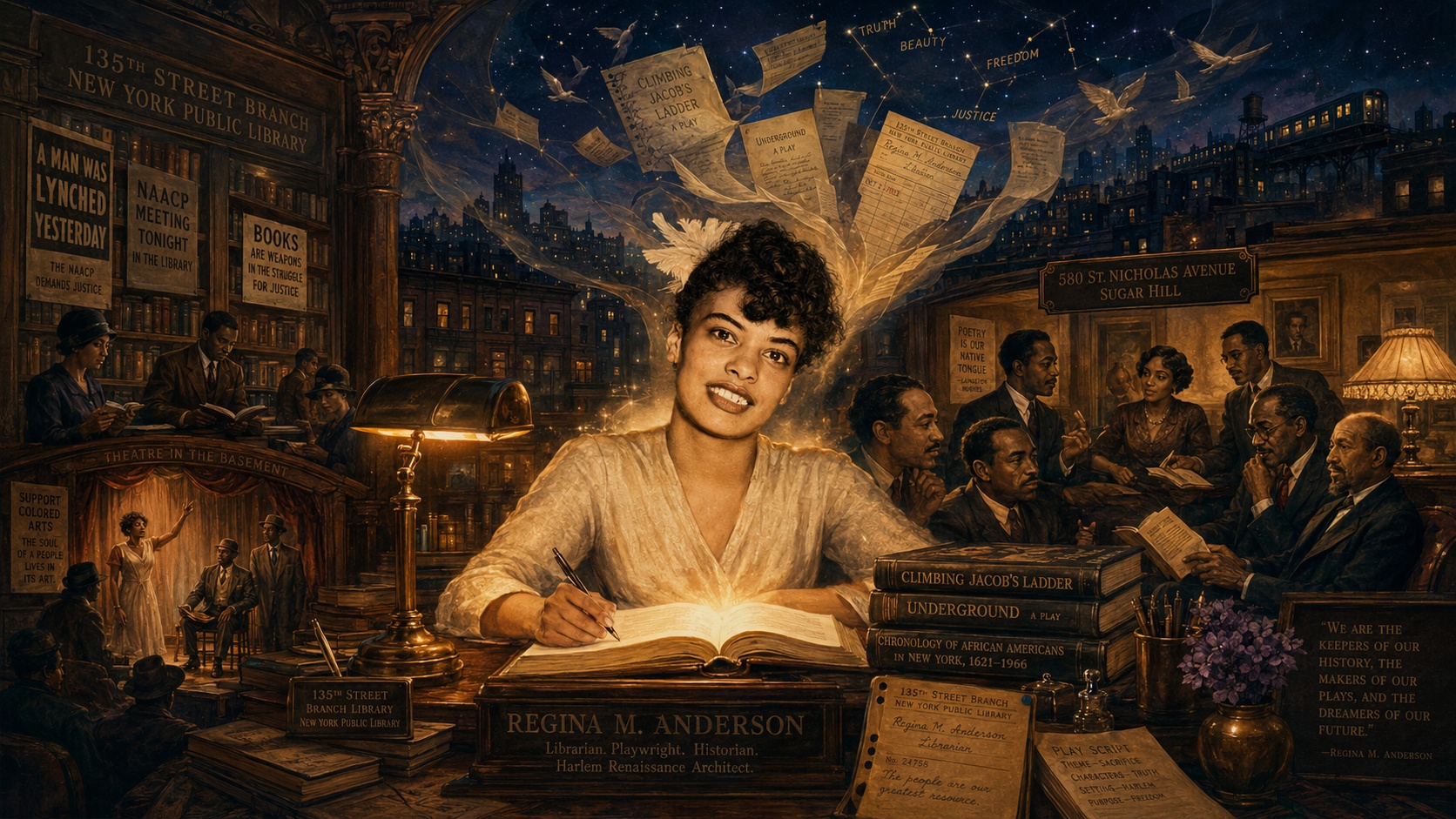
At the 135th Street Branch—later the heart of what became the Schomburg Center for Research in Black Culture—Anderson helped transform the library into a forum for Black public life. The branch hosted lectures by figures such as Hubert Harrison and Margaret Sanger, meetings of the NAACP and the Anti-Lynching Crusaders, and public discussions about race, health, and politics. Anderson’s work in programming and community outreach made the library into much more than a repository of books; under her hand, it became a space where Harlem’s residents could encounter ideas, organize, and see their own histories reflected.
Over the decades, she served at several NYPL branches beyond 135th Street, including the Washington Heights Branch, where she confronted entrenched racism and sexism in promotion and pay. She developed “Family Night at the Library” and other programs that brought working-class families into the library as active participants rather than passive borrowers, encouraging children and adults alike to view reading and history as shared, communal processes. She retired from NYPL in 1966, but the archive of her work—the Regina Andrews papers held by NYPL—demonstrates her continued involvement in community life and her use of the library as a platform for both cultural and civic activism.
“580” and the Harlem salon world
If the library was one of Anderson’s public stages, her home at 580 St. Nicholas Avenue was another. Sharing the Sugar Hill apartment with Ethel Ray Nance and Louella Tucker, Anderson helped create a domestic space that functioned as a West Side counterpart to A’Lelia Walker’s famous “Dark Tower” salon. The apartment, known variously as “580,” “Dream Haven,” and the “Harlem West Side Literary Salon,” hosted gatherings of writers, artists, and activists who were at the forefront of the Harlem Renaissance.
Guests at 580 included W.E.B. Du Bois, Langston Hughes, Countee Cullen, Jean Toomer, Charles S. Johnson, and many others who shaped Black letters in the 1920s and 1930s. In this setting, Anderson was not merely a hospitable host but a careful curator of conversations, pairing people, texts, and ideas in ways that fostered collaboration and solidarity. Her salon work made visible a key structure of the Harlem Renaissance: the importance of Black women’s domestic spaces as incubators of aesthetic and political movements.
The Civic Club dinner and the birth of a movement
In 1924, Anderson’s organizational gifts came to the fore publicly when she helped plan and coordinate the now-famous Civic Club dinner. The event, held at the Civic Club in New York, brought together more than one hundred guests, including W.E.B. Du Bois, Jean Toomer, Countee Cullen, Langston Hughes, Charles S. Johnson, and Hubert Delany. Many historians treat this dinner as a moment when Harlem’s emerging group of Black writers and intellectuals gained a clearer sense of themselves as part of a shared literary movement.
Anderson’s role in organizing the dinner illustrates the way she navigated the overlapping worlds of the library, the salon, and formal civic institutions. She moved easily between the 135th Street Branch, private homes, and public venues, helping create the conditions for the Harlem Renaissance to flourish.
Krigwa Players and the Negro Experimental Theatre
Later in 1924, Anderson collaborated with W.E.B. Du Bois to found the Krigwa Players (“Crisis Guild of Writers and Artists”), a Black theatre group created under the aegis of the NAACP’s journal, The Crisis. Staging plays written by Black authors and performed by Black actors, the Krigwa Players turned the basement of the 135th Street library into an experimental theatre space, claiming institutional square footage for Black-controlled art.
Though the Krigwa Players were short-lived, they established a template: small, community-rooted theatre companies committed to serious Black drama. After Krigwa disbanded, Anderson co-founded the Harlem Experimental Theatre with Dorothy Peterson and Harold Jackman, continuing the project of developing and staging new Black plays. The Theatre became a model for “little theatre” groups throughout the United States, giving emerging playwrights and actors a place to work outside of commercial Broadway, where roles were few and often deeply stereotyped.
In these ventures, Anderson’s dual identities—as librarian and theatre artist—converged. She was building an archive of performance as much as a program of readings, using plays to interrogate the history and ongoing violence of racism in the United States.
Playwright and the politics of memory
Anderson not only organized theatre; she wrote for it. Using the pseudonym “Ursula Trelling” (often rendered “Ursala Trelling”), she penned one-act plays that tackled subjects central to Black historical memory. In 1931, the Theatre produced her play Climbing Jacob’s Ladder, which dramatizes a lynching that occurs while a congregation is praying in church. The juxtaposition of devout worship and sudden racial terror refuses to confine lynching to the outside world; instead, it brings violence directly into religious space and asks what faith looks like in its wake.
The following year, in 1932, the company staged Underground, Anderson’s play focused on the Underground Railroad. In tracing the perilous routes through which enslaved people sought freedom, she linked the historical memory of enslavement and resistance to the contemporary struggles of Black communities confronting Jim Crow and northern racism.
Through these works, Anderson joined a broader tradition of Black women artists—particularly playwrights and fiction writers—who used narrative to confront lynching, the Maafa, and the structures of racial domination. Her choice to employ a pseudonym suggests both the risks of writing on such subjects and a strategic desire to let the work circulate without limiting herself to a single public role.
Intellectual labour and historical mapping
Beyond her theatrical work, Anderson contributed to Black historical scholarship in more conventional forms. In 1971, she and Ethel Ray Nance coedited Chronology of African-Americans in New York, 1621–1966, a work that mapped more than three centuries of Black presence in the city. The chronology documented events ranging from the arrival of enslaved Africans in New Amsterdam to the evolution of Harlem as a Black metropolis, providing a scaffold for subsequent researchers and community historians.
This publication reflected what she had long been doing in her daily practice as a librarian: collecting, organizing, and presenting information that revealed the depth of Black history in New York. Long before “Black Studies” became an institutionalized academic field, she had been curating materials, hosting events, and shaping reading lists that allowed young people and adults to see themselves in historical narratives. Her papers at NYPL—letters, reports, scrapbooks, and program notes—testify to her ongoing commitment to documenting Black life.
Civic activism and international work
Anderson’s work was never confined to the library or the stage. In 1940, she joined the National Urban League, an organization focused on helping African Americans navigate life in the urban North, particularly during the Great Migration. Through the League, she engaged with housing, employment, and education issues, connecting her library work with broader social service and civil rights agendas.
Her role with the Urban League eventually led her into international arenas. She represented the organization at the United States Mission to the United Nations and served on the U.S. National Commission for UNESCO, participating in discussions on education, human rights, and cultural heritage at the global level. At the same time, she became active in the National Council of Women of the United States (NCWUS), rising to the position of vice president and representing the Council at the UN while still managing the Washington Heights Branch of NYPL. Even after her formal retirement, she continued hosting NCWUS gatherings and remained involved in local historical and women’s organizations in New York State, including in Ossining and Carmel.
Personal life and final years
At some point during her New York years, Anderson married William T. Andrews, a lawyer and New York state assemblyman, and thereafter was often known as Regina Anderson Andrews. Their partnership linked her cultural work in Harlem to the formal political sphere of Albany, and she continued to balance her roles as librarian, playwright, hostess, and political spouse.
She lived long enough to see the Harlem Renaissance historicized, the civil-rights movement unfold, and Black women’s intellectual work gain greater recognition in academic and popular circles, even if her own contributions were often mentioned only in passing. Regina Anderson Andrews died on 5 February 1993 (with some sources listing 6 February) in Ossining, New York, closing a life that had quietly threaded itself through many of the major currents of twentieth-century African American history.
Legacy
Regina M. Anderson’s legacy lies in the intersections she inhabited and created. The library, under her care, became a Black forum, a theatre, a classroom, and a site where anti-lynching campaigns and community meetings could take root. In her apartment at 580 St. Nicholas Avenue, she turned her domestic space into a literary salon where friendships were conducted over food and manuscripts passed hand to hand. On stage, through plays like Climbing Jacob’s Ladder and Underground, she confronted lynching and the Maafa as ongoing wounds in the American body politic, insisting that they be remembered and argued over in public. Today, scholars, librarians, and theatre practitioners increasingly recognize Regina M. Anderson as a Harlem Renaissance original.
Source:
https://www.britannica.com/biography/Regina-M-Anderson
https://www.harlemworldmagazine.com/harlems-legendary-american-playwright-and-librarian-regina-m-anderson-1901-1993/
https://www.encyclopedia.com/women/encyclopedias-almanacs-transcripts-and-maps/anderson-regina-m-1901-1993
https://archives.nypl.org/scm/20587
https://en.wikipedia.org/wiki/Regina_M._Anderson
https://amsterdamnews.com/news/2017/07/27/regina-anderson-andrews-librarian-playwright-and-p/