

Moremi Ajasoro was a legendary Yoruba queen whose courage, intelligence, and tragic sacrifice have echoed across centuries. Remembered in Ile-Ife as “Africa’s Lady Liberty,” she stands at the crossroads of history and myth, celebrated as a saviour by some and condemned by others.
Princess of Offa, Queen of Ile‑Ife
According to Yoruba oral traditions, Moremi was born a princess in Offa, a town renowned for its warrior heritage and the rigorous training of its children in courage and resilience. Her father, Lukugba, was famed as a fearless hunter who returned from treacherous forests where others had vanished, and his daring exploits became a template for his daughter’s own bravery. Moremi grew up under the influence of Offa’s sacred tradition of Ijakadi (Playful Combat), a ritualised form of wrestling designed to build strength, endurance, and unshakeable resolve in the face of adversity.
Through marriage, Moremi left Offa and entered the royal court of Ile-Ife, where she became Ayaba (Queen Consort). Most accounts describe her as the wife of King Oranmiyan, son of Oduduwa, the ancestral progenitor of the Yoruba people, though some traditions name Obalufon Alayemore II instead. In either case, she occupied a place at the heart of political power in the spiritual capital of the Yoruba world.
A Kingdom Under Siege
During Moremi’s time, Ile-Ife lived under the shadow of relentless raids by a neighbouring group known as the Ugbo or “Forest People.” These raiders swept into the city to loot, burn, and carry people away into slavery, appearing on the battlefield cloaked in raffia palm fronds that rendered them terrifying, almost otherworldly figures. To the people of Ife, they seemed like invincible spirits rather than human enemies, and sacrifices and rituals offered for protection did little to halt the devastation.
As the raids continued, the crisis was not merely military but spiritual and psychological. The fear of these “spirits” eroded morale, and the city’s leaders struggled to find a way to protect their people.
The Spy Queen and the Secret of Fire
Refusing to watch her people perish, Moremi sought help from the spirit of the Esimirin (Esinmirin) River. At its banks, she made a solemn vow: if the deity would reveal the secret to defeating the Ugbo, she would repay the favour with the greatest sacrifice she could offer.
The strategy that followed reads like a classic espionage tale. Moremi posed as a trader and intentionally allowed herself to be captured in one of the Ugbo raids, infiltrating their stronghold from within. Because of her beauty and intelligence, she soon attracted the favour of the Ugbo king—identified in some accounts as Orunmakin—and was taken not as a common captive but as his queen.
In the intimacy of the palace, Moremi used skilful conversation and “pillow talk” to win the king’s trust. Gradually, he revealed the secret behind the raiders’ terrifying appearance: the “spirits” on the battlefield were ordinary men whose raffia costumes were highly flammable. Armed with this knowledge, Moremi staged a daring escape and returned to Ile-Ife, where she instructed the city’s warriors to meet the Ugbo with burning torches and fire.
When the Ugbo next attacked, the people of Ife set their raffia coverings ablaze. Stripped of their disguises and their psychological edge, the raiders were routed, and the era of their dominance over Ile-Ife came to an end.
The Ultimate Sacrifice: Oluorogbo
Victory, however, came at an unbearable cost. Returning to the Esimirin River to fulfil her vow, Moremi offered rams, cattle, and other valuable sacrifices, but the deity refused them all. The spirit demanded her only son, Oluorogbo—the child who embodied both her maternal love and the future of her lineage.
Faced with an impossible choice between breaking her vow and saving her child, Moremi chose to honour her promise. She sacrificed Oluorogbo, and the grief that followed plunged Ile-Ife into mourning. To ease her anguish, the people of Ife vowed to become her “eternal children,” a collective act of remembrance that transformed a personal tragedy into a foundational myth of national survival.
In Yoruba spiritual memory, Oluorogbo himself becomes a heroic figure. Some traditions describe him as “The Redemptorist” (Omoliworogbo), the one destined to restore the world if it ever stood on the brink of destruction, and there are versions of the story in which he does not truly die, but is raised up to the heavens by Olodumare, the Supreme Being.
Rejection, Ambiguity, and the Cost of Female Power
Although many popular retellings end with Moremi enshrined as a celebrated heroine, other strands of oral tradition paint a more painful picture of her later life. Some accounts suggest that while King Oranmiyan welcomed her back and reinstated her as queen, his other wives resented her return and conspired to make her position in the palace unbearable. In this version, their hostility eventually drove her from Ife.
Seeking refuge, Moremi is said to have attempted to return to her father’s house in Offa, only to be turned away at the gate by guards who no longer recognised her. Forced to spend the night outside, she disappeared by morning, giving rise to speculation that she may have taken her own life to join her son. Read this way, her story becomes not only one of heroism but also of rejection—a woman who saved a nation yet found no true home in the end.
Some scholars argue that the death of Oluorogbo and the suffering that haunts Moremi’s later years can be read as a metaphorical punishment for female power. In their view, male storytellers reshaped her triumph into a cautionary tale in which a woman who exercises intelligence, agency, and political influence must pay a catastrophic price. Unlike many male warriors who returned from battle to honour and reward, Moremi’s victory is followed by loss that “completely destroyed her,” signalling the deep suspicions surrounding women’s leadership.
One Woman, Two Stories
Strikingly, Moremi Ajasoro is not remembered the same way everywhere. In Ile-Ife, she is a saviour and a mother of the nation; in Ugbo Ilaje, she is remembered as a traitor. From the Ugbo perspective, she used her status as their anointed queen to betray a husband who treated her with honour, extracting military secrets that led to their defeat. Their leaders frame their campaign against Ile-Ife as a legitimate attempt to reclaim land they believe was taken by Oduduwa, casting Moremi’s actions as an unjust intervention in a just struggle.
This divergent memory is ritually inscribed in Ugbo traditions, including a ceremony in which a statue of Moremi is flogged by chiefs, a symbolic condemnation of her betrayal. Thus, the same woman is simultaneously venerated and vilified, showing how history is never only about events but also about who tells the story and what stakes they hold in its outcome.
Festivals, Monuments, and Modern Commemorations
In Ile-Ife, Moremi’s legacy is woven into ritual life, public art, and contemporary cultural projects. The Edi Festival, which originated after her death, commemorates her sacrifice and the liberation of the city from the Ugbo raids. During the festival, participants reenact the ancient battles: some dress in raffia leaves, while others pursue them with torches, symbolically replaying the moment when fire stripped the raiders of their terrifying disguises.
In 2016–2017, a 42‑foot statue of Queen Moremi was unveiled in the Ooni’s palace at Enuwa in Ile-Ife. Recognised as the tallest statue in Nigeria and among the tallest in Africa, it depicts Moremi in regal Aso Oke and beads, holding aloft a blazing torch of Oguso (palm kernel fronds)—a sculpted memory of the fire that turned the tide of war. This monument, situated on the very grounds believed to be her former compound, has come to be known as the “Moremi Statue of Liberty,” visually aligning her with global icons of freedom and resistance.
Beyond the palace, another statue stands at Moremi Hall in Obafemi Awolowo University (OAU), and together these works of art explore different moods and meanings of her image—from readiness for war and proclamation of victory to formal dignity and royal composure. The Ooni of Ife has further extended her commemoration through initiatives such as the Queen Moremi beauty pageant and the Moremi Ajasoro Annual Lecture, which highlight beauty, character, leadership, and the continued relevance of her story in contemporary discussions of womanhood and power.
A Timeless Symbol of Courage and Complexity
Today, Moremi Ajasoro endures in Yoruba and wider African imagination as a symbol of courage, patriotism, and selfless devotion, but also as a figure who exposes the deep tensions around loyalty, gender, and memory. Her life brings together the hunter’s courage of her father Lukugba, the warrior ethos of Offa, the political intrigues of royal courts, the spiritual weight of vows, and the devastating cost of liberation.
To some, she is the mother who gave her only son for her people; to others, the queen who betrayed her husband and his kingdom. Between these extremes lies a woman whose story refuses to be simple—a heroine whose light was born in fire, whose triumph came wrapped in grief, and whose legacy continues to challenge how we define heroism itself.
This post is lovingly dedicated to my maternal Yoruba line, which I learned about today through my African Ancestry mtDNA results—a homecoming of the blood that has finally given my foremothers a name, a place, and an honoured place in my work. It is also dedicated to my grandmother, Beatrice Stephenson, who went in search of our history long before such DNA tests existed, walking by faith and memory where I can now walk with genetic evidence in my hands.
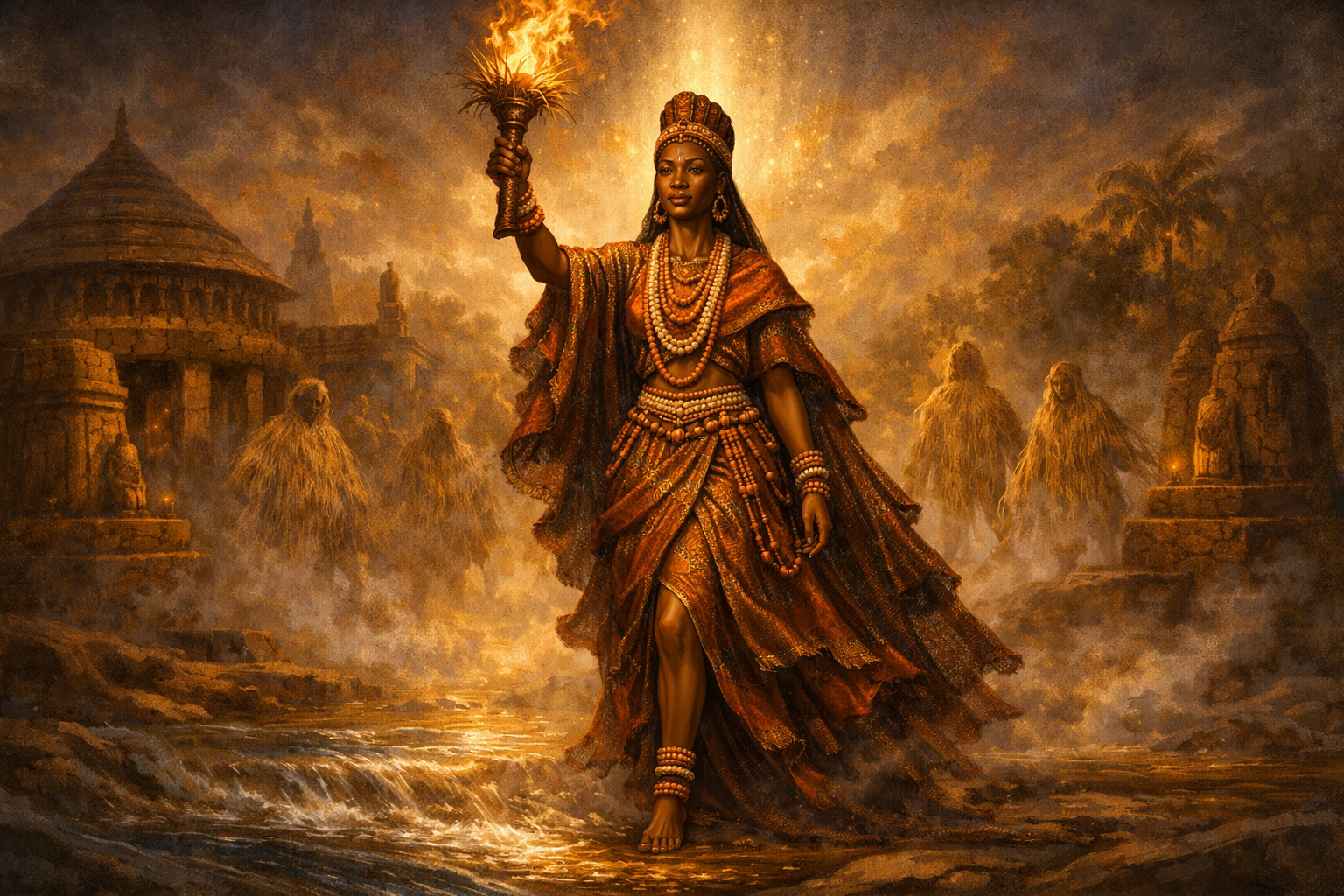
Acknowledgement: Research support and drafting assistance provided by Perplexity (AI); all errors and interpretations are my own. The illustration of Queen Moremi Ajasoro: The Flame of Liberation, was created in collaboration with AI (ChatGPT “Spruce”), based on historical and cultural guidance from the author.
This artwork honours Queen Moremi Ajasoro of Ile-Ife, whose courage and sacrifice stand as enduring symbols of Yoruba resilience and spiritual strength.
Sources:
Balogun, Lekan, Moremi (Play/Book), Legendaire Books, January 2015.
Kollo, Charles, “Africa’s Rich History: Meet Queen Moremi Ajasoro, The brave Yoruba Queen who sacrificed all for her people (Part 1),” Global African Times, June 2025.
Anoba, Ibrahim, “African Heroes of Freedom: Queen Moremi Ajasoro,” Libertarianism.org, June 2019.
Opara, Claude, “MOREMI: An African Legend” (Comic Adaptation), Teambooktu, December 2023.
offaindigenes, “Moremi Ajansoro” (Historical overview).
Adebisi, Aremu Adams, “Moremi Ajasoro” (Modern poem), African Poems: Oral Poetry from Africa.
Wikipedia, “Moremi Ajasoro” (Encyclopedia entry).
Beesley, Jack, “Moremi Ajasoro,” Team Queens (Educational history blog).
Oreofe, “Moremi Ajasoro, Princess of the Yoruba,” Yoruba Folk Tales, January 2018.
Nyotuoro, Achieng’, “Moremi Ajasoro, the Legendary Yoruba Queen,” November 2022.
Okonjo, Kamdi, “Queen Moremi,” AFA (African Queens series).
Adeleye-Fayemi, Bisi, “Reflections on the legend of Moremi Ajasoro,” Vanguard News, November 2023.
Bolawole, Bolanle, “Remembering Moremi Ajasoro,” September 2021.
Adeniji, Tinuoluwa, “Queen Moremi: The Legendary Yoruba Queen,” Tales and Whispers.
Sanusi, Sola, “The story of Ile Ife’s unforgettable female legend, Moremi Ajasoro,” Legit.ng, May 2018.
Nairaland Forum, “The story of Moremi Ajasoro | Yoruba History – Culture – Nigeria”.
Thessy Yemisi, Akinbileje and Joe, Igbaro, “Moremi Statue in Ile-Ife: A Symbol of Yoruba Aesthetics,” African Research Review, January 2010.
