
Jacques Stephen Alexis (1922–1961) was a Haitian novelist, neurologist, and Marxist political activist whose life and work came to embody the intertwined struggles for culture, dignity, and freedom in 20th‑century Haiti.
A life between science and letters
Born in Gonaïves into a prominent intellectual family, Alexis was the son of diplomat and historian Stephen Alexis and a descendant of Jean‑Jacques Dessalines, one of the founding fathers of Haiti. His dual background in science and the arts defined much of his life; he studied medicine in Port‑au‑Prince and later specialized in neurology in Paris, even as he emerged as a gifted writer from the age of 18. This formation shaped his understanding of the writer as both healer and witness, someone who must, in his words, dive into “the depths of the life of his people” rather than remain detached from their daily struggles.
Architect of “marvelous realism”
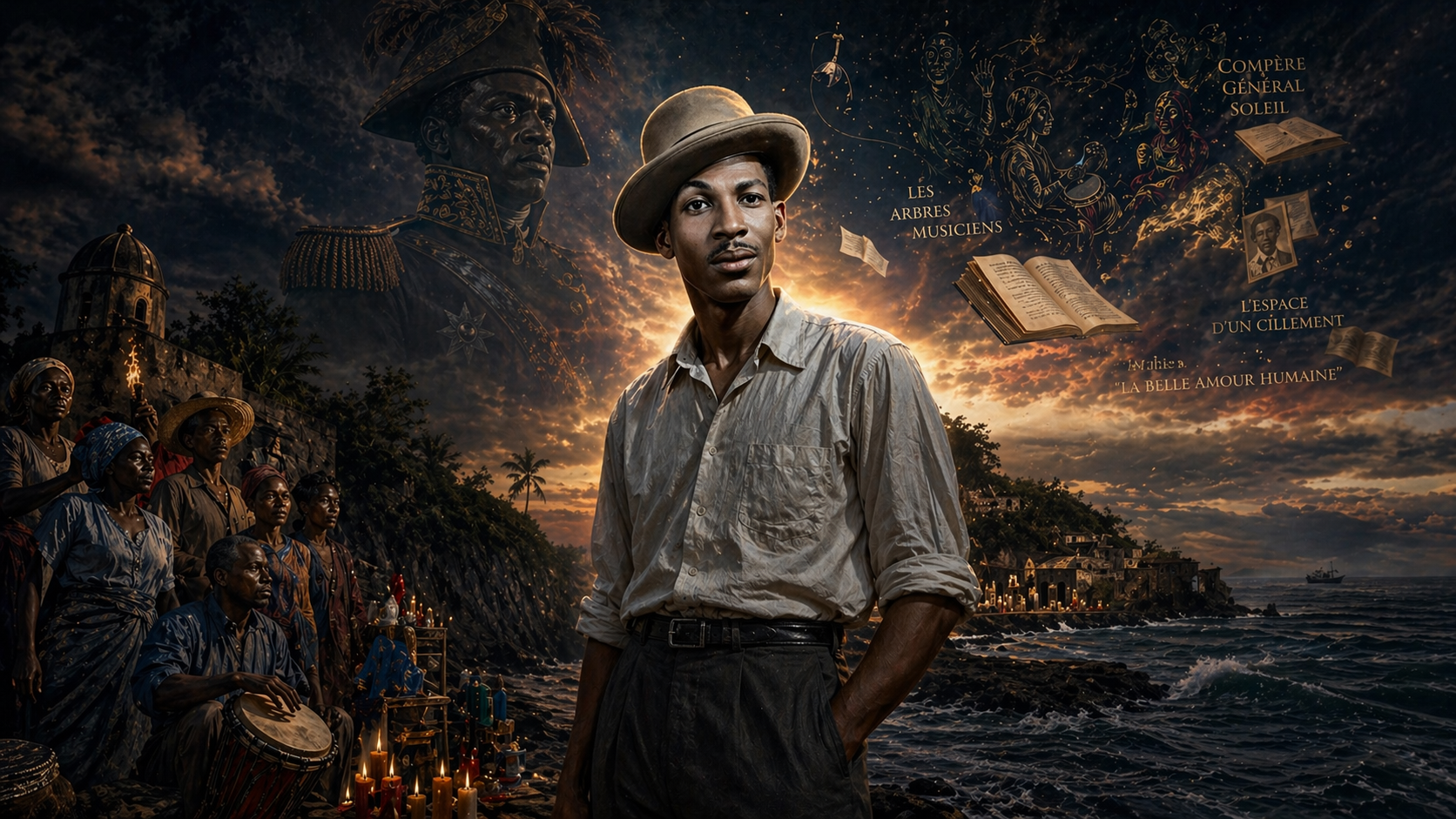
As a literary figure, Alexis is most famous for his four major novels: Compère Général Soleil (1955), Les Arbres musiciens (1957), L’Espace d’un cillement (1959), and Romancero aux étoiles (1960). He was a primary theorist of “marvelous realism” (réalisme merveilleux), a specifically Haitian aesthetic that sought to capture the country’s unique cultural and social realities.
Marvelous realism blends poetic intensity with social realism, grounding itself in the daily lives, struggles, and agency of the peasantry and the “little guy.” Alexis “Haitianized” modern fiction by integrating national traditions such as the lodyans (storytelling), folk songs, Vodou, and Haiti’s African and Amerindian heritage. His prose is known for its sensory richness: sight, sound, smell, touch, and taste are mobilised to carry the reader through emotional journeys and “ecstasies of joy,” even as he confronts exploitation, poverty, and state violence. Through this framework, Alexis became a central figure of the mid‑twentieth‑century Haitian intelligentsia, using literature to interpret the political ferment of his time.
Revolutionary politics and “Human Love”
Alexis was equally committed to revolutionary politics, drawing heavily on Marxism and the example of earlier Haitian intellectuals like Jacques Roumain. In 1946, he helped lead a successful student strike that, in alliance with workers and civil servants, contributed to the overthrow of President Élie Lescot. Later, in 1959, he founded the People’s Consensus Party (PEP), a left‑wing organisation created to oppose the dictatorship of François “Papa Doc” Duvalier. This act of political defiance led to his persecution and exile, during which he travelled to Moscow and China to represent Haitian communists and meet leaders such as Mao Zedong.
His 1960 letter to Duvalier, written from Pétion‑Ville, is one of the most important documents of Haitian intellectual resistance. In it, he asserts his right to live and work in his homeland as a descendant “by two lines” of Dessalines, insisting that “my dead sleep in this land; the soil is red with the blood of generations of men who bear my name.” He explains that although many countries would build “golden bridges” for him as a neurologist, he chooses to remain in Haiti because authentic creation requires daily contact with those whose hands are calloused by labour. Declaring himself “a child of the future,” Alexis refuses intimidation and affirms that he has not been “accessible to the sentiment called fear,” having “looked death in the eye without blinking.”
This letter crystallises his ethics of “Human Love” (La Belle Amour Humaine): a humanism grounded not in abstraction, but in solidarity with workers, peasants, youth, and all those who “suffer, fall, hope, and still believe.”
Martyrdom at Môle‑Saint‑Nicolas
Alexis’s resistance culminated in April 1961, when he attempted a clandestine return to Haiti by landing at Môle‑Saint‑Nicolas with a small group of supporters, intending to launch an uprising against the Duvalier regime. He was quickly captured by the Tonton Macoutes and government soldiers, tortured—including the reported puncturing of an eye, a grim irony in light of his line, “When one gets to a one‑eyed people country, one closes one eye”—and killed. His burial site remains unknown.
In death, he joined the long list of Haitian martyrs whose bodies disappeared into the state’s terror, but whose names entered the country’s living memory. His life and work have since served as a symbol of Haitian cultural nationalism and resistance.
Legacy, celebration, and enduring relevance
One of Alexis’s famous quotes is: “The trees fall from time to time, but the voice of the forest never loses its power. Life begins.” He understood from Haitian history and from his own lineage that great people had fallen—Louverture, Dessalines, countless unnamed militants—and that he too might fall. Yet he also knew that the forest endures when the trees are cut down: his voice lives on through his people, through the “little guy” and the peasantry whose lives and struggles he placed at the centre of his work.
Today, Jacques Stephen Alexis is honoured in Haiti as a national heritage figure and standard‑bearer of the country’s culture, a living “voice of the forest” that refuses to be silenced. His legacy is sustained through government initiatives, educational campaigns, and commemorative events that emphasise his humanism, activism, and patriotism. In 2022, the centenary of his birth was marked by a year‑long series of celebrations centred on his essay “La Belle Amour Humaine,” including tributes organised by the Ministry of Culture and Communication and the Ministry of National Education to ensure that his work reaches new generations.
In his birthplace of Gonaïves, April 22 has been observed as “General Compère Soleil Day,” drawing hundreds of people to honour his literary contributions. His memory is also kept alive through theatrical representations, religious ceremonies, international colloquia, and symbolic gestures such as young people laying wreaths at his family residence, given the persistent mystery surrounding his burial site. Internationally, his standing was further affirmed in 2018, when he posthumously received the first Jean d’Ormesson literary award in Paris for his novel In the Flicker of an Eyelid.
Haitian intellectuals and the wider public continue to revere Alexis for his “inclusive lens,” which valued all social classes and sought to redefine the human experience through the perspective of Haiti’s “little people” and peasant culture. In the context of ongoing social and political crises, his calls for collective interest over individualism, his insistence that “life begins” even after loss, and his commitment to “Human Love” remain urgently relevant. His humanist vision—“Happy new year to my friend Humankind!” and blessings to all who “suffer, fall, hope, and still believe”—remains a living resource for those seeking solidarity, social justice, and a decolonial re‑imagining of the human from the vantage point of Haiti’s “little people.”
Source:
Escola, Marc, “Revisiting the works and ideas of Jacques Stephen Alexis (Port-au-Prince)”.
Haiti Support Group, “Alexis, Jacques Stephen”.
Haiti Then and Now (HTN), “Day 21 in Haitian Heritage Month: (Jacques Stéphen Alexis, Famous Haitian Writer, Medical Doctor, and Marxist Who Challenged the Duvalier Regime)!”.
International Magazine Kreol, “Jacques Stephen Alexis – Haitian Author and Political Activist”.
Joseph, Murdith, “A century later, Haitian writer Jacques Stephen Alexis’ works still resonate – The Haitian Times”.
Liverpool University Press.
Mail King Viv, “Jacques Stephen Alexis: Haitian Political Writer”.
UM Libraries Digital Exhibits, “Jacques Stéphen Alexis, 1922-1961. Haitian novelist, essayist, activist, and neurologist”.
University of Miami Libraries, “Remembering Jacques Stéphen Alexis: A Centenary Celebration”.
Wikipedia, “Jacques Stephen Alexis”.