
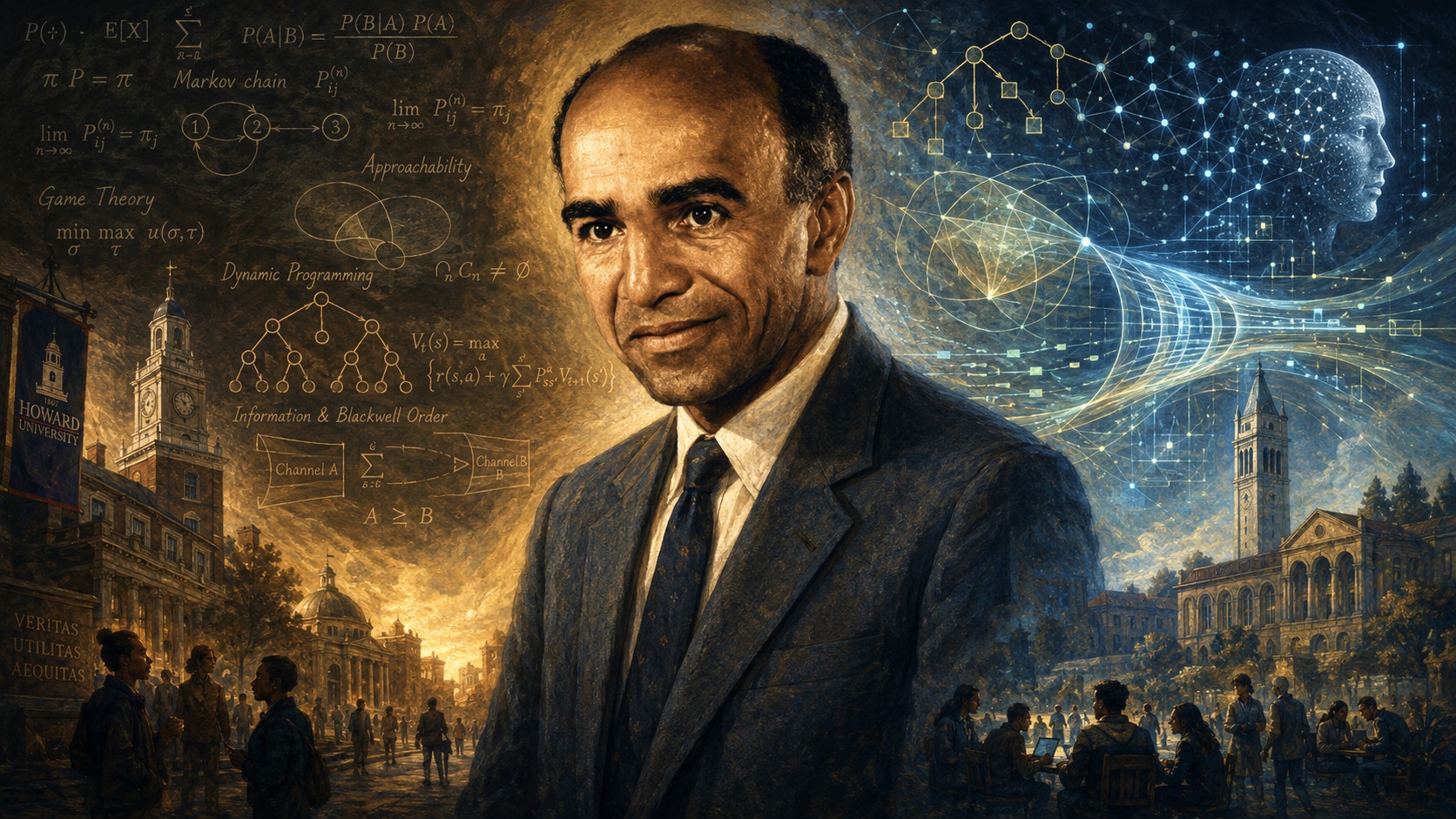
David Harold Blackwell (April 24, 1919 – July 8, 2010) was an American statistician and mathematician whose groundbreaking work in game theory, probability theory, information theory, and statistics shaped the foundations of modern science. Over the course of his career, David Blackwell shattered barrier after barrier, amassing a remarkable list of historic firsts that underscore both his extraordinary intellect and the entrenched obstacles he faced. He was the first African American inducted into the National Academy of Sciences in 1965, breaking a barrier that had long stood in American science. At UC Berkeley, he made history as the first African American to hold a tenured full professorship, further expanding the frontiers of academic inclusion. He was only the seventh African American ever to earn a Ph.D. in mathematics. He was also the first Black person to be named a Fellow of the American Statistical Association. In 2012, President Barack Obama posthumously awarded him the National Medal of Science, the nation’s highest scientific honor, in recognition of his legacy.
Blackwell never wrote a line of code, designed an algorithm, trained a neural network, or built a chatbot. Yet when NVIDIA—the world leader in artificial intelligence—needed a name for its most advanced computing architecture, they chose his. This was not a symbolic gesture or an act of charity, but a powerful acknowledgment: the very mathematics that underpins modern AI rests, in significant part, on the work of a Black man from Centralia, Illinois. Coming of age during the era of American apartheid, Blackwell broke barriers at every turn, leaving behind theorems so elegant and influential that the digital future could not escape their reach.
David Harold Blackwell was born on April 24, 1919, in Centralia, Illinois, and displayed remarkable intellect from an early age. Twice promoted ahead of his peers, Blackwell completed his bachelor’s, master’s, and doctorate in mathematics at the University of Illinois at Urbana-Champaign by the age of twenty-two. In 1941, he became only the seventh African American in history to earn a doctorate in mathematics. This achievement unfolded during the height of Jim Crow, when the country’s most esteemed institutions were still unwilling to reconcile their lofty ideals with the realities of segregation. Although Blackwell was awarded a fellowship at the Institute for Advanced Study in Princeton, Princeton University barred him from its campus. He found himself a fellow at the institute that overlooked the university, looking down on Princeton yet never welcomed into the campus below. Undeterred, Blackwell pressed forward, forging his own path.
After his fellowship, Blackwell joined the faculty at Howard University, the renowned historically Black institution in Washington, D.C. Over the next decade, he rose to full professor and became Chair of the Department of Mathematics. At Howard, Blackwell distinguished himself as a gifted teacher and mentor, nurturing generations of students while advancing his own groundbreaking research. His quiet, relentless brilliance and his genuine delight in the beauty of mathematics inspired all who studied with him.
Blackwell’s next chapter was groundbreaking. In 1954, he joined the faculty at the University of California, Berkeley, becoming the first African American to earn a tenured full professorship there. This achievement resonated far beyond his own career, marking a significant milestone for all Black scholars who had been denied entry into elite academic spaces. Blackwell would later serve as Chair of the Department of Statistics and remain at Berkeley for the rest of his distinguished academic career.
Blackwell’s scholarly output was nothing short of transformative. His pioneering contributions to probability theory, mathematical statistics, game theory, and information theory now form a vital part of the foundation upon which the modern AI revolution stands.
The Rao–Blackwell Theorem
Blackwell’s most celebrated achievement, developed in collaboration with C. R. Rao, is the Rao–Blackwell Theorem. This foundational result provides a systematic way to improve statistical estimators by conditioning them on sufficient statistics, thereby reducing prediction variance and increasing accuracy. Its impact is far from historical trivia: the theorem is woven into the fabric of modern machine learning, where minimizing error and enhancing predictive power are central challenges. Every AI system striving to learn from data and reduce its mistakes owes a conceptual debt to the path first mapped by Blackwell and Rao.
Dynamic Programming and Reinforcement Learning
Blackwell also independently devised key ideas in what is now known as dynamic programming—a strategy for making optimal decisions across a sequence of steps by working backward from a desired outcome and allocating rewards or penalties along the way. This approach is the mathematical backbone of reinforcement learning, a field that empowers AI systems to master games, drive vehicles, manage resources, and tackle complex physical tasks through feedback and adaptation. The sequential decision-making framework he helped pioneer remains at the heart of intelligent machines today.
The Approachability Theorem
In competitive settings—where multiple agents pursue their own goals amid uncertainty—Blackwell’s Approachability Theorem ensures that an agent can systematically move closer to a desired outcome over time. This result is foundational for adversarial machine learning, multi-agent systems, and the design of robust AI agents operating in unpredictable environments. It offers a mathematical promise: intelligent agents can, through learning, succeed even in the face of opposition.
Bayesian Statistics and the Blackwell Order
A committed Bayesian, Blackwell worked within a tradition that treats probability as a measure of belief, one that evolves as new evidence emerges. His 1969 textbook Basic Statistics was among the first to introduce Bayesian methods to a broad audience. Blackwell helped lay the philosophical and technical groundwork for modern AI systems that must reason under uncertainty, quantify their confidence, and update their models in light of new data. His collaboration with David Freedman and others on information ordering produced what is now known as the Blackwell Order, a framework for formally comparing information sources—a concept more vital than ever in the data-driven age of AI.
Game Theory and Statistical Decision Theory
With Meyer Girshick, Blackwell co-authored Theory of Games and Statistical Decisions (1954), a text that forged the mathematical links between statistical reasoning and strategic choice. This work placed Blackwell at the crossroads of game theory and statistics, building the theoretical backbone that would support the rise of computer science and, ultimately, the algorithms that power modern artificial intelligence.
The Man Behind the Work
Those who knew Blackwell remembered him as warm, generous, and animated by a deep joy for ideas. Despite the formidable barriers he broke, he carried no bitterness—only an infectious enthusiasm for the beauty of mathematics. He delighted in the pleasure of discovery, whether it was the elegance of a clean proof or the thrill of linking distant concepts in unexpected ways. As a mentor, he guided generations of students—many of them students of “melanin”—at a time when such guidance was both uncommon and vitally important.
In 1944, Blackwell married Ann Madison, and together they raised eight children—a testament to his devotion as a family man, which matched his dedication to scholarship. He passed away in Oakland, California, on July 8, 2010, at the age of ninety-one. Only in recent years have the full contours of his legacy come into focus, as the AI community and the broader world have begun to truly appreciate the depth and reach of his contributions.
NVIDIA Names Its Future After Him
In March 2024, NVIDIA introduced the Blackwell GPU architecture—its most advanced computing platform to date—in a tribute to David Blackwell’s enduring influence. NVIDIA CEO Jensen Huang made the motivation clear: “This GPU is named after David Blackwell, an American mathematician and statistician whose work has had a lasting impact in mathematics as well as the specific domain of AI.”
The Grace Blackwell superchip, which fuses NVIDIA’s Grace CPU with the Blackwell GPU, is designed to drive AI models comprising more than a trillion parameters. These are the very generative AI, deep learning, and large language model workloads that trace their roots to the mathematical foundations Blackwell established decades ago. It is a profound irony, and a mark of progress, that the chip powering today’s AI revolution bears the name of a man who, not so long ago, was denied entry to university campuses.
Lisa Blackwell, his granddaughter, has spoken movingly about the moment she realized the vast reach of her grandfather’s legacy: how so much of what we now call artificial intelligence is built upon the theorems he proved with pencil and paper in the mid-twentieth century—at a time and in a country that too often failed to recognize his humanity.
The Legacy That Could Not Be Contained
A 2026 arXiv survey, “The Theorems of Dr. David Blackwell and Their Contributions to Artificial Intelligence,” draws direct connections from three of Blackwell’s foundational results—the Rao–Blackwell theorem, the Approachability theorem, and the Blackwell Informativeness theorem—to the core of today’s artificial intelligence. Modern methods such as Markov Chain Monte Carlo inference, reinforcement learning from human feedback (RLHF), large language model alignment, and autonomous robot navigation all build on the groundwork Blackwell established. These are not mere historical curiosities, but vital methodologies that actively shape how AI researchers and engineers create systems that are ever more precise, adaptive, and robust.
But Blackwell’s legacy extends far beyond mathematics. It thrives in the institutions, honors, and commemorations that bear his name. Each year at MathFest, the Mathematical Association of America and the National Association of Mathematicians present the MAA–NAM David Blackwell Lecture—a tradition begun in 1994, with Blackwell delivering the first address himself. This series honors not only scholarly achievement, but also the spirit of mentorship and service that defined Blackwell’s career, turning the lecture into a living tribute to his intellectual and ethical example.
His influence is woven into the very structures of recognition in mathematics. The Blackwell–Tapia Prize, named for both David Blackwell and Richard A. Tapia, honors mathematicians who pair research excellence with mentorship, leadership, and service to underrepresented communities. Through this prize, Blackwell’s name has become synonymous not only with intellectual brilliance but with the responsibility to open doors for others and to expand opportunity where it has been lacking.
At Berkeley—the institution where Blackwell shattered one of academia’s most visible racial barriers—his legacy is now etched into the campus itself. In 2018, the university opened David Blackwell Hall, an undergraduate residence that weaves his story into the daily routines of new generations. For many students, Blackwell’s name is first encountered in campus life, only later revealed as belonging to one of the architects of modern statistics and probability.
Blackwell’s story also lives on in public history and cultural memory. In 2019, the educational book “David Blackwell and the Deadliest Duel” introduced his life and ideas to younger readers, while his granddaughter Leeza Blackwell began production on a documentary film, “Game of Genius.” This growing recognition signals a vital shift: Blackwell is emerging from the confines of specialist circles and taking his place in the wider narrative of genius, resilience, and transformative thought.
At the core, Blackwell’s genius tackled three challenges that still define artificial intelligence: using information efficiently, making optimal decisions under uncertainty over time, and discerning the value of different information sources. He pursued these truths not for future technologies, but for the sake of knowledge itself. That is why his legacy has escaped every boundary—racial, disciplinary, or historical—that might have contained it. Today, Blackwell’s ideas move through the world as theorems, as living traditions in academia, as names on awards and halls, as stories in books and film, and as the silent logic animating the intelligent machines that shape modern life.
Source:
https://en.wikipedia.org/wiki/David_Blackwell
https://arxiv.org/abs/2604.06621
https://www.theactuarymagazine.org/from-markov-chains-to-ai/
https://thedig.howard.edu/all-stories/dr-david-harold-blackwell-enduring-legacy-howard-luminary-age-ai
https://ima.org.uk/11670/david-blackwell-centenary/
https://mathshistory.st-andrews.ac.uk/Biographies/Blackwell/
https://math.illinois.edu/david-blackwell
https://senate.universityofcalifornia.edu/_files/inmemoriam/html/davidharoldblackwell.html