
“I am Toussaint Louverture; perhaps my name has made itself known to you. I have undertaken vengeance. I want Liberty and Equality to reign in Saint‑Domingue. I am working to make that happen. Unite yourselves to us, brothers, and fight with us for the same cause.”
From the cane fields of Bréda to the snowbound walls of Fort de Joux, the life of François‑Dominique Toussaint Louverture spans one of the most dramatic arcs in human history. Born in chains, he would become the commanding genius of the Ayitian revolution, a strategist who shattered an old order built on captivity and announced to the world that Black humanity would no longer bow. Sudhir Hazareesingh calls him “the first Black superhero of the modern age,” and Haitians remember him as le Précurseur – the precursor – the one who opened the path along which others would march to Ayiti’s full independence.
Roots of a future commander
Toussaint’s beginnings were humble yet marked by an ancestral nobility. He first drew breath on the Bréda plantation at Haut‑du‑Cap, sometime around 20 May 1743, bearing the name Toussaint Bréda. His father, Hyppolite – Gaou Guinou – was remembered in family tradition as a prince or high official from Allada, in the region later known as the Slave Coast; captured in war and carried across the Atlantic, he brought with him the memory of a royal house and a sense of dignity that he transmitted to his son. His mother, Pauline, came from the Aja people, embedding in Toussaint a double inheritance from the kingdoms of West Africa.
Baptised in the Catholic Church under the guidance of Jesuits, Toussaint grew up between African memory and European scripture. His godfather, Pierre‑Baptiste Simon, a carpenter and gatekeeper on Bréda, arranged for the boy to work in a hospital refectory, where priests taught him French and catechism. Physically slight – nicknamed Fatras‑Bâton, the “little stick” – he possessed instead a formidable inward strength: a hunger for books, a keen eye for landscapes and animals, and a listening ear for the wisdom of elders.
Recognised for his skill with horses, he was taken out of the cane rows and trained as an equestrian and coachman. He learned to ride with extraordinary mastery, earning the legend of the “Centaur of the Savannas” who could cross a raging river standing upright on his mount. Under Bayon de Libertat, the plantation manager, Toussaint became steward of Bréda and transformed it into one of the most productive estates in northern Saint‑Domingue. People in the region coined a saying – “wise as Toussaint” – acknowledging his prudence and intelligence across lines of colour and status.
By the late 1770s, Toussaint obtained his freedom and entered the fragile stratum of free Black Ayitians. He married Suzanne Simone Baptiste, adopted her son Placide, and fathered sons Isaac and Saint‑Jean; in later years he would tell his captors that he had fathered sixteen children, eleven already gone before him. He rented land, acquired modest property, and moved in the ambiguous space between those still held in captivity and the class of free people of African descent, learning to navigate the fault lines of a violent society.
A world built on captivity
The Saint‑Domingue into which Toussaint matured was the most lucrative territory in the Americas. This “Pearl of the Antilles” supplied close to forty percent of Europe’s sugar and more than half its coffee, feeding insatiable appetites in Paris, London, and beyond. Its shimmering wealth rested on the bodies of hundreds of thousands of Ayitians held in captivity, who laboured under a regime of terror in cane fields, coffee slopes, and boiling‑houses. A rigid hierarchy separated French grands blancs and petits blancs, free people of African descent, and the vast majority in chains; skin itself became an “aristocracy,” a ladder of rights and humiliations.
When the Bastille fell in 1789, and the French Revolution proclaimed liberté, égalité, fraternité, those words traveled across the ocean like a spark through dry cane. Free people of African descent demanded recognition of their rights; white planters demanded autonomy and more control over Ayitians; different factions armed themselves with the language of rights while clinging to their privileges. Underneath them all, Ayitians in captivity listened, remembered their own ancestral covenants, and waited.
The night of fire
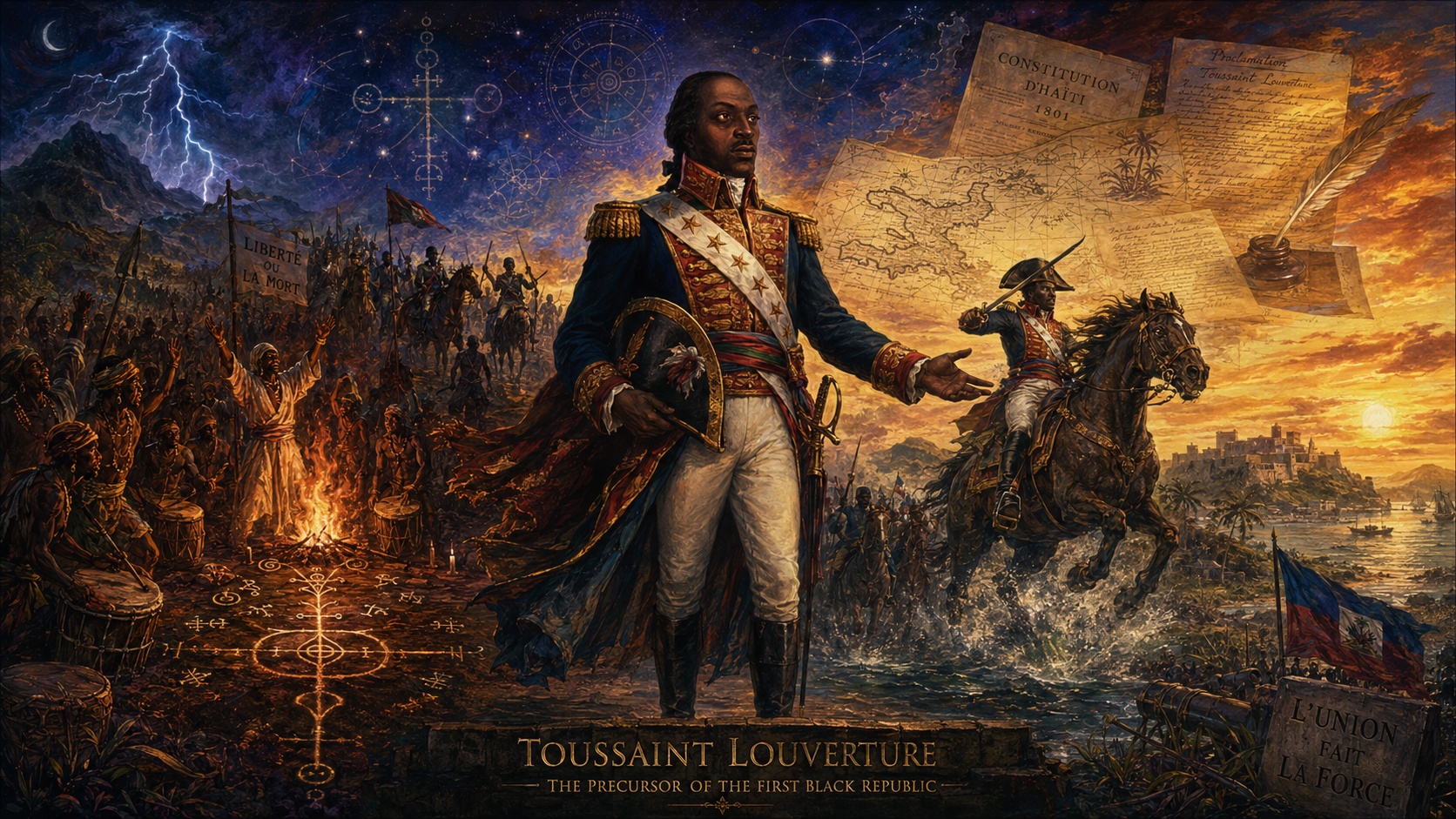
The waiting ended in August 1791. In the hills above the plantations, at a place remembered as Bois Caïman, Ayitian leaders gathered under a stormy sky to swear an oath. The priest Boukman Dutty invoked the God who saw their suffering and called them to stand up; a pig was sacrificed, drums beat, and a vow was made to overturn the old order. Within days, coordinated uprisings swept across the Northern Province: cane fields burned, plantation houses fell, and captors who had long wielded the whip now felt the steel of retribution.
At first, Toussaint moved cautiously. He secured his family’s safety, and according to later accounts, he helped protect Bayon de Libertat and his household, sending them to refuge. Only after these bonds were honored did he step fully into the uprising. Bringing with him his knowledge of herbs, discipline, and logistics, he joined the forces of Georges Biassou and Jean‑François Papillon as a healer and organizer – the médecin général of the insurgent army. Very quickly, his talents as a strategist shone: from a scattered uprising he forged units of thousands, drilled them, and taught them to move with speed and precision through sugar, mountain, and marsh.
“I have undertaken vengeance”: the first proclamations
Out of the smoke of burning plantations, Toussaint’s voice began to speak. On 29 August 1793, he issued a proclamation to Ayitians and to the world:
“I am Toussaint Louverture; perhaps my name has made itself known to you. I have undertaken vengeance… I want Liberty and Equality to reign in Saint‑Domingue.”
In this text, he addressed “Brothers and Friends,” announcing that the age of submission had ended and that he had taken up the cause of his people. He insisted that liberty and equality were indivisible, that “equality cannot exist without liberty,” and that for liberty to endure Ayitians must stand as one. In letters to the French, he rejected the idea that any law could turn a human being into property, declared that it was not a crime to be born Black, and denounced the “aristocracy of skin” that had justified so many abuses. He argued instead that all were “men … made like” their captors and free by natural right – words that echoed, yet exceeded, European Enlightenment declarations.
The opening: from Spanish banners to French colors
In the early years of the Revolution, the island was a chessboard of nations. Spain, which held the eastern part of Hispaniola, went to war with France and offered freedom to Ayitians who would fight under its flag. Toussaint accepted Spanish commission, becoming a brigadier of the tropas auxiliares, commanding Ayitian troops in campaigns against the French. It was in this period, around 1793, that he began to sign himself “Louverture” – “the opening” – a name that captured his ability to pierce enemy lines and, perhaps, the spiritual gate‑opening associated with Papa Legba in Ayitian religious imagination.
Yet Toussaint’s allegiance was never simply to a crown; it was to freedom. When, under immense pressure from Ayitian arms, French commissioner Sonthonax proclaimed the end of the Maafa in Saint‑Domingue, and when the National Convention in Paris extended that decree to all French territories in February 1794, the balance shifted. In May 1794, Toussaint performed what contemporaries called a volte‑face: he left the Spanish service and brought his seasoned Ayitian army over to the French Republic, stating that he could not fight against a political order that now recognized the freedom of his people.
From that point, he rose swiftly. General Étienne Laveaux, recognizing his indispensable role, promoted him and later named him Lieutenant‑Governor of the colony. “After God, Laveaux,” Toussaint said, acknowledging the alliance; Laveaux, in turn, hailed him as the “Black Spartacus.” By 1797, no other commander in Saint‑Domingue matched his authority.
Wars on all fronts
The late 1790s were years of war on every horizon. British forces, dreaming of capturing the island and re‑imposing captivity, landed tens of thousands of soldiers; disease and Ayitian resistance would ultimately destroy them. Toussaint met this threat with relentless campaigns, combining pitched battles with scorched‑earth tactics, and in 1798, he negotiated a withdrawal that humiliated his enemies and preserved Ayitian gains.
Within Ayiti, he faced another rival in André Rigaud, the powerful leader of the southern, mixed‑race forces. Their conflict, remembered as the War of the Knives (1799–1800), pitted different visions of Ayitian society against one another. With Jean‑Jacques Dessalines as his hard‑edged lieutenant and the quiet support of the United States Navy, Toussaint emerged victorious. Rigaud fled to France, and the southern region was brought under Toussaint’s rule.
When these wars ended, Toussaint stood as the uncontested leader of Saint‑Domingue. Foreign nations had been repelled; internal opposition had been broken; Ayitian arms had proved themselves capable of defeating the might of Europe.
Governor of an island and the law of 1801
With military victory came the task of building a new order. Toussaint understood that liberty without structure could be short‑lived, especially with hostile forces watching for any weakness. In January 1801, he marched east, into Spanish Santo Domingo, united the island under his command, and ended the trafficking in human beings there, extending freedom to thousands more who had been held in captivity.
On 7 July 1801, he presided over the promulgation of a constitution for Saint‑Domingue. This document, the first in the Americas to permanently end captivity, declared that “there cannot exist [people held in bondage] in this territory; servitude is therein forever abolished,” and affirmed that all inhabitants were free and – in a complex gesture – French. It recognized Catholicism as the official religion, protected individual rights, and named Toussaint Governor‑General for life, with the right to choose his successor. Formally, Ayiti remained within the French sphere; practically, it had become an autonomous Ayitian polity, governed by its own laws and armed forces.
Toussaint’s governance reflected his formation: steeped in Enlightenment texts and Catholic ethics, shaped by African traditions, and tempered by the harsh realities of plantation economies. He believed that for freedom to endure, the land had to produce; he therefore required Ayitians, now no longer in legal captivity, to return to plantations as paid “cultivators,” under a disciplined regime enforced by military officers. “Without work, there can be no freedom,” he insisted, a phrase that revealed both his determination to prevent economic collapse and the authoritarian edge that would haunt his legacy. Many Ayitians chafed under this system, longing for smaller plots, village life, or maroon freedom rather than regimented plantations.
The gathering storm: Napoleon’s ambition
Thousands of kilometers away, in Paris, another man of destiny watched these developments with suspicion. Napoleon Bonaparte, First Consul of France, read the 1801 Constitution as a challenge to his authority. For him, Saint‑Domingue was not a community of free Ayitians but a key pillar in his grand design for a renewed French empire in the Americas; its sugar and coffee revenues would, he believed, fund his wars.
In 1802, he dispatched a massive expeditionary force – around forty‑three thousand soldiers and sailors – under his brother‑in‑law, General Charles Leclerc. Their mission was to reassert French control, remove Toussaint, and, though this was not openly stated at first, reverse the gains of the Ayitian revolution.
When the French fleet appeared off Cap Français, Toussaint’s lieutenant Henri Christophe answered with fire, torching the city rather than surrendering it. Thus began a war of national resistance: fortified posts like Crête‑à‑Pierrot held off repeated assaults; Ayitian fighters used the mountains, ravines, and fevers of the land itself as allies; French regiments, unaccustomed to the climate, fell in their thousands to yellow fever.
Yet the campaign also exposed fissures. Some Ayitian officers, including Christophe and Dessalines, shifted their allegiance, at least temporarily, to the French, swayed by promises or exhausted by devastation. By mid‑1802, the country was scarred and its people weary. Toussaint, seeking to preserve what he could, agreed to lay down arms in exchange for guarantees that freedom would be respected and that his officers would retain rank. He retired to his estate at Ennery, hoping perhaps to live out his days in quiet cultivation.
Betrayal and the road to Fort de Joux
The promise was a trap. In June 1802, General Jean‑Baptiste Brunet invited Toussaint to a meeting under the pretext of discussing local administration. When Toussaint arrived, he was seized, bound, and carried to the waiting ship Le Héros. As he was forced aboard, Toussaint turned to his captors and spoke the words that would echo through centuries:
“In overthrowing me, you have done no more than cut down the trunk of the tree of liberty in Saint‑Domingue; it will spring back from the roots, for they are numerous and deep.”
Those roots were the Ayitian people themselves, whose memory of captivity and resistance could not be uprooted by the deportation of a single leader.
The ship bore him away from the tropical landscapes he had known all his life to the cold, stony fortresses of eastern France. At Fort de Joux, perched in the Jura Mountains near the Swiss border, he was locked in a damp cell with a bricked‑up window, denied regular firewood, clothing, or medical care. Guards interrupted his sleep, and his faithful servant Mars Plaisir was removed from him.
Even in that cell, Toussaint wrote: letters to Napoleon defending his conduct, explanations of his actions, protests at his treatment. “But my colour, my colour, has it ever prevented me from serving my country with diligence and devotion?” he asked, exposing the racism at the core of his fall. No answer came. On 7 April 1803, weakened by cold, hunger, and neglect, he died, his lungs filled with blood, “without a friend to close his eyes.” Nine months later, Ayiti would stand as an independent republic.
After the precursor: Ayiti arises
With Toussaint removed, Napoleon believed the path was clear. But his expedition had already sown its own defeat. The betrayal of the Ayitian general, combined with the reimposition of captivity in other French territories, convinced those who remained that no compromise with France was possible. Jean‑Jacques Dessalines, Henri Christophe, and other commanders re‑entered the struggle with a new, uncompromising aim: complete separation.
The war that followed was total. French troops, ravaged by fever and guerrilla attacks, retreated step by step. On 18 November 1803, at Vertières, Ayitian forces delivered the final crushing blow. On 1 January 1804, in Gonaïves, Dessalines proclaimed the birth of a new nation, taking the Taíno name Ayiti to mark the break from the old order. The world’s first Black‑led republic, founded by Ayitians who had broken their chains and defeated a European empire, stepped onto the stage of history.
In Ayitian memory, Toussaint is honoured as le Précurseur – the one who prepared the ground – while Dessalines is hailed as Liberator. One opened the path; the other completed the march. Together, they and their comrades transformed a rising of people in captivity into a revolution that permanently altered the Atlantic world.
Thought, faith, and contradictions
Toussaint’s mind was as complex as the times through which he moved. He read classical histories, Enlightenment philosophy, and the fiery pages of the Abbé Raynal, who had imagined a “Black Spartacus” rising to avenge his people. He meditated on Catholic teachings, attended Mass, and used biblical cadences in his proclamations, yet he also spoke the language of natural rights and universal humanity. In this fusion of African inheritance, European texts, and Ayitian experience, he forged a distinctive political imagination.
Historians and Ayitian thinkers have long debated his contradictions. He articulated a radical vision of Black dignity, denounced the “aristocracy of skin,” and insisted that no human could rightfully be held in captivity. Yet as governor he enforced labour regimes that many Ayitians experienced as a continuation of plantation violence under new names. He remained formally attached to France, stopping short of a full declaration of independence even as he drafted an autonomous constitution and commanded a de facto sovereign state.
C. L. R. James saw in this hesitation his “tragic error”: a faith that the French Republic could be a partner in Black freedom, long after its own leaders had turned away from their most radical promises. Others, like Hazareesingh, read Toussaint’s universalism as a powerful counter‑vision to both European racism and narrow nationalisms, an example of how Black revolutionary thought could remake the meaning of citizenship itself.
Echoes across the Black Atlantic
Toussaint’s life did not end at Fort de Joux; it reverberated across oceans. News of Ayiti’s uprising and of his leadership reached communities from Charleston to Bahia, from London docks to West African coastlines. Frederick Douglass later hailed him as one of the great heroes of the age; Marcus Garvey ranked his brilliance above Cromwell, Napoleon, and Washington. Aimé Césaire devoted a book to him, arguing that it was in Ayiti that Blackness first stood and proclaimed faith in its own humanity.
C. L. R. James’s The Black Jacobins placed Toussaint at the heart of a global history of revolution and emancipation, making his story essential reading for generations of anti‑colonial activists. Artists, too, seized on his image. Jacob Lawrence’s 1938 series painted his journey in bold, angular scenes; Haitian artist Edouard Duval‑Carrié surrounds him with luminous colours and spirits, exploring “Creole republicanism” and alternative futures in works like Mémoire sans Histoire, Maroon Republicaine, and Creole Republicaine. Because no authenticated portrait survives, every depiction of Toussaint is, in a sense, an act of imagination – a reminder that his figure remains open, like his name, an “opening” through which each era rethinks freedom.
The consequences of his struggle extended into geopolitics. Napoleon’s failure in Ayiti led him to abandon his American ambitions and sell the Louisiana Territory to the United States, doubling its size. Ayiti’s example inspired conspiracies and uprisings across the Caribbean and the Americas; captors invoked it in fear, while Ayitians and their descendants invoked it in hope.
Epilogue: the opening remains
From the cane rows of Bréda to the courts of Paris, from the battlefields of Crête‑à‑Pierrot to the stone chill of Fort de Joux, Toussaint Louverture walked a path only a few in any century have trod. He turned a rising of people held in captivity into a disciplined revolution; he authored a constitution that made freedom irreversible; he envisioned an Ayitian society where Black dignity was non‑negotiable, even as he wrestled with the demands of labour, production, and survival.
His captors believed they had silenced him when they locked him in a mountain cell far from Ayiti’s shores. Yet his words proved true: the tree they thought they had felled rose again, its roots nourished by the memory of Ayitians who had once been bound and now walked as citizens of their own republic. As long as struggles for Black dignity and universal human worth continue, the opening he carved – the louverture – remains, inviting new generations to step through.
Source:
The Black Jacobins: Toussaint L’Ouverture and the San Domingo Revolution by C. L. R. James
Night of Fire: The Black Napoleon and the Battle for Haiti by Martin Ros
Black Spartacus: The Epic Life of Toussaint Louverture by Sudhir Hazareesingh
https://www.britannica.com/biography/Toussaint-Louverture
https://www.britannica.com/topic/Haitian-Revolution
https://en.wikipedia.org/wiki/Toussaint_Louverture
https://www.jstor.org/stable/j.ctt1pv89b9