
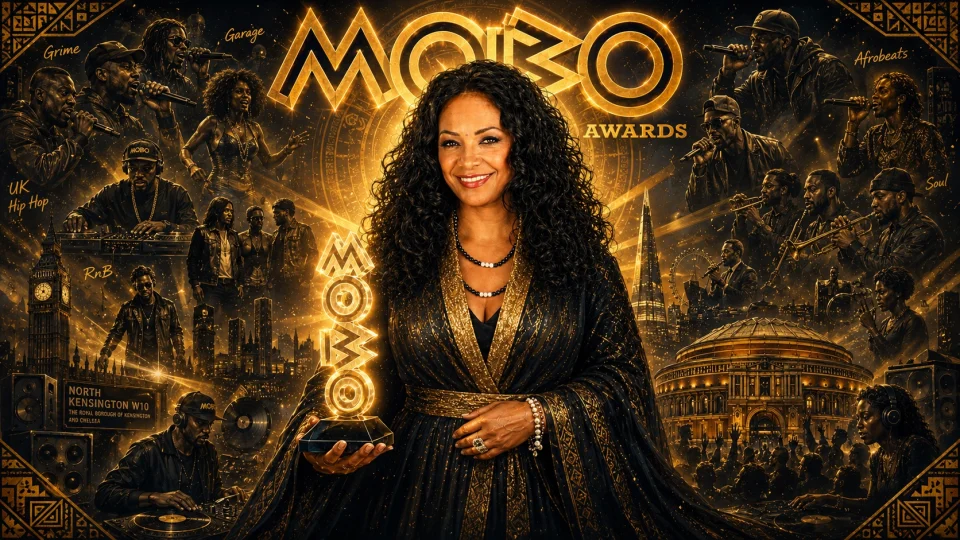
“Thirty years ago, the MOBO Organisation was born out of a desire to create space where there was none — to recognise, celebrate and elevate Black music and culture.”
Kanya King CBE (12 February 1969 – 3 June 2026) was a pioneering British entrepreneur and cultural visionary, renowned as the founder and CEO of the MOBO (Music of Black Origin) Awards.
King was born and raised in Kilburn, North London, the youngest of nine children. Her father, Christian Ocloo, was Ghanaian, and her mother, Mary, was Irish. Her childhood, spent in a crowded council flat, was filled with the warmth of family and friends, yet shaped by profound material hardship and the daily realities of racism and exclusion. Her father, whose strong African accent often made finding work difficult, faced persistent barriers, and the family experienced the structural discrimination common to many mixed-race and immigrant households in Britain during the 1970s and 1980s. A pivotal moment in King’s life occurred when her father died of leukaemia when she was just thirteen. Before his passing, he urged her to “be the best you can be”—a simple but powerful message that became her guiding mantra. In the years that followed, King attributed her ambition, her refusal to accept low expectations, and her determination to build something extraordinary from adversity directly to her father’s enduring words.
At sixteen, King became a teenage mother and left school, an experience that left her feeling “written off” by society. A careers adviser once told her that her best hope was to manage a local supermarket, a judgment that reflected the limited imagination others had for a young Black working class single mother. Instead of accepting these limitations, King channeled them into motivation. She later remarked that the experience “put a fire in her belly” and intensified her resolve to prove that a deprived background should never determine one’s potential. From the age of seventeen, she contributed to her family’s finances, determined to become independent and to defy stereotypes about women living on benefits.
Education and Early Professional Formation
Despite leaving school without qualifications, King maintained a deep intellectual curiosity. Unwilling to let teenage motherhood define her future, she eventually resumed her education and secured a place at Goldsmiths, University of London, to study English Literature. Goldsmiths proved to be a transformative chapter in her life. Immersed in the college’s creative and radical intellectual atmosphere, and drawing from her own experiences of marginalization, King developed a keen understanding of how Black artists and communities were systematically excluded from the institutions that shape cultural recognition in Britain.
After graduating, King began working as a television researcher, a role that placed her at the intersection of media, music, and public perception. Simultaneously, she was active as a grassroots promoter, organizing music nights at renowned London venues like the Hippodrome. These experiences gave her a firsthand appreciation for the vibrancy and commercial promise of Black-origin music, even as she witnessed mainstream broadcasters and award shows repeatedly overlook it. The combination of academic insight, behind-the-scenes television work, and practical experience in live music venues uniquely equipped King for the bold move that would define her career.
The Vision for MOBO: Cultural Justice in the Age of Britpop
By the mid 1990s, Britpop dominated British culture. Bands like Oasis and Blur, draped in Union Jack imagery, filled television screens and headlines, while British urban music—rooted in reggae, R&B, hip-hop, gospel, jungle, and emerging Black British genres—remained sidelined. King recognized not just a commercial opportunity but a profound injustice: music that was shaping youth culture and rooted in Black creativity was consistently ignored, marginalized, or even demonized by mainstream platforms.
While working as a TV researcher, King noticed a glaring absence: no mainstream British platform honored this music on its own terms. She envisioned an awards ceremony dedicated to celebrating music of Black origin, aiming to challenge the institutional frameworks that kept these genres invisible. Her goal was to spotlight African and diasporic cultural lineages and the vibrant genres they inspired.
When a broadcast opportunity emerged with Carlton Television, King seized the moment. The timeline was daunting—she had only six or seven weeks to create an entirely new awards show from scratch. Repeatedly, she was told that Black music was “too niche,” that there was no audience, and that the industry simply was not interested. Undeterred, King pressed forward, unwavering in her conviction that the awards “had to exist” and that failure was not an option.
Remortgaging the Home: Risk, Sacrifice and the First MOBO Awards
When King was unable to secure financial backing from broadcasters, labels, or sponsors, she made a decision that would become legendary in British music history: she remortgaged her home to produce the inaugural MOBO Awards. For a single mother who had risen from a crowded council flat to home ownership, this was not an act of bravado but, as King later described, a necessity. She kept the decision from her mother, understanding that her mother’s concern for her security would lead her to urge her not to take such a bold risk.
Working from a makeshift office in her bedroom, King and a small team built the first MOBO Awards from the ground up. In 1996, the inaugural ceremony was held at the New Connaught Rooms in London and broadcast on Carlton Television. The event drew considerable attention, notably with the attendance of then-Leader of the Opposition Tony Blair, who recognized the political importance of a platform showcasing Black British cultural achievement. The first MOBO Award was presented to UK dance act Baby D for Best Dance Act, reflecting both the wide range of genres MOBO would celebrate and its commitment to championing artists previously overlooked by mainstream institutions.
The impact was immediate. Within a year, the ceremony moved to the Royal Albert Hall and quickly became a star-studded fixture on the British cultural calendar. The MOBO Awards attracted international icons such as Destiny’s Child, Janet Jackson, Beyoncé, Rihanna, Tina Turner, and Jay-Z, alongside celebrated British artists like Beverley Knight and Craig David. Described by the organization as an “act of cultural justice,” the MOBO Awards have firmly established itself as a vital and influential force in recognizing Black music and talent.
Crisis, Media Hostility and a Second Remortgage
Despite the early success of the MOBO Awards, King continued to face hostility and the persistent racial dynamics of British media. Sensationalist headlines often misrepresented the event, focusing on unfounded allegations of violence and painting the awards as a source of danger and disorder. In 2002, this negative coverage peaked when the awards were falsely implicated in violence that had, in reality, occurred at an unrelated after-party.
Fearing reputational damage, sponsors withdrew their support, leaving the awards on the verge of collapse. In response, King once again risked her personal security by remortgaging her home to keep MOBO alive. This bold move underscored that MOBO was far more than a business for her—it was a vital cultural mission. King was determined to safeguard the only major British platform celebrating music of Black origin, refusing to let it be destroyed by racism and short-sightedness.
This period of crisis ultimately reshaped public perception. As the awards endured and thrived, King’s story—of a young single mother who twice risked her home to keep MOBO alive—became a powerful symbol of courage and conviction. Her unwavering commitment helped establish her as one of Britain’s most resilient and visionary cultural entrepreneurs.
Building a Global Brand: MOBO’s Expansion and Reach
Over the next three decades, King transformed MOBO into a globally renowned brand. The awards evolved into Europe’s largest urban music ceremony, broadcast on major channels and platforms, ultimately reaching hundreds of millions of viewers in over 200 countries. The show’s journey from Carlton to ITV, Channel 4, the BBC, and international networks mirrored its growing acclaim and recognition of Black British music as a vital force in both national and global culture.
In 2009, King took the awards outside London for the first time, hosting the ceremony in Glasgow. In the years that followed, MOBO travelled to cities including Liverpool, Leeds, Sheffield, Coventry, and Newcastle. This national tour was deliberate: King envisioned MOBO as a truly British institution, not confined to the capital, and wanted communities across the country—especially those with vibrant Black and multicultural populations—to experience the awards firsthand. In early 2026, Manchester hosted the 30th anniversary celebration. King graced the red carpet for her final public appearance, witnessing three decades of achievement come together in a powerful collective celebration.
The roster of artists whose careers were nurtured, elevated, or validated by MOBO is extensive and spans generations. In the UK, it includes Stormzy, Amy Winehouse, Craig David, Emeli Sandé, Tinie Tempah, Little Simz, Skepta, Central Cee, So Solid Crew, Kano, Rita Ora, and many more. Internationally, the awards have honoured icons such as Janet Jackson, Beyoncé, Rihanna, Jay-Z, and Tina Turner. For countless emerging talents, the MOBO stage served as their first major television platform—a space where they saw themselves celebrated rather than sidelined. Stormzy, for example, won his very first award at MOBO, eventually collecting multiple honors and becoming a global icon in his own right.
Beyond the Ceremony: MOBO as Infrastructure
Under King’s leadership, MOBO transformed from a yearly awards show into a vital institution for the Black community and music of Black origin. King insisted that recognition was only the beginning—the platform also needed to deliver concrete pathways, resources, and opportunities.
To that end, she launched and expanded a range of initiatives:
• MOBO Unsung developed into an annual talent competition and artist development program for unsigned and emerging talent, offering mentoring, industry connections, and performance opportunities.
• The MOBO Fringe Festival turned host cities into vibrant cultural hubs, featuring showcases, industry panels, school programs, and youth events alongside the main awards.
• House of MOBO established a year-round creative space where artists could gather, collaborate, and celebrate their work.
• MOBO Help Musicians Amplified, in partnership with Help Musicians, provided grants and mentorship to artists facing financial and structural barriers within the industry.
• MOBO Season, which included MOBOvation Talks and community-focused events, extended the brand’s reach beyond one night, using the platform to celebrate excellence throughout British culture.
• The MOBO Trust supported executive fellowships, training, and development opportunities, formalizing talent support within organizational and corporate contexts.
These initiatives reflected King’s conviction that MOBO’s purpose was not just to hand out awards, but to lay the foundation for lasting Black excellence—by fostering skills, networks, confidence, and institutional support.
MOBOLISE and the Wider Fight Against Underrepresentation
In 2020, King expanded her mission beyond music by launching Mobolise—a platform created to address the stark underrepresentation of Black talent across major sectors of the economy. Recognizing that these challenges extended far beyond stages and studios, she set out to connect Black professionals with opportunities in fields like technology, media, finance, and law.
Mobolise sought to break down systemic barriers by connecting Black professionals and creatives with meaningful opportunities, mentors, and employers committed to genuine diversity. The initiative went beyond individual success—it aimed to reshape boardrooms and decision-making spaces. For King, the message was clear: industries that shape the world should mirror the diversity of the communities they serve. She argued that diverse organizations are more innovative and effective, and that leadership representation is inseparable from equity at all levels.
Mobolise echoed King’s broader public work with organizations like the Creative Industries Council and other advisory bodies. In these roles, she consistently championed structural change, insisting that representation in culture must be matched by inclusion in governance, strategy, and ownership.
As MOBO expanded in scale and prestige, it also faced criticism—especially concerning whom the awards should honor. Some observers contended that when mainstream European artists like Sam Smith or Ed Sheeran won multiple awards, the ceremony risked straying from its original purpose of centering Black artists who were often marginalized. Critics questioned the logic of recognizing established European performers at an event explicitly dedicated to music of Black origin.
King’s response was principled and consistent. She maintained that MOBO recognized genre and musical lineage, not skin color. If an artist’s work was deeply rooted in Black music traditions—whether soul, R&B, gospel, hip-hop, or others—their inclusion aligned with MOBO’s purpose. The event, she argued, was never about separating artists by race but about honoring music born from Black culture, often appropriated or overlooked elsewhere.
Yet, King also listened to the communities MOBO aimed to serve. Over time, the awards sharpened their focus on Black artists in nominations and categories, and expanded into genres like grime, drill, and electronic music—ensuring the platform stayed anchored in contemporary Black creativity. This adaptive approach reflected King’s balance of clear vision and a willingness to evolve alongside her community.
Honors, Recognition and Shifting Perceptions
The scale of King’s contribution to British culture and enterprise was underscored by the many honors she received. She was appointed MBE in 1999 for services to the music industry and elevated to CBE in 2018. Universities awarded her multiple honorary doctorates in fields from business to music and law. She regularly appeared among London’s Most Influential People, Britain’s Most Influential Black People, the country’s 100 most powerful women, and was featured in high-profile initiatives such as the BBC’s inaugural 100 Women.
For her mother, who once worried that Kanya lacked a “proper job,” the turning point came when King received her MBE. A well-known anecdote from the first MOBO Awards recounts her mother asking Tony Blair if he could find Kanya a government job—unaware that her daughter was already building something of equal or greater significance. As honors, media recognition, and the enduring success of the awards accumulated, both family and the public came to appreciate how King’s vision had reshaped the cultural landscape.
Personal Life, Motherhood and the Question of “How”
Behind the public image of an unstoppable entrepreneur was a woman deeply rooted in family and an unwavering work ethic. King was a devoted mother to her son, Jem, whom she had at sixteen. She often recalled how becoming a mother so young fueled her drive for independence and her resolve to create a brighter future for them both.
Some wondered how, given her background, King managed to own a property to remortgage. While specific details are scarce, her story is one of determination: childhood jobs, early entry into the workforce, a refusal to rely on benefits, pursuit of higher education, and steady professional progress in television. This combination of relentless effort and advancement enabled her to secure a home—one she ultimately leveraged to build the MOBO platform. The answer was not a windfall, but years of incremental hard work and a willingness to risk everything when the moment demanded it.
Illness, Health Advocacy and Final Years
In December 2024, while accepting a prestigious LIVEtime Achievement Award, King publicly revealed her diagnosis of stage IV bowel cancer, with a prognosis of as little as six months to live. True to form, she refused to let the illness define her. King told audiences she would not let others set limits on her life—just as she had never allowed them to do so in her career.
Rather than retreating from public life, she used her platform to champion health equity, particularly in Black communities. King encouraged open conversations about health, confronted stigma and fatalism, and urged people to prioritize early detection. Her partnerships with organizations like Prostate Cancer UK reflected her belief that cultural platforms could drive real change in health outcomes—not just in entertainment.
King continued to appear at MOBO events during her illness, including the 2025 ceremony in Newcastle and the 30th anniversary in Manchester. Those who saw her in her final months were moved by the same courage, humor, and determination that had defined her life. When she died peacefully on 3 June 2026, surrounded by family and friends, she was remembered as a woman who “refused to be diminished” by anything—including cancer.
Tributes and the Measure of a Legacy
The response to King’s passing revealed the vast reach of her influence. Musicians, politicians, business leaders, creatives, and community organizers all paid tribute. Artists who grew up watching the MOBO Awards shared how seeing Black music celebrated on primetime television expanded their sense of possibility. Established performers acknowledged that the platform elevated their work and opened doors that might otherwise have remained closed.
Political leaders emphasized her transformative impact on British culture, noting that she “changed the face of culture and music” by creating opportunities where none had existed. Industry colleagues recognized not only her entrepreneurial brilliance but also her moral clarity, describing the creation of MOBO as an act of cultural justice—not merely branding.
Perhaps her family’s words best capture her legacy: “thirty years of music, of joy, of resistance, of proof that one woman, with vision, nerve, and love, can move an entire culture.” King’s impact cannot be measured by ratings, ticket sales, or award lists alone. Her legacy lives on in the transformed landscape of British and global music, in the institutions she built for emerging talent, musicians, and Black professionals, in the language of cultural justice she championed, and in the countless people who now see greater possibilities for themselves because she refused to accept imposed limits.
Source:
https://en.wikipedia.org/wiki/Kanya_King
https://www.theguardian.com/music/2026/jun/05/kanya-king-founder-of-mobo-awards-for-black-british-music-dies-aged-57
https://www.bbc.co.uk/news/articles/cy89qg3n7vv
http://www.kanyaking.com/biography.htm
https://news.sky.com/story/mobo-awards-founder-kanya-king-dies-aged-57-
https://www.voice-online.co.uk/entertainment/2026/06/05/kanya-king-had-one-final-
https://www.voice-online.co.uk/news/2026/06/05/mobo-founder-kanya-king-dies-aged-
https://www.voice-online.co.uk/news/uk-news/2024/12/12/mobo-founder-receives-livetime-achievement-honour-and-reveals-
https://www.voice-online.co.uk/entertainment/2026/03/08/kanyakingmoboawards-iwd
https://clevertykes.com/the-far-from-easy-childhood-of-kanya-king-
https://www.billboard.com/music/music-news/kanya-king-mobos-obituary-dead-123626498