

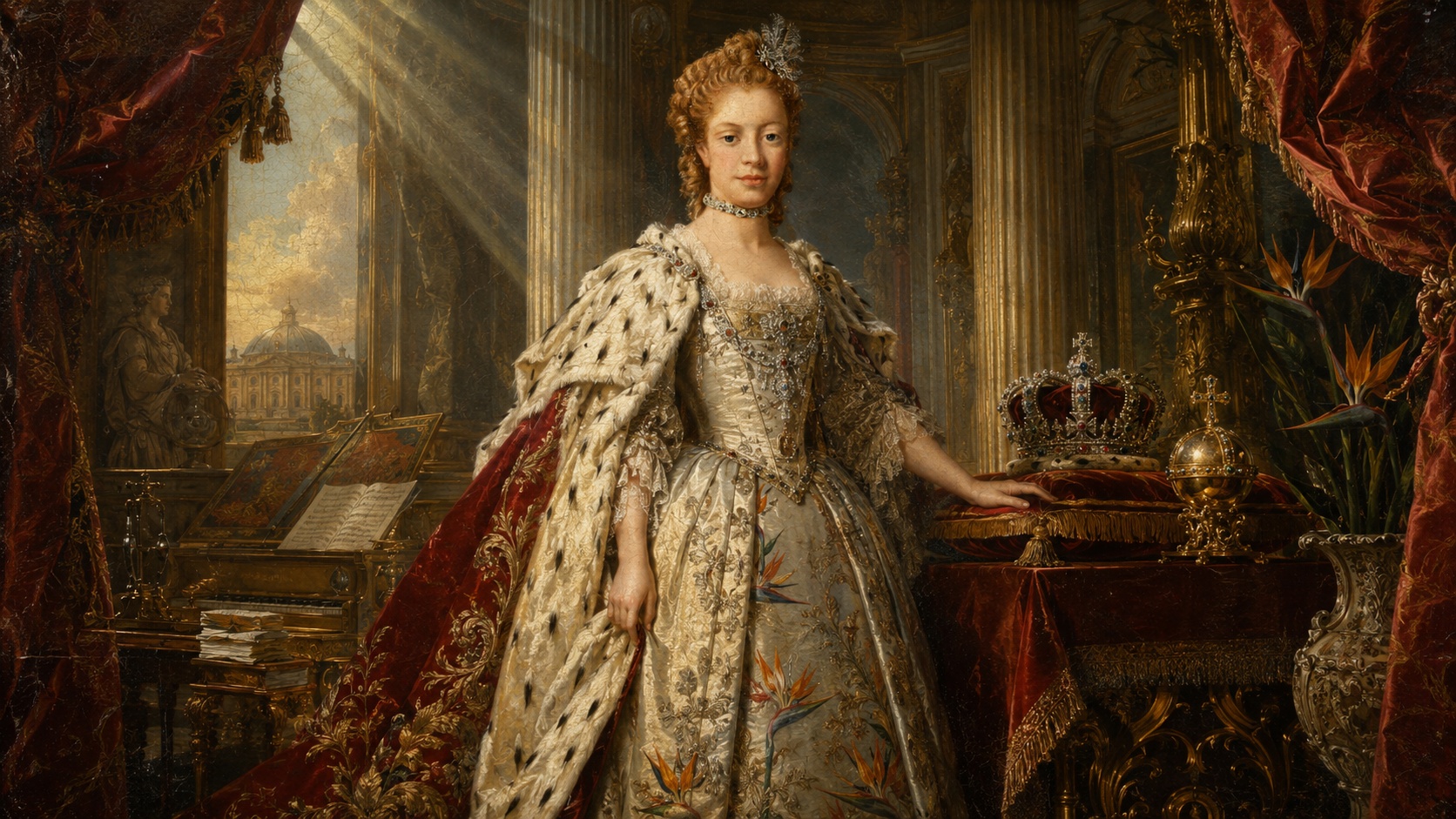
Charlotte of Mecklenburg-Strelitz was Queen of Great Britain and Ireland from 1761, following her marriage to King George III, until her death in 1818. As George’s consort, she was also Electress of Hanover and became Queen of Hanover in 1814. She holds the distinction of being Britain’s longest-serving queen consort, with a tenure of 57 years and 70 days.
Sophia Charlotte was born on 19 May 1744 in the small castle of Mirow, in the Duchy of Mecklenburg-Strelitz, a modest provincial region in the northern reaches of the Holy Roman Empire. She was the youngest daughter of Duke Charles Louis Frederick of Mecklenburg-Strelitz and Princess Elizabeth Albertina of Saxe-Hildburghausen, and the eighth of their children. Charlotte lost her father at the age of eight; her mother then took sole responsibility for the children’s upbringing, ensuring she received an education suited to her station. Though modest by the standards of Europe’s grander courts, this education encompassed languages, natural history, religion, household management, and, above all, music. The wider German aristocracy regarded Mecklenburg-Strelitz as a backwater, and as a minor princess Charlotte had no expectation of great dynastic consequence—until 1760.
In that year, twenty-two-year-old George III ascended the British throne and urgently required a suitable bride. Advisors scoured Europe for candidates who met strict criteria: she had to be Protestant, youthful, respectable, not overly educated, and—most importantly—unlikely to interfere in political affairs. Charlotte’s relative obscurity, reputed good nature, and lack of political ambition made her an ideal choice. Colonel David Graeme, part of the diplomatic party sent to assess her in Mecklenburg-Strelitz, described her as “small but with a pretty figure,” with “expressive eyes full of good humour,” noting also her flat nose and large mouth, which he thought “luckily countered by all her animation.” Despite these qualified observations, his report was favorable enough that the marriage contract was signed by Charlotte’s eldest brother in August 1761, and she set out for England almost immediately.
Charlotte’s journey to England was arduous. She endured three storms at sea and arrived in London on 8 September 1761, pale, seasick, and reportedly trembling. Within six hours of her arrival, she married George III at the Chapel Royal, St James’s Palace, in a ceremony officiated by the Archbishop of Canterbury. Remarkably, she had never set foot in England before that day, and she and George III had never met until the moment of their wedding. Their coronation at Westminster Abbey followed on 22 September 1761. At just seventeen, Charlotte spoke no English and faced the daunting task of adapting to the British court, but she applied herself with determination, reportedly spending six hours a day on language lessons during her first years at court.
What began as a diplomatic arrangement evolved, by all historical accounts, into a genuine love match. George III was deeply devoted to Charlotte, purchasing the Queen’s House (later Buckingham Palace) as her personal residence, where she gave birth to fourteen of their fifteen children. Even Horace Walpole, often acerbic in his descriptions of the Queen, acknowledged the warmth between the royal couple. They bonded over shared passions for music, literature, natural history, and theatre, and often performed music together in private—he on the flute or violin, she on the harpsichord. Their private correspondence and courtiers’ recollections consistently describe a marriage unusually marked by mutual respect and tenderness for a royal union.
During their fifty-seven-year marriage, George III and Queen Charlotte had fifteen children, thirteen of whom survived to adulthood, a remarkable feat for the era. Among them were two future British monarchs: George, Prince of Wales (later George IV), and Prince William, Duke of Clarence (later William IV). Their daughter Charlotte, Princess Royal, became Queen of Württemberg, while Prince Ernest Augustus later became King of Hanover. Their fourth son, Prince Edward, Duke of Kent, was the father of Queen Victoria, making Charlotte the direct ancestor of every subsequent British monarch. The couple also knew deep grief in the deaths of two young sons, Prince Alfred and Prince Octavius, who died in infancy.
Charlotte was a devoted mother, though often overwhelmed by the sheer scale of her responsibilities. As George III’s mental illness steadily eroded his ability to rule and to participate in family life, she assumed increasing responsibility for both the royal household and the well-being of their many children. Some historians have criticized her for an apparent coldness toward her adult children, particularly her daughters, several of whom led constrained and unhappy lives, never permitted to marry, as Charlotte kept them close as companions during her husband’s long decline.
Patron of the Arts and Sciences
Queen Charlotte was among the most active royal patrons of the arts and sciences in the eighteenth century, with music as her greatest passion. On her arrival in England in 1761, she brought two harpsichords from Germany and took lessons with Johann Christian Bach—the youngest son of Johann Sebastian Bach, known as the “English Bach”—who became her Music Master and composed numerous works for her. Concerts were held twice weekly at the royal residences, where Charlotte and George performed for intimate audiences throughout their lives. In 1764, she invited eight-year-old Wolfgang Amadeus Mozart to England for a year-long visit; he accompanied the Queen as she sang and dedicated to her his set of six sonatas for keyboard and violin, Opus 3 (K. 10–15), whose manuscript, copied by Leopold Mozart, is preserved in the Royal Music Library at the British Library. Later, following the death of Joseph Haydn’s Austrian patron, Charlotte invited the composer to England, where he resided for several years.
Her scientific interests were equally significant. Charlotte was an accomplished amateur botanist who collaborated with Sir Joseph Banks, the renowned naturalist and President of the Royal Society, to develop Kew Gardens into a leading centre for botanical research. She catalogued and illustrated plants, pressed specimens, and regularly attended lectures on botany and zoology from the President of the newly formed Linnean Society. In recognition of her contributions to botany and her German heritage, the South African Bird of Paradise flower was named Strelitzia reginae—“the queen of Strelitz”—when it was introduced to Kew Gardens in 1773, a name it retains today.
Charlotte was also a strong supporter of the visual arts. George III helped found the Royal Academy of Arts in 1768, and she shared his enthusiasm, patronizing female artists specialising in botanical illustration and supporting painters and writers across a variety of disciplines.
The King’s Illness and Charlotte’s Endurance
The most defining trial of Charlotte’s queenship was the progressive mental illness of George III. The King’s first recorded episode occurred around 1765, but the most severe crisis came in 1788–89, when his violent and erratic behaviour caused profound distress for the entire family. Charlotte endured episodes in which the King became physically violent toward her and the household. Medical understanding of mental illness at the time was limited, and treatments such as cold immersion and physical restraint were often harsh and ineffective. She spent many agonising hours at Kew and Windsor awaiting news of her husband’s condition, often with only her daughters for company.
The Regency Crisis of 1788–89 brought public political conflict into the family’s private suffering, as the Prince of Wales sought to exploit his father’s illness to gain power. Caught between safeguarding her husband’s crown and managing her eldest son’s ambitions, Charlotte found herself in an agonising position, and the conflict permanently damaged her relationship with the Prince of Wales. After George III’s final and irreversible descent into madness in 1811, she remained his legal guardian until her own death.
Despite her husband’s wish that she remain outside politics, Charlotte’s private correspondence—including letters to her brother Charles, preserved at Windsor Castle and microfilmed by the Library of Congress—reveals a woman deeply engaged with the events of her time. She followed the American Revolution with keen interest, wrote insightfully about the deployment of Hessian mercenaries, and confided to her brother: “Je deviendray politique malgré moi”—“I am becoming political despite myself.”
Charitable Legacy
Charlotte was a committed philanthropist, lending her name and active patronage to one of England’s oldest and most distinguished maternity hospitals. Founded in 1739 as a lying-in hospital for the relief of poor women in childbirth, the institution now known as Queen Charlotte’s and Chelsea Hospital has moved through various locations across London—from Bayswater to Marylebone Road, Ravenscourt Park, and finally its current site in Acton. Under her patronage it became a leading centre for maternity and neonatal care, a legacy that continues today; in 2001 the hospital was formally reopened in its present location by HRH Princess Anne.
Final Years and Death
By the second decade of the nineteenth century, Charlotte’s world had closed in around her. George III, now blind, nearly deaf, and lost to advanced dementia, was confined to isolated apartments at Windsor, and the couple had effectively been separated for years. Charlotte’s own health began to fail in 1818: she suffered from dropsy (now recognised as oedema, or fluid retention) as well as seizures of unclear origin. By the summer of that year, walking had become increasingly difficult, and she was confined to Kew Palace with round-the-clock medical care. Occasional rallies gave her family brief hope, but her decline was inexorable. In the early hours of 17 November 1818, Queen Charlotte died at Kew Palace at the age of seventy-four. The official bulletin attributed her death to “a gradual accumulation of water in her limbs and on her chest, which no medicines could relieve.”
Charlotte died surrounded by her sons, though not her daughters; the very daughters she had kept so close during her lifetime were, in the end, not present at her bedside. George III, living out his final years in isolation, may never have learned of her passing. Her service as Britain’s queen consort spanned fifty-seven years and seventy days, the longest in British history at the time, and she was laid to rest at St George’s Chapel, Windsor Castle.
Legacy
Queen Charlotte’s legacy is woven through many strands of British and world history. She is the direct ancestress of every British monarch since George IV, including Queen Victoria and all who followed, through her son Prince Edward, Duke of Kent. The city of Charlotte, North Carolina, and the island of St. Charlotte in the Caribbean were named in her honour during her lifetime. The Bird of Paradise flower, Strelitzia reginae, commemorates her name and passion for botany, and the hospital that bears her name continues to serve women and children in London. Through Johann Christian Bach’s tutelage and Mozart’s dedication of his Opus 3 sonatas, Charlotte also left a lasting mark on the history of Western music.
As her biographers observe, Charlotte arrived in England as a frightened, seasick girl of seventeen, yet learned to navigate one of Europe’s most demanding royal courts. She bore fifteen children, supported a mentally ill husband through decades of suffering without ever losing her public composure, and helped shape the intellectual and cultural life of Britain during one of its most turbulent eras. Even without the modern debates that now swirl around her legacy, Charlotte’s story is remarkable enough to stand on its own.
Source:
General Biographical Overviews
- The Royal Household – Official Biography
“Queen Charlotte (19 May 1744 – 17 November 1818)” – concise official life, marriage, children, later years, and patronage.
https://www.royal.uk/encyclopedia/queen-charlotte-19-may-1744-17-november-1818 - Encyclopaedia Entry
Britannica – “Charlotte | Regency Period, Hanover Dynasty, German Princess.”
https://www.britannica.com/biography/Charlotte-queen-of-England - Wikipedia Overview
“Charlotte of Mecklenburg‑Strelitz” – useful for quick reference to dates, titles, and family connections.
https://en.wikipedia.org/wiki/Charlotte_of_Mecklenburg-Strelitz - History Channel (UK)
“11 facts about Queen Charlotte: Britain’s longest reigning female consort.”
https://www.history.co.uk/articles/queen-charlotte-facts - Town & Country
“Queen Charlotte and King George III’s Family Tree” – clear visual sense of the 15 children and their descendants.
https://www.townandcountrymag.com/society/tradition/a43533175/queen-charlotte-king-george-family-tree/ - Blenheim Palace
“Queen Charlotte at Blenheim Palace” – short biographical sketch with emphasis on her Hanoverian and Victorian connections.
https://www.blenheimpalace.com/stories/queen-charlotte/
Scholarly and Book‑Length Work
- Natalee Garrett, Queen Charlotte: Family, Duty, Scandal (Routledge, 2025)
Routledge’s first full scholarly biography in over fifty years; uses British and German archival material.
Publisher page:
https://fass.open.ac.uk/history/news/history-lecturer-publishes-biography-queen-charlotte - Adrian Tinniswood, The Real Queen Charlotte (Pen & Sword, 2024)
Accessible modern biography; Guardian Bookshop listing:
https://guardianbookshop.com/the-real-queen-charlotte-9781399097055/
Kew, Botany, and Scientific Networks
- Historic Royal Palaces – Kew Palace
“Queen Charlotte” – her life at Kew, domestic routines, final illness, and death.
https://www.hrp.org.uk/kew-palace/history-and-stories/queen-charlotte/ - Kew Gardens
“Royal Treasures – Kew Palace and Queen Charlotte’s Cottage” – her rustic retreat, walks, and family life.
https://www.kew.org/kew-gardens/whats-in-the-gardens/kew-palace-and-queen-charlottes-cottage - Royal Society / Natural History Networks
“Queen Charlotte’s scientific collections and natural history networks” – on her role in botanical and scientific culture.
https://royalsocietypublishing.org/rsnr/article/77/2/323/48402 - Winterbourne House & Garden
“Plant Spotlight: Strelitzia reginae” – explains how the Bird of Paradise was named in her honour by Sir Joseph Banks.
https://www.winterbourne.org.uk/blog/2021/06/01/plant-spotlight-strelitzia-reginae/
Music, Instruments, and Cultural Patronage
- Historic Royal Palaces – Kew
“Kew the Music: George III and Queen Charlotte’s Instruments” – their harpsichords and domestic music‑making.
https://www.hrp.org.uk/blog/kew-the-music-george-iii-and-queen-charlottes-instruments/ - Historic Royal Palaces – Queen Charlotte’s Drawing Room
Focus on music in the drawing room; weekly family concerts and Charlotte’s playing while waiting for news of George’s condition.
https://www.hrp.org.uk/kew-palace/whats-on/queen-charlottes-drawing-room/ - Royal Central
“Music for a Queen: Mozart and Queen Charlotte” – details of Mozart’s 1764 visit and the Opus 3 sonata dedication.
https://royalcentral.co.uk/interests/history/music-for-a-queen-mozart-and-queen-charlotte-125692/
Hospital and Charitable Work
- Imperial Health Charity / NHS
“Queen Charlotte’s and Chelsea Hospital” – modern overview and brief history of the maternity hospital that bears her name.
https://www.imperialcharity.org.uk/what-we-do/our-hospitals/queen-charlottes-and-chelsea-hospital-donate - Historic England – Heritage Gateway
“Queen Charlotte’s Hospital, Ravenscourt Park” – architectural and institutional history, tracing the lying‑in hospital’s origins from 1739.
https://www.heritagegateway.org.uk/Gateway/Results_Single.aspx?uid=1062773&resourceID=19191
Illness, Final Years, and Death
- Historic Royal Palaces – Kew Palace
Section “Charlotte’s final days” and “The death of Queen Charlotte” – detailed narrative of her last illness and funeral.
https://www.hrp.org.uk/kew-palace/history-and-stories/queen-charlotte/ - Regency Redingote
“Regency Bicentennial: The Death of Queen Charlotte” – draws on contemporary bulletins and funeral accounts.
https://regencyredingote.wordpress.com/2018/11/16/regency-bicentennial-the-death-of-queen-charlotte/