
Joe Louis, the “Brown Bomber,” was one of the most dominant heavyweight champions in boxing history and a national symbol of Black dignity, American patriotism, and sporting excellence in the mid‑twentieth century.
Early life and migration
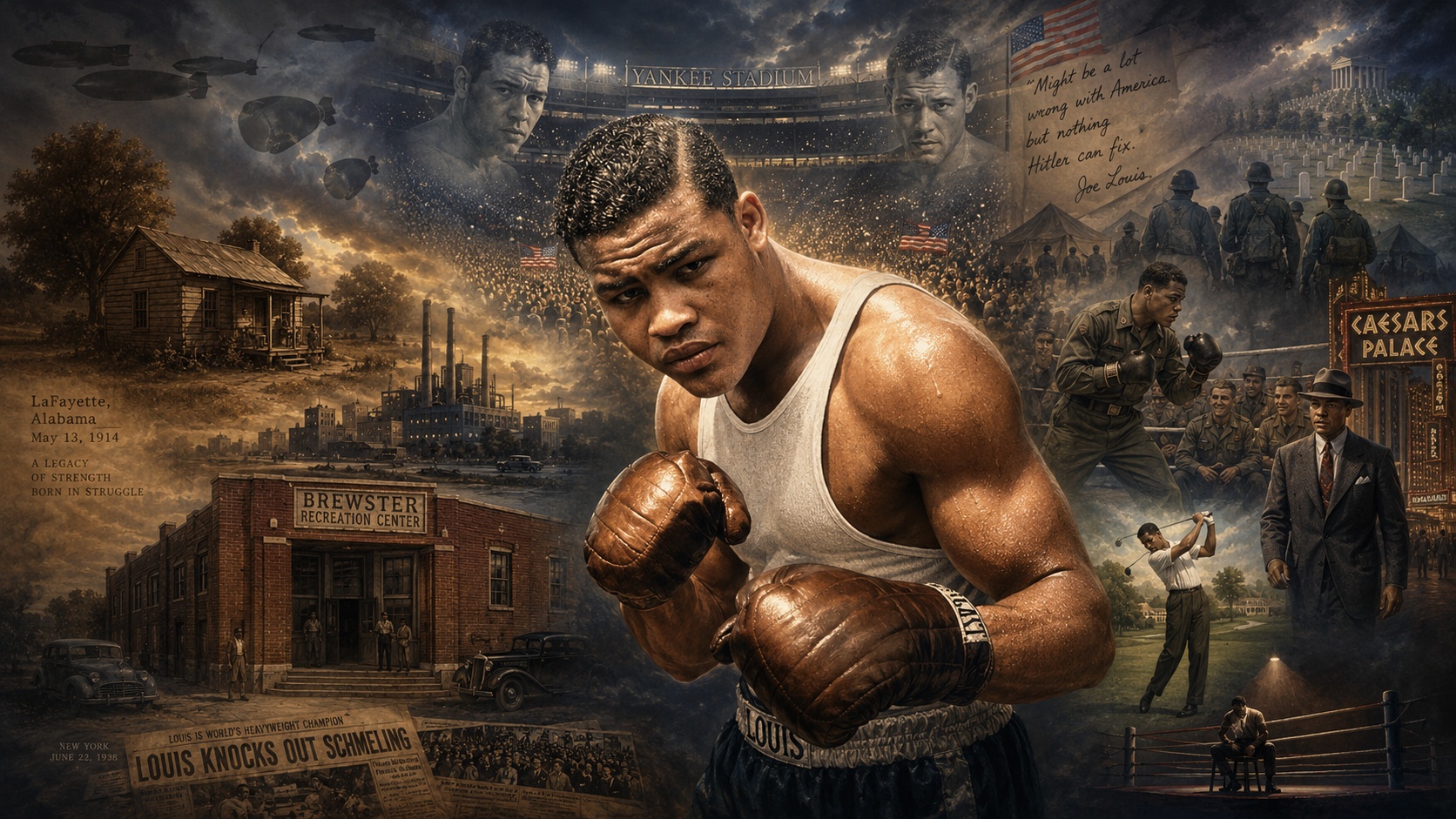
Joseph Louis Barrow was born on May 13, 1914, in a modest shack near LaFayette, Alabama, the seventh of eight children to Munroe and Lillie Barrow. His early years were shaped by extreme poverty and the trauma of losing his father, who was committed to a mental institution when Joe was only two. In 1926, seeking better opportunities during the Great Migration, his mother and stepfather, Pat Brooks, relocated the family to Detroit, drawn by the promise of jobs in the growing automotive industry. In Detroit, Louis was reserved and soft‑spoken, hindered by a speech impediment that caused teachers and others to underestimate his intelligence, even as he quietly searched for purpose.
Discovering boxing
Louis’s introduction to boxing occurred when a friend brought him to the Brewster Recreation Center in Detroit—a gym that would prove pivotal for his developing talent. To keep his new passion hidden from his mother, who hoped he would pursue violin lessons instead, Louis used his lesson money to rent a gym locker and concealed his gloves in his violin case. He began competing under the name “Joe Louis,” dropping his surname Barrow. Though his parents were initially displeased upon discovering his involvement in boxing, his mother ultimately supported him, telling her children she would help them pursue their dreams if they wanted something badly enough, so long as they remembered their Christian upbringing.
Louis’s amateur career began in late 1932 and started inauspiciously—he was knocked down seven times in his first bout. However, he adapted quickly, compiling an impressive amateur record of 50–4 with 43 knockouts, and capturing the National AAU light heavyweight title in 1934 before turning professional later that year.
Professional rise and the “Seven Commandments”
As a professional, Louis was managed by Detroit businessman John Roxborough and Chicago promoter Julian Black, who brought on Jack “Chappy” Blackburn as his trainer. Aware of the intense backlash that had followed Jack Johnson, the first Black heavyweight champion, Roxborough and Black established a strict code of conduct for Louis known as the “Seven Commandments.” These guidelines barred him from being photographed with European women, prohibited boasting over a defeated opponent, emphasized avoiding fixed fights, and insisted he “live and fight clean.” All were intended to present Louis as a respectable and modest champion in a racially hostile era. As a result, the press promoted him as a soft‑spoken, clean‑living figure—a “marketable hero” at a time when boxing was plagued by scandal and corruption.
Louis rose to national prominence by winning his first 27 professional bouts, including dominant victories over former champions Primo Carnera and Max Baer. However, his rapid ascent was halted on June 19, 1936, when he endured his first professional defeat—a 12th‑round knockout by former German champion Max Schmeling, who had meticulously studied Louis’s fighting style and exploited his lackadaisical training, exacerbated by distractions such as golf.
World heavyweight champion
Despite this setback, Louis’s star power and undeniable skill secured him a title shot against champion James J. Braddock. On June 22, 1937, at Comiskey Park in Chicago, Louis overcame an early knockdown to defeat Braddock in the eighth round, becoming the first African American to hold the world heavyweight title since Johnson in 1908. His victory sparked jubilant celebrations in Black communities nationwide, where it was celebrated as a communal triumph over the color barrier in one of America’s most prominent sports.
Yet Louis did not consider himself the true champion until he could avenge his loss to Schmeling. Their highly anticipated rematch on June 22, 1938, at Yankee Stadium unfolded against the tense backdrop of World War II, with the press framing the fight as a symbolic clash between American democracy and Nazi Germany. Louis overwhelmed Schmeling, knocking him down repeatedly in just over two minutes of the first round and forcing a stoppage—an emphatic victory that solidified his legacy as a hero to Americans of every background.
The “Bum of the Month Club” and wartime service
As champion, Louis was remarkably active, defending his title a record 25 times—more than any other heavyweight in history. He routinely faced top‑ten contenders in quick succession, leading sportswriters to label his string of challengers the “Bum of the Month Club”—a term that unfairly dismissed the real skill of many opponents. Among his most legendary defenses was his 1941 bout against light‑heavyweight champion Billy Conn. Trailing on points, Louis staged a dramatic comeback to knock Conn out in the thirteenth round, showcasing his resilience and punching prowess.
When the United States entered World War II, Louis enlisted in the Army in 1942, famously stating, “Might be a lot wrong with America but nothing Hitler can fix.” He donated his purses from two title fights to military relief funds—generosity that the IRS later counted as taxable income. Throughout the war, Louis fought 96 exhibition bouts before an estimated two million troops and leveraged his influence to help Black soldiers gain access to Officer Candidate School, supporting figures like a young Jackie Robinson. His wartime declarations, such as “We’ll win, ’cause we’re on God’s side,” were widely reported and cemented his status as a patriotic icon, even as he endured the realities of Jim Crow discrimination.
Financial struggles and late‑career comeback
Louis returned from the war burdened by heavy tax liabilities, with his donated purses forming the basis for a tremendous IRS debt. He defended his title four more times—including two grueling bouts against Jersey Joe Walcott—before retiring as undefeated champion in 1949. The mounting, unpaid tax bill—exceeding $500,000—eventually forced him into an ill‑fated comeback in 1950.
At 36, well past his athletic prime, Louis lost a 15‑round decision to Ezzard Charles, who had succeeded him as champion. On October 26, 1951, his storied career ended painfully when the young contender Rocky Marciano knocked him out, sending Louis through the ropes—a haunting image of a fallen legend. Marciano, deeply moved, wept in Louis’s dressing room afterward and apologized to the man he had long idolized.
Wrestling, refereeing, and later work
In the 1950s, faced with ongoing tax burdens and financial difficulties, Louis turned to professional wrestling as a means of support. He made his debut in August 1954 with a victory over Bobby Nelson and embarked on a brief 1956 tour under promoter Ray Fabiani, defeating Cowboy Rocky Lee. However, a rematch left him with cracked ribs and cost him his wrestling license. A heart condition further limited his wrestling career, though he made sporadic returns—including a 1959 loss to Buddy Rogers—and participated in occasional matches into the early 1970s, with his final bout recorded in 1973.
In addition to occasional wrestling, Louis served as a referee in both wrestling and boxing matches, a role he continued into the early 1970s. He eventually found some stability as a greeter at Caesars Palace in Las Vegas, though health problems and lingering tax debts continued to shape his later years. In a groundbreaking achievement, he also broke color barriers in golf by becoming the first African American to compete in a PGA‑sanctioned tournament in 1952.
Personal life and relationships
Louis’s personal life was as eventful as his public career, marked by four marriages and a large family of both biological and adopted children. He married his first wife, secretary Marva Trotter, in 1935 just hours before his fight with Max Baer. Their turbulent relationship ended in divorce in 1945, was rekindled with a remarriage in 1946, and dissolved again by 1948 or 1949. In 1955, he wed Harlem businesswoman Rose Morgan, but the marriage was annulled in 1958. His final marriage, to Los Angeles attorney Martha Jefferson on St. Patrick’s Day 1959, endured until his death in 1981.
With Marva, Louis had two biological children: daughter Jacqueline, born in 1943, and son Joseph Louis Barrow Jr., born in 1947. He also adopted several children; some accounts state that he and Martha had four: John, Joyce, Janet, and another son, also named Joseph Louis Barrow Jr. Outside his marriages, Louis was romantically linked with high-profile entertainers such as singer Lena Horne, actress Lana Turner, and figure skater Sonja Henie. He remained discreet about these relationships, mindful of his managers’ warnings regarding the career risks of being seen with white women.
Nickname and public image
The American press in the mid‑1930s dubbed him the “Brown Bomber,” a nickname likely coined by either Detroit boxing manager Scotty Monteith or Detroit Free Press writer Charles Ward. The name fused racial identification (“Brown”) with a nod to his devastating punching power (“Bomber”), and it soon eclipsed other racially inflected monikers such as “Mahogany Mauler” and “Chocolate Chopper.” As the world moved toward World War II, the “Bomber” label took on national symbolism, particularly in the 1938 Schmeling rematch, where Louis was cast as the embodiment of American might and the “free world” in opposition to Nazism.
Louis’s team and the press used the nickname and his carefully managed behavior to market him as a clean, trustworthy champion who could “save” boxing from its associations with fixed fights and organized crime. His softball team was named the “Brown Bombers,” and even a Canadian football club, the Winnipeg Blue Bombers, reportedly drew its nickname from sportswriters inspired by Louis’s persona.
Reputation in boxing history
Within the boxing world, Joe Louis is universally recognized as one of the greatest heavyweight champions—and indeed, one of the finest fighters—of all time. His style blended devastating yet efficient power, a sharp jab, and precise finishing ability. Observers marveled at how he could knock out opponents with seemingly effortless, compact punches. German rival Max Schmeling called him the hardest puncher he had ever encountered, while former champion Jack Dempsey admitted relief at never facing Louis in the ring and later helped raise funds for him during tough times. Rocky Marciano deeply admired Louis, and even Muhammad Ali, who often proclaimed himself “The Greatest,” ultimately conceded, “Joe Louis was the greatest.”
Historians and boxing experts have echoed these sentiments. In 1978, members of the Boxing Writers Association of America voted Louis the greatest heavyweight in history, and The Ring magazine ranked him first on its list of the 100 greatest punchers. Pulitzer Prize–winning columnist Red Smith argued that Louis might have been the greatest fighter who ever lived, asserting he had “no shadow of doubt” that a prime Louis would have defeated Muhammad Ali. Journalists credited Louis with restoring boxing’s reputation in the mid‑1930s, describing him as a boon to a sport then mired in scandal, corruption, and poor-quality fighters.
Voice, quotes, and philosophy
Louis left a legacy of memorable remarks that revealed his competitive spirit, patriotism, and perspective on adversity. Before his 1946 rematch with Billy Conn, he famously quipped, “He can run, but he can’t hide,” capturing his belief that no evasive strategy could shield an opponent forever. He is also credited with the now‑ubiquitous phrase, “Everyone has a plan until they’ve been hit,” which has transcended boxing. On the inevitability of defeat, he reflected, “Every man’s got to figure to get beat sometime,” acknowledging the limits faced even by a great champion.
His patriotism, complicated by the realities of racial inequality, produced memorable lines such as “Might be a lot wrong with America but nothing Hitler can fix” and “We’ll win, ’cause we’re on God’s side,” both of which resonated deeply during wartime. Reflecting on his financial ups and downs, he joked, “When I was boxing I made five million and wound up broke, owing the government a million. If I was boxing today I’d make ten million and wind up broke, owing the government two million.” Near the end of his memoir, he summarized his life with characteristic understatement: “I did the best I could with what I had,” later adding, “I almost always did exactly what I wanted to do.” After his final loss to Marciano, he accepted defeat with typical composure: “What’s the use of crying? The better man won. I guess everything happens for the best.”
Death and enduring legacy
Joe Louis died of a heart attack on April 12, 1981, at the age of 66. In recognition of his extraordinary service and symbolic stature, President Ronald Reagan waived eligibility requirements so that Louis could be buried with full military honors at Arlington National Cemetery. In a poignant coda to their shared history, Max Schmeling served as a pallbearer and helped pay for the funeral, representing the unlikely friendship that had blossomed from their once‑bitter rivalry.
Louis’s final professional record stood at 68 wins and 3 losses, with 54 victories by knockout, and he was awarded the Congressional Gold Medal posthumously in 1982. For millions, he represented more than a champion; he embodied quiet dignity in an era of virulent racism, carrying himself with humility even as he demolished opponents in the ring. Reporter Jimmy Cannon captured his significance best, calling Joe Louis “a credit to his race—the human race,” a tribute that has come to define his legacy in both sports and American history.
Source:
https://en.wikipedia.org/wiki/Joe_Louis
https://nmaahc.si.edu/explore/stories/joe-louis
https://www.britannica.com/biography/Joe-Louis
http://www.ibhof.com/pages/about/inductees/modern/louis.html
https://www.pbs.org/wgbh/americanexperience/features/fight-joe-louis-tribute/
https://www.pbs.org/wgbh/americanexperience/features/fight-joe-louis-1914-1981/
https://www.theguardian.com/sport/2018/apr/13/joe-louis-boxing-greatest-heavyweights-dies-obituary
https://www.biography.com/athletes/joe-louis
https://encyclopediaofalabama.org/article/joe-louis/