
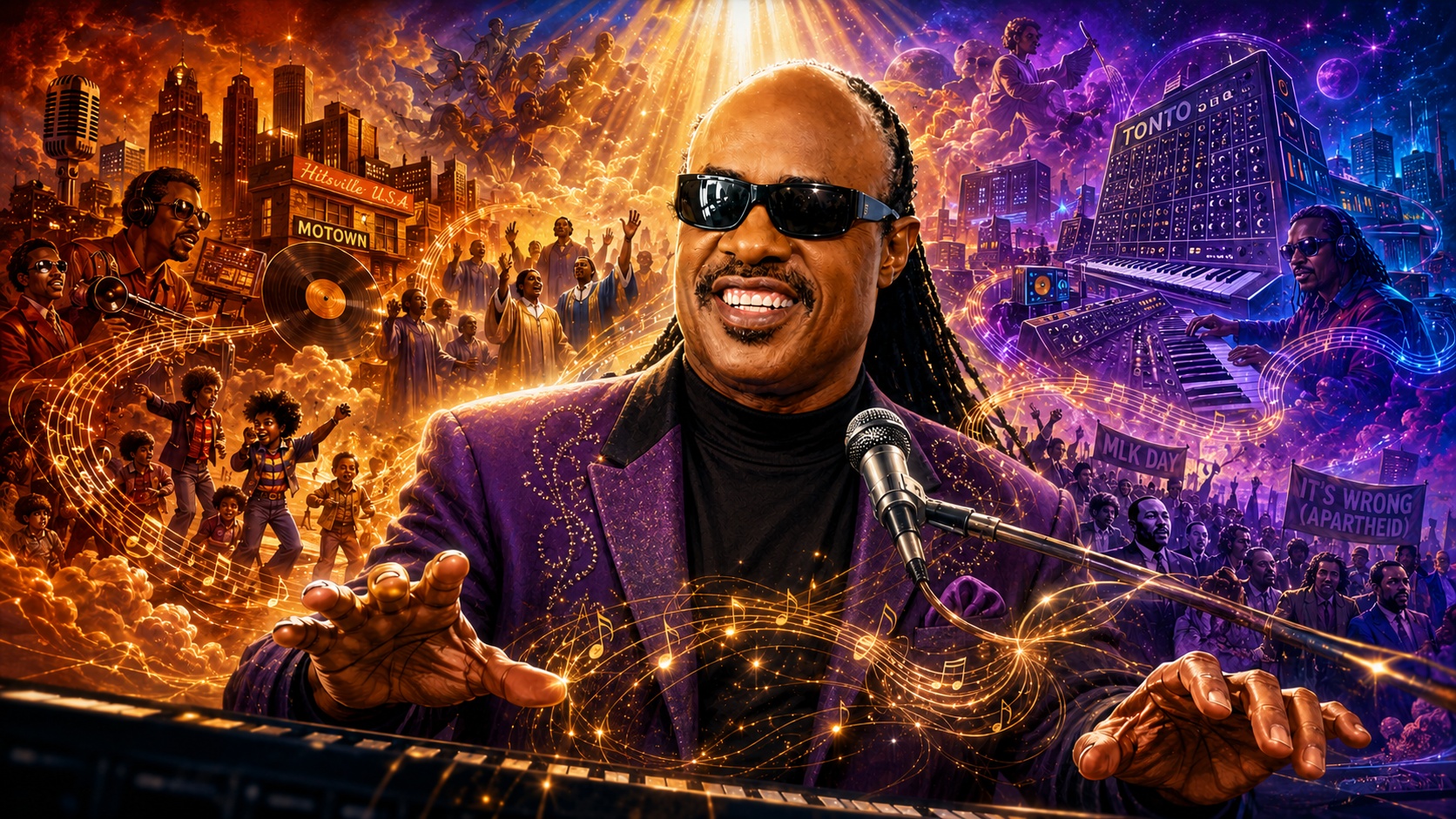
Stevie Wonder, born Stevland Hardaway Judkins on May 13, 1950, in Saginaw, Michigan, is celebrated as one of the most influential and visionary artists in modern music. His career as a composer and performer is marked by a groundbreaking blend of technical innovation and unwavering dedication to Black social progress. Born six weeks premature, Wonder was placed in an oxygen-rich incubator, resulting in retinopathy of prematurity and permanent blindness—a challenge he later reframed as a catalyst for his heightened inner vision and spiritual awareness. Raised primarily by his mother, Lula Mae Hardaway, Wonder immersed himself in Detroit’s vibrant church and neighborhood scenes, teaching himself piano, harmonica, and drums before age ten, and performing as a child soloist in the Whitestone Baptist Church choir. Lula Mae fostered not only his extraordinary musical talent but also his sense of purpose, co-writing songs with him and steering him toward the Motown environment that would ultimately launch his remarkable career.
Wonder’s entry into the recording industry began when Ronnie White of the Miracles discovered the eleven-year-old prodigy and introduced him to Motown’s Tamla label. There, Berry Gordy signed him, and producer Clarence Paul gave him the stage name “Little Stevie Wonder.” By age twelve, Wonder had released two albums—The Jazz Soul of Little Stevie and A Tribute to Uncle Ray. In 1963, his dynamic live harmonica performance on “Fingertips (Part 2)” made history as Motown’s first live single to reach number one on the Billboard Hot 100, establishing him as the youngest solo artist ever to top the chart. Throughout the 1960s, Wonder became a central Motown figure, delivering hits such as “Uptight (Everything Is Alright),” “My Cherie Amour,” “For Once in My Life,” and “Signed, Sealed, Delivered I’m Yours”—the latter co-written with his mother. He also began composing for other artists, contributing songs like “Tears of a Clown” and “It’s a Shame,” which reflected his evolving ambitions beyond the typical singles formula.
A pivotal moment in Stevie Wonder’s career arrived in 1971, when at age twenty-one, his original Motown contract expired. The end of this contract granted him access to royalties estimated at around one million dollars and gave him unprecedented bargaining power within a label renowned for its tight control over artists. During contract renegotiations, Wonder insisted on—and secured—complete creative autonomy, including the right to produce his own material and retain ownership of his publishing. This milestone set the stage for his legendary “classic period.” Between 1972 and 1976, Wonder released five seminal albums—Music of My Mind, Talking Book, Innervisions, Fulfillingness’ First Finale, and Songs in the Key of Life—works widely celebrated as among the most significant in the history of popular music. Collaborating with synthesizer engineers Malcolm Cecil and Robert Margouleff and utilizing their TONTO system, Wonder elevated Moog and ARP synthesizers from mere embellishments to the centerpiece of his creative process, crafting layered, Afrofuturist soundscapes that revolutionized the sonic vocabulary of soul and R&B.
These albums not only transformed the sound of Black popular music but also expanded its thematic scope. Innervisions (1973) tackled issues such as American racism, spiritual disillusionment, and the drug trade with striking narrative force, most notably in “Living for the City.” This song’s vivid depiction of a young Black man’s journey from the South to New York is now recognized as a forerunner of socially conscious hip-hop. Just days after Innervisions was released, Wonder narrowly survived a car accident in North Carolina when a logging truck collided with his vehicle, leaving him in a coma for four days with serious head injuries. Witnesses recounted that gospel singer Ira Tucker sang “Higher Ground” at Wonder’s bedside and that Wonder’s fingers began moving in rhythm with the song—a moment Wonder later described as a sign affirming his spiritual mission and urging him to “reach another higher ground.” He chose to keep the scar on his forehead, seeing it as a visible testament to the hardships he had overcome.
Songs in the Key of Life (1976) stands as Stevie Wonder’s magnum opus—a sprawling double album with an accompanying EP that debuted at number one on the Billboard chart, remained there for thirteen weeks, and earned the Grammy for Album of the Year. This achievement completed an unprecedented trio of Album of the Year wins within four years. Through songs such as “Sir Duke,” “I Wish,” “Isn’t She Lovely,” “As,” “Pastime Paradise,” and “Black Man,” Wonder crafted a sweeping tribute to Black history, daily joy, and spiritual yearning, expertly blending jazz harmonies, gospel vitality, funk energy, and pop lyricism. Critics have hailed the album as a tapestry that encapsulates the vastness of the African American musical tradition more completely than nearly any other work, and Rolling Stone ranked it number four on its 2020 list of the 500 greatest albums. The influence of Songs in the Key of Life reverberates throughout global popular culture: “Pastime Paradise” laid the foundation for Coolio’s “Gangsta’s Paradise,” and the album has provided inspiration and material for hip-hop producers for decades.
Wonder’s technological innovations have also left a profound mark on music beyond his own recordings. In the early 1980s, he collaborated with inventor Ray Kurzweil to develop the Kurzweil 250, one of the first digital keyboards capable of authentically reproducing acoustic piano and orchestral sounds. This breakthrough helped bridge the gap between electronic and acoustic music, transforming studio production across genres. As a musician, Wonder is a remarkable multi-instrumentalist, performing piano, harmonica, drums, clavinet, synthesizers, percussion, and more on his albums. His iconic clavinet riffs on “Superstition” and “Higher Ground” are definitive examples of keyboard groove. Wonder’s voice—supple, rhythmically adventurous, and deeply expressive—has been praised by peers as a benchmark for modern vocal performance and a model for emotional depth in soul and pop music.
From the 1980s onward, Stevie Wonder’s influence extended well beyond music, encompassing both mainstream pop stardom and global activism. He achieved international chart-toppers with “Ebony and Ivory” (with Paul McCartney), “I Just Called to Say I Love You,” and “Part‑Time Lover,” with the first earning him an Academy Award for Best Original Song. While some critics considered these tracks a softer turn from his classic-period output, Wonder steadfastly leveraged his fame to advance political and humanitarian causes. Inspired by hearing Martin Luther King, Jr. as a child, Wonder became a driving force behind the campaign to establish a national holiday honoring King. In 1980, he released “Happy Birthday” as both a tribute and rallying anthem, spearheaded rallies and advocacy events, and, after years of effort, witnessed President Ronald Reagan sign the holiday legislation in 1983. Wonder then headlined the inaugural national observance in 1986, cementing his role as a cultural and civic leader.
Wonder’s anti-apartheid activism marked another defining chapter of his public life. When he dedicated his 1985 Oscar to the then-imprisoned Nelson Mandela, the South African government retaliated by banning his music. Undeterred, Wonder intensified his advocacy with the release of “It’s Wrong (Apartheid)” and by testifying before a United Nations committee to condemn apartheid. He joined and was arrested at protests outside the South African embassy in Washington, D.C., and contributed to the landmark charity single “We Are the World,” exemplifying how celebrity influence could drive global humanitarian efforts. His commitment to activism also encompassed disability rights—through the Wonder Vision Awards and his work with the President’s Committee on Employment of People with Disabilities—as well as later philanthropy, including donating proceeds from “Shelter in the Rain” to Hurricane Katrina relief and serving as a United Nations Messenger of Peace from 2009 onward.
Throughout his life, Stevie Wonder has portrayed his musical gift as an extension of his faith. Deeply rooted in the Black Baptist tradition of his Detroit upbringing, he credits God as the wellspring of his creativity and has composed songs that openly explore spiritual themes, such as “Have a Talk with God,” “Higher Ground,” and “As.” Scholars and critics observe that his lyrics seamlessly intertwine Christian beliefs with a cosmic perspective and an Afrocentric understanding of history, framing love, justice, and community not only as emotions but as spiritual disciplines. Albums like Songs in the Key of Life are thus celebrated not just as musical triumphs but as profound meditations on the soul’s passage through joy, adversity, and spiritual awakening.
Wonder’s personal life has evolved in tandem with his illustrious public career. He has been married three times: first to singer-songwriter Syreeta Wright (1970–1972), with whom he maintained a creative partnership; then to fashion designer Kai Millard Morris (2001–2012), with whom he shares two sons; and most recently to Tomeeka Robyn Bracy, whom he married in 2017 and with whom he has two younger children. Altogether, Wonder is the father of nine children from five relationships, including his eldest daughter Aisha, born in 1975, whose birth inspired “Isn’t She Lovely” and who now often performs at his side. In 2019, Wonder underwent a successful kidney transplant and by late 2020 reported feeling revitalized and eager to continue his work—a commitment he has demonstrated through ongoing tours and fresh musical projects.
In May 2024, Stevie Wonder deepened his spiritual and political ties to Africa by accepting Ghanaian citizenship during a ceremony in Accra led by President Nana Akufo‑Addo. Wonder described this moment as the fulfillment of a lifelong dream to reconnect the African diaspora, calling Ghana “where I need to be,” while still affirming his American roots. Ghanaian officials honored him for his decades of advocacy for African liberation and his vital role in elevating Black culture and dignity on the world stage. By taking this step, Wonder joined a legacy of African American intellectuals and artists—including W.E.B. Du Bois, Maya Angelou, and others—who have sought belonging and historical healing by forging new lives on the continent.
The cascade of honors that followed reflects the vastness of Wonder’s influence. He was inducted into the Rock and Roll Hall of Fame in 1989, received the Kennedy Center Honors and Polar Music Prize in 1999, and later earned a Grammy Lifetime Achievement Award, the Library of Congress Gershwin Prize, and the Presidential Medal of Freedom from Barack Obama in 2014. According to Guinness World Records, Wonder holds 25 Grammy Awards—the most ever by a solo male artist—along with an Academy Award, numerous number-one albums, and a prolific discography of 23 studio albums and over 90 singles. His impact has sparked growing academic attention: in 2026, the University of Chicago offered “The Wonder Lab,” a course dedicated to exploring his legacy and examining how his pursuit of creative freedom, pioneering use of synthesizers, and activism have continually redefined the possibilities for Black artists in popular music.
In recent years, Wonder has remained a vital force in music and advocacy. He released A Time to Love in 2005, followed by a series of politically resonant singles on his So What the Fuss label in 2020, and announced the forthcoming project Through the Eyes of Wonder—a performance piece exploring life through the lens of visual impairment. Wonder has continued to tour globally, including the “Love, Light & Song” UK tour and “Sing Your Song!” performances in the mid‑2020s. He has repeatedly affirmed his intention to keep performing and inspiring younger generations for as long as he is able. For many, Wonder’s lasting significance stems not only from the timeless appeal of classics like “Superstition” and “As,” but also from the way his life story continually navigates the tension between constraint and possibility—between barriers imposed by disability, racism, or the music industry, and the boundless worlds opened by imagination, artistry, and moral purpose.
Source:
https://en.wikipedia.org/wiki/Stevie_Wonder
https://www.britannica.com/biography/Stevie-Wonder
https://www.bbc.co.uk/news/articles/c1k81r9ejpeo
https://www.motownmuseum.org/artist/stevie-wonder/
https://steviewonder.org.uk/stevie-wonder-biography
https://www.rollingstone.com/music/music-lists/best-stevie-wonder-songs-1235086603/part-time-lover-1235087013/