
Juan Rodríguez (Dutch: Jan Rodrigues; Portuguese: João Rodrigues) holds the distinction of being the first documented non-indigenous person to reside on Manhattan Island. He arrived in 1613—seven years before the Pilgrims landed at Plymouth—and is recognized as New York City’s earliest foreign resident.
Rodríguez was born in Santo Domingo, the first Spanish colony in the Americas, to a Portuguese sailor and an African mother. He was raised in a society where Africans and people of mixed ancestry made up the majority and where maritime trade and multilingual exchange were part of everyday life. Immersed in this multicultural environment, Rodríguez developed an exceptional talent for languages—an ability that would later make him indispensable to Dutch merchants seeking access to the North American fur trade. This blend of maritime experience, Caribbean heritage, and linguistic talent led to his recruitment for a Dutch trading expedition in the early seventeenth century.
In 1613, Rodríguez joined the crew of the Dutch merchant ship Jonge Tobias, captained by Thijs Volckenz Mossel, on a voyage from Santo Domingo to the land the Lenape called Mannahatta. At the time, the Dutch were just beginning to test fur-trading ventures along the North River (Hudson River), building on Henry Hudson’s 1609 exploration and relying on intermediaries who could communicate with Indigenous communities.
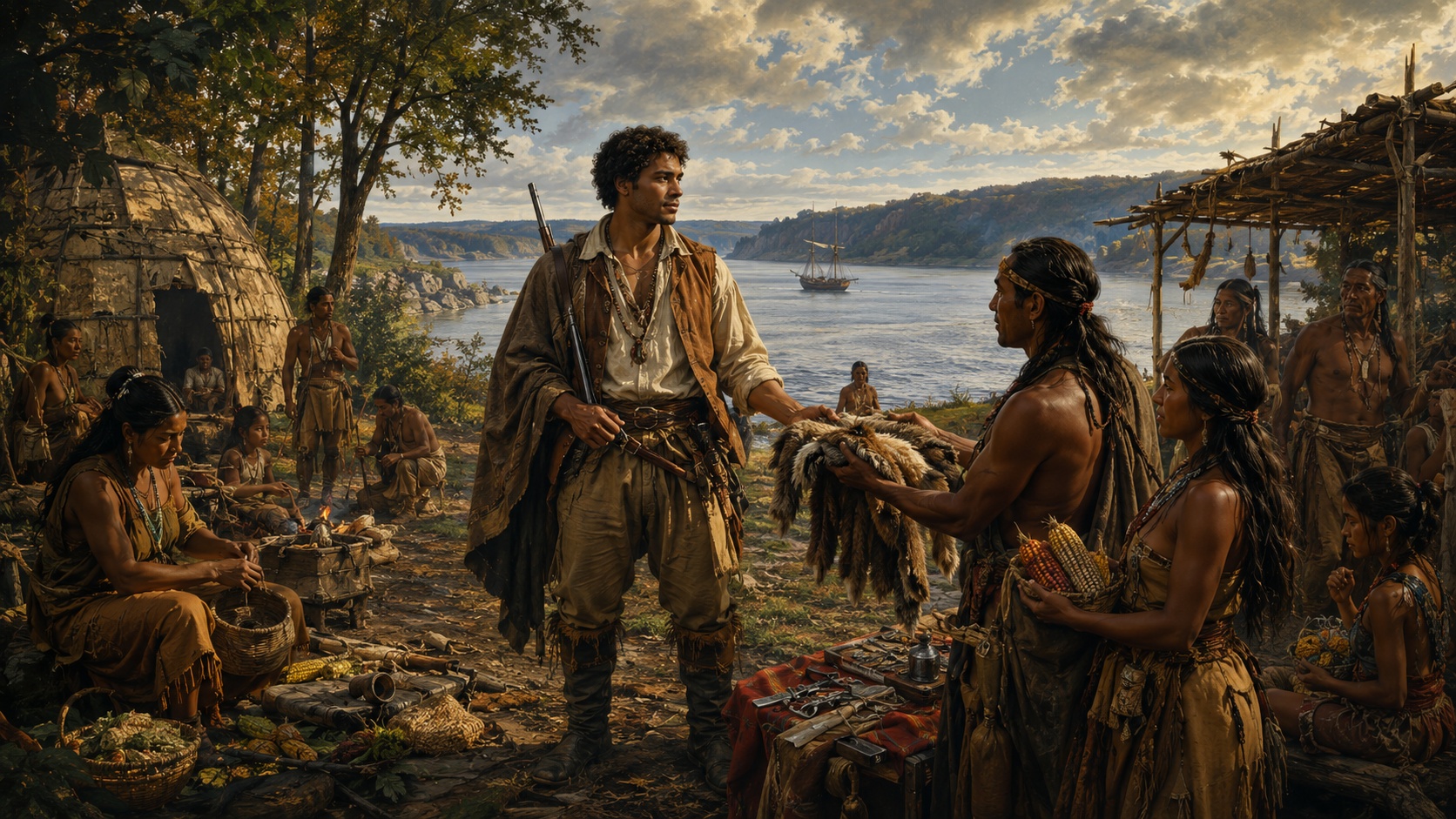
Upon reaching New York Harbor, the Jonge Tobias anchored off Manhattan, where the crew bartered European goods for furs with the Lenape. During this trading season, Rodríguez made the pivotal decision that would secure his place in history: when Mossel prepared to depart, Rodríguez refused to leave with the ship, insisting on remaining behind on the island.
Left behind with wages paid in trade goods—”eighty hatchets, some knives, a musket and a sabre”—Rodríguez established his own trading post and became deeply involved in the local Lenape community. He mastered the Algonquian language spoken by the Lenape and is believed to have married into their society, making him not only Manhattan’s first non-indigenous resident but also its earliest known merchant and cultural mediator. When Dutch ships returned the following year, Rodríguez remained, serving as an essential bridge between European traders and the Lenape people.
In 1614, Dutch captain Adriaen Block arrived and enlisted Rodríguez’s expertise, hiring him to trade on behalf of his company. When Mossel returned and found Rodríguez working for a competitor, a confrontation followed—reportedly escalating into a physical altercation. The dispute was recorded in Amsterdam’s notarial archives: Block’s complaint read, “Rodriguez, born in Sto. Domingo, who had arrived there with the ship of said Mossel, stayed ashore at the same place.” Mossel, meanwhile, accused Rodríguez of desertion. Throughout the conflict, Rodríguez insisted on his freedom to work for whomever he chose.
After the legal dispute, Rodríguez vanishes from the historical record. Some accounts speculate that he may have remained in Manhattan into the 1640s, perhaps as part of a community of free Black residents near today’s Bowery, possibly known as “Jan de Fort Orange.” His remarkable story remained hidden for over 340 years until 1959, when Dutch historian Simon Hart uncovered the 1613–1614 notarial records in the Amsterdam City Archives. Only in 2013 did the Dominican Studies Institute at the City College of New York publish English- and Spanish-language translations of his court case, bringing his story to a wider audience.
In October 2012, the New York City Council honored Rodríguez’s legacy by naming the stretch of Broadway from 159th Street to 218th Street after him. The first street sign was erected on May 15, 2013—the 400th anniversary of his arrival.
Today, Juan Rodríguez is recognized as a foundational—yet long-overlooked—figure in the histories of New York and the African diaspora in North America. His story challenges the traditional narrative that traces the city’s beginnings to Dutch settlers in the 1620s or English rule in the 1660s. Instead, Rodríguez’s presence reveals that a free Afro-Latino from Santo Domingo was already living, trading, and forging relationships on Mannahatta as early as 1613.
For Dominicans, Afro-Latinos, and Black New Yorkers, Rodríguez’s story represents an early, documented ancestral presence in the city—centuries before large-scale Caribbean migrations. For historians, his life illuminates the interconnected worlds of the Spanish Caribbean colonies, Dutch commercial ventures, and Indigenous Lenape homelands in the early seventeenth century, demonstrating how a single individual could bridge all these domains at once. Ramona Hernandez, Director of the Dominican Studies Institute, described him as “the first immigrant, the first Black person, the first merchant, the first Latino, and, to us, the first Dominican to have ever lived in New York City.”
Source:
https://www.ccny.cuny.edu/news/cuny-dsi-monograph-documents-dominican-heritage-of-first-settler
https://enslaved.org/fullStory/16-23-92888/
https://ogs.ny.gov/juan-rodriguez
https://libguides.nypl.org/dominicanrepublicgenealogyintro/atNYPL
https://en.wikipedia.org/wiki/Juan_Rodriguez_(trader)
https://www.mcny.org/juan-rodriguez
https://archive.nytimes.com/cityroom.blogs.nytimes.com/2012/10/02/honoring-a-very-early-new-yorker/
https://www.manhattantimesnews.com/citys-first-immigrant-honored-on-broadway-primer-inmigrante-de-la-ciudad-honrado/
https://janos.nyc/history/juan-rodriguez-an-original-new-yorker/