
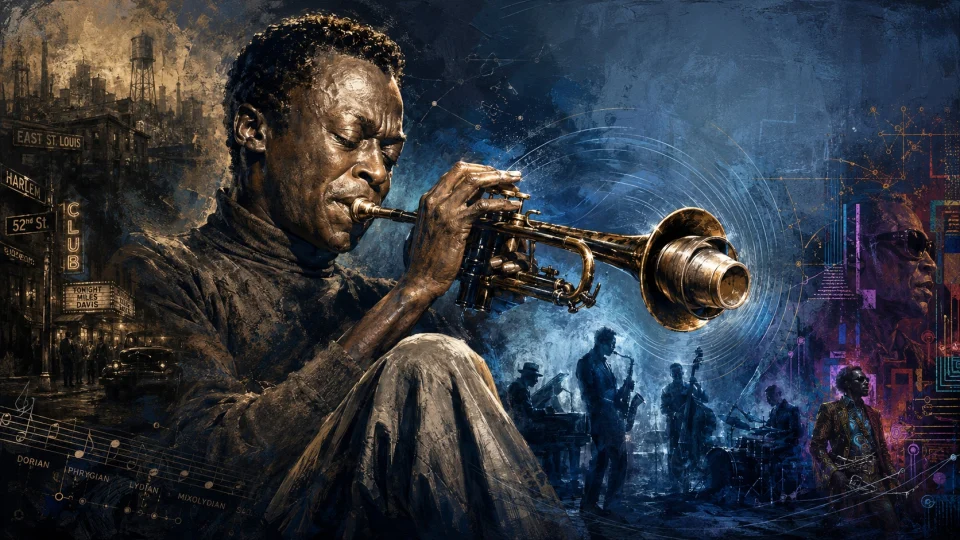
Miles Davis (1926–1991) was an American trumpeter, composer, and bandleader widely regarded as one of the most influential and innovative artists in the history of jazz and 20th-century music. Over nearly five decades, Davis was at the forefront of every major stylistic evolution in jazz, including bebop, cool jazz, hard bop, third stream, modal jazz, and jazz-rock fusion. His groundbreaking 1959 album Kind of Blue is often cited as the greatest jazz album ever recorded. In 2009, the U.S. House of Representatives recognized the album as a national treasure. In 1990, Davis received the Recording Academy Lifetime Achievement Award, and ten of his recordings—including Birth of the Cool, Bitches Brew, and Kind of Blue—have been inducted into the GRAMMY Hall of Fame.
Early life and family
Miles Dewey Davis III was born on May 26, 1926, in Alton, Illinois, into an affluent, upper‑class African‑American family whose material security never shielded him from the realities of racism. His father, Miles Dewey Davis Jr., was a prosperous dental surgeon, landowner, and proud “race man,” while his mother, Cleota Mae Henry, was a music teacher and violinist, creating a household where professionalism, Black pride, and the arts were deeply valued.
In 1927, the family moved to East St. Louis, where they lived in a racially mixed neighborhood behind his father’s dental office. Davis attended John Robinson Elementary and Lincoln High School, excelling in mathematics, music, and sports, yet he met persistent racial discrimination in music competitions that hardened his resolve to become a better musician. Summers at his grandparents’ 200‑acre farm near Pine Bluff, Arkansas—fishing, riding horses, and hearing country blues and gospel—planted early seeds of the Black musical idioms that would later resurface in his sound and, by his own account, became a deep reservoir of feeling he drew on throughout his career.
Musical beginnings and the trumpet
Davis received his first trumpet at around nine or ten. The most decisive figure in his early training was Elwood Buchanan, a local trumpeter and family friend who insisted Davis play without vibrato—so much so that he would strike Davis’s knuckles when he slipped—thereby shaping the “dry,” mid-range tone that would become Davis’s hallmark. By age twelve, Davis had already decided music was the most important thing in his life, and as a teenager, he began performing with local bands across East St. Louis.
A humiliating moment at the Castle Ballroom—a drummer challenged Davis for not knowing what he was playing—motivated him to immerse himself in music theory and method books. At fifteen, he joined Eddie Randle’s Blue Devils, later known as the Rhumboogie Orchestra, and eventually became the band’s musical director. This formative experience exposed him to the responsibilities of leading a professional ensemble. During these years, he also drew inspiration and mentorship from acclaimed local trumpeter Clark Terry, who exemplified both virtuosity and professionalism.
The 1944 catalyst and move to New York
Davis’s life changed in July 1944 when the Billy Eckstine Big Band arrived in St. Louis with Charlie “Bird” Parker and Dizzy Gillespie, the standard‑bearers of the new bebop revolution. When the band’s regular trumpeter fell ill, the 18‑year‑old Davis was invited to sit in for two weeks, giving him firsthand exposure to the “nascent sounds of bebop” and convincing him that his future lay “where the action was” in New York City.
After graduating from Lincoln High School in 1944, Davis moved to New York that September, ostensibly to study at the Juilliard School of Music (then the Institute of Musical Art). He passed his audition “with flying colors” and enrolled in courses in theory, piano, and dictation, but Juilliard quickly became a “convenient passport” rather than a genuine academic destination. Nights were spent haunting Harlem and 52nd Street clubs like Minton’s and Monroe’s in search of Parker and Gillespie, and he often skipped daytime classes to immerse himself in the experimental jam sessions that were redefining jazz.
By 1945, Davis was recording professionally, initially as a sideman for Herbie Fields. That same year, with his father’s permission, he dropped out of Juilliard to replace Dizzy Gillespie in Charlie Parker’s quintet—an opportunity that cemented his place among the core innovators of bebop. Between 1946 and 1947, Davis made his first recordings as a leader with the Miles Davis Sextet and the Miles Davis All Stars, collaborating with Parker (now on tenor saxophone), pianist John Lewis, and bassist Nelson Boyd on pieces like “Milestones,” “Half Nelson,” and “Sippin’ at Bells.”
These sessions marked Davis’s transition from promising sideman to bandleader, and captured the beginnings of his lifelong fascination with form and texture. One of his earliest recording sessions as a leader, in 1946, featured vocalists Earl Coleman and Ann Baker—a rare instance of Davis working with singers that foreshadowed his later emphasis on lyricism, voice-like phrasing, and evocative mood.
Birth of the Cool and early leadership
By the late 1940s, Davis had grown dissatisfied with bebop’s frenetic pace and density, prompting him to search for a more relaxed, orchestral sound. His 1949–1950 nonet recordings—later released as Birth of the Cool—introduced innovative arrangements and a chamber-like texture that departed from the raw, small-group feel of bebop and helped launch the so-called “cool jazz” movement. These sessions revealed Davis’s emerging talent as a conceptualist, showing a growing focus on color, balance, and the overall architecture of the music rather than virtuosity alone.
At the same time, Davis’s trumpet style was already unmistakable—mid-range, soft, and clear, standing in stark contrast to the high-voltage brilliance of contemporaries like Dizzy Gillespie. He increasingly used the Harmon mute held close to the microphone, which produced an intimate, whispering timbre that became synonymous with his musical persona and his reputation as a “master of cool.” Even at this early stage, Davis’s “less is more” philosophy—favoring space, silence, and slow-burning phrases over dense cascades of notes—set him apart from other trumpet players.
Paris, cinema, and the modal turn
Paris became a pivotal setting for Davis’s artistic and emotional transformation. During his first visit in 1949 for the Paris International Jazz Festival, he was deeply moved by the respect shown to Black musicians and to jazz itself. Davis later reflected that the trip “changed the way I looked at things forever.”
He returned to Paris in late 1957 to perform at Club Saint‑Germain with Kenny Clarke, Barney Wilen, René Urtreger, and Pierre Michelot. During this stay, Gréco introduced him to director Louis Malle, who invited Davis to a private screening of Ascenseur pour l’échafaud. Inspired, Davis brought the band into a Paris studio, projected scenes from the film, and had the musicians improvise to the images using only minimal harmonic sketches. Recorded in a single overnight session, the resulting soundtrack is now considered a blueprint for the modal language of Milestones and Kind of Blue. Rather than detailed chord changes, Davis provided modes, cultivating a spacious, nocturnal atmosphere that foreshadowed his later innovations. This period marks Davis as both a cinematic modernist and an artist, experimenting with new forms in a European context that offered him a dignity too often denied at home.
Addiction, struggle, and recovery
Davis’s success in the late 1940s and early 1950s ran parallel to mounting personal turmoil. Around 1950, he developed a debilitating heroin addiction that lasted nearly four years, during which he lived in part as a hustler and his playing noticeably declined. In 1953–1954, he withdrew to his father’s farm and, by his own account, overcame the addiction “cold turkey,” emerging from withdrawal resolute in his determination to rebuild his career.
This period of recovery set the stage for Davis’s mid‑1950s resurgence with the first great quintet. Yet cycles of self‑destructive behavior would recur: in later decades, he struggled with alcohol and cocaine, culminating in a five‑year hiatus from 1975 to 1980 when he abandoned performing and recording. Davis later reflected that “sex and drugs took the place music had occupied in my life.” These cycles of collapse and renewal became a defining, if troubling, element of his legend, complicating any narrative of straightforward ascent.
The first great quintet and hard bop
By 1955, Davis had firmly re‑established himself at the forefront of jazz, largely through the creation of his first great quintet. In assembling this group, he recognized the talent of tenor saxophonist John Coltrane—who replaced Sonny Rollins—and brought together pianist Red Garland, bassist Paul Chambers, and drummer Philly Joe Jones. The quintet’s recordings blended bebop’s complexity with a more soulful, hard‑bop sensibility, juxtaposing Davis’s understated legato lines with Coltrane’s increasingly intense “sheets of sound” improvisations.
Albums from this era placed Davis at the heart of hard bop’s rise, emphasizing deep blues roots, intricate harmonies, and propulsive rhythms. The quintet also cemented his reputation as a remarkable “talent spotter,” with his bands serving as launching pads for future jazz luminaries. Davis’s leadership—characterized by sparse written instructions and an expectation that sidemen find their own voices within brief sketches—helped nurture musicians who would later transform jazz in their own right.
In 1959, Davis released Kind of Blue—now acclaimed as the most influential and best‑selling jazz album in history, and a pivotal moment in the transition from chord-based improvisation to modal jazz. Drawing on theoretical concepts from George Russell, Davis pursued a “looser melodic approach,” encouraging soloists to improvise over modes rather than constantly shifting chords. To maintain spontaneity, he gave his sextet—John Coltrane, Cannonball Adderley, Bill Evans, Wynton Kelly (on “Freddie Freeloader”), Paul Chambers, and Jimmy Cobb—only skeletal sketches instead of detailed arrangements.
The resulting music emphasized space, lyrical motifs, and relaxed tempos—a deliberate counterpoint to bebop’s density. Kind of Blue not only revolutionized jazz practice, but also became a “mainstream doorway” for listeners once intimidated by the genre’s complexity, eventually selling over five million copies in the United States alone. Its atmospheric sound and modal approach deeply influenced later rock, progressive, and ambient music. In 2009, the U.S. House of Representatives recognized the album as a national treasure.
The year Kind of Blue was released also marked one of the most traumatic events in Davis’s life. In August 1959, during a break outside New York’s Birdland nightclub, Davis was escorting a woman to a taxi when a patrolman ordered him to “move on.” Davis explained he was working at the club but refused to leave. The officer arrested him and struck him with a nightstick; as two detectives held back the crowd, another detective approached from behind and beat Davis over the head. He was sent to the hospital for stitches and then to jail, charged with disorderly conduct and third-degree assault.
He was acquitted of all charges in January 1960, but the incident left a lasting psychological scar. Davis later said it “changed my whole life and whole attitude again,” thrusting him back into bitterness and cynicism about U.S. race relations just as he had begun to feel hopeful. Critics often connect this episode to the hardening of his public persona as the so‑called “Prince of Darkness”—a figure marked by a whispery, damaged voice (the result of a 1955 operation on his larynx), quick temper, and guarded demeanor. Coupled with sickle cell anemia, repeated hip surgeries, and chronic pain, this racial trauma shaped both Davis’s volatility and his fiercely uncompromising artistic vision.
Orchestral Experiments and Sketches of Spain
Alongside his groundbreaking small-group projects, Davis embarked on innovative collaborations with arranger Gil Evans that pushed the boundaries of jazz orchestration. Their partnership reached a high point with Sketches of Spain (1960), inspired when Davis’s wife, Frances Taylor, encouraged him to attend a performance by flamenco dancer Roberto Iglesias. Drawing deeply from Spanish folk traditions and the works of composers such as Joaquín Rodrigo (Concierto de Aranjuez) and Manuel de Falla, Davis and Evans created a distinctive sonic landscape that wove together jazz, classical, and flamenco, using castanets and other distinctive timbres.
Sketches of Spain expanded the emotional and cultural horizons of jazz, demonstrating that Davis’s muted, introspective trumpet could thrive in cinematic and quasi-symphonic settings as well as on the bandstand. The album reflected his growing embrace of non-American musical traditions and his vision of himself as part of a broader global modernism, transcending the confines of conventional jazz.
The second quintet and the lost quintet
In the mid‑1960s, Davis assembled his second great quintet, comprising Wayne Shorter, Herbie Hancock, Ron Carter, and the prodigious teenage drummer Tony Williams. This ensemble propelled hard bop into avant‑garde territory, experimenting with open forms, ambiguous harmonies, and intricate rhythmic interplay yet still retaining the swing and clarity of earlier jazz. As before, Davis provided minimal written material, urging his bandmates to blur the lines between composition and improvisation in real time. Their live performances became renowned for the approach known as “time, no changes,” where the rhythmic pulse persisted even as harmonic boundaries dissolved.
The quintet served as a laboratory for the ideas that would later shape Davis’s shift toward electric instruments and rock‑inflected grooves. It further cemented his reputation as a visionary bandleader who could “hear the future,” recruiting young, relatively unknown musicians and giving them space to transform the language of jazz. Many members—Shorter, Hancock, and others—would go on to lead their own groundbreaking groups in fusion, funk, and beyond.
A pivotal yet often overlooked phase in Davis’s artistic journey is the so-called “lost quintet” of 1969–1970. This ensemble—Wayne Shorter, Chick Corea, Dave Holland, and Jack DeJohnette—never recorded a studio album as this specific lineup, hence the moniker “lost,” but their electrifying performances are preserved in live recordings like Live in Europe 1969: The Bootleg Series Vol. 2. In these concerts, the group pushes the harmonic freedom and rhythmic volatility of the second quintet into the realm of amplified, rock-inflected soundscapes, with Corea on electric piano and Holland on bass, often abandoning set chord changes entirely.
Contemporary accounts and later commentary note that Davis, having adopted a macrobiotic diet and distanced himself from drugs, played with remarkable vigor in 1969—making this one of his peaks as a live improviser. Musically, the lost quintet stands as the bridge between the acoustic avant-garde and Davis’s radical electric period: it pushes song forms to their limits, paving the way for the dense, studio-crafted sound of Bitches Brew while preserving the ferocious, interactive spirit of live small-group jazz.
Bitches Brew and the electric revolution
Davis’s most radical departure from jazz tradition emerged with In a Silent Way (1969) and, even more dramatically, Bitches Brew, recorded in August 1969 and released in April 1970. Spurred in part by his second wife, Betty Mabry—who introduced him to Jimi Hendrix, Sly and the Family Stone, and James Brown—Davis shifted away from swing rhythms toward straighter, funk- and rock-oriented grooves. He embraced electric keyboards, electric bass, and a louder, denser sonic palette. For Bitches Brew, Davis assembled a massive rhythm section with multiple keyboardists, two bassists, several drummers, and percussionists, using only brief sketches and cues to steer sprawling collective improvisations.
Producer Teo Macero then used extensive editing, splicing, and tape loops to craft long, cinematic tracks from hours of raw studio material, transforming the studio into a compositional tool. Jazz purists accused Davis of “selling out” and abandoning “true jazz,” while some critics and musicians claimed the music wasn’t jazz at all. Stanley Crouch later dubbed him “the most brilliant sellout in the history of jazz.” Nevertheless, Bitches Brew became a million-selling record, put Davis on the cover of Rolling Stone—the first jazz musician to receive that honor—and ignited the jazz-rock fusion movement that defined the 1970s.
Davis’s electric experimentation reached new heights of intensity and controversy with On the Corner (1972). He openly stated his desire to connect with young Black audiences who had turned to funk and R&B, building the album around relentless, multi-layered grooves that echoed the noisy, polyrhythmic New York street life visible from his window. The musicians were initially left uncredited on the sleeve—a deliberate challenge to jazz’s cult of the soloist and a statement in favor of collectivized, anonymous sound over individual heroics.
The album’s dense, repetitive structures and heavy reliance on electric instruments led some critics to label it “the most hated album in jazz,” with many reviewers dismissing it as formless noise. Yet later generations of musicians and scholars have recognized in it a kind of Africanist modernism: a deliberate focus on groove, timbre, and repetition that anticipates funk, hip-hop, and electronic music, and echoes Davis’s own descriptions of this period as an exploration of the African roots of American music. Viewed this way, the electric period stands not just as a commercial move, but as a consciously Black, anti-elitist re-centering of rhythm and Black youth culture within his art.
Hiatus, return, and 1980s reinvention
By the mid‑1970s, relentless touring, drug use, and mounting physical ailments had taken their toll on Davis. In 1975, he withdrew from public performance and recording, living reclusively in his New York brownstone for nearly five years. During this period, he struggled with cocaine addiction and chronic pain, later admitting that he let “sex and drugs” displace music in his life.
With encouragement from actress Cicely Tyson, whom he married in 1981, Davis gradually returned to health and music. His 1980s comeback albums blended funk, pop, and electronic sounds. He recruited younger musicians, embraced synthesizers and drum machines, and deliberately appealed to younger Black audiences who favored R&B and hip-hop over traditional jazz. At the same time, Davis openly dismissed nostalgic revivals of his earlier work, describing revisiting old material as “warmed‑over turkey” and pointedly asking resistant fans, “Should I wait for you?”
Visual art and late creativity
In his final decade, Davis devoted himself to painting and drawing, regarding visual art as an extension of his musical practice. After a stroke in 1982 temporarily paralyzed his right hand, Cicely Tyson encouraged him to draw as part of his rehabilitation. In 1984, he met sculptor Jo Gelbard, who became both his partner and his teacher. Davis described his creative philosophy as, “line is like phrase and coating colors is like code,” claiming that good paintings made him “hear good music”—suggesting a synesthetic connection between his visual and sonic worlds.
Davis continued to paint prolifically until his death. Gelbard recalled that he completed a final, haunting canvas—filled with dark, ghostly figures—just two days before he died. Posthumous exhibitions, including London shows that juxtaposed his late-period music with his paintings, affirmed his status as a serious, if unconventional, visual artist as well as a musician, extending his legacy into the broader Black avant‑garde of sound and image.
Personal life, relationships, and violence
Davis’s personal life was as celebrated as it was troubled. His high-school sweetheart, Irene Birth (Cawthon), joined him in New York in the mid‑1940s, and together they had three children: Cheryl, Gregory, and Miles IV. In 1949, Davis traveled to Paris for the International Jazz Festival, where he began a deep relationship with Juliette Gréco and developed lasting ties with French intellectual circles.
He married dancer Frances Taylor in 1959—her image appears on the cover of Someday My Prince Will Come—but their marriage was marked by his physical abuse, which he later attributed to his temperamental and jealous nature. After divorcing Taylor in 1968, Davis married Betty Mabry, whose style and musical tastes catalyzed his shift toward electric, rock‑inflected music, though their marriage lasted barely a year. In 1981, he wed Cicely Tyson, who helped him overcome cocaine and stage a musical comeback, but their relationship was also tempestuous and ended in divorce in 1989. His later partner, sculptor Jo Gelbard, nurtured his painting but also experienced escalating aggression and violence from him in his final year.
Beyond these relationships, Davis had a son, Erin, with his partner, Marguerite Eskridge, in 1970, and maintained complex ties with children from different households. Biographers and critics widely document that Davis was abusive toward women in his life and often unrepentant about this violence—a “distressing fact” that complicates any attempt to separate the beauty of his music from the harm he caused interpersonally.
Black identity, politics, and global travels
Davis’s artistry was deeply rooted in Black history and the African‑American experience. His father, a proud “race man,” taught him never to view his skin color as a disadvantage and insisted that his son demand respect as an artist. Early experiences of discrimination—including the 1959 police beating—intensified his sense of racial injustice and shaped the bitterness and guardedness of his public persona. At the same time, he maintained that musical ability was not determined by race and employed European collaborators such as Gil Evans, Bill Evans, and John McLaughlin when they fit his sonic vision.
Musically, Davis treated the blues, gospel, and later funk as reservoirs of African‑derived expression, and he described his electric period as an exploration of the African roots of American music. He drew inspiration from performances by Les Ballets Africains in the late 1950s, incorporated African rhythms and grooves into his 1970s work, and titled his 1989 album Amandla using a Zulu and Xhosa word associated with anti‑apartheid struggles. In 1985, he joined Artists United Against Apartheid to record “Sun City,” aligning himself with broader Black diasporic struggles against South African apartheid.
Internationally, his first trip abroad—to Paris in 1949—profoundly affected him, as he felt Black musicians and jazz were treated with far more respect there than in the United States. Over the decades he toured extensively in Europe and Japan, recording live albums in Tokyo, Osaka, Berlin, Amsterdam, and at the Montreux Jazz Festival, among other venues. Honors such as the Léonie Sonning Music Prize in Denmark and the French Légion d’honneur (Chevalier) in 1991 reflected his stature as a global cultural figure
Style, technique, and musical philosophy
As a trumpeter, Davis forged a sound and approach that were instantly recognizable and widely imitated. Under the stern guidance of Elwood Buchanan, he eschewed vibrato, developing a centered, mid-range tone and favoring a “round” sound without the brashness typical of other players. The Harmon mute, positioned close to the microphone, became his signature, giving his lines an intimate, almost vocal character.
His musical philosophy revolved around economy, space, and understatement. Davis described himself as always listening “for what I can leave out,” favoring fewer, more meaningful notes over displays of technical virtuosity. As a composer and bandleader, he preferred providing brief sketches rather than fully notated scores, urging musicians to “play what you know and then play more than you know,” and to stretch beyond their comfort zones. This approach fostered individuality within his bands and reflected his belief that the best jazz arose from the dynamic tension between structure and freedom.
Reputation, criticism, and legacy
Contemporaries and later critics have frequently compared Davis to Picasso, citing his relentless stylistic evolution and refusal to repeat himself. Friends and admirers—including Bob Dylan, Count Basie, Mick Jagger, and Bill Cosby—praised his “economy of movement,” his aura of “cool,” and his status as a “national treasure” whose albums defined generations of listening. Davis also became a cultural style icon, regularly listed among the best-dressed men of his era and celebrated for his fashion sense as much as his artistic vision.
Yet Davis also drew fierce criticism, especially for his electric and fusion periods. Traditionalists like Wynton Marsalis contended that these records were “not jazz,” while Stanley Crouch famously called him “the most brilliant sellout in the history of jazz.” Some critics questioned his technical command of the trumpet, describing him as merely “adequate” and noting his tendency to miss notes, even as they acknowledged the originality of his phrasing and musical concepts. Many biographers have also foregrounded the “rank misogyny” and domestic violence detailed in his own autobiography, arguing that these realities must be squarely acknowledged alongside his artistic achievements.
Awards, honors, and discography
Over his career, Davis recorded approximately 48–51 studio albums, along with 36 live albums, 35 compilations, 17 box sets, and four soundtracks—creating one of the most extensive and varied discographies in jazz. His landmark releases—Birth of the Cool, Kind of Blue, Sketches of Spain, In a Silent Way, Bitches Brew, On the Corner, and many more—chart a journey through bebop, cool jazz, hard bop, third stream, modal jazz, and jazz-rock fusion.
Davis received eight Grammy Awards and a Lifetime Achievement Award during his life, and in 2006 was posthumously inducted into the Rock and Roll Hall of Fame, which hailed him as a musician who changed the course of music at least five times. Honors from European governments and institutions further underscored his transnational influence and the extent to which his work redefined not only a genre but the sonic vocabulary of the twentieth century.
Death and enduring influence
Miles Davis died on September 28, 1991, in Santa Monica, California, at the age of sixty-five, from complications of a stroke, pneumonia, and respiratory failure. He was buried in Woodlawn Cemetery in the Bronx, near Duke Ellington’s grave, with one of his trumpets placed in the coffin—symbolically closing the circle of a life defined by sound.
In the decades since his death, Davis’s influence has continued to resonate across jazz, rock, funk, electronic, and hip-hop music, shaping artists as diverse as Prince, Santana, Radiohead, and Kendrick Lamar. His relentless pursuit of change—never waiting for audiences to catch up—remains both an inspiration and a challenge.
A Listening Road Map
According to writer Jimmie Briggs, reflecting on Davis’s “complicated legacy as artist” in a centennial essay for Vanity Fair, a handful of albums offer an especially useful road map through his many transformations.
- Kind of Blue (1959)
Still the best‑selling jazz album of all time, Kind of Blue introduced a spacious, modal language through now‑canonical pieces such as “So What,” “Freddie Freeloader,” and “Blue in Green,” and became the primary entry point into Davis’s work for generations of listeners. - Sketches of Spain (1960)
Davis’s third major collaboration with arranger Gil Evans after Miles Ahead and Porgy and Bess, Sketches of Spain transforms Joaquín Rodrigo’s Concierto de Aranjuez and Spanish folk materials into an orchestral meditation on mood and color, cementing his reputation as a jazz modernist who could work on symphonic scale. - In a Silent Way (1969)
Often heard as the doorway to his electric period, In a Silent Way fuses jazz improvisation with rock textures and extended studio editing, with Davis drawing on the influence of his second wife, funk innovator Betty Davis, as he shifts from his earlier “Black Ivy” image toward a more flamboyant, Afrofuturist stage persona of psychedelic shirts, colored shades, and tight, almost rock‑star clothing. - On the Corner (1972)
Initially dismissed by many critics and long regarded as a commercial and artistic misfire, On the Corner built its sound from loop‑like bass vamps, tape edits, and dense urban polyrhythms; in hindsight it has been reclaimed as a precursor of hip‑hop sampling, ambient groove, and experimental rock, praised for its prescience by artists as diverse as Brian Eno, Questlove, Sonic Youth, and Radiohead. - Tutu (1986)
Created in collaboration with producer and multi‑instrumentalist Marcus Miller during Davis’s late‑career resurgence, Tutu absorbed influences from contemporary Black pop and from Prince, who had composed a track intended for the album and later joined Davis onstage at Paisley Park in 1987; their brief, much‑bootlegged New Year’s Eve performance has since taken on mythic status among fans.
Placed alongside the narrative of his life, these recordings give listeners a concise path through Davis’s many transformations—modal cool, orchestral experiment, electric rupture, Black urban groove, and digital‑era reinvention.
Source:
https://www.biography.com/musicians/miles-davis
https://en.wikipedia.org/wiki/Miles_Davis
https://www.milesdavis.com/timeline/
https://www.youtube.com/watch?v=qlB4AUbxKr8
https://www.youtube.com/watch?v=UKgdQNTroB4
https://www.theguardian.com/music/2020/jun/08/miles-davis-where-to-start-in-his-back-catalogue
https://www.vanityfair.com/culture/story/miles-davis-centennial-100-years?srsltid=AfmBOopMqUGactmDN91KzQwyS2eL6aWGDUnGghUGIC6qlIvl3j2-SLkF