
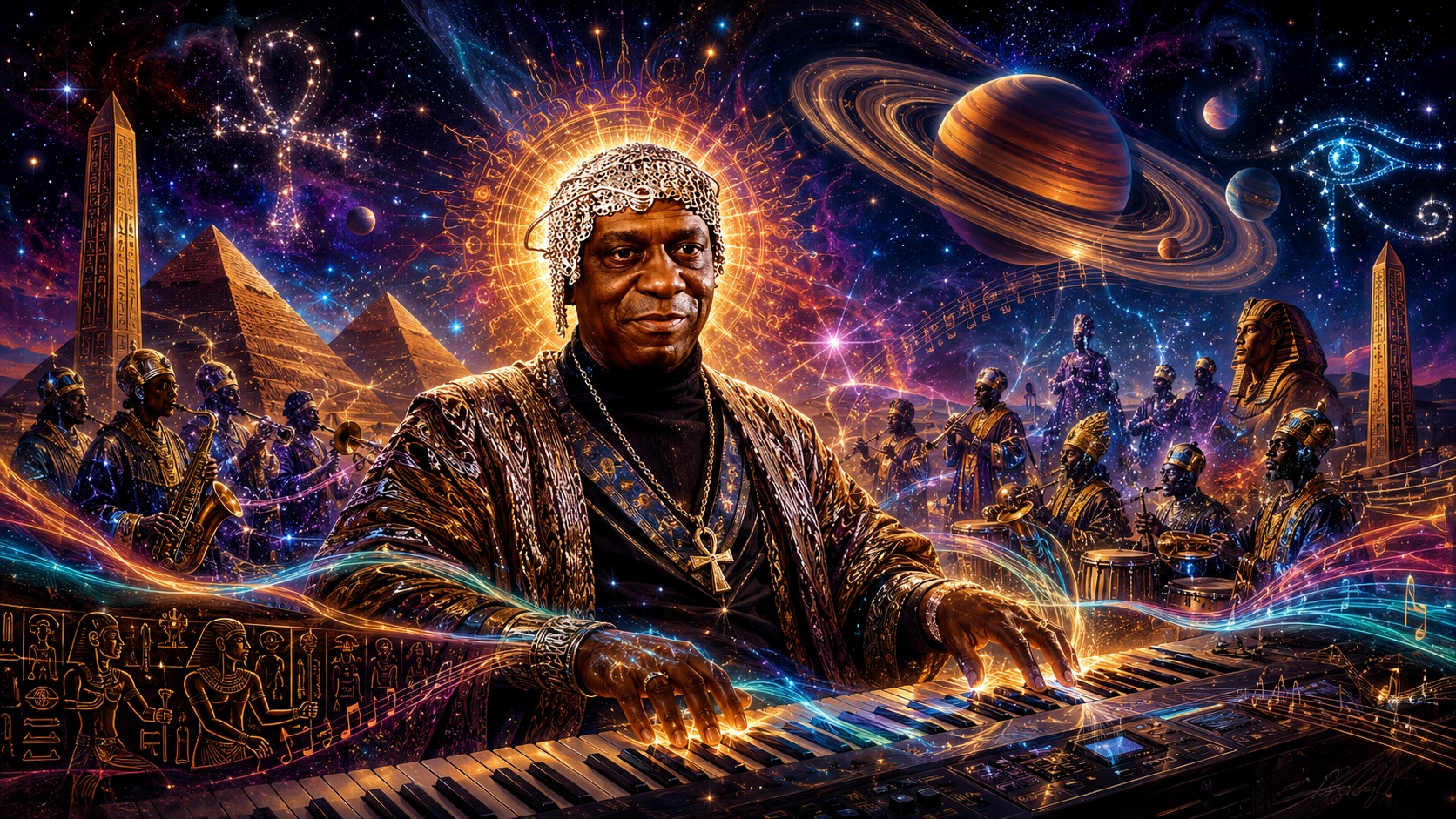
Sun Ra was a visionary American jazz composer and bandleader celebrated for his pioneering role in the Afrofuturism movement. Born as Herman Poole Blount, he later renounced his legal identity to adopt a cosmic persona, claiming he originated from the planet Saturn. Over his expansive career, he led the Arkestra, an experimental ensemble known for its theatrical performances and diverse musical styles ranging from swing to free jazz. A prolific recording artist and an early adopter of electronic synthesizers, he used his art to express a distinctive “cosmic” philosophy concerned with peace, Black identity, and alternative futures. His vast discography and enduring influence continue to shape modern music, film, and philosophy. Sun Ra died on 30 May 1993 in Birmingham, the city of his birth, completing what he might have called the great parabola: the arc of a rocket that returns, changed, to where it began.
Herman “Sonny” Blount was born on May 22, 1914, in Birmingham, Alabama, to Ida and Carry Blount. His parents separated early, and he was raised primarily by his mother, great-aunt Ida, and maternal grandmother. Named after Black Herman, the famous vaudeville magician known for “raising the dead,” he grew up in a household where the marvellous and the everyday overlapped. Great-aunt Ida took the young Blount to see touring bands led by Duke Ellington, Fletcher Henderson, and Fats Waller, giving him early exposure to the breadth of Black orchestral music and seeding a deep reverence for its history.
Music emerged as his first language. When Ida bought him a piano at age eleven, Blount taught himself to play, using his sister’s lesson books to learn to read notation. By twelve he was composing and sight-reading, and relatives recalled that he could reproduce entire big-band arrangements from memory after hearing them once. He attended Birmingham’s segregated Industrial High School (now Parker High School), where music teacher John T. “Fess” Whatley ran a famously demanding programme that produced many professional musicians. Industrial High, then the largest Black high school in the United States, was where Blount developed his lifelong commitment to discipline—an ethic he later instilled in the Arkestra through all-day rehearsals and relentless practice. During his youth he also lived with a medical condition, cryptorchidism, which caused chronic physical discomfort and likely contributed to a strong sense of social isolation, turning him further inward towards music and study.
Birmingham also served as a fertile ground for Blount’s spiritual and intellectual awakening. As a young man, he devoured books at the Black Masonic Lodge—one of the rare spaces where African Americans enjoyed unrestricted access to literature. There, he immersed himself in works on Freemasonry, esotericism, and ancient history, which sparked his boundless imagination to hidden connections between Africa, the ancient Mediterranean, and the modern world. He likely encountered the Moorish Science Temple, Black Masonic traditions, and early Pan-Africanist debates. Works such as George G. M. James’s Stolen Legacy, which argued that classical Greek philosophy drew heavily on ancient Egyptian thought, made a deep impression. These early encounters planted the seeds of the “myth-science” that would later characterise his philosophy: a hybrid approach that treated myth, history, and esoteric knowledge as tools for reconfiguring the present.
In 1934, Blount began his professional career touring with his former teacher Ethel Harper before taking over leadership of the group as the Sonny Blount Orchestra. He briefly attended Alabama Agricultural and Mechanical University on a scholarship in 1935 but left after a year. Blount later claimed that during his college years, around 1936 or 1937, he experienced a visionary event that he described as teleportation to Saturn. In his account, his body changed, he could see through himself, and he rose up, no longer in human form, to a distant planet. There, extraterrestrial beings placed him on a stage and charged him with a mission: to stop attending college because there would be great trouble in schools and to speak instead through music so that the world might listen. Whether taken literally or as a personal myth, this experience became central to how he understood his life’s task.
During the Second World War, Blount became one of the first Black conscientious objectors, refusing military service on religious and personal grounds. His refusal led to imprisonment and then to a period of alternate service in a forestry camp, before he was discharged in 1943 due to a hernia. The ordeal left him deeply embittered and radicalized, pushing him to the brink of suicide. In 1945, following the death of his great-aunt Ida, he left Birmingham for Chicago as part of the Second Great Migration, joining thousands of other Black Southerners seeking new opportunities in the urban North.
In Chicago, Blount quickly established himself on the local music scene. His recording debut came in 1946 with blues singer Wynonie Harris. More significantly, in August that year he joined bandleader Fletcher Henderson’s orchestra at the Club DeLisa as pianist and arranger. Although Henderson’s great band of the 1920s had long since dissipated, Blount found in him a living connection to the jazz tradition and a lesson in what could happen when innovators were not supported by the industry or the public. Fellow musicians such as Dizzy Gillespie encouraged him to persist in his unorthodox musical direction, and Thelonious Monk reportedly defended him against critics who dismissed him as “too far out,” remarking simply, “Yeah, but it swings.”
Chicago in the late 1940s was a crucible of Black intellectual and spiritual life. Black Muslims, Black Hebrews, Pan-Africanists, storefront preachers, and esoteric thinkers argued their positions on street corners and in small meeting halls, producing and distributing pamphlets that circulated through the community. Blount immersed himself in these debates, reading Afrocentric histories, theosophical texts, ancient Egyptian literature, and the Tibetan Book of the Dead. Out of these materials he developed what he later called “Astro-Black Mythology”: a cosmology that linked ancient Egyptian heritage to an intergalactic future. In his reading, Black people were literally the descendants of ancient Egyptian civilisation, and the way forward from the catastrophe of enslavement and colonialism was not a simple return to the past but a cosmic leap towards a new destiny beyond Earth. He concluded that African history had been systematically suppressed and distorted by European powers, and that art and myth had to be mobilised to counter that erasure.
Around 1951, Blount joined a study circle in Chicago called Thmei Research, named after the Egyptian goddess of truth and justice. Together with a young radiologist, Alton Abraham, and others, he participated in community meetings, produced mimeographed newsletters, and gave public lectures in Washington Park. Abraham subscribed to numerous esoteric magazines, and he and Blount collected thousands of occult pamphlets and volumes. Thmei Research became the intellectual and spiritual laboratory in which “Sun Ra”—as a mythic persona and sustained project—was conceived and developed.
On October 20, 1952, Blount took the transformative step of legally changing his name to Le Sony’r Ra, discarding “Blount” as a remnant of captivity. The name “Ra” invoked the ancient Egyptian sun god, but in Sun Ra’s cosmology, it carried a deeper significance: “Over half the Black people in America are ancient Egyptians, although they don’t know it. So I’m doing really what comes natural for me and them.”
In musical terms, he was equally innovative. In 1956, Sun Ra became the first jazz musician known to have recorded with an electric piano, integrating its timbres into his already distinctive ensemble sound. In 1957, he and Alton Abraham founded El Saturn Records, making him one of the first Black artists to own an independent label and retain control of his masters. “It was me creating something that nobody owned but us,” he later recalled. El Saturn released two landmark early albums—Super-Sonic Jazz (1957) and Jazz in Silhouette (1959), the latter widely regarded as one of the finest jazz records of the late 1950s. Over the course of his career, Saturn and associated imprints issued well over 200 albums and more than 1,000 individual tracks, many in small, hand-distributed runs that later became collectors’ items.
Sun Ra’s music defies strict periodisation, but it is often described in three broad phases. In each, he worked according to a principle he called an “equation” rather than a philosophy: music as a pragmatic, logical intervention in reality. The Chicago phase of the 1950s moved from tightly arranged swing and bebop towards what critics labelled “cosmic jazz”—orchestral music that remained accessible and often reminiscent of Duke Ellington or Count Basie, yet was enriched by modal experimentation, unusual harmonies, and exotic percussion. Albums such as We Travel the Space Ways, The Nubians of Plutonia, and Jazz in Silhouette belong to this period.
The New York phase, roughly 1961–1968, saw the Arkestra relocate to Manhattan and then to Brooklyn. The ensemble expanded to include multiple drummers and an array of percussion instruments, and Sun Ra began conducting through body gestures, a method later associated with cornetist Butch Morris. Electronic instruments, present in his work since the mid-1950s, became increasingly central: synthesizers, electric pianos, and tape delay helped him create dense, otherworldly textures years before such sounds became common in jazz. He rejected the label “free jazz” for this work, preferring to describe it as “phre music,” explaining that “ph” is a definite article and “Re” the name of the sun: music of the sun. Notable albums from this period include The Magic City, The Heliocentric Worlds of Sun Ra, Atlantis, and Cosmic Tones for Mental Therapy.
The Philadelphia phase, from 1968 until his death, was marked by stylistic eclecticism. In this period, performances and recordings might juxtapose swing standards with avant-garde compositions, Disney melodies with percussion-driven improvisations. Sun Ra insisted on affirming “a continuity with the ignored jazz tradition,” famously declaring, “They tried to fool you, now I got to school you, about jazz.” His approach during these years underscored his belief that innovation did not require the rejection of earlier Black musical forms, but rather their re-contextualisation within a broader, cosmic frame.
From the mid-1950s until his death, Sun Ra led what he called the Arkestra, a collective, communal, ever-evolving ensemble that functioned simultaneously as musical group, esoteric study circle, and way of life. The Arkestra lived, rehearsed, and toured together. In New York, they occupied a communal residence known as the Sun Palace, which allowed for spontaneous, round-the-clock rehearsals. During this time the band adopted the futuristic, Egyptian-inspired costumes—robes, capes, headdresses—that became their visual trademark. In 1968 the group relocated to the Germantown section of Philadelphia. Their new home, a three-storey rowhouse at 5626 Morton Street, became the Arkestral Institute of Sun Ra and has remained the Arkestra’s base for more than half a century. Neighbours came to regard them as respectable and somewhat eccentric residents: drug-free, friendly with children, and occasionally offering free afternoon concerts in the local park.
Throughout the 1970s and 1980s, Sun Ra and the Arkestra toured internationally, performing at European festivals, in Japan, and across the Americas. They made multiple visits to Egypt, where they performed near the pyramids, further cementing the connection between Sun Ra’s personal mythology and ancient Nile Valley heritage. In 1971 he served as artist-in-residence at the University of California, Berkeley, where he taught a course titled “The Black Man in the Cosmos,” blending esoteric readings with discussions of history and contemporary politics. He also starred in the 1974 feature film Space Is the Place, which offered a cinematic synthesis of his “cosmic” philosophy.
Space Is the Place, directed by John Coney, is often cited as Sun Ra’s most complete artistic statement. In the film, he appears as a figure arriving from outer space to establish a Black society on another planet—a utopian world where Black people can live “without European people around,” transported not by rockets but by the power of music. The film functions simultaneously as blaxploitation pastiche, cosmic ritual, concert film, and political manifesto. Some scholars read it as his response to formations like the Black Panther Party, suggesting that he advocated not only terrestrial community programmes but also a musical and imaginative technology capable of transforming consciousness itself. The script includes a line that distils his sense of ancestral mission: “I’m actually a presence sent to you by your ancestors,” presenting Sun Ra as a messenger not only from Saturn but from the collective ancestral soul of the Black diaspora.
Humour occupied a significant place in his worldview. Sun Ra stated that a sense of humour was essential because the world’s situation was so serious that people might otherwise go mad. “There’s also that sense of humor, by which people sometimes learn to laugh about themselves,” he said. “The situation is so serious that the people could go crazy because of it. They need to smile and realize how ridiculous everything is. A race without a sense of humor is in bad shape.” Members of the Arkestra corroborated this dimension of his character. Drummer Andrew Cyrille recalled that Sun Ra’s comments were often humorous, occasionally ridiculous, and frequently accurate in their insights.
By the final decades of his life, Sun Ra had come to be regarded as a founding figure of Afrofuturism, a cultural philosophy and aesthetic that uses science fiction, ancient African heritage, technology, and cosmic imagery to imagine liberated Black futures. He was among the earliest African American artists to engage the imagery of the Space Age as a political and imaginative field. Observing that Black people were largely absent from mainstream visions of the future, he argued, in practice, that the response was to generate alternative futures in which they were central. His influence now radiates across multiple generations and genres of artists and thinkers.
Scholars of Afrofuturism and African diaspora thought frequently situate Sun Ra within the African trickster tradition, alongside figures such as Eshù/Elegguá, Anansi, and Legba. Like these deities, he is seen as standing at the crossroads of identities: Saturn and Alabama, prophet and comedian, philosopher and hustler, ancient Egyptian pharaoh and avant-garde bandleader. His humour and paradoxes functioned as gates, requiring listeners to move beyond literal-minded interpretations to access deeper meanings. His stage costumes—robes, headdresses, and Egyptian iconography—were at once sincere spiritual attire, a critique of the ways Black performers had been costumed and commodified, and a joyful disruption of conventional expectations. He also commented that many avant-garde musicians took themselves overly seriously, and that his costuming was, among other things, a form of comic relief.
Beyond music and performance, Sun Ra was a substantial poet and writer. His poem collections, most notably This Planet Is Doomed: The Science Fiction Poetry of Sun Ra (Kicks Books), with a foreword by Amiri Baraka, gather texts that circulated in mimeographed booklets or appeared as lyrics and chants within Arkestra performances. His poetry reiterates the core themes of his music: outer space and apocalypse as recurrent motifs, the Earth as backward and exhausted, ancient African history as both wound and resource, and a paradoxical love for humanity expressed through warnings of impending catastrophe. Lines such as “I pull the veil aside and step through its portals; dreams rush to meet me” illustrate how he combined mystical imagery with political and philosophical concerns. He himself underscored the unity of his practice by stating, “The music is the words and the words are the music.”
Sun Ra suffered a stroke in 1990 but continued to compose, perform, and lead the Arkestra for as long as his health allowed. In late 1992 he returned to Birmingham to live with his elder sister, Mary Jenkins, who, together with Blount cousins, became his primary caregiver. In January 1993 he was admitted to Princeton Baptist Medical Center, suffering from congestive heart failure, respiratory failure, strokes, circulatory problems, and other serious illnesses. He died in hospital on 30 May 1993 and was buried in Elmwood Cemetery. His grave’s footstone reads: “Herman Sonny Blount aka Le Sony’r Ra.”
The Arkestra has continued to perform in the decades since his death, led by long-time members such as John Gilmore and, later, Marshall Allen, who has preserved and extended the ensemble’s repertoire. Since 1993, Sun Ra has also been the subject of sustained academic study across musicology, African diaspora studies, philosophy, literature, and film. John F. Szwed’s Space Is the Place: The Lives and Times of Sun Ra (1997) remains a key biographical and interpretive work. The Sun Ra / El Saturn Archive—approximately six hundred tapes recorded between the 1950s and 1993, housed at Chicago’s Experimental Sound Studio—serves as an important resource for scholars and musicians, while documentary projects such as the American Masters film Sun Ra: Do the Impossible have introduced his story to broader audiences.
In an era of resurgent Afrofuturism—from films like Black Panther to the work of artists such as Janelle Monáe and the renewed attention to writers like Octavia Butler—Sun Ra’s foundational importance becomes increasingly evident. Decades before these developments, he recognised that one of the most radical acts available to a Black artist was to refuse the inherited terms of the world and to imagine, through music, myth, costume, film, poetry, and performance, a world arranged otherwise. He was far from naive about the condition of the planet; he often suggested that the world was deeply, perhaps fatally, damaged. Yet his humour, his trickster wit, his “cosmic algebra,” and his vast body of music offered, at once, diagnosis, lament, and alternative. “The possible has been tried and failed,” he declared. “Now it’s time to try the impossible.”
Source:
https://en.wikipedia.org/wiki/Sun_Ra
https://www.ebsco.com/research-starters/history/sun-ra
https://alafricanamerican.com/herman-poole-blount-sun-ra/
https://findingaids.library.upenn.edu/records/UPENN_RBML_PUSP.MS.COLL.1572
https://www.arts.gov/honors/jazz/sun-ra (linked from and https://encyclopediaofalabama.org/article/herman-blount-sun-ra/
https://www.frieze.com/article/sunrise-different-dimensions
https://corbettvsdempsey.com/exhibitions/pathways-to-unknown-worlds-sun-ra-el-saturn-chicagos-afro-futurist-underground-1954-1968/
https://en.wikipedia.org/wiki/El_Saturn_Records
https://www.pbs.org/wnet/americanmasters/how-sun-ra-created-his-own-label/37466/
https://icareifyoulisten.com/2024/04/sun-ra-el-saturn-archive-iconic-bandleaders-living-inspiration/
https://lavelleporter.com/2014/05/21/sunra100/
https://hotblog69.wordpress.com/2013/06/12/sun-ras-intergalactic-legacy-the-work-of-sun-ra-and-his-influence-on-contemporary-electronic-music
https://www.nortonrecords.com/kb2-this-planet-is-doomed-the-science-fiction-poetry-of-sun-ra/