
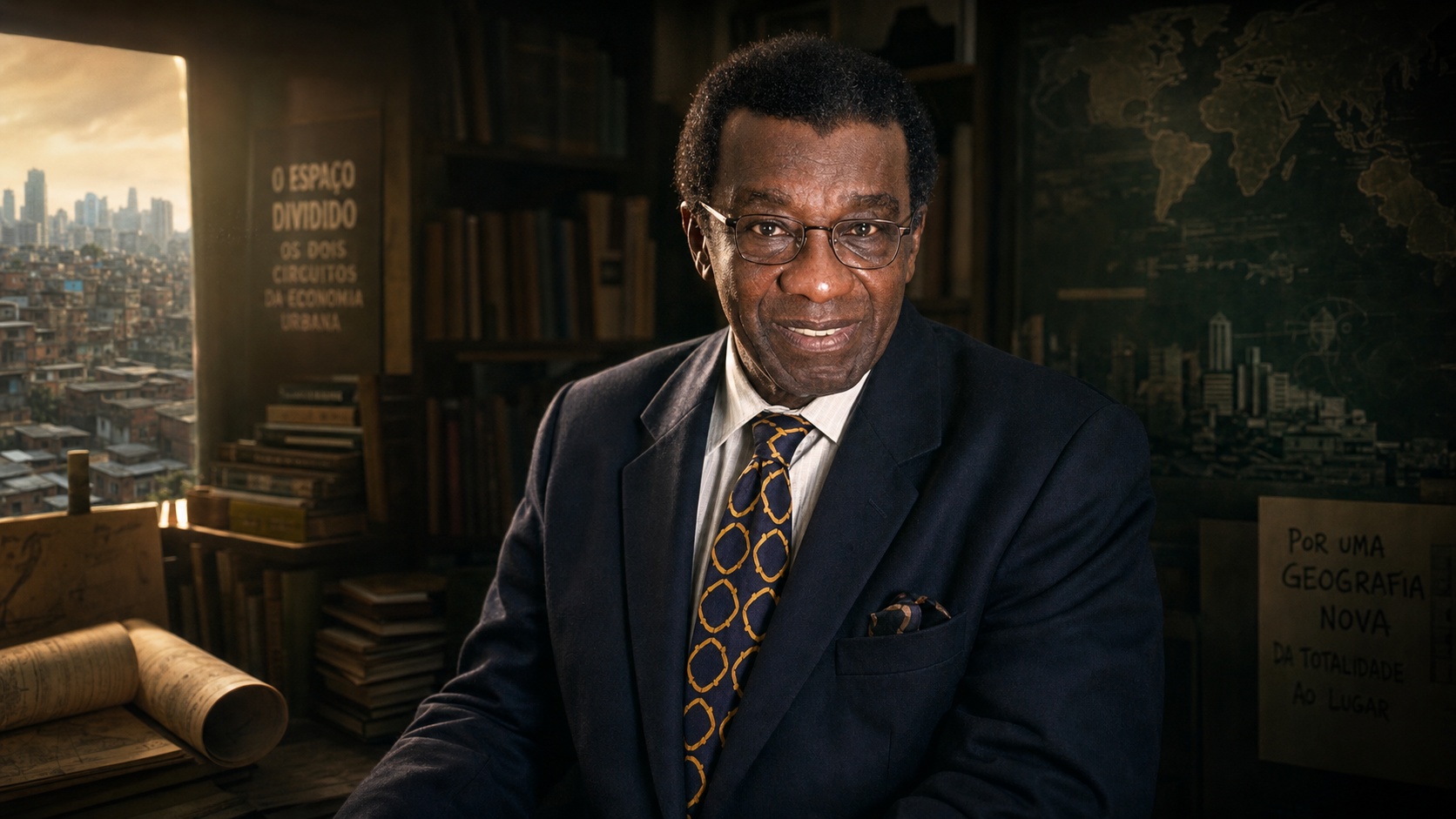
Milton Almeida dos Santos was a pioneering Black Brazilian geographer whose groundbreaking work reshaped global understandings of cities, space, and globalization from the vantage point of the dispossessed. In 1994, he became the first Latin American — and the first non–Anglo-Saxon scholar — to receive the prestigious Vautrin Lud International Geography Prize, widely regarded as the Nobel Prize of geography. This honor recognized a lifetime devoted to mapping the geographies of inequality and insisting that those relegated to the margins of modern society are, in fact, central to its fabric. Santos remains one of the most influential figures in Brazilian and Latin American social sciences, forging a critical geography of the Global South that directly confronts the ongoing legacies of the Maafa, colonialism, and racial capitalism.
Education and Early Career
There is a particular kind of knowledge that does not begin in libraries. It begins in the red earth of the interior, in the silence between poverty and aspiration, in the face of a father who should not, by the logic of his world, have been able to read — and yet did. Milton Almeida dos Santos was born on May 3, 1926, in Brotas de Macaúbas, a small town nestled in the Chapada Diamantina highlands of Bahia, Brazil. His parents were elementary school teachers — descendants of captive people freed after Brazil’s 1888 abolition decree — who taught their son at home and moved frequently through the interior of Bahia in search of work. By the age of eight, he had already completed the equivalent of an elementary school education.
His paternal grandfather had been held in captivity, and his father constantly reminded him that the family’s relative access to education rested on that unhealed historical wound. That inheritance — the pain of oppression transmuted into the dignity of learning — became the animating force of everything Santos would eventually build. He was a Black man in a country that had spent four centuries insisting that Black people occupied the bottom rung of geography and society. He spent his life proving, with meticulous intellectual care, that the bottom rung was not natural — it was constructed, maintained, and could be dismantled.
As a teenager, Santos was sent to Alcobaça to study French and “good manners,” a sign of his parents’ determination to arm their son with tools usually reserved for the Brazilian elite. He moved to Salvador for secondary education, financing his own studies by teaching geography and mathematics to fellow students. Higher education was not easily accessible to him, but he learned French and English largely by himself and enrolled in law at the Federal University of Bahia.
He graduated in law, but instead of practicing, he took a position teaching high-school geography in Ilhéus, the cocoa capital of Bahia. In Ilhéus, he also worked as a journalist for the newspaper A Tarde, honing the public voice that would eventually make him a powerful critic of Brazilian society. His path had already begun to bend away from the courtroom and toward a different kind of advocacy: geography as a weapon of clarity for the dispossessed.
In 1955, Santos traveled to France to pursue doctoral studies at the University of Strasbourg. He earned his doctorate in Human Geography in 1958 with a thesis on the population and urban center of Bahia, work that already showed his concern with the city as a concentration of historical and social forces rather than a neutral container of streets and buildings. Salvador — the first capital of colonial Brazil, the port through which millions of Africans were trafficked into the Americas — became for him a living archive of the ways colonialism, captivity, and capitalism inscribe themselves into space.
Exile and the Global South Itinerary
Santos returned to Brazil in 1959 and became a professor at the Federal University of Bahia, while also continuing his work in journalism and public life. His sociological analyses of Bahia’s geography made him a staunch critic of the plight of those excluded by Brazilian society and a defender of their claims on space and citizenship. This growing public presence, however, made him vulnerable when Brazil entered its darkest political period.
On April 1, 1964, a military coup overthrew the democratic government of President João Goulart and installed a dictatorship that would last two decades. Shortly after the coup, Santos was arrested under the National Security Law, imprisoned for roughly two months, and released only after suffering a serious health crisis that nearly led to a heart attack. Dismissed from his university post by the new regime, he was forced into exile — an expulsion that uprooted him from Bahia but opened a different, planetary classroom.
Over the following years he taught and worked as a consultant in France, the United States, Canada, Peru, Venezuela, Great Britain, Nigeria, and Tanzania. He held positions at institutions such as the Sorbonne in Paris and MIT, and served as an expert for organizations including the International Labour Organisation, the Organisation of American States, and UNESCO. At the University of Dar es Salaam in Tanzania, he encountered another port city shaped by a different but related slave trade, one that further deepened his understanding of how colonization and capitalism had organized the world’s spaces from the perspective of the powerful.
Exile was a wound, but it was also a method. Santos was no longer studying one peripheral city; he was moving among many, tracing the common patterns that linked Latin American favelas, African cities, and the marginalized zones of the so-called Third World. He saw that the geography of underdevelopment was not an accident or a lack. It was an intentional pattern, reproduced at different scales by the same global forces.
For a New Geography
In 1977, Santos returned to Brazil and joined the University of São Paulo, where he would remain for the rest of his career. The following year he published Por uma Geografia Nova (For a New Geography), a book that has since become a classic in radical and decolonial geography. The argument was uncompromising: traditional geography, as developed in Europe and North America, had often served as an instrument of colonial domination — mapping, classifying, and ordering lands and peoples in ways that justified conquest and extraction.
A “new” geography, in Santos’s vision, had to think globally while centering those at the margins. It had to situate local conditions within the wider context of capitalist globalization, which he described as a “perverse universalization” — a system that spread itself across the planet under the banner of generalization and progress while deepening discrimination, concentrating power in the hands of a few and increasing the vulnerability of the many. He insisted that every place, however small or seemingly insignificant, was “in its own way the world” because the largest historical forces were always present in local space.
One of his most influential contributions was the theory of the “two circuits” of the urban economy in underdeveloped countries, elaborated in works like O Espaço Dividido. The upper circuit consisted of modern firms, advanced technologies, and global capital; the lower circuit comprised the informal economy — street vendors, domestic workers, market women, small repair shops — populated largely by the poor and disproportionately by Black and brown people. Santos showed that these circuits were not separate worlds but deeply interdependent, with the upper circuit feeding on and externalizing costs onto the lower.
Another central concept was “used territory” (território usado), which he defined as the concrete, lived territory produced by those who actually use and inhabit it, not the abstract lines drawn on maps by distant authorities. Territory in this sense was a record of struggle: the accumulation of infrastructure, labor, violence, and everyday practices that made a place what it was. In Brazil, that meant a territory marked by Indigenous dispossession, African enslavement, and the unfinished project of Black and popular citizenship.
The Noble Geographer
Santos’s work did not go unnoticed. In 1994 he became the first Brazilian — and the first non–Anglo-Saxon scholar — to receive the Vautrin Lud International Geography Prize, often described as geography’s equivalent to the Nobel Prize. The award recognized his international standing in studies of cities, space, and territory, particularly in the Global South. In 1997 his book A Natureza do Espaço (The Nature of Space) received Brazil’s prestigious Jabuti Award, and he was named Professor Emeritus of the Faculty of Philosophy, Letters and Human Sciences at the University of São Paulo.
In his final major work, Por uma Outra Globalização (For Another Globalization, 2000), Santos turned his attention directly to the dominant discourse of the 1990s: globalization. He branded the actually existing globalization a “perverse phenomenon” that operated with a “mendacious vocabulary,” invoking phrases like “global village” and “world citizens” to mask the deepening inequalities it produced. Yet he refused fatalism. He argued that another kind of globalization was possible, one based on the everyday practices and values of ordinary people, on solidarity rather than competition, and on a different relationship between technique, territory, and power.
For colleagues such as Aziz Ab’Sáber, Santos was not only a geographer but “a philosopher of geography,” a thinker whose independent spirit stood in the lineage of Jean-Paul Sartre while being rooted in the realities of Black and poor Brazil. French newspaper Le Monde situated him explicitly within the Black intelligentsia of Brazil, underlining how his contributions were inseparable from the history of slavery, racial hierarchy, and resistance in that country.
Santos died of cancer on June 24, 2001, in a public hospital in São Paulo. The place of his death was emblematic: a public institution in a city whose inequalities he had spent a lifetime mapping and contesting. His thinking continues to travel — translated, taught, and taken up by scholars and activists who are trying to understand not only where we are, but how we got here and how the map might be drawn otherwise.
Santos and the Afterlife of the Maafa
Although Santos did not always name the transatlantic trafficking directly in his theoretical writings, the Maafa is present everywhere in the landscapes he described. His hometown of Bahia and his doctoral focus, Salvador, were central nodes in the Atlantic system, ports through which millions of Africans were forced into the Americas. The favelas, informal settlements, and segregated neighborhoods that concerned him so deeply were not simply products of recent policy failures; they were the spatial afterlife of the Maafa, the continuation of oppression in urban form.
His theory of the divided city can be read as a map showing how the descendants of the Maafa are kept within a structurally subordinate circuit of the economy, even as their labour and proximity are essential to the functioning of the affluent circuit. His concept of used territory invites readers to see Brazilian space as made by those whose ancestors were dragged across the Atlantic and forced to build others’ wealth, even as they were denied full citizenship.
For readers concerned with Maafa memory, Santos offers not only historical facts but also a method: a way of reading cities, territories, and global flows that makes visible the ongoing work of captivity and colonialism in the present. His geography is noble because it insists on the dignity and centrality of those whom history has tried to place at the margins.
Sources:
http://ndl.ethernet.edu.et/bitstream/123456789/36561/1/19.pdf.pdf
https://www.springerprofessional.de/en/milton-santos-a-pioneer-in-critical-geography-from-the-global-so/12271444
https://irgac.org/articles/milton-santos-space-technique-and-globalization
https://en.wikipedia.org/wiki/Milton_Santos
https://progressivegeographies.com/2021/12/15/milton-santos-the-nature-of-space-and-for-a-new-geography-with-a-commentary-at-progressive-geographies/
https://onlinelibrary.wiley.com/doi/pdf/10.1111/anti.12319 https://www.dukeupress.edu/the-nature-of-space