

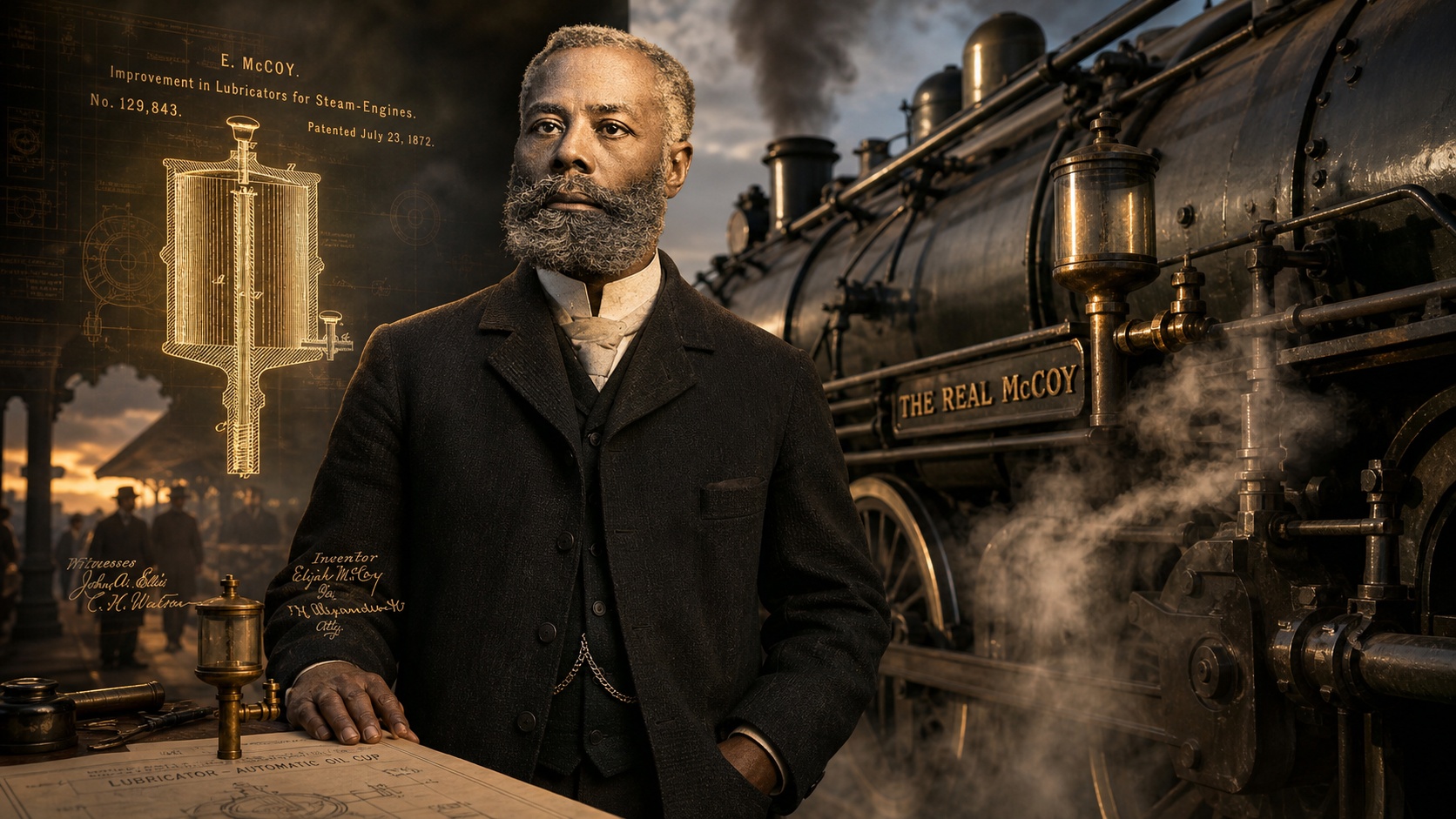
Elijah McCoy was a pioneering Black Canadian‑American mechanical engineer and inventor whose automatic lubricator transformed steam power and became synonymous with the idea of “the real McCoy.”
Early life and roots in freedom
Elijah J. McCoy was born on 2 May 1844 in Colchester, Ontario, Canada West, to George and Mildred McCoy, who had escaped enslavement in Kentucky via the Underground Railroad. His parents settled on farmland granted in recognition of George McCoy’s service in the British forces during the War of 1812, creating a fragile but determined freedom in which their children were raised. Growing up in this borderland Black community, Elijah showed an early aptitude for mechanics, spending hours experimenting with his father’s tools and observing how everyday devices worked. Although schools in Upper Canada were segregated, he received his early education in Black schools in Colchester Township, where his curiosity about machines and motion continued to deepen.
Apprenticeship in Scotland and the “fireman engineer”
Because advanced technical training was effectively closed to Black students in North America, his family sent him at about age fifteen to Edinburgh, Scotland, where he apprenticed and studied mechanical engineering, eventually qualifying as a mechanical engineer. This was an extraordinary step for a Black teenager in the mid‑nineteenth century, reflecting both his evident talent and his parents’ belief that expertise could be a pathway to secure freedom. When McCoy returned to the United States, however, he encountered entrenched racism: despite his Scottish credentials, no firm would hire him as an engineer, and the doors of formal professional practice remained closed. He accepted work with the Michigan Central Railroad in Ypsilanti as a fireman and oiler, responsible for shovelling coal, maintaining steam pressure, and stopping the train at intervals to manually lubricate the engine’s moving parts. Rather than seeing this as a humiliation, McCoy treated the footplate and roundhouse as a laboratory, using his engineering training to study the inefficiencies of steam locomotives firsthand.
Inventing the automatic lubricator
In the era before his innovation, steam engines had to be halted every few miles so that workers could apply oil by hand to pistons, cylinders, and other moving components, a process that wasted fuel, time, and money and exposed machinery to uneven wear. Drawing on two years of experimentation in a small workshop near his home in Ypsilanti, McCoy devised an automatic lubricator—a compact “oil‑drip cup” that used steam pressure and gravity to feed measured amounts of oil to moving parts while the engine remained in motion. In 1872 he secured U.S. patent 129,843 for an “Improvement in Lubricators for Steam‑Engines,” formalising a design that could be fitted to locomotives and marine engines and later to factory machinery. Railroad companies quickly recognised that his device allowed trains to run for long stretches without stopping, increasing speed, reducing breakdowns, and cutting operating costs so dramatically that the lubricator soon became standard equipment. Over subsequent decades, McCoy refined his systems, developing new variants—such as a graphite lubricator for superheated machinery—that extended automatic lubrication into emerging industrial applications.
“The Real McCoy” and an authentic reputation
McCoy’s lubricators gained a reputation among engineers and railroad operators for reliability and durability, and as the design spread, imitators rushed to market cheaper, inferior copies. According to widely circulated accounts, buyers and mechanics came to insist on his genuine devices, asking whether a product was “the real McCoy” to distinguish it from knock‑offs, a phrase that entered broader English usage as a shorthand for the authentic, best‑quality article. Linguists note that expressions resembling “the real McCoy” may have earlier roots—such as Scottish advertising slogans—so the exact etymology is debated, but the association with Elijah McCoy became firmly attached in popular memory and Black historical narratives. Whatever its precise linguistic origin, the phrase aptly captures how his work set a benchmark for industrial reliability in an age when technological change was remaking everyday life. Within Black communities, “the real McCoy” also came to stand as a quiet tribute to a Black engineer whose excellence prevailed despite structural exclusion.
Prolific inventor beyond the railroads
Though best known for his railroad lubricators, McCoy was a remarkably prolific inventor, holding somewhere between 50 and 57 patents over the course of his life, most of them related to lubrication technology. He applied his ingenuity to domestic and consumer life as well, patenting designs for a folding or portable ironing board, a lawn sprinkler, and improved rubber heels for shoes—devices that brought his engineering sensibility into the rhythms of everyday labour and leisure. As his reputation grew, McCoy increasingly worked as a consultant for engineering firms, and in 1920 he founded the Elijah McCoy Manufacturing Company in Detroit to produce lubricators under his own name rather than seeing others profit from his designs. This entrepreneurial move was both a bid for economic independence and an assertion of authorship in a world where Black inventors’ contributions were often obscured. Even so, many products that benefited from his ideas did not bear his name, illustrating the persistent gap between Black innovation and public recognition in the industrial age.
Hardship, loss, and late recognition
McCoy’s later years were marked by both institutional honour and personal tragedy. In 1922 he was involved in a serious automobile accident in which his second wife, Mary, was killed; he suffered injuries that led to declining health over the following years. He died on 10 October 1929 in Michigan, leaving behind a body of work that had quietly reshaped how machines moved across rail lines, oceans, and factory floors. Long after his death, institutions began to publicly acknowledge his impact: he was inducted into the National Inventors Hall of Fame in 2001, and in 2012 the U.S. Patent and Trademark Office named its first regional satellite office in Detroit the Elijah J. McCoy Midwest Regional Patent Office. Historical markers at sites associated with his life in Michigan, along with educational materials and plays, now preserve his story as part of the broader narrative of Black creativity in the making of modern industry.
A legacy of Black engineering excellence
Elijah McCoy’s life embodies a tension familiar in Black Atlantic history: world‑changing invention emerging within and against structures of racial exclusion. The son of freedom seekers, trained abroad because of colonial and American racism, he was forced into manual labour but used that position to mechanise away the very drudgery to which he had been relegated. His automatic lubricator not only accelerated trains and steamships but also symbolised how Black expertise underpinned the industrial revolution even when Black people were barred from its rewards. Through the enduring expression “the real McCoy,” his name has slipped into everyday language as a measure of authenticity, a reminder—often unspoken—of a Black engineer whose work became the unseen standard. Remembering him as more than a phrase restores Elijah McCoy as a figure of excellence, perseverance, and quiet, radical transformation in the history of global technology.
Sources:
https://en.wikipedia.org/wiki/Elijah_McCoy
https://www.britannica.com/biography/Elijah-McCoy
https://www.biography.com/inventors/elijah-mccoy
https://www.nps.gov/people/elijah-mccoy.htm
https://engineeringhalloffame.org/profile/elijah-mccoy
https://www.invent.org/inductees/elijah-mccoy
https://www.ljmu.ac.uk/about-us/edi/edipedia/a-to-z-list/elijah-mccoy/elijah-mccoy
https://www.machinerylubrication.com/Read/32292/elijah-mccoy-a-founding-far-to-machinery-lubrication-real-mccoy