
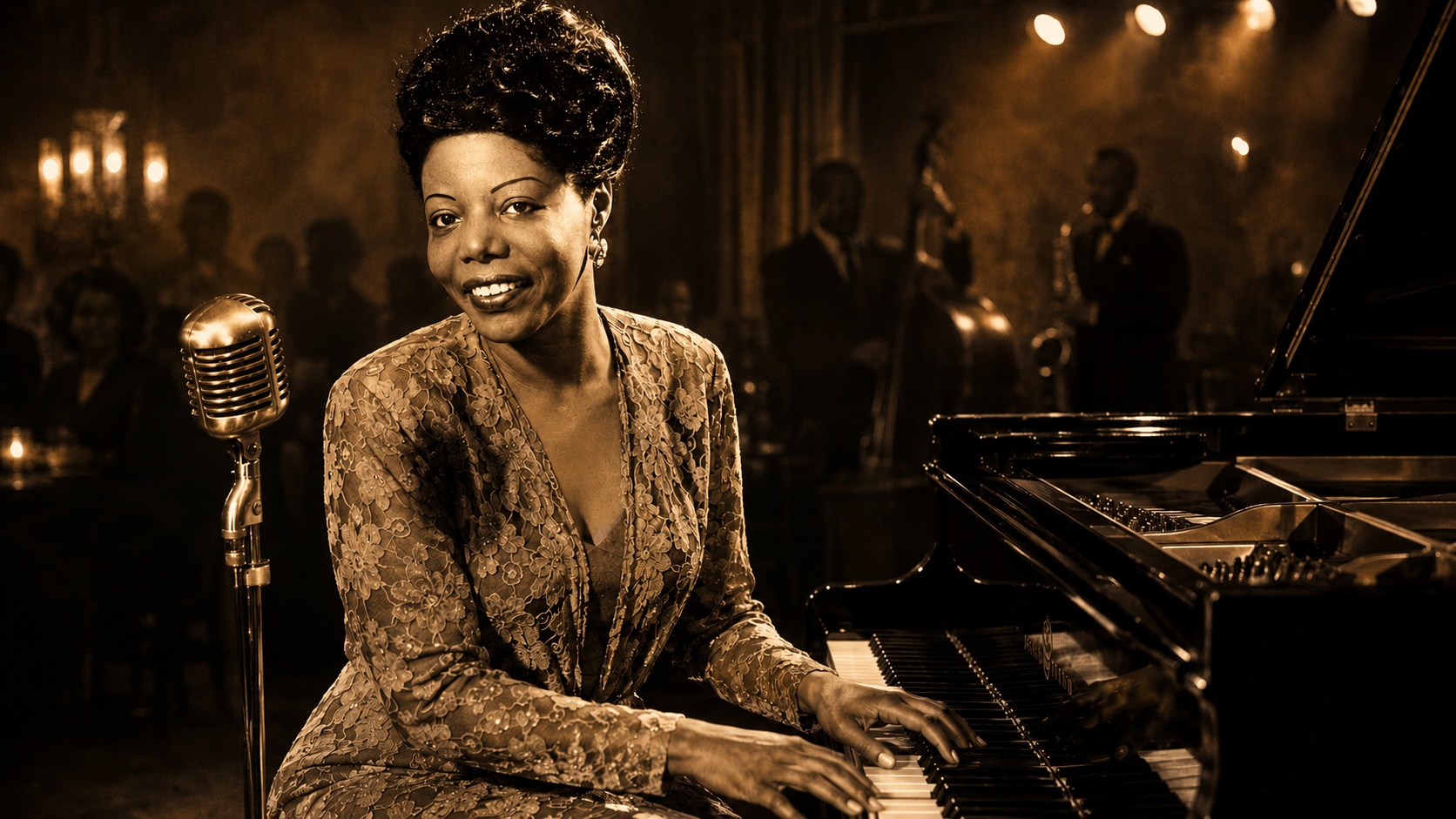
Mary Lou Williams was an African‑American jazz pianist, composer, arranger, and occasional vocalist, widely regarded as one of the most important architects of twentieth-century jazz. Over a career spanning more than five decades, she wrote hundreds of compositions and arrangements and recorded more than 100 records on 78s, 45s, and LPs. Williams wrote and arranged for bandleaders such as Duke Ellington and Benny Goodman, and she became a friend, mentor, and teacher to Thelonious Monk, Charlie Parker, Bud Powell, Miles Davis, Tadd Dameron, Dizzy Gillespie, and many others who would shape the bebop revolution.
Born Mary Elfrieda Scruggs on May 8, 1910, in Atlanta, Georgia, she soon adopted her stepfather’s surname and was known as Mary Lou Burley. She grew up in the East Liberty neighborhood of Pittsburgh, Pennsylvania, one of eleven children in a blended household. A self-taught prodigy, she taught herself to play the piano as a very young child, and by the age of six she was already helping to support her ten half-brothers and sisters by playing at neighborhood parties. She began performing publicly at seven and became known admiringly in Pittsburgh as “the little piano girl of East Liberty.”
By her early teens, Williams was working as a touring professional. In 1922, at around twelve years old, she joined the Orpheum vaudeville circuit. The following year, she briefly played with Duke Ellington and his early Washington, D.C. ensemble, the Washingtonians, when they passed through Pittsburgh. One vivid testament to her early power at the piano came when she was just fifteen: at a late‑night jam with McKinney’s Cotton Pickers at Harlem’s Rhythm Club, Louis Armstrong entered, listened in silence, then picked her up and kissed her in admiration, a memory she recalled with characteristic shyness.
At thirteen, she began working more regularly in vaudeville acts, and at sixteen, she married saxophonist John Williams. The couple moved to Memphis, where she recorded her first sides with the Synco Jazzers, before John joined Andy Kirk’s Kansas City‑based orchestra, the Twelve Clouds of Joy, in 1929. Williams initially contributed arrangements for the band from a distance, then filled in for an absent pianist on Kirk’s first recording session, impressing the group so much that she eventually became a full‑time member. Her intricate, swinging arrangements and striking solos were largely responsible for the band’s distinctive sound and eventual national success. A formidable stride pianist, she drew praise from contemporaries, including Jelly Roll Morton, who recognized in her both a keeper of the early piano traditions and a forward‑looking innovator.
During the 1930s and early 1940s, Williams emerged as one of the most sought‑after arrangers in swing. She wrote original works such as “Roll ‘Em” for Benny Goodman—a hard‑driving boogie‑woogie‑inflected piece that became a Goodman hit—and “What’s Your Story, Morning Glory?,” later popularized with lyrics by others. She also arranged for other major bands, including those of Goodman, Earl Hines, and Tommy Dorsey, shaping the rhythmic and harmonic language of big-band jazz from behind the scenes.
Mary Lou Williams remained with Andy Kirk’s Twelve Clouds of Joy until 1942, by which time she had divorced John Williams and later married trumpeter Harold “Shorty” Baker. She co‑led a small group with Baker before he joined Duke Ellington’s orchestra. Williams did significant writing for Ellington and his band, most notably her recasting of Irving Berlin’s “Blue Skies” into a high‑energy horn battle titled “Trumpets No End.” In 1948, she briefly played with Benny Goodman’s small bop‑oriented group, further modernising her style as jazz shifted into the bebop era.
By the early to mid‑1940s, Williams was already functioning as a spiritual and artistic centre for the young modernists who would transform jazz. In her Harlem apartment, she hosted, coached, and informally taught figures such as Thelonious Monk, Bud Powell, Tadd Dameron, Dizzy Gillespie, and Charlie Parker, encouraging their experiments with advanced harmony and rhythm while also grounding them in earlier traditions. Her ambitious “Zodiac Suite,” composed between 1942 and 1945 and premiered in 1945, showcased her modern concepts: a cycle of twelve pieces, each inspired by an astrological sign and associated musicians, blending swing, blues, modern classical harmony, and striking orchestral colors. Another notable work, “In the Land of Oo‑Bla‑Dee,” recorded by Dizzy Gillespie, offered a bebop fable mixing playful lyrics with complex, forward‑leaning writing.
In the early 1950s, Williams experienced what she later described as spiritual and emotional exhaustion. She spent 1952–1954 largely in Europe, performing in London and Paris, before returning to the United States and undergoing a profound religious conversion to Catholicism. For several years, she withdrew from performing, devoting herself to prayer, charitable work, and service, including feeding and supporting musicians in need in Harlem. Her commitment to faith eventually led her to imagine a new synthesis of jazz and liturgy.
Gillespie and other colleagues gradually coaxed her back to the bandstand. In 1957, she re‑emerged dramatically as a guest soloist with Dizzy Gillespie’s orchestra at the Newport Jazz Festival, demonstrating that her playing had only deepened. Over the 1960s, she increasingly focused on what she called “sacred jazz,” composing large‑scale liturgical works in the jazz idiom. She wrote at least three major Masses—often referred to as the “Pittsburgh Mass,” “Mary Lou’s Mass,” and other sacred suites—becoming the first jazz composer formally commissioned by the Catholic Church to write a Mass. In 1975, “Mary Lou’s Mass” was performed at St. Patrick’s Cathedral in New York, a landmark moment for both jazz and sacred music.
Stylistically, Williams remained restlessly contemporary. By the early 1970s, she could sound as harmonically and rhythmically searching as younger modal players such as McCoy Tyner, even as she drew freely on stride, swing, blues, and bebop in the same set. She had little affection for the more radical avant‑garde. Yet she occasionally ventured into freer territory, including a famously unsuccessful duo concert with Cecil Taylor in 1977, during which their approaches proved too divergent to reconcile. More often, she organized her later concerts as “history of jazz” recitals, moving from ragtime and spirituals through swing and bebop to contemporary idioms, all at the same piano.
Williams also became an important educator. In the 1970s, her work was embraced by a new generation of listeners and scholars, leading to a late‑career resurgence. From 1977 until her death, she served as an artist-in-residence at Duke University, where she taught the History of Jazz, coached ensembles, and directed the Duke Jazz Ensemble, bringing her lived knowledge of every era of jazz into the classroom. In 1978, she performed at the White House for President Jimmy Carter. She appeared as a featured artist at Benny Goodman’s 40th‑anniversary Carnegie Hall concert, a symbolic acknowledgement of the central role she had played in the music’s evolution.
Across her life, Mary Lou Williams recorded as a leader for numerous labels, including early piano solos for Brunswick in 1930, sessions for Decca in 1938, Columbia and Savoy, extensive sides for Asch and Folkways between 1944 and 1947, plus recordings for Victor, King, Atlantic, Circle, Vogue, Prestige, Blue Star, Jazztone, her own Mary Records label in the early 1970s, Chiaroscuro, SteepleChase, and Pablo in the late 1970s. Beyond records, her influence circulated through the scores she wrote for other bands, the protégés she nurtured, and the sacred works she offered to the Church.
Mary Lou Williams died of bladder cancer on May 28, 1981, in Durham, North Carolina, at the age of seventy‑one. By then, she had lived through and helped shape virtually every phase of jazz—from the classic stride era through swing, bebop, and the modal 1970s—while insisting that the music remain, at its core, an expression of spirit and community. Duke Ellington once said that her writing and performing had always been “just a little ahead” throughout her career; posterity has confirmed that she was not only ahead of her time but essential to it.
Source:
http://www.allmusic.com/artist/mary-lou-williams-mn0000859820/biography
https://en.wikipedia.org/wiki/Mary_Lou_Williams
https://www.britannica.com/biography/Mary-Lou-Williams
https://www.blackpast.org/african-american-history/williams-mary-lou-1910-1981
https://jazztimes.com/features/profiles/mary-lou-williams-mother-of-us-all
https://www.nashvillesymphony.org/classical-program-notes/mary-lou-williams-zodiac-suite
https://en.wikipedia.org/wiki/Zodiac_Suite
https://urbanfaith.com/mary-lous-sacred-jazz
https://www.nytimes.com/1981/05/30/obituaries/mary-lou-williams-a-jazz-great-dies.
htmlhttps://www.npr.org/2010/05/06/126537497/mary-lou-williams-on-piano-jazz