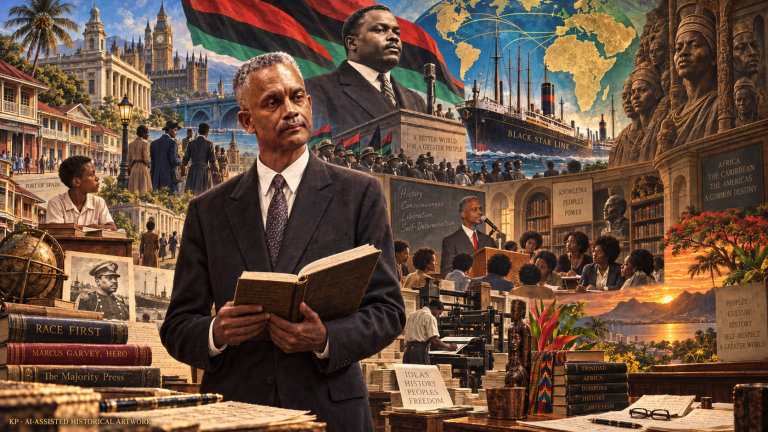

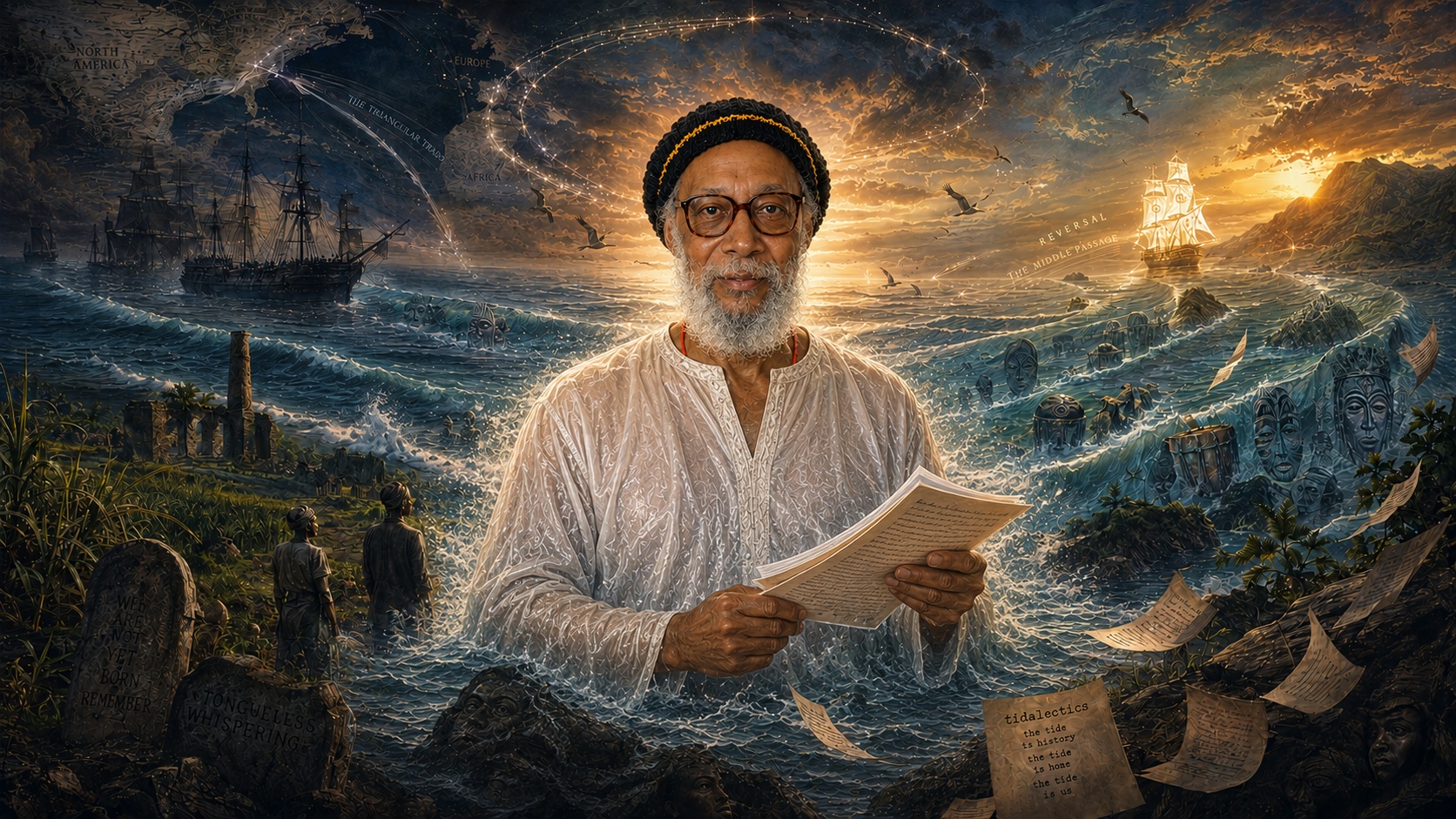
Edward Kamau Brathwaite — born Lawson Edward Brathwaite on May 11, 1930 — was a Barbadian poet, historian, linguist and cultural theorist who became one of the towering figures of Caribbean literature and of the Black Atlantic world. Over more than six decades, he traced the submerged African roots of Caribbean culture, language and landscape, insisting that those roots be named, honoured and thought on their own terms. Where colonialism scattered, Brathwaite gathered; where the Maafa severed, he stitched; where Western thought moved in straight lines, he moved like water — in tides.
Bridgetown beginnings
Brathwaite was born into the colonial world of Barbados to Hilton Brathwaite, a warehouse clerk, and Beryl Gill, a gifted pianist. He grew up in Bridgetown at a time when the island’s entire landmass had been reshaped into sugar production, what he would later call a “total plantation.” In 1945 he entered Harrison College, where he founded a school newspaper, wrote essays on jazz, and began publishing poems in Bim, the Barbadian literary journal that nurtured many of the region’s writers.
In 1949 he won the Barbados Island Scholarship and left for Pembroke College, Cambridge, to study history, graduating with a BA in 1953 and a Diploma of Education in 1954. While in Britain he began contributing poems and stories to the BBC’s Caribbean Voices programme, an early expression of his commitment to oral tradition and to speaking back to the region from abroad.
The Ghana years: reversing the Middle Passage
In 1955 Brathwaite made the journey that would transform his life and work: he left the Caribbean for the Gold Coast (later Ghana) to serve as an education officer in the Ministry of Education. He spent seven to eight years there, arriving in time to witness Kwame Nkrumah lead Ghana to independence in 1957, the first sub‑Saharan African country to break colonial rule. The experience profoundly shifted his understanding of Caribbean identity, allowing him to see the Caribbean as part of a wider African world rather than an isolated colonial outpost.
In Ghana he studied with the musicologist J. H. Kwabena Nketia, absorbing the rhythmic and tonal structures of Akan music, and worked with Efua Sutherland in the Ghana Folk Theatre, deepening his sense of poetry as performance and communal ritual. He later spoke of this period as a “radical rupture” and a “complete change” from his earlier, more “Keatsian” work, and critics have often described these years as his reversal of the Middle Passage: a Barbadian poet crossing eastward across the Atlantic to reconnect with the ancestral homeland that slavery had sought to sever.
In 1960 he married Doris Monica Wellcome, a Guyanese teacher and librarian; they would have one son, Michael.
Return, movement, and the Caribbean Artists Movement
Brathwaite returned to the Caribbean in 1962 and soon began teaching history for the University of the West Indies, first in St Lucia and then at the Mona campus in Jamaica. In the mid‑1960s, while completing a PhD at the University of Sussex, he co‑founded the Caribbean Artists Movement (CAM) in London with John La Rose and Andrew Salkey. What began as a gathering in his Bloomsbury flat in December 1966 grew into a major cultural formation, bringing together Caribbean writers, artists and intellectuals in Britain and helping to shape emergent Black British cultural identity.
His Sussex doctoral thesis became The Development of Creole Society in Jamaica, 1770–1820 (1971), a landmark historical study of how African and European peoples created a new creole society under slavery. The book cemented his reputation as both poet and historian and laid some of the groundwork for his later thinking on creolisation and nation language.
In 1971, during a fellowship in Kenya, he was given the name “Kamau” by the grandmother of novelist Ngũgĩ wa Thiong’o, a naming he experienced as the sealing of the bridge he had been building between Atlantic and ancestor, homeland and heartland.
Poet, theorist and innovator
Across the 1960s and 70s, Brathwaite emerged as a leading voice in Caribbean poetry. His trilogy The Arrivants: A New World Trilogy (1973) — comprising Rights of Passage, Masks and Islands — charts the migrations and psychic survival of African peoples across the diaspora, moving between the Caribbean, Africa, Britain and the Americas. In these books he experimented with broken lines, African‑derived rhythms, and a powerful mixture of history, myth and oral performance.
Alongside the poetry he developed influential concepts that reshaped Caribbean letters. In History of the Voice (1984) he argued that Caribbean English carries a submerged African rhythm and structure that he called “nation language,” challenging the colonial idea of “dialect” as a degraded form of English. He later coined “tidalectics” — a Caribbean way of thinking history and identity through the back‑and‑forth movement of the sea rather than the straight line of Western dialectics — and, in his later years, evolved the Sycorax “video style,” using computer fonts, spacing and layout to create visually and rhythmically charged poems on the page.
“Time of salt”
The late 1980s were, in Brathwaite’s words, his “time of salt.” In May 1986 his wife Doris was diagnosed with uterine cancer and died three months later, a loss he memorialised in The Zea Mexican Diary: 7 September 1926 – 7 September 1986, an intensely personal work often described as one of the most powerful love texts in Caribbean literature. In 1988 Hurricane Gilbert destroyed his home in Irish Town, Jamaica, along with his extensive personal library and manuscripts — his “Library of Alexandria,” as he called it.
Two years later, in 1990, three men broke into his home; one pressed a gun to the back of his head and pulled the trigger. The gun did not fire, but Brathwaite experienced the event as an assassination and began to refer to himself as a “ghost‑bullet” survivor. Out of this triple catastrophe — wife, archive, near‑death — came his Sycorax video style: a typographical, visually experimental mode of poetry that sought to capture dream, “riddim drama” and the fractured experience of Caribbean modernity on the computer screen and page.
Later years and honours
In 1992 Brathwaite was appointed Professor of Comparative Literature at New York University, dividing his time between New York and his home, CowPastor (often “Cow Pasture”), in Barbados. He remarried in 1998, to Beverly Reid, and continued to publish major works, including Born to Slow Horses (2005), which won the Griffin Poetry Prize, and The Lazarus Poems (2017), a late meditation on survival and rebirth.
Over his long career he received numerous honours: the Neustadt International Prize for Literature (1994), the Griffin Poetry Prize (2006), Guggenheim and Fulbright Fellowships, the Musgrave Gold Medal, the Order of Barbados, the PEN/Voelcker Award for Poetry, and an Honorary Fellowship at Pembroke College, Cambridge, among others.
Edward Kamau Brathwaite died in Barbados on February 4, 2020, aged 89, having spent his final years rooted at CowPastor on the “total plantation” island whose history he had spent a lifetime re‑reading and transforming. He is remembered as a visionary poet of the Caribbean Sea, a historian of creole society, and a thinker whose work continues to shape how the African diaspora understands language, land and the long tides of history.
Source:
https://en.wikipedia.org/wiki/Kamau_Brathwaite
https://www.poetryfoundation.org/poets/kamau-brathwaite
https://www.theguardian.com/books/2020/feb/05/edward-kamau-brathwaite-obituary
https://www.peepaltreepress.com/authors/kamau-brathwaite
https://pure-oai.bham.ac.uk/ws/files/162674094/10rev_Ghana_final_edits_JZ.pdf
https://www.britannica.com/biography/Kamau-Brathwaite
https://antiracism-lab.artsrn.ualberta.ca/decolonize/edward-kamau-brathwaite-subversions-of-the-caribbean-creole-griot
https://scielo.org.za/scielo.php?script=sci_arttext&pid=S2219-82372019000100001
https://www.pem.cam.ac.uk/kit-smarts-blog/kamau-brathwaite-poet-historian-honorary-fellow
https://annaleedavis.com/archive/g9os44kqby9aa1r54enqhat65dhxdh
https://ebooks.inflibnet.ac.in/engp06/chapter/kamau-brathwaite/
http://geca.area.ge.cnr.it/files/356052.pdf
https://literariness.org/2025/06/04/analysis-of-kamau-brathwaites-ancestors/
https://archive-vol-ii.weebly.com/kamau-brathwaite.html
https://www.scribd.com/document/428892471/Brathwaite-History-of-the-Voice