
I went to the crossroad
Fell down on my knees
I went to the crossroad
Fell down on my knees
Asked the Lord above, “Have mercy now,
Save poor Bob, if you please.”
Robert Leroy Johnson (c. 1911–1938) was an American blues musician and songwriter, widely celebrated as the “King of the Delta Blues Singers,” a title often shortened simply to “King of the Delta Blues.” Though his professional recording career spanned just seven months and produced only 29 distinct songs, Johnson is regarded as one of the most influential musicians of the 20th century. His profound impact on later artists led the Rock and Roll Hall of Fame to call him perhaps the “first ever rock star.”
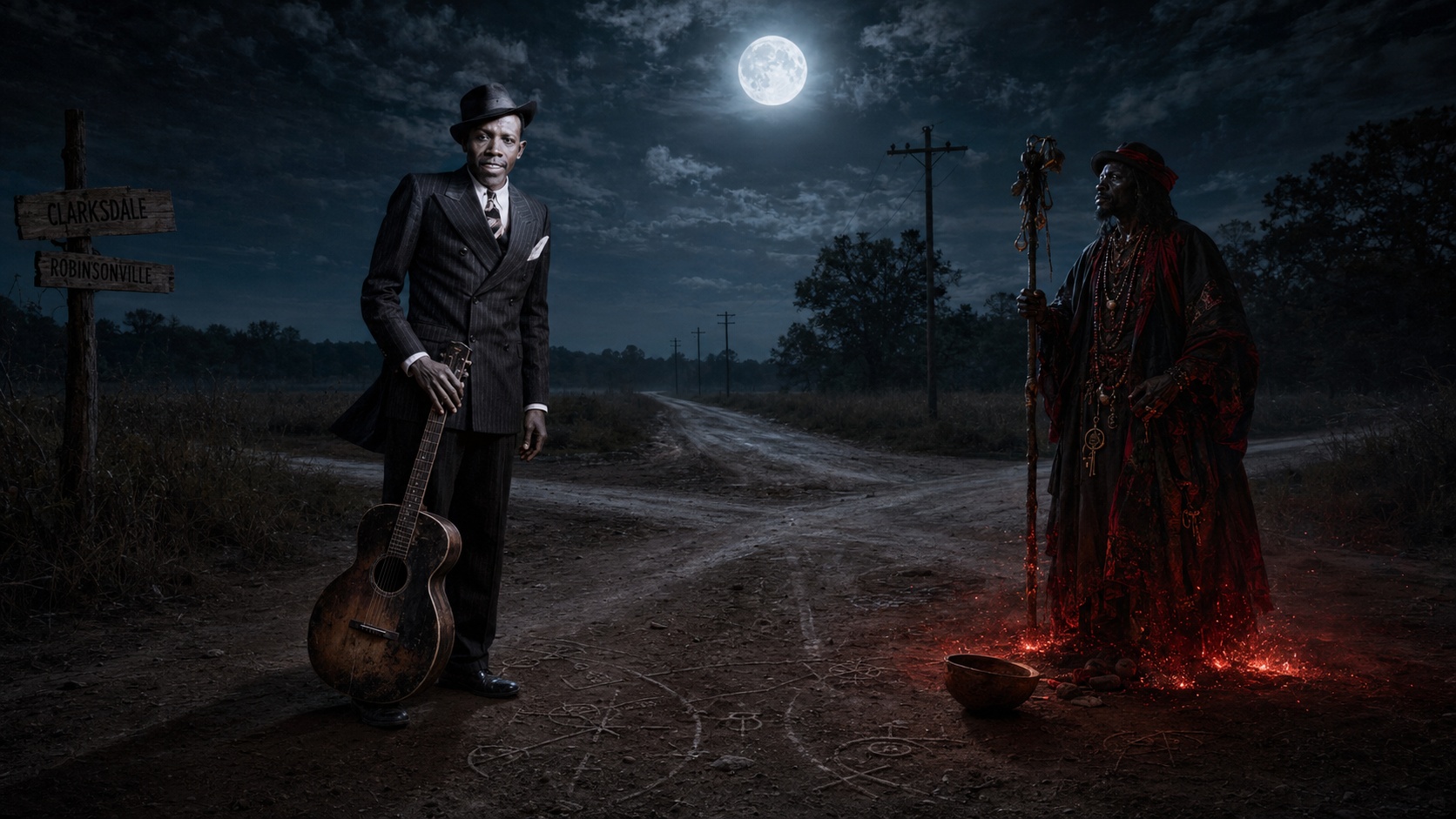
Johnson is best known for his revolutionary guitar technique, which allowed him to sound like a “full orchestra”—playing complex bass lines, rhythm, and lead melodies all at once. His sudden and dramatic mastery of the instrument, especially after being regarded as a “terrible” player by contemporaries, ignited the most famous legend in blues history: that he encountered a powerful force at a midnight crossroads and exchanged something essential for musical genius.
Johnson’s early life was marked by instability and reinvention. As a child, he used several surnames and grew up amid fractured family circumstances—experiences that echo in the restless quality of his later songs. His years in both Mississippi and Memphis broadened his exposure beyond rural blues, shaping his musical imagination. Johnson endured deep personal tragedy, losing two wives to childbirth while still a young man. He died at 27 under mysterious circumstances, with the most enduring story holding that he was poisoned by a jealous husband while performing at a country dance. This untimely, enigmatic death made him the founding figure of what would later be mythologised as the tragic “27 Club” of musicians.
Early Life
Robert Leroy Johnson was born in Hazlehurst, Mississippi, on or around May 8, 1911. His birth was unusual for the era, as he was born out of wedlock to Julia Dodds and a plantation worker named Noah Johnson. By the time Robert was born, Julia’s husband, Charles Dodds, had already left Mississippi for Memphis to escape a lynch mob after a dispute with white landowners; in Memphis, Charles adopted the surname Spencer.
At three or four years old, Robert joined Charles Spencer in Memphis, where he spent the next eight or nine years of his childhood. This formative period proved influential: he attended Carnes Avenue Colored School and received a formal education in arithmetic, reading, music, and geography. Historians note that his city upbringing and literacy—evident in the quality of his later signature—set him apart from most rural blues musicians.
Around 1919 or 1920, Robert returned to his mother after she married a sharecropper named Will “Dusty” Willis, who was 24 years younger than her. The family settled in Commerce, Mississippi, on the Abbay & Leatherman Plantation. Though expected to work as a field hand, Johnson showed a clear preference for music over agricultural labour.
Johnson’s passion for music surfaced early. As a boy, he was known for playing the harmonica and jaw harp, and he learned the basics of guitar from his older brother while in Memphis. Throughout his youth, Johnson used several surnames—Dodds, Spencer, Moore, James, and Barstow. In the 1920 census, he appeared as Robert Spencer, and in the Delta, he was sometimes called “Little Robert Dusty” after his stepfather. At 13, Robert finally learned the identity of his biological father. Seeking a name of his own, he officially adopted the surname Johnson, using it for the first time on his marriage certificate in 1929.
Sudden Mastery and the Crossroads
One of the most enduring stories about Johnson is that he left as an unremarkable guitarist and returned with astonishing mastery of the instrument. Fellow musicians recalled his early playing as unimpressive or even “terrible,” only to be amazed by his transformation upon his return. This dramatic shift fuelled the famous crossroads legend.
In its most familiar form, the story claims that Robert Johnson sold his soul to the Devil at a rural Mississippi crossroads in exchange for extraordinary musical talent. According to the myth, a young and ambitious Johnson, yearning for greatness, was told to take his guitar to a crossroads near the Dockery Plantation at midnight. There, he encountered a “large being” who took his guitar, tuned it, played a few songs, and returned it, bestowing Johnson with immediate, supernatural mastery in return for his soul.
However, the crossroads narrative was attached to Robert Johnson only after his death, nearly two decades after he died in 1938. The legend had earlier been associated with Tommy Johnson, an unrelated Delta blues musician. The key catalyst in linking Robert Johnson to the crossroads story was a 1966 Down Beat article by journalist Pete Welding, who treated Son House’s passing remark that Johnson had “sold his soul to the devil to play like that” as though it reflected a serious belief. Significantly, other interviewers were unable to draw the same claim from House, and Johnson’s close companion, the bluesman Johnny Shines, dismissed the idea as “preposterous, bordering on slanderous.” House had witnessed Johnson’s remarkable musical development—from novice player to startling virtuoso in roughly two years—and he may simply have reached for the already-circulating Tommy Johnson mythology to explain it. The legend fit Robert Johnson’s life neatly: the mysterious absences, the sudden transformation, the rumours of practising in graveyards at night, his itinerant life, and his early death.
Marriage, Loss, and the Road
Tragedy marked the beginning of Johnson’s adult life, especially in his pursuit of a stable family. In 1929, he married Virginia Travis, who was either 14 or 16 years old. Just a year later, both Virginia and their baby died during childbirth. Some religious relatives saw this as divine retribution for Robert’s devotion to “secular” or “Devil’s music.”
Johnson married his second wife, Calletta Craft, in 1931. The couple lived briefly in Clarksdale, but Calletta also died young, passing away around 1933. After these losses, Johnson abandoned the idea of a settled life and embraced the road as an itinerant “walking” musician. He became known as a “ladies’ man,” maintaining a network of girlfriends across the South. He often formed relationships with women in different towns, staying with them until he moved on—or until a boyfriend returned.
In 1931, Johnson had a relationship with 17-year-old Virgie Mae Smith (also known as Jane Cain), resulting in the birth of his son, Claud Johnson. Decades later, Claud was declared Robert’s legal heir after a court battle that concluded in 1998. One of Johnson’s most stable long-term relationships was with Estella Coleman in Helena, Arkansas. Her son, Robert Lockwood Jr., became Johnson’s protégé and “adopted son,” learning guitar directly from him and later becoming a significant bluesman in his own right.
Character and Personality
Contemporaries and fellow musicians described Johnson as a study in contradictions. Publicly, he was well-mannered, soft-spoken, and meticulous in appearance—even while travelling dusty roads. Privately, he could be moody or withdrawn, often disappearing from performances without warning. Johnson was known for his fondness for whiskey and women. He used multiple surnames and frequently gave hosts only partial or conflicting accounts of his life, which contributed to an aura of elusiveness and self‑reinvention.
Music and Recordings
Johnson’s recorded legacy is famously small—just twenty-nine songs captured during sessions in San Antonio (1936) and Dallas (1937). These sessions, held not in formal studios but in improvised hotel-room setups, produced recordings whose intimacy and rawness later fuelled his legend. Yet within these few tracks lies a musical universe. His guitar conjured bass, rhythm, and lead all at once, creating the illusion of multiple musicians. His voice conveyed urgency, tension, wit, sensuality, and dread with remarkable range.
Songs like “Terraplane Blues,” “Cross Road Blues,” “Hellhound on My Trail,” “Love in Vain,” and “Sweet Home Chicago” have become foundational to modern music. Johnson’s lyrics are poetically dense—he sang of wandering, longing, spiritual searching, fear, loneliness, and survival, often using imagery that made the ordinary feel haunted and the supernatural feel eerily familiar. His relative literacy and exposure to urban life in Memphis may have contributed to the complexity and fluidity of his language, which ranges across scenes and states of mind with unusual freedom.
Johnson’s work blurs the lines between sacred and secular. He drew from a world where church hymns, work songs, street cries, folk beliefs, and blues all intertwined. This complexity helps explain why later listeners heard in him not just a musician, but a voice carrying deep cultural echoes into modern times.
Death and Myth
Johnson died in 1938 at the age of twenty-seven, most likely near Greenwood, Mississippi, under circumstances still shrouded in mystery. His death certificate gave no official cause, though it mentioned a suspicion of syphilis, and later researchers have speculated about congenital syphilis or Marfan syndrome as contributing factors. The most enduring account holds that he was poisoned at a country dance—possibly with whiskey tainted by strychnine or mothballs—by a jealous husband who caught Johnson flirting with his wife. Witness testimony from contemporaries such as David “Honeyboy” Edwards helped cement this narrative of a slow, agonising death following the poisoned drink.
Johnson was laid to rest in a homemade coffin in an unmarked pauper’s grave. Even his burial remains a matter of speculation, with multiple sites later claimed as his final resting place. This instability of record, place, and testimony contributes to Johnson’s enduring mystique—he seems less a fixed historical figure and more a presence suspended between archive and folklore. He lives on in documents, songs, memories, and stories, but never fully within any single one of them.
The aura surrounding his death also seeded one of rock culture’s most persistent ideas: the so‑called 27 Club. The term refers to a group of prominent musicians and performers who died at the age of 27, often in violent or enigmatic circumstances—figures such as Jim Morrison, Jimi Hendrix, Janis Joplin, Kurt Cobain, and Amy Winehouse. Within rock ’n’ roll culture, these artists are often cast as immensely talented yet troubled individuals whose lives ended while grappling with personal “demons.” Robert Johnson is widely regarded as the original and foundational member of this imagined club, his mysterious death in 1938 at age 27—paired with the enduring crossroads legend—frequently cited as the mythic starting point for this pattern.
Legacy
Claud Johnson is the only legally recognised heir of Robert Johnson. His path to recognition was marked by legal battles and moments of historical discovery. For most of his adult life, Claud maintained a low profile, working as a truck driver in Crystal Springs, Mississippi. The most public chapter of his life was his legal battle for recognition as Robert Johnson’s son, culminating in 1998. He faced court challenges from relatives descended from Johnson’s half-sister, Carrie Harris Thompson. Claud’s case was bolstered by testimony from Eula Mae Williams, a friend of Virgie Mae Smith, who confirmed the relationship between Robert and Virgie. Ultimately, the Mississippi courts ruled in Claud’s favour, naming him the sole legal heir and awarding him royalties that had accrued from Johnson’s posthumous success.
During his lifetime, Robert Johnson achieved only modest commercial recognition. The 1961 Columbia collection King of the Delta Blues Singers introduced his music to new audiences and helped spark the blues revival that shaped both British and American rock. Later generations of musicians—including Eric Clapton, Keith Richards, and Bob Dylan—came to see Johnson not as a minor regional figure, but as a foundational influence.
Institutions eventually confirmed what musicians had long recognised. Johnson was inducted into the Rock and Roll Hall of Fame in 1986 as an early influence and later received a Grammy Lifetime Achievement Award. Yet his greatest legacy is not found in awards, but in the enduring vitality of his songs—tense, restless, intimate, shadowed, and open, as if still echoing at a crossroads where history, migration, spirit, and music converge.
After his legal recognition, Claud became a steward of his father’s legacy, notably accepting the Mississippi Musicians Hall of Fame Award on Robert Johnson’s behalf in 2000. Claud Johnson died at 83 on June 30, 2015. He left behind six children, and his descendants continue to protect and promote Robert Johnson’s legacy. For example, his son Steven Johnson performs his grandfather’s music, while his grandson Steve Johnson serves as co‑director of the Robert Johnson Blues Foundation, which offers scholarships to young musicians and runs a museum in Crystal Springs.
Closing Reflection
Robert Johnson endures because he embodies multiple identities. He can be heard as a historical bluesman, a master technician, a lyrical poet, a wanderer of the Jim Crow South, and a mythic figure through whom listeners explore the costs of genius.
The force Johnson encountered at the crossroads—often labelled the “Devil” in popular folklore—can be more deeply understood through an African diasporic lens as Esu: the divine messenger, trickster, opener of roads, and guardian of thresholds in Yoruba cosmology and its diasporic traditions. In this context, the crossroads symbolises transition, choice, initiation, ambiguity, and power. Naming the force as Esu shifts interpretation away from a Christianised, sensational reading imposed on Black expressive culture and toward a more culturally rooted understanding of crossroads symbolism.
Recasting the crossroads figure as Esu rather than the Devil does not diminish the legend; it enriches it—restoring a cosmological texture more attuned to African diasporic views of power, passage, paradox, and exchange. Seen this way, Johnson’s story becomes one of encountering sacred power, artistic transformation, and the perilous knowledge that often accompanies brilliance. Viewed this way, Johnson becomes an artist working at the threshold—between worlds, sacred systems, oral memory, and recorded sound. This is why his music still feels unfinished in the best sense: always in motion, always summoning, always questioning what must be surrendered and what might be gained at the crossroads.
Source:
https://www.tshaonline.org/handbook/entries/johnson-robert
https://folklife-media.si.edu/docs/festival/program-book-articles/FESTBK1991_06.pdf
https://www.loc.gov/static/programs/national-recording-preservation-board/documents/RobertJohnsonCompleteRecordings.pdf
http://www.robertjohnsonbluesfoundation.org/blues-foundation
https://en.wikipedia.org/wiki/Robert_Johnson
https://www.robertjohnsonbluesfoundation.org/biography/
https://www.udiscovermusic.com/stories/devils-music-myth-robert-johnson/
https://www.rockhall.com/inductees/robert-johnson
https://mississippiencyclopedia.org/entries/crossroads-myth/
https://law.jrank.org/pages/3763/Robert-Johnson-Estate-1998-An-Unknown-Heir.html
https://www.americanbluesscene.com/2014/02/robert-johnsons-son-wins-custody-of-photos-profits/
https://www.billboard.com/music/music-news/robert-johnsons-son-wins-case-over-only-existing-5915620/