


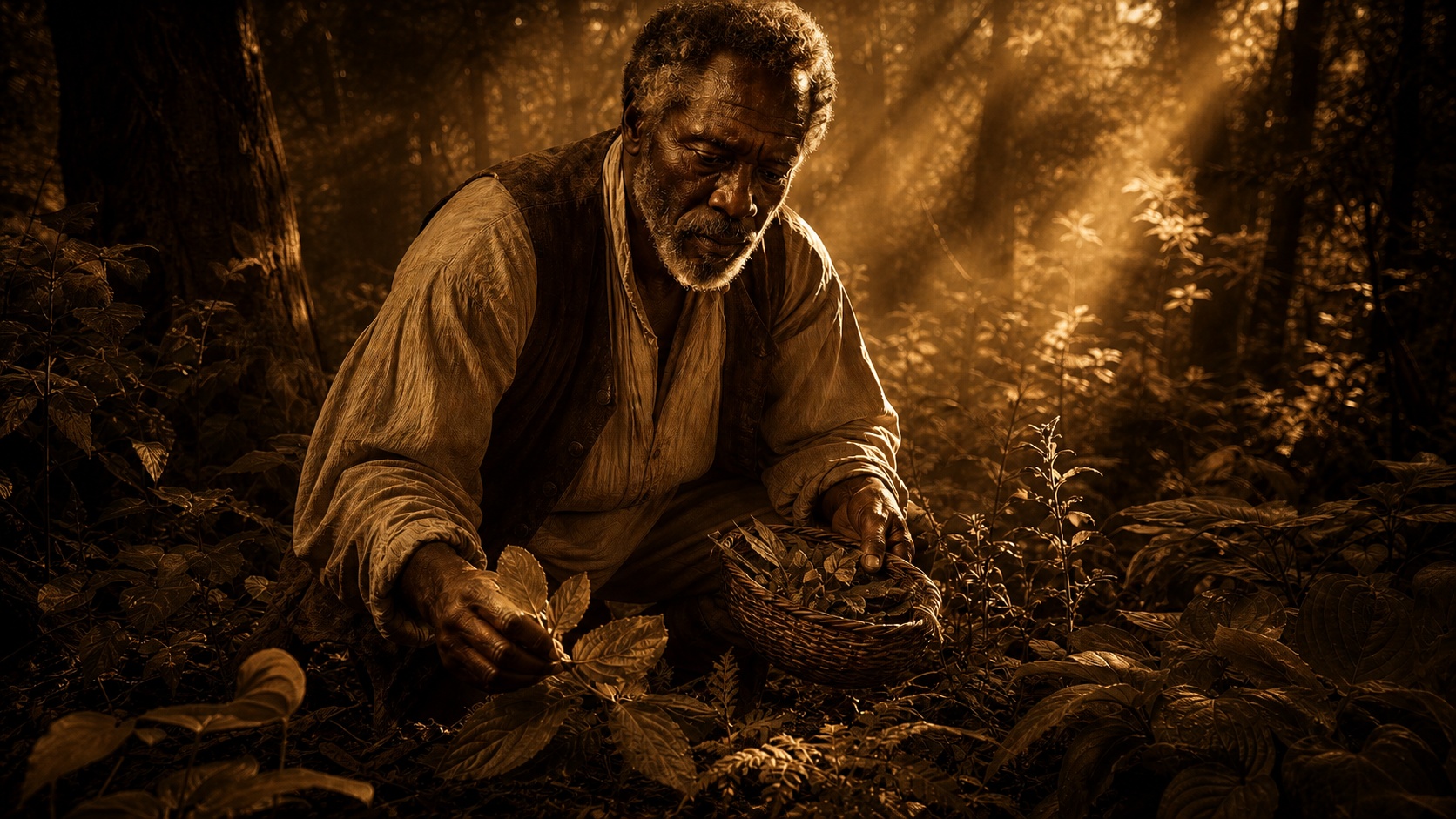
Caesar was an African healer living under forced servitude in early South Carolina whose knowledge of botanical medicine became valuable enough to secure his freedom. In 1750, after years of treating the sick, he presented his remedies for poison and rattlesnake bites to the South Carolina General Assembly in exchange for his release from captivity and a lifetime annuity, making him one of the earliest known Black medical practitioners to have his findings published.
Little is known about Caesar’s early life, but surviving records place his birth around 1682 or 1683, and historians believe he may have been born in Africa. By the time he entered the written archive, he was held in captivity by John Norman of Beech Hill in St. Paul’s Parish, near Charleston. He was already an older man when legislators first took formal notice of him in 1749, describing him as “near sixty-seven years” of age. Yet long before the Assembly wrote down his name, Caesar appears to have been known locally as a healer of unusual skill.
His reputation rested on results. Witnesses reported that Caesar had cured people believed to have been poisoned and had also treated rattlesnake bites and other illnesses. In a society haunted by fears of poison, rebellion, and bodily vulnerability, this was no small gift. South Carolina’s domineering class feared both the hidden dangers of the natural world and the possibility that the oppressed might use intimate knowledge of food, plants, and household routines as forms of resistance. Caesar’s healing work emerged at that tense crossroads of fear and necessity, where Black knowledge was indispensable to survival even as Black life itself was systematically devalued.
That contradiction is essential. The same society that treated African people as property depended not only on their labour but on their intelligence, memory, and technological skill. Planters in South Carolina relied on African expertise in rice cultivation, irrigation, processing, and planting methods, especially knowledge carried by enslaved people from West African rice-growing regions. In other words, Caesar’s story was not exceptional because it involved African knowledge; it was exceptional because his oppressors were forced, however briefly, to pay for it.
What makes Caesar especially striking is that he did not surrender his knowledge without terms. When the South Carolina Commons House of Assembly investigated his cures in 1749, Caesar made clear that if he disclosed the ingredients and methods behind them, he expected his freedom and financial support in return. The Assembly accepted the bargain. In the spring of 1750, legislators arranged to secure his release from John Norman and promised him an annuity of £100 South Carolina currency for life, while also compensating Norman £500. The tax act ratified on May 31, 1750, formally appropriated that money for Caesar’s freedom in recognition of his discovery of an antidote against poison.
Caesar’s cures entered public print just before that legal ratification. The South-Carolina Gazette published them on May 14, 1750, in an issue also catalogued by some sources as the May 7–14, 1750 issue. In that moment, the newspaper turned Caesar’s healing knowledge into public property. The publication preserved his remedies, but it also exposed the unequal terms under which Black knowledge was extracted, authenticated, and redistributed for the benefit of those in power.
Caesar’s poison antidote was based chiefly on two plants: plantain and wild horehound. The printed recipe instructed readers to take three ounces of the roots of plantain and wild horehound, fresh or dried, boil them in two quarts of water until one quart remained, and strain the liquid. The patient was then to drink one third of the decoction on three successive mornings while fasting, continuing if relief appeared. The cure also required dietary restraint, avoiding rich or fatty foods, and included its own diagnostic test: if no change occurred after the third dose, Caesar advised that either the patient had not been poisoned or the poison lay beyond the reach of that remedy. This is one of the most revealing aspects of his method, because it shows that Caesar offered not merely an herb list but a diagnostic framework—an interpretation of symptoms, bodily response, and the limits of cure.
His rattlesnake-bite remedy was similarly direct and rooted in the same botanical world. For snakebite, the Gazette instructed readers to bruise plantain or horehound—using the roots and branches in summer—in a mortar and press out the juice. One large spoonful was to be given as quickly as possible, especially if swelling had already begun. If relief did not come within an hour, a second spoonful was to be administered. As with the poison cure, the language of the printed text was absolute in tone, reflecting the conventions of eighteenth-century remedy literature as well as the confidence placed in Caesar’s skill by those who testified on his behalf.
These recipes spread far beyond the landscape in which they were first practised. Because of popular demand, the Gazette reprinted Caesar’s cures in its February 25–March 4, 1751 issue. From there, his remedies circulated in newspapers, almanacs, journals, and later medical compilations in North America and Britain. This wide circulation is why historians often identify Caesar as the first African American whose medical knowledge appeared in print. Yet even that fact carries a painful irony: Black medical intelligence was made legible to the Atlantic world only after it had been filtered through the approvals of a colonial legislature and the presses of a slave society.
After gaining freedom, Caesar appears to have remained in St. Paul’s Parish near the place where he had long lived. In his will, he called himself “Doctor Caesar of South Carolina in St. Paul’s Parish, Practitioner of Phisick,” a rare and powerful act of self-naming in the eighteenth-century record. He also used his estate to benefit family members who remained in forced servitude, including his wife Lily and daughters Lucy and Hannah. Freedom, even when won, did not erase the architecture of captivity surrounding those he loved.
Caesar likely died around 1754. What remains of him in the archive is partial, as it is for so many African and African-descended people whose lives were lived under captivity. But even these fragments carry unusual force. Caesar is remembered because he transformed healing into negotiation. He took knowledge of plants, symptoms, and cure and made that knowledge the price of freedom.
His story belongs to a broader history of Black healers whose expertise Maafa societies depended upon even as they sought to control it. In South Carolina, another healer named Sampson later won freedom under similar terms, suggesting that Caesar’s case was not an isolated wonder but part of a larger pattern in which African-derived medical knowledge could, under rare circumstances, be leveraged against forced servitude. That leverage was always precarious. The same society that rewarded Caesar also moved to regulate and restrict Black medical practice more tightly.
To write Caesar’s life biographically, then, is to write across silences. The record does not tell us what he remembered of Africa, who taught him the properties of roots, how he understood illness beyond the language printed by those who held him in subjugation, or what freedom felt like after a lifetime without autonomy. But it does tell us something of immense moral and political significance: an elderly African healer in South Carolina possessed knowledge powerful enough to make the colonial state pay for his emancipation.
Dr. Caesar’s freedom should be read as evidence. If a colonial government could assign monetary value to African medical knowledge in 1750, then the same Atlantic world can be made to reckon with the far greater debt incurred through the theft of African farming technologies, environmental expertise, craftsmanship, and generations of unpaid labour. Caesar’s life is therefore not only a biographical fragment or an early medical story. It is also a reparative argument. It reminds us that African knowledge built wealth, preserved life, and sustained empire—and that what was built through extraction remains a debt still owed.
Source:
Charleston County Public Library, “Doctor Caesar and His Antidote for Poison in 1750” (Charleston Time Machine)
https://www.ccpl.org/charleston-time-machine/doctor-caesar-and-his-antidote-poison-1750
South Carolina Encyclopedia, “Caesar”
https://www.scencyclopedia.org/sce/entries/caesar/
America’s Black Holocaust Museum, “The Published Medical Discoveries of the Enslaved Dr. Caesar”
https://www.abhmuseum.org/the-published-medical-discoveries-of-the-enslaved-dr-caesar/
“Enslaved Doctors · Health and Wellness of Enslaved People” https://ecgm.omeka.net/exhibits/show/health-of-the-enslaved/enslaved-doctors
“Rice in the Lowcountry · African Passages, Lowcountry Adaptations”
https://ldhi.library.cofc.edu/exhibits/show/africanpassageslowcountryadapt/sectionii_introduction/rice_lowcountry “South Carolina Rice Plantations” (PDF)
https://glc.yale.edu/sites/default/files/files/South%20Carolina%20Rice%20Plantations.pdf
