
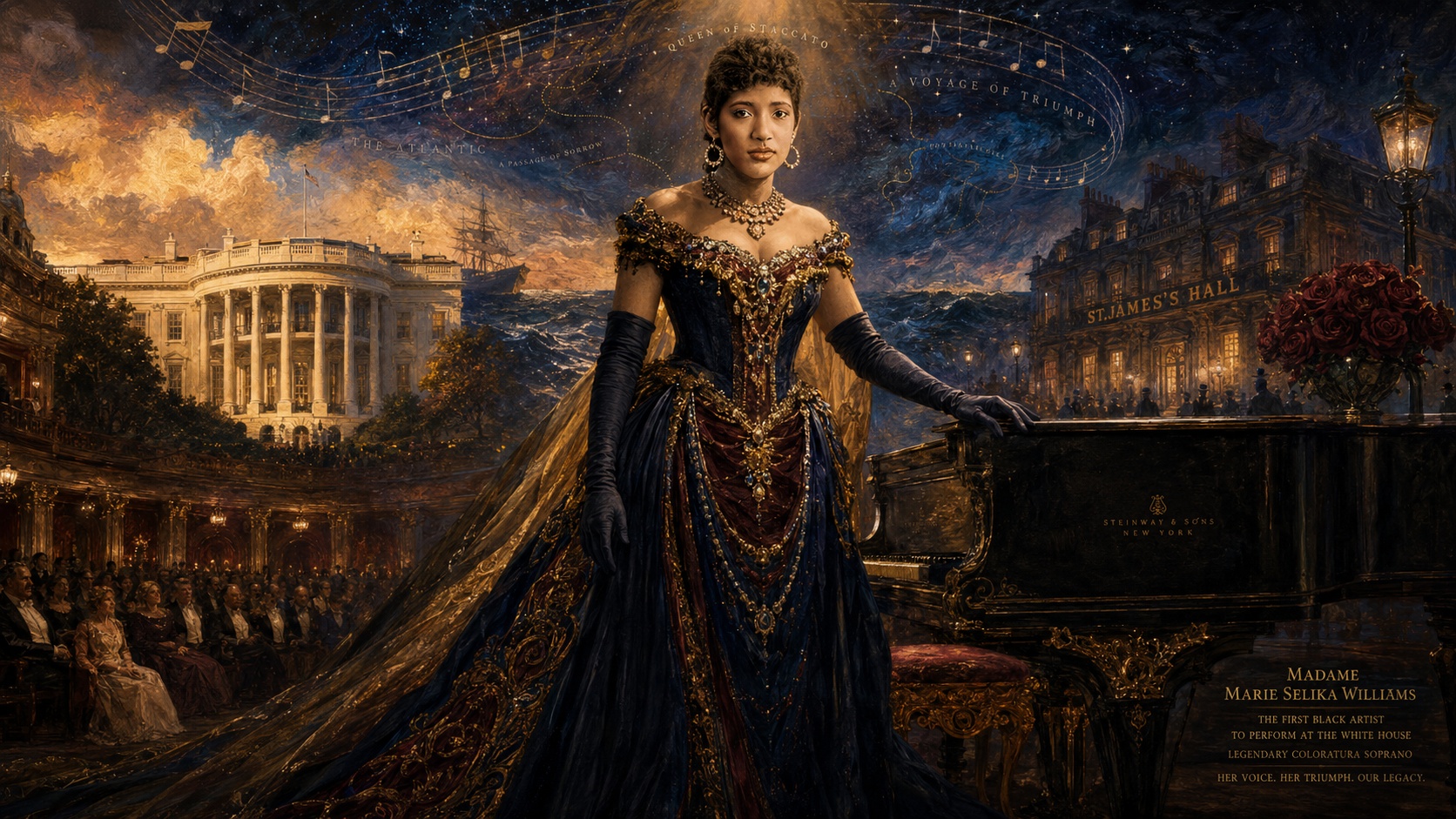
Marie Selika Williams (c. 1849/1850–20 May 1937) was one of the most accomplished and pathbreaking African American classical singers of the nineteenth century. Born Mary S. Price Holloway in Natchez, Mississippi, she rose from the margins of a violently racialized society to become a celebrated coloratura soprano known internationally as “Madame Selika” and “the Queen of Staccato.” In 1878, she made history as the first Black artist to give a formal recital at the White House. During the early 1880s, she toured Europe with her husband, singing in London venues such as St James’s Hall and the Royal Aquarium, and it is said that she later sang before Queen Victoria, although this has not yet been confirmed in the surviving press.
The precise details of her birth are uncertain. Most sources place it around 1849, while her death certificate records 20 May 1850. She was born into a family with roots in the Deep South, yet her grandmother, Serina McGee Holloway, would later insist in a 1893 obituary that she had “never been a [captive],” a striking claim in mid‑nineteenth‑century Mississippi. After her mother’s death, Mary was raised in Cincinnati, Ohio, by her father, Samuel Price Holloway within an extended Black family network. Her childhood unfolded in a vibrant Black urban community where churches, schools, and mutual aid societies were critical sites of self-expression and protection.
In Cincinnati, her talent was first recognized in the Black church. She sang in Sunday school at Allen Temple A.M.E., and soon her voice became a familiar presence in the city’s Black church programs and school entertainments. She likely attended the public and private schools established for Black children, institutions that maintained robust music programs despite segregation and chronic underfunding.
As a young woman, Mary moved west to San Francisco, part of a broader movement of Black people seeking opportunity beyond the Jim Crow order consolidating in the East and South. There, she studied with the Italian teacher, Signora G. Bianchi, affiliated with the Pacific Musical Academy, grounding herself in the bel canto vocal tradition. In San Francisco, she married baritone Sampson W. Williams on 9 June 1873, and made her professional debut at Pacific Hall in the California Theater in October 1875, supported by a politically engaged Black community that saw her success as part of a collective project of racial uplift.
The couple later relocated to Chicago, where she undertook further study with the Italian baritone Signor Antonio Farini, one of the city’s most respected voice teachers. Farini praised her as among his most gifted pupils, emphasizing the technical refinement of her breathing, phrasing, and register transitions. In 1877, the influential impresario Max Strakosch heard her sing in Farini’s studio and issued a glowing letter of endorsement. Although he did not ultimately sign her to his company, his praise—subsequently published by African American impresario Sam Lucas—helped frame her in the press as “the finest prima donna of color in the world.”
It was during these years that she adopted the name by which history remembers her: Selika. She took it from Sélika, the captive African queen in Giacomo Meyerbeer’s opera L’Africaine (1865), a heroine who chooses death over oppression. The name first appeared in the press in 1876, when she introduced “The Selika Magic Waltz,” composed for her by Frederick G. Carnes, whose “Grand Vocal Waltz of Magic” was designed to display her extraordinary range. By wearing the identity of an African queen from the European opera canon, Marie Selika Williams asserted a regal Black womanhood against a culture invested in denying Black women dignity; it was a conscious act of artistic and political self‑definition.
On 13 November 1878, Marie Selika Williams inscribed her name in American history when she stepped into the Green Room of the White House to sing for President Rutherford B. Hayes and First Lady Lucy Webb Hayes. Introduced by Frederick Douglass, then U.S. Marshal for the District of Columbia, she became the first Black artist to give a formal recital at the presidential residence. Her program ranged from Verdi’s “Ernani, involami” to the Irish melody “The Last Rose of Summer,” Millard’s “Ave Maria,” and E. W. Mulder’s virtuosic “Staccato Polka,” the showpiece that would cement her title as “Queen of Staccato.” Contemporary reports describe a rapt audience and warm congratulations from the President and First Lady, even as journalists candidly acknowledged that racial prejudice would limit her material success despite her unquestionable artistry.
In the years that followed, Selika’s career expanded onto national and international stages. She sang at Philadelphia’s Academy of Music and New York’s Steinway Hall, drawing praise from the Boston Globe, which hailed her as “a phenomenal artiste.” Between 1882 and 1885, she and Sampson Williams—by then performing under the exoticized stage name “Signor Velosko, the Hawaiian tenor”—toured England, Scotland, France, Germany, and Belgium. In London, she performed at St James’s Hall in a benefit concert for enslaved Cuban children, sharing the stage with the famed Carlotta Patti and attracting the support of abolitionist poet and diplomat James Russell Lowell. Reports from the tour emphasize how, unlike in the United States, the couple encountered little overt color prejudice in European hotels and concert halls, a contrast that Black journalists used to indict America’s “uncivilized” racial order.
Marie Selika Williams’s voice was widely celebrated for its range, agility, and expressive power. A true coloratura soprano, she commanded a range that extended well over three octaves, which reviewers described as “wonderfully powerful, liquid and flexible.” Her repertoire drew on the central European operatic canon—Verdi, Donizetti, Gounod, Meyerbeer, Halévy—alongside German lieder and French art song she studied during language training in Boston. Critics frequently compared her to Adelina Patti, dubbing her “America’s Colored Patti,” a comparison that both honored her artistry and reflected the racialized frameworks through which Black excellence was measured.
Despite her skill and international reputation, the structural barriers facing a Black woman in nineteenth‑century classical music were immense. Black singers were effectively barred from major American opera companies, and the dominant commercial avenue for Black performers remained the demeaning world of minstrelsy, which Selika consistently refused. She instead built a career through concerts, lyceum circuits, benefit performances, and community events, often performing for predominantly Black audiences, especially in the South. On one tour, she canceled a performance when an opera house refused to sell first‑class seats to Black patrons, choosing solidarity with her community over personal gain.
Selika’s appearances at mass gatherings and iconic venues underscored both her artistic stature and her symbolic role. In 1887, she sang before an audience of around 15,000 at Cincinnati Music Hall during a Republican ratification meeting, her voice carrying across a space that had only recently echoed with wartime rhetoric and Reconstruction debates. At the 1893 World’s Columbian Exposition in Chicago—an event many African Americans boycotted due to segregationist policies—she chose to sing at alternative venues more welcoming to Black performers and audiences. In 1896, she appeared at Carnegie Hall for the Zion Grand Centennial Jubilee of Zion AME Church, sharing the platform with fellow Black divas Sissieretta Jones and Flora Batson, in an evening that brought Black musical excellence to one of the most prestigious concert halls in the world.
Her personal and professional life was deeply intertwined with that of Sampson W. Williams, who served as her duet partner and often as co‑architect of her tours. Some commentators have suggested that her insistence on performing with her husband, whose vocal abilities were often judged to be less than her own, may have limited her opportunities that required a different kind of managerial backing. Yet their partnership also reflects the survival strategies and mutual loyalty that many Black couples forged in a hostile cultural economy, where trustworthy management and equitable contracts were rare.
In the final decades of her life, Marie Selika Williams shifted from performance to pedagogy. After Sampson’s death in 1911, she settled in New York and taught at the Martin‑Smith Music School, the first private music school in the United States established by African Americans for Black students and teachers. There she trained a younger generation of singers and musicians, many of whom would come of age during the Harlem Renaissance. Her last known public performance took place at the New Star Casino, sharing a program with students, a chorus from the Riverdale Colored Orphan Asylum, and a young Marian Anderson, whose later triumphs at the Lincoln Memorial and the Metropolitan Opera would partially fulfill the promise that Selika’s own era had denied.
Marie Selika Williams died in New York City on 20 May 1937, aged 87. A devout Catholic, she received a requiem high mass at St Mark’s Roman Catholic Church before being laid to rest in the family plot at Holy Cross Cemetery in Philadelphia. Critics and contemporaries remembered her as “the greatest female singer the race has ever produced,” and a few insisted that “time nor rivals can wrest her laurels so richly won.” Today, she is recognized as a foundational figure in the lineage of Black women in classical music—a direct forerunner to Sissieretta Jones, Flora Batson, and Marian Anderson—whose voice, choices, and uncompromising refusal of degradation carved out new space for Black presence on the concert stage.
Author’s Note: Date Discrepancy
There is a small but important discrepancy in the historical record regarding Marie Selika Williams’s dates. Some modern reference works list her life span as circa 1849–19 May 1937, while recent archival research cites her death certificate, which records her birth as 20 May 1850 and her death as 20 May 1937. In keeping with that primary document, this article follows the dates given on her death certificate and uses 20 May as both her birth and death date.
Source:
https://blackpast.org/african-american-history/williams-marie-selika-c-1849-1937/
https://en.wikipedia.org/wiki/Marie_Selika_Williams
https://friendsofmusichall.org/2026/03/23/madame-marie-selika-cincinnati-internationally-renowned-black-diva-in-music-hall/
https://thevoiceofblackcincinnati.com/madame-selika/
https://racingnelliebly.com/strange_times/marie-selika-williams-gave-white-house-recital/ https://www.whitehousehistory.org/photos/americas-musical-life-escalates-photo-1
https://afrovoices.com/sissieretta-jones-biography/