
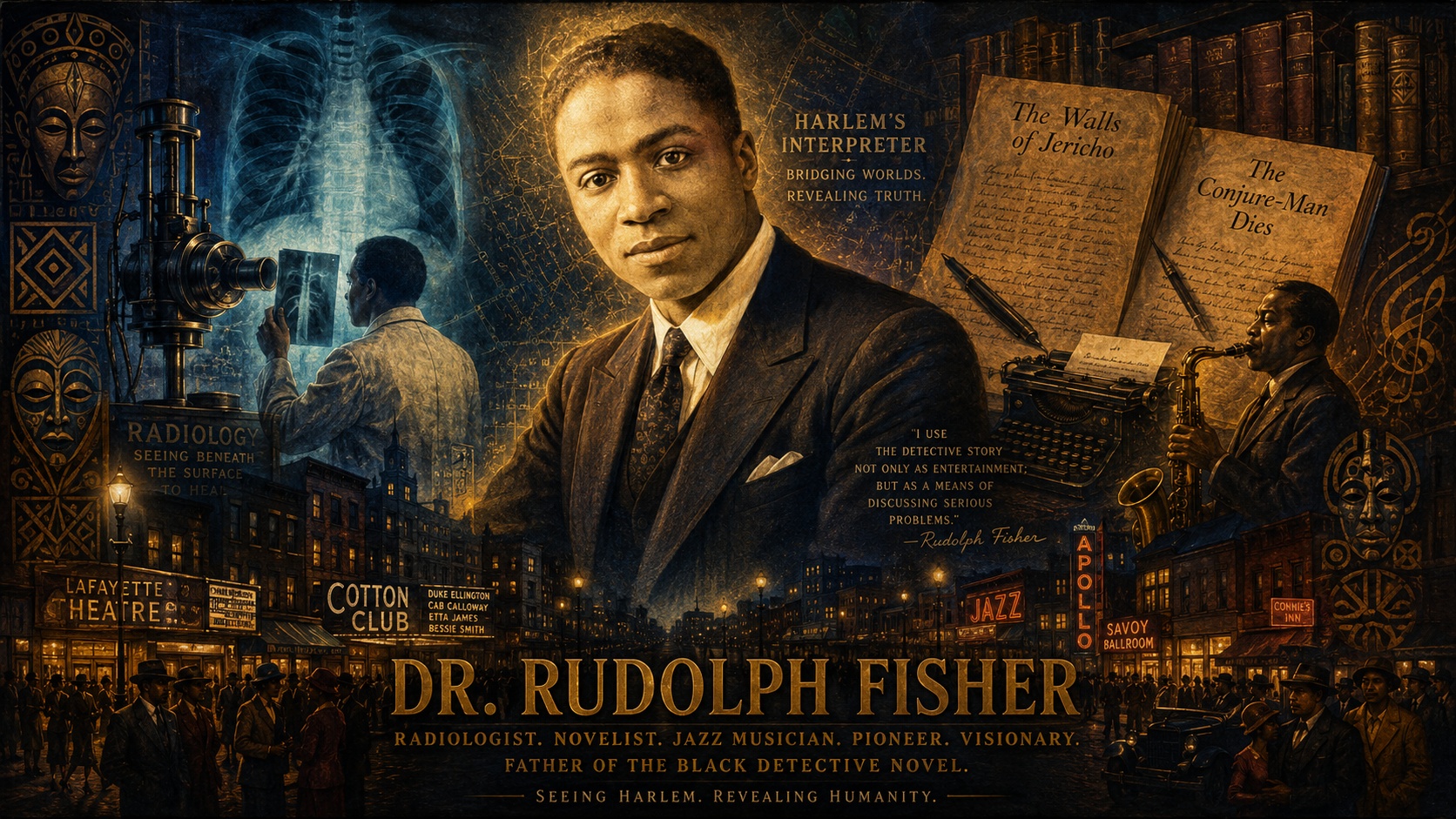
Rudolph Fisher (1897–1934) was a physician, radiologist, writer, musician, and orator whose remarkable, though brief, life had a profound impact on the Harlem Renaissance and African American literary and intellectual history. Frequently described as a Renaissance man, Fisher moved effortlessly among the laboratory, the clinic, the piano, and the page. He combined scientific rigor with artistic imagination to challenge racist mythologies and illuminate Harlem with what contemporaries called “X-ray vision.”
Early life and education
Fisher was born in Washington, D.C., on May 9, 1897, and raised in Providence, Rhode Island. A gifted and accomplished student, he graduated from Classical High School with honors before attending Brown University. There, he double-majored in English and Biology, earned a Master’s degree in Biology, and was inducted into Phi Beta Kappa and other honorary societies. In 1919, he delivered a celebrated valedictory address, “The Emancipation of Science,” championing the fundamental harmony between science and religion and science’s vital role in serving humanity. He later attended Howard University Medical School, graduating summa cum laude in 1924, and cemented his reputation as both a man of letters and a man of science.
Medical career and scientific vision
Trained during a time when radiology—then known as roentgenology—was still emerging as a medical discipline, Fisher became one of only about thirty Black physicians practicing or teaching radiology in the United States by 1934. After completing a fellowship at Columbia University, where he studied the effects of ultraviolet rays on viruses, he established a private practice and radiologic laboratory in Harlem and served as superintendent of the International Hospital in New York. His work in radiology not only brought him personal recognition but also shaped his views on race, science, and society. Fisher actively challenged the “medical mythologies” used to claim Black inferiority and to justify segregation and lynching. Through both public statements and fiction, he promoted a philosophy of the “oneness of purpose” between science and religion, employing scientific reasoning to demonstrate the insignificance of race as a biological category.
Fisher’s groundbreaking medical career came at a high personal cost. On December 26, 1934, he died of abdominal cancer at just thirty-seven years old, with many contemporaries attributing his illness to prolonged exposure to X-rays during his research and practice. His untimely death was widely regarded as marking the end of the most vibrant era of the Harlem Renaissance, depriving Black literature and medicine of one of their most brilliant polymaths.
Harlem’s interpreter and the Black detective novel
Alongside his medical career, Fisher established himself as a major literary voice, earning recognition as “Harlem’s interpreter” and “Harlem’s chronicler” for his vivid, realistic depictions of the Black metropolis. From 1925 to 1934, he published between 15 and 17 short stories and 2 novels, focusing almost entirely on Harlem as his canvas. His first published story, The City of Refuge (1925) in the Atlantic Monthly, explored the Great Migration through the eyes of a Southern newcomer whose initial excitement about urban life in the North gives way to disillusionment as he is taken advantage of by more experienced Harlemites. Fisher often revisited such migrant characters, examining the challenges of modernity, the collision between Southern religious traditions and urban secularism, and the evolving tensions among Southern migrants, West Indian immigrants, and long-established Northern Black residents.
His debut novel, The Walls of Jericho (1928), responded to the challenge of capturing Harlem’s varied social layers within a single story. The book centers on intraracial class conflict between the “dickties”—Harlem’s respectable, upper-class residents—and the “rats,” the working-class denizens of Lenox Avenue. In doing so, Fisher shifted the focus from Black–white antagonism to the nuances of class, color, and regional prejudice within the Black community itself. His second novel, The Conjure-Man Dies: A Mystery Tale of Dark Harlem (1932), broke new ground as the first known detective novel to feature an all-Black cast and a Black detective. Fisher introduced Dr. John Archer and Detective Perry Dart as central investigators in a case sparked by the mysterious death of a West African conjure man in Harlem. With this work, Fisher essentially invented the Black detective novel, establishing a new literary form that would later inspire writers like Chester Himes and Walter Mosley.
Critics lauded Fisher’s “satirical realism and witty humor,” observing that he rejected the prevailing “racial uplift” approach that highlighted only the most respectable aspects of Black life. Rather, Fisher brought a clinical, unsentimental perspective—his famed “X-ray vision”—to the everyday realities of Harlem, vividly portraying its street language (“Harlemese”), cabarets, storefront churches, internal tensions, and vibrant humanity. For Fisher, Harlem was more than a setting; it was a central character—the “black capital of the world”—whose “flavor, music, and poetry” he sought to interpret.
Science, race, and the detective imagination
Fisher’s fiction was deeply influenced by his medical background and active participation in debates about race and science. In The Conjure-Man Dies and the companion story “John Archer’s Nose,” he introduced Dr. John Archer—a scientifically minded physician often seen as Fisher’s literary alter ego—who channels the author’s own theories and expertise. Through Archer, Fisher integrated cutting-edge medical technologies—including X-rays, blood typing, and detailed anatomical knowledge—into African American literature, establishing forensic logic as a key tool for crime-solving. This innovation not only modernized the detective genre within Black literature but also highlighted Black excellence in science and technology at a time when Black physicians were systematically excluded by the American Medical Association and other white institutions.
Simultaneously, Fisher used the detective genre to question Western scientific methods and their role in constructing the African as an exotic other. The Conjure-Man Dies serves as a “lost highway” connecting African and African American traditions: the plot revolves around ancient African rituals, and its central mystery—centered on N’gana Frimbo, a West African conjure man—challenges Archer and Dart to operate at the intersection of Western logic, African spiritual practices, and local superstition. By solving an “African” mystery through scientific deduction while honoring the complexities of African ritual and belief, Fisher created a critical dialogue between European science and African cosmologies. In doing so, he dismantled “scientific” racism and reclaimed science as a powerful tool for Black intellectual empowerment.
Music, oratory, and personality
Beyond medicine and literature, Fisher’s talents encompassed music and public speaking, further solidifying his reputation as a true polymath. As an accomplished jazz pianist and composer, he toured the East Coast with Paul Robeson to help fund his medical studies and later arranged music for Robeson’s New York concerts. At Brown University, Fisher was a prize-winning orator; his flawless, idiomatic German during a speech so astonished listeners that some doubted a Black student could have delivered it—an accusation rooted in prejudice and “birtherism.” In Harlem, peers such as Langston Hughes remembered him as the “wittiest” of his peers, a man whose sharp wit could be “frightening” even to other brilliant writers.
This formidable wit and breadth of talent—radiologist, novelist, short story writer, dramatist, musician, and orator—shaped his public image as the “real embodiment” of the Renaissance ideal. Fisher purposefully resisted being confined to a single profession or mode of expression, insisting on viewing the world through both artistic and scientific perspectives. For contemporaries and later critics, his most lasting contribution lies in this rejection of narrow specialization: he stood as living evidence of Black intellectual and creative expansiveness at a time when racist ideologies sought to limit Black potential.
Rudolph Fisher’s life was dazzlingly full yet tragically brief. He exemplified Black intellectual brilliance, fusing science and art with a deep, unsentimental love for Black urban life. There is something especially poignant about a man who used X-rays to peer inside the body and then applied that same penetrating vision to Harlem—ultimately paying for his insight with his own life. Fisher died at just thirty-seven, on December 26, 1934, but continues to endure as a pioneering intellect who illuminated the Black metropolis and expanded the horizons of African American art.
Sources:
https://dr.lib.iastate.edu/server/api/core/bitstreams/0f60a868-bc05-4cd8-b125-8e5bf52ad8ee/content
https://theseacs.org/wp-content/uploads/Chander_Rudolph.pdf
https://en.wikipedia.org/w/index.php?title=Rudolph_Fisher&oldid=1351150506
https://www.stagesoffreedom.org/rudolph-fisher
https://www.keyreporter.org/articles/2020/remembering-rudolph-fisher-leading-figure-of-the-harlem-renaissance/
https://theamericanscholar.org/renaissance-man/
https://archive2.news.brown.edu/2007-2015/articles/2011/02/fisher.html
https://www.harlemworldmagazine.com/rudolph-fisher-physician-writer-musician-and-harlemite-1897-1934/
https://www.theoldie.co.uk/blog/x-ray-vision-rudolph-fisher-in-harlem-by-lindsay-johns