

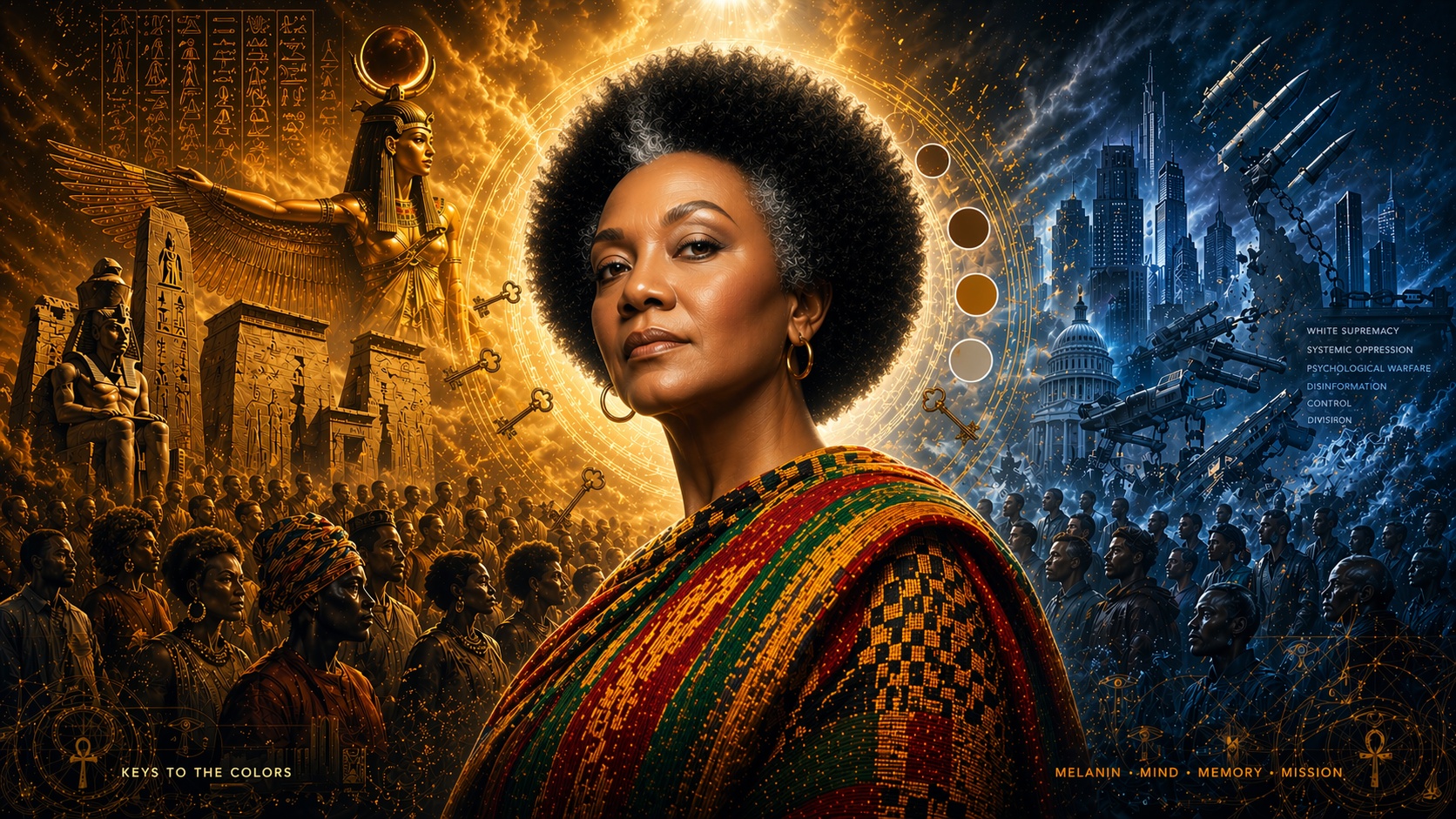
“There is no mental health for Black people without understanding racism and [European] supremacy; it is the major origin of stress that impacts us… There will never be peace as long as there is [European] supremacy.” ~Dr. Frances Cress-Welsing
The Isis Papers: The Keys to Colors by Dr. Frances Cress Welsing is my favorite book. This remarkable collection of essays written over 18 years, is deeply informed by Neely Fuller Jr.’s work, The United Independent Compensatory Code, which defines racism as a system of power rather than just individual prejudice. Where Fuller clarifies what racism is and where it operates, The Isis Papers explores how and why racism functions—particularly on psychological and symbolic levels. Dr. Welsing examines racism and its effects by decoding the symbolism of European‑dominated culture, arguing that symbols often arise from unconscious drives rather than fully conscious intent. This means that the dynamics of racism can operate below our conscious awareness, unless we deliberately cultivate the tools to perceive them.
A key idea in The Isis Papers is that non‑European peoples are often responding to a deeper psychological dynamic within European‑dominated societies, rather than simply to isolated, individual acts of bias. Welsing suggests that what we experience as racism is tied to a profound sense of insecurity and anxiety within the culture that holds global power. As she puts it, “Any neurotic drive for supremacy is founded upon a deep and pervading sense of inadequacy and inferiority.” Reading her work invited me to see that understanding history alone is not enough; without a psychological framework for the system that distorted and attempted to erase Black histories, our education can remain partial.
In his book Civilization or Barbarism, Cheikh Anta Diop outlines three factors of cultural identity: the historical, the linguistic, and the psychological. Historical consciousness—knowing the past and knowing oneself within that past—is essential but incomplete by itself. Cultural identity also requires a psychologically healthy Afrikan‑centred orientation, supported by the language we use and the values we hold. Knowing our history is just one move on the planetary “chessboard” between African and European worlds; recognizing what “his‑story” has done to our psyche, and how we can heal from that, is another.
From this perspective, it is possible for someone to know Black history in detail yet still hold deeply negative beliefs about Black people and Black cultures. Such a person might, for example, conclude that “we (Black people) must have done something wicked to have been enslaved,” while never applying the same logic to Europeans during the Black Death, Jewish communities during the Holocaust, or Indigenous peoples who experienced genocide and land theft. This mindset treats Black history as somehow lesser than European history or “civilization,” and accepts terms like “history from below” as if Black perspectives are naturally marginal. In that view, Rome is automatically considered a “higher” civilization than Ancient Kemet, or Greece more “classical” than Mali, without seriously examining what those words mean or whom they serve. Diop reminds us that language is never neutral; the words we use can either affirm or undermine our sense of self.
Our beliefs shape our values, and our values shape our identity. If someone deeply values European cultural forms above all others—literature, music, religion, institutions, aesthetics, education, technology—then knowledge of Black history alone cannot easily transform that hierarchy, because Black history has already been devalued in their inner world. For Black history to sustain its full meaning, it has to be understood psychologically (and linguistically) so that it can withstand a context in which it is constantly negated. Values are often more resistant to change than beliefs, yet meaningful value change usually begins with a shift in belief—a demanding inner process that each person must undertake for themselves. It is difficult to “enter” someone’s inner world when their mind is closed, and so we sometimes see people who are very knowledgeable about Black history still gravitating towards European spaces and aesthetics because that is what they have been taught to esteem.
For some, cultural identity becomes more about “routes” than “roots”: about travel, status and proximity to “whiteness” rather than deep connection to ancestral lineages. Yet, like the roots of a tree that travel different paths to anchor the plant and help it withstand the elements, returning to our roots provides the stability needed to navigate the world. My own journey has been shaped by ancestral guidance, including a dream in which my grandmother urged me to return to my roots (Sankofa)—a powerful reminder that our elders and Egun call us back to ourselves rather than to purely external routes. In that sense, seeking inclusion and validation from the cultural “other” can never fully substitute for the groundedness that comes from honouring our own traditions and histories.
The Isis Papers has become a centering text for all my learning. It provides a firm psychological foundation from which I can build my historical knowledge and interpret our contemporary realities. It has helped me to better understand many of the contradictions we see within the Afrikan/Black world, including the figure of the person who knows a great deal about Black history yet still operates in ways that are harmful to Black people. For me, The Isis Papers cuts through layers of confusion and misdirection and invites a clearer, more self‑respecting way of seeing.
Black history matters. It is essential that we know the past and remain connected to the memory of our people. At the same time, we have to acknowledge that this memory was violently interrupted, and that the captivity of our ancestors involved not only physical domination but also psychological and linguistic violence. We speak, write and dream in languages shaped by those who once claimed we had no history, and within these languages the word “black” often carries negative, fear‑laden associations. Many of us live with unprocessed trauma, and so we may internalize distorted beliefs about Blackness that work against our own wellbeing and collective dignity. This is why, in my view, historical knowledge on its own cannot enable us to fully grasp the depth of the violence that underlies the repeated killing of Black people, or the everyday cultural “programming” that normalizes that violence.
Welsing’s work equips us to read these patterns differently, including in contemporary media. Popular dramas and comedies that play with the language of Blackness, crime, or incarceration can function as sites where certain ideas about Black people are rehearsed and reinforced. Once you begin to work with Welsing’s concepts, it becomes easier to see how some programmes operate at the level of the psyche, shaping what audiences come to view as normal or acceptable in relation to Black life. For example, historical knowledge alone does not make you understand why someone would call a drama series, Orange Is the New Black. From a self‑respecting standpoint, Welsing’s insights change how we choose to spend our time, and what we allow to enter our minds.
Dr. Frances Cress Welsing dedicated The Isis Papers to “the victims of the global system of [European] supremacy (racism), all non‑[European] people worldwide, past and present, who have resolved to end this great travesty and bring justice, then peace to planet Earth.” She urged non‑European readers to deepen their understanding by studying works like Kenneth O’Reilley’s Racial Matters: The FBI’s Secret File on Black America, 1960–1972 and by reflecting on historical episodes such as the Wannsee Conference, where a modern state coolly planned mass destruction. For Welsing, such study is about grasping the real dimensions of organized power and then imagining something better.
There is no book quite like The Isis Papers. I have read the works of Amos Wilson, Frantz Fanon, Walter Rodney, and Marimba Ani’s Yurugu, all of which are extraordinary contributions. Yet for me, The Isis Papers stands out because of the way it brings psychology, symbolism, and global power into a single, coherent framework. It is not, however, an easy book to read and absorb without either an Afrikan‑centred orientation or a genuine desire to awaken from cultural amnesia. Welsing’s psychological concepts are strong medicine; they can be unsettling, but they also have the potential to shift our footing in a liberating way. As with any powerful text, you may find that you either resonate with it deeply or resist it strongly—and both responses can be the beginning of deeper reflection.
Marcus Garvey said that we must emancipate ourselves from mental slavery. For those who are willing to be free, The Isis Papers offers one set of keys for loosening the chains on our minds.
Here are 7 things you would have learned if you read The Isis Papers:
1. What is racism?
In Welsing’s framework, racism is not simply an attitude, prejudice, or even racial hatred. Racism is defined as European supremacy: a global power system of domination designed to secure European genetic survival, in which the majority of the world’s European people participate, consciously or unconsciously.
She argues that people of color, and particularly Black people, hold greater genetic potential in terms of melanin, and thus represent a perceived threat to European genetic continuity. Because of this, Welsing contends that Black people become a primary target for violence and repression, with Black males especially marked for control or destruction within this logic. She notes that “initial hostility and aggression” in the encounter between Europeans and non‑European peoples is well documented in European sources themselves. From this vantage point, images like King Kong—a giant dark figure opposite a European woman who must ultimately be destroyed—can be read as symbolic stories in which the imagined threat of Black male power to European survival is dramatised and then eliminated.
2. The degradation of sex
Welsing proposes that within European culture, sexuality is often framed through sin, guilt, and shame, and that this framing is historically linked to anxiety about the pale, exposed body. She contrasts this with many non‑European traditions in which people do not conceive of themselves as “born in sin” or treat their genitals as the primary source of evil. In her reading, the idea of “original sin” is symbolically tied to sex, nakedness, and the appearance of pale skin as a mutation away from the norm of richly pigmented skin.
From here, she interprets certain recurring cultural images—the Black woman as “mammy,” the eroticization and degradation of Black women under captivity, and the intense hostility towards intimate relationships between Black men and European women—as expressions of a deeper, unresolved anxiety. Historically, she notes that European male access to Black women was often structured through systems of captivity and coercion, even as Black people were dehumanised in language and law. In this psychoanalytic view, rage at the idea of a Black man and European woman together reflects fear of the Black male’s perceived capacity to fulfil the European woman’s desire for a child of colour, and thus to “annihilate” European genetics over time.
3. Projection – “If hate and lack of respect are manifested towards others, hate and lack of respect are felt most often at deep levels towards the self.”
Welsing places psychological projection at the heart of the system. She describes racism as a structure of contradiction, deception, and projection, in which unresolved feelings of fear, inadequacy, and self‑alienation are displaced onto Black people. Drawing on psychoanalytic ideas, she suggests that European males experiencing deep levels of inferiority, masculine self‑doubt and anxiety project these inner conflicts onto Black males, who then become the visible bearers of the fears that European men struggle to face within themselves.
At the same time, she notes that Black men have been systematically blocked from full competition in key areas of human activity—economics, education, entertainment, labor, law, politics, religion, sex, and war—while still retaining a sense of pride in their bodies and sexuality. In her reading, this creates a situation where Black men are forced to live out, in public view, the “inner nightmare” and neurotic anxieties of European males under a system of European supremacy. She contrasts this with reflections like Mark Twain’s, who wrote admiringly of Black and brown complexions and described many European complexions as “bleached out” by comparison, underscoring how beauty norms are neither fixed nor universal.
4. Albinism
Welsing argues that pale skin can be understood as a form of albinism, noting that there is no essential microscopic difference between the skin classified as “white” and that of a person described as an albino, apart from melanin content. Her theory suggests that pale‑skinned people originated as albino offspring of dark‑skinned parents in Africa thousands of years ago, and that these children, marked by their difference, experienced rejection and had to live apart from the main population. Over time, she proposes, these isolated groups migrated northward to escape the intense equatorial sun and eventually settled in the region now known as Europe, where intermarriage among themselves produced a distinct population.
She connects this idea to thinkers like Arthur Schopenhauer, who wrote that “the white colour of skin is not natural to man,” and suggested that human beings were originally black or brown. Schopenhauer argued there is “no such thing as a white race” in nature, but rather that European people are “faded or bleached” versions of a darker original. Welsing uses such reflections to support her view that European identity is historically rooted in a condition of difference and vulnerability, which then shapes later anxieties about color.
5. Penis Envy
In The Isis Papers, Welsing extends her analysis into the symbolic realm of the body. She contends that penis envy in European culture begins with envy of the perceived genetic power in the Black male’s phallus and testicles—the capacity, through reproduction, to bring forth children of colour who could “absorb” European genetics. She suggests that the recurring European fascination with comparing Black and European male genitalia is an unconscious way of grappling with this perceived imbalance in power.
From there, she reads everyday objects as phallic symbols: the large dark cigar, the long black limousine, and especially missiles shaped and deployed by powerful states. The more important a European male perceives himself to be, she argues, the larger and more conspicuous his symbolic “phallus” becomes, whether as vehicle, weapon, or object of display. In this interpretation, the construction of missiles and other phallic weaponry aimed disproportionately at people of colour can reflect an unconscious attempt to equalise or overpower the feared potency of the Black male body.
6. Guns as Symbols
Welsing also reads gun culture symbolically. She notes the strong resistance among many Euro‑Americans to limiting access to firearms, despite the catastrophic harm they cause, and interprets this as more than a policy preference. In her analysis, the gun functions as a substitute phallus: the handle and chamber corresponding to the testicles, and the barrel to the penis. The firing of the gun, in this symbolic language, mirrors the feared capacity of the Black male phallus to “destroy” European genetic survival, but in reversed form—projecting lethal force outward rather than generating life.
She notes phrases like “the great equaliser” and expressions such as “son of a gun” as cultural hints that the gun stands in for masculine power and lineage. In this reading, the weapon becomes the preferred, idealised phallus of the European male, compensating for a sense of deep inadequacy beneath a hardened exterior. Welsing even extends this symbolism to popular pastimes like cockfighting and to slang names for the penis such as “cock” and “dick,” suggesting that language, guns, and play are all stitched together in a single unconscious drama about power and vulnerability.
7. Black Fear
Finally, Welsing focuses on the emotional climate in which Black people live. She states that Black people across the world live under a global system of European supremacy that restricts true power and shapes almost every area of life. In her view, this system is the central problem confronting Black and other non‑European peoples—not individual prejudice in isolation, but a structured, enduring pattern.
She argues that, particularly since the assassinations of courageous Black leaders, many Black communities have been understandably fearful of directly confronting the violent potential of European domination. As a result, much of our public discourse oscillates between complaint and accommodation, accompanied by the hope that full integration into existing structures will eventually be possible. Welsing believes that the fear of death at the hands of a European supremacy system is often repressed and then turned inward, showing up as Black suicide, Black‑on‑Black violence, child and partner abuse, and attempts to escape Blackness through assimilation, interracial relationships, or religious conversion. For her, the starting point for transforming this reality is the deliberate growth of deep self‑respect and group respect among Black people, so that fear no longer quietly governs our choices.
Image Acknowledgement & Symbolism:
Title: Dr. Frances Cress Welsing: Keys to the Colors
Image created by: Spruce (AI image generation)
Creative direction: Meserette Kentake and Tylis (Perplexity AI)
This portrait presents Dr. Frances Cress Welsing as a visionary interpreter of power, memory, and psychology. Her kente garment anchors her in African continuity, while the circular halo motifs reference her concept of “keys to the colors”—insight as a tool for decoding systems. The background contrasts golden Kemetian antiquity and collective Black unity with cold blue symbols of modern power and militarisation, suggesting a tension between ancestral knowledge and contemporary domination. Overall, the image positions Welsing as both analyst and guide—reading the world, and revealing its hidden structures.
Source:
The Isis Papers by Dr. Frances Cress Welsing



15 Responses
Bless you !!!!!
I really enjoy this page, if you do not mind I am going to make as many people aware of it as possible even ones who will wish they had not noticed!!! Truth is the only answers that can used to bring an end to the majority of the ills of the world!!! Please continue to rise and stand for the truth!!!
Thank you for knowledge and truth. I am over 50 and was never taught or made aware of this information.
Wow, so much needed insight and information. I appreciate these pieces of the puzzle that gives me a clear view of how and why whytes try to intimidate me so. I am a strong willed intellectual, and a heavily melenated sistah that won’t allow a Whyte to psychologically dominate me… And these pieces of the puzzle is why. Thanks for an awesome read. I will now share with my four sons.
Very informative. Love it.
Refreshing, yet angers me that we have succumb to allowing this. Not educating and building to destroy white supremacy!!!
This is great information, these are the things that should be taught to our people. Knowledge is power. Thanks!
I feel blessed to have found this site, can’t put it down, so much information, keeps me hungry for more with a better understanding of who we are as a race/people and what can be done to finally move through the sickness of the American society. Thanks again for sharing valuable research and connecting the dots
Truth be told! Thanks.
This article should be on the front page of everything Black people come in contact with. Having read The Isis Papers several times, the content becomes more clear. This article encapsulates Dr. Welsing’s writings masterfully.
To the writer of this powerful and very illuminating article: Brother/Sister: You have struck a mighty blow towards the death and demise of Global White Supremacy!! GWS is on its last leg/episode and may it be completely extinguished and decimated in our life time!! ALL peoples of African origin (The Black Man/Woman),should read this powerful article in conjunction with the book!!
Excellent article with much to be discovered. I plan on ordering every book / document you suggest here. Thank you for this valuable perspective. It’s creative and deep down in the rabbit hole where truth usually lies. Powerful and painful are the only words I can use to describe the 7 areas you write about on this page – but everything makes perfect sense. Solutions – let’s keep finding them. Love & Light to you my friend.
As a student of The Isis Papers for more than 30 years I want to express deep gratitude and appreciation for your contributions toward understanding and teaching the concepts in “The Keys to the Colors.” I’m also a student of every African scholar I can find who has studied and understands human psychology from an African centered point of view. An example, beyond the names you mention, (Frantz Fanon, Amos Wilson and Marimba Ani), are Dr’s Cedric X, D. Phillip McGee, Wade Nobles, and Na’im Akbar. These scholars wrote “Voodoo or IQ: an Introduction to African Psychology.” This short but powerful article addresses the role of origins as it relates to human psychology. Indeed, a deep enough search into Nile Valley Civilization reveals the African origin of human psychology. There are many other African centered scholars who have made contributions on this topic. The point being, Africans who know they are African should conclude that anyone attempting to understand the nature of human behavior should start at the beginning of humanity.
I agree with your assessment of Dr. Welsings’ work. She dedicated her life to helping us understand the dynamics of white supremacy (racism). I should add that Neeley Fuller’s ongoing pronouncement that “If you don’t understand racism/white supremacy–what it is and how it works–everything else you do understand–will only confuse you.
I have learned that this statement also works in reverse. That is, if you do truly understand the science supporting racism/white supremacy, unfolding human events will become crystalized to any attempts to understand the culture that dominates this planet.
Africans everywhere should do what another African hero (Amilcar Cabral) suggested and that is Return to the Source.
Powerful analogy of the truth!
Dr. Frances Cress Welsing’s contributions to the world will be studied and researched for the decades to come. She was one of the most important scholars of the turn of the 21 century. Black females continue to change the face of the planet.