
Queen Charlotte’s racial identity remains one of the most intensely debated topics in modern British royal historiography. The controversy raises profound questions about the construction of race, the politics of historical memory, and whether a 13th‑century Moorish ancestor could make an 18th‑century German queen “Black.”
The first time I encountered an image of Queen Charlotte Sophia was in a book by Jamaican‑American historian J. A. Rogers. Years later, I unexpectedly found myself standing before her portrait at Queen Charlotte’s Hospital in Hammersmith, London. The painting took my breath away — I could scarcely believe my eyes, because I was looking at a woman who appeared to be of mixed race. The experience was profound. Her gaze seemed to search my soul, even as I sought answers about her identity. Seeing Queen Charlotte Sophia’s portrait compelled me to wonder, “Who are you?” I am certain J. A. Rogers and many others have felt the same urge to question her racial background.
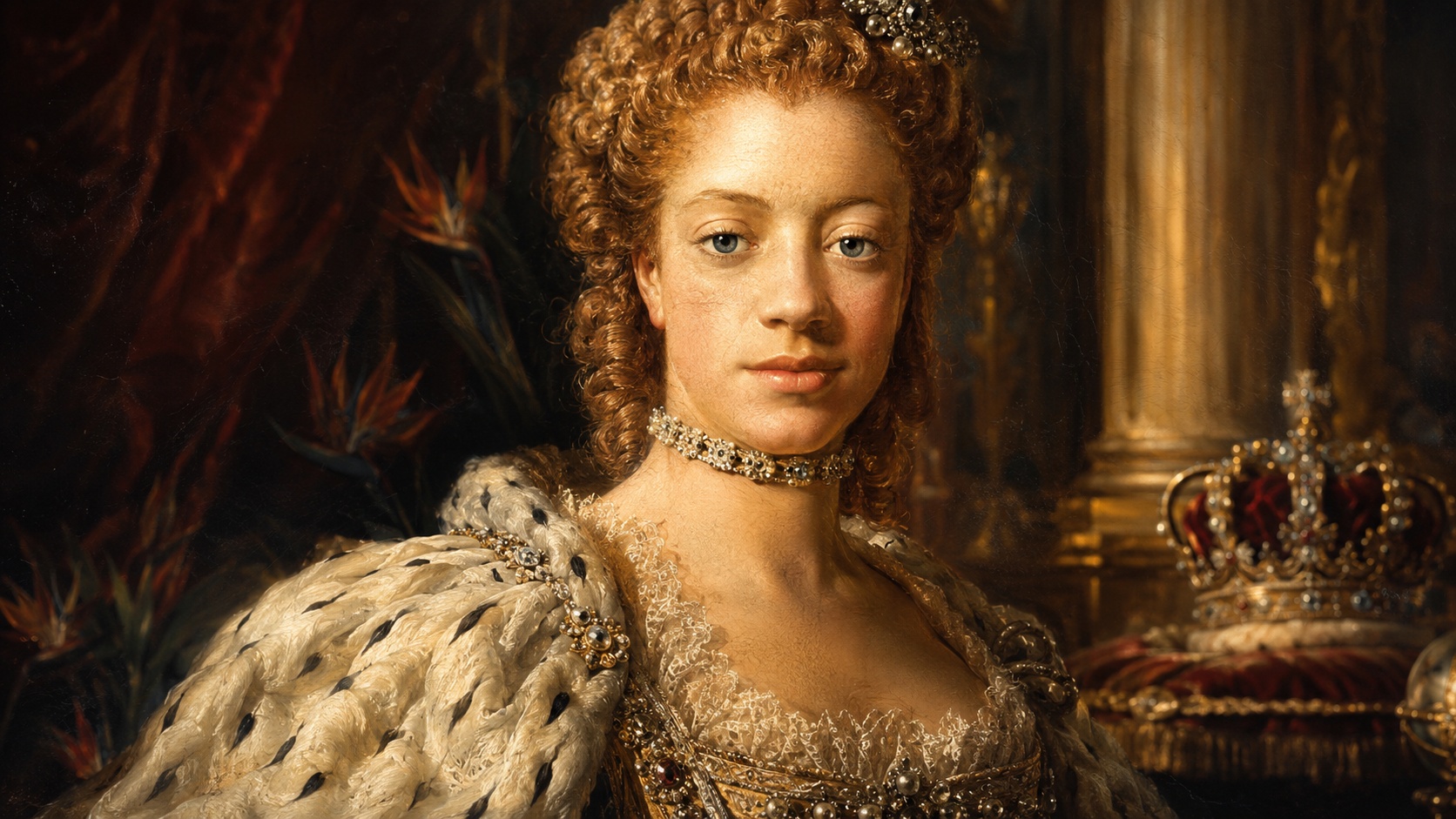
The portrait I viewed was an Allan Ramsay–style coronation painting (or a studio copy in that manner), depicting her in full regalia beside the crown and a column, draped in a heavy ermine‑trimmed robe and an embroidered gold skirt. In this version, the facial features, skin tone, and hair texture are precisely the aspects that have led many viewers — including myself — to interpret her appearance as mixed race: the broader nose, fuller lips, and subtly distinct complexion are especially pronounced.
Ramsay, a Scottish artist who served as King’s Principal Painter, created official portraits of Queen Charlotte Sophia that were widely circulated throughout British society. His depictions of Queen Charlotte differ noticeably from those of other painters. For instance, the Thomas Gainsborough portrait portrays her as unambiguously European in appearance.
Some argue that Ramsay was a committed abolitionist, and intentionally accentuated Charlotte’s features — whatever their true nature — to promote an abolitionist message, aware that copies of the coronation portrait would reach the British territories. Yet this was a crowned queen, not an anonymous sitter, and a painter could not simply invent a racialized visage without facing consequences.
In the eighteenth century, a court painter needed to ensure the likeness was recognizable to courtiers and foreign diplomats — the same woman they encountered at court — despite the expectation of flattery that smoothed age, uneven skin, or awkward features. Ramsay could not plausibly transform a pale, sharp‑featured German princess into a visibly mixed‑race queen and have that image accepted as her “official face.” The widespread adoption and circulation of Ramsay’s coronation portrait suggest his depiction was well within the boundaries of what contemporaries recognized as Charlotte.
The abolitionist interpretation relies on three main arguments: that Ramsay had anti-Maafa sympathies, that the trafficking of Africans was fiercely debated, and that his portraits depicted more African‑coded features than those by other artists. From this, some authors infer that he deliberately accentuated her appearance as a subtle political statement — amplifying Blackness that might otherwise have gone unnoticed. However, had Ramsay truly invented Blackness where none existed, the king and queen — who routinely rejected unsatisfactory portraits — could have refused to authorize copies or circulation. Moreover, foreign observers, caricaturists, and pamphleteers — eager to exploit even minor scandals — would almost certainly have remarked on any overtly “racialized” distortion of the queen’s likeness.
There are no records of such protests regarding Ramsay’s portraits, which undermines the notion that his abolitionist sympathies alone account for the visual effect.
The Case FOR African Ancestry
The Genealogical Claim
The modern genealogy argument originates with Mario de Valdes y Cocom, a self‑described independent researcher who published his findings in a 1997 PBS Frontline article. He claimed that Charlotte was directly descended from Margarita de Castro e Sousa, a Black branch of the Portuguese royal house, and that six separate genealogical lines traced back to this ancestress. According to Valdes, intense royal inbreeding could have allowed African features to be concentrated and passed down rather than diluted.
Valdes ultimately traced this lineage to Madragana (born c. 1230), a mistress of King Afonso III of Portugal. Historical sources variously described Madragana as a “Moor,” a term that Valdes interpreted as meaning South Saharan Black African.
Contemporary Descriptions
Supporters of this claim cite several contemporaneous accounts that describe Charlotte’s appearance in racialized terms. Baron Stockmar, reportedly the royal physician, described her as having “a true [mixed-race] face.” Horace Walpole noted that her “nostrils [were] spreading too wide” and “the mouth has the same fault” — features that 18th‑century Europeans racialized as African. Sir Walter Scott wrote that she was “ill‑coloured.” During the War of 1812, British Vice Admiral Sir Alexander Cochrane weaponized the claim that “the Queen of England was a [Black] woman” to recruit captive people to the British cause, suggesting the notion had some currency at the time.
Proponents also point out that artists of the period were expected to soften or erase racially “undesirable” features, so the fact that Ramsay’s portraits show African characteristics at all may indicate an unusual degree of honesty. Historian Gretchen Gerzina has stated she believes it is “probable” that Charlotte had African ancestry, citing a portrait she saw in Nova Scotia that displayed distinctly African features. She also claimed that Princess Anne reportedly acknowledged that “everybody knows” of this heritage.
The Case AGAINST African Ancestry
Who Was Madragana, Really?
The African‑ancestry argument’s entire foundation rests on Madragana being a South Saharan Black woman — but this identification is deeply contested. One historical analysis notes: “A more reasonable presumption is that the ancestors of Madragana were from North Africa, possibly blue‑eyed Berbers or even Vandals, a Germanic tribe who had settled there.” Some researchers believe she was a Mozarab — an Iberian Christian of possible Sephardi Jewish origin.
The Mathematics of Genetic Dilution
Even if Madragana were of South Saharan African origin, the genetic arithmetic is fatal to the “Black queen” claim. Madragana lived around 1230, while Charlotte was born in 1744 — roughly 500 years and about 15 generations apart, assuming a generation averages 25 years. After 15 generations of mixing, Charlotte’s theoretical African ancestry would be just 1 in 32,768 parts — or approximately 0.003%. Even under Valdes’s “six lineages” argument, this fraction remains biologically and visually negligible. As one analyst put it: “After 15 generations, there would be an infinitesimal amount of that DNA left… Charlotte’s Moorish heritage would, statistically, account for perhaps one gene.” This is less African ancestry than the average Euro-American carries unknowingly.
One Drop of Blood?
This cuts to the heart of racial epistemology: does one drop of Black blood make you Black?
The one‑drop rule was a legal principle formalised in US state laws primarily between 1910 and 1930. It was an instrument of hypodescent — the automatic assignment of mixed‑race children to the lower‑status, non‑white group — designed specifically to preserve white privilege and expand the pool of captive people. It was never applied in 18th‑century Britain, and it was never a biological, genetic, or anthropological principle — it was a tool of racial terror.
Applied to Charlotte, one‑drop thinking would say: if Madragana had any South Saharan ancestry, and if Charlotte descends from her, Charlotte is “Black.” But this logic:
- assumes Madragana was South Saharan Black (which is unproven),
- ignores that 500 years of intermarriage with European royalty would leave no detectable African genomic trace,
- treats race as a contaminant rather than as a social and biological spectrum, and
- was not the framework of Charlotte’s own time and place.
If we applied one‑drop logic consistently, as one commentator noted, Charlotte would be approximately 1/32,768th “Moorish” — and even that assumes Moors were Black in a South Saharan sense.
It is important to note that in medieval and early modern European usage, Moor was an exonym with overlapping meanings, not a precise ethnic label. It could mean Muslims of al‑Andalus and the Maghreb (mainly Arab and Berber), more generally dark‑skinned North Africans, or, in some later English usage, simply dark‑skinned or Black people, including South Saharan Africans.
So yes: there were “black Moors” (South Saharan or very dark‑skinned Africans) alongside “white Moors” (lighter, often Arab or Berber North Africans) in European description. That ambiguity is exactly why people can marshal Moor to support very different claims.
However, Blackamoor emerges as a more explicitly racial term. In early modern English, Blackamoor or Black‑a‑moor usually referred to a figure understood as Black African, especially in decorative arts, jewellery, sculpture, and servile imagery. The term sits at the intersection of race, servitude, and exoticism, signalling that the “Moor” in question is not just Muslim or North African, but emphatically Black.
In Madragana’s case, the sources call her a Moor but do not, as far as we know, apply an equivalent of “Blackamoor,” which is why modern scholars remain divided on whether she was understood as ethnically Black in a South Saharan sense.
Stockmar Problem and the Silence of Her Contemporaries
The Stockmar “[mixed-race] face” quote is repeatedly cited as a smoking gun — but there is a fundamental chronological flaw: Baron Stockmar was born in 1787, making it impossible for him to have seen Charlotte “at birth,” as some sources claim. He arrived at court only two years before Charlotte’s death in 1818, when she was elderly and reportedly unwell, and his descriptions of her children in the same diary are equally unflattering. This makes Stockmar’s testimony a late, possibly spiteful, and certainly medically unreliable observation — not a birth record.
Perhaps the most powerful counter‑argument is one of absence. In an intensely racist society, where the transatlantic trafficking was still active, the Queen of England, having visibly African features, would have been the defining political and social scandal of the era. Yet no contemporary newspaper, diarist, or court correspondent made this claim during her lifetime. Political caricatures, which ruthlessly mocked both the King and Queen, consistently depicted Charlotte as a European woman. Portraits of her parents, siblings, and children also show unambiguously European features. Historian Andrew Roberts calls the claims “utter rubbish,” attributing their persistence to historians’ reluctance to challenge them for fear of appearing racist.
However!
The Bussa-led war of 1816 was fuelled in part by an extraordinary rumor: that the Queen was a Black woman and that she had already granted freedom which was being withheld in Barbados.
Testimony collected after the Rising recorded several versions of the rumor. Daniel, a carpenter at the River plantation, recalled being told by Cain Davis that the Queen and William Wilberforce had ordered that the Black population be freed, but that the island’s inhabitants opposed it. Another account went further: freedom, it was said, was to come through “a black woman who was a Queen, for whom Mr. Wilberforce acted in England.”
The “Queen” during the Rising was Charlotte Sophia.
Additionally, the warriors’ flag gives visual form to their political imagination. Accounts of a surviving flag from the Rising describe George III, Britannia, a Black woman, and a crowned Black man.
So, this begs the question: How did the British monarchy become associated with Blackness and emancipation in Barbados for captive people? Why did they believe that the Queen was a Black woman?
Why the Debate Persists
The theory has been popularised — not substantiated — chiefly through its depiction in the Netflix series Bridgerton and its spinoff Queen Charlotte, which were explicitly labelled “fiction inspired by fact”; by African diaspora scholars and communities seeking visible representation within European royal history; and by the political resonance of the abolitionist movement, which may have strategically promoted the idea at different moments.
The desire for Charlotte to be Black is understandable, given how completely Black people have been erased from European royal narratives. Yet what is settled is this: Charlotte of Mecklenburg‑Strelitz was German by birth, culture, and documented lineage. If she carried any South Saharan genetic material at all, it was so remote as to be scientifically invisible — less, in all likelihood, than what you would find in any random sample of southern European people today. The “Black queen” claim is a compelling story, born of real political need, but built on a very fragile historical foundation. However, as National Geographic concluded: “Since it’s impossible to determine how Charlotte looked in real life, the argument will likely never be settled.”
What You See vs. Why You See It
What makes this such a rich debate is the distinction between appearance and the reasons behind it. In the Ramsay portraits, three main explanations have emerged. Some argue that Charlotte genuinely had mixed‑race ancestry, physically expressed through features inherited from the Madragana lineage — a point central to Mario de Valdes y Cocom’s argument. Others believe her broad features can be attributed to her family’s Germanic‑Vandal heritage: the House of Mecklenburg carried the title Princeps Vandalorum (“Prince of the Vandals”), referencing a northern Germanic tribe that migrated across North Africa, which could explain her broader nasal features without invoking South Saharan ancestry. A third possibility is that Allan Ramsay intentionally emphasized certain features for political reasons, while still painting a face that contemporaries recognized as the Queen.
One particularly compelling piece of evidence from researcher Kimba Hudson is that many Charlotte portraits appear to exist in two versions: one in which she reads as mixed‑race (clearly in Ramsay’s hand and technique), and another version of the same composition in which the face has been “whitened” and the hair straightened. This suggests that something in those originals prompted later artists or studios to consciously revise the representation.
So did Ramsay paint Queen Charlotte as she truly appeared? Was he documenting a German queen whose features happened to align with racialized notions of African ancestry, or was he engaging in a subtle visual politics that later artists attempted to erase? Do we really believe that he painted her for Black viewership?
Whether the answer lies in documentary accuracy, Germanic heritage, or a masterstroke of abolitionist symbolism remains a beautifully, maddeningly open question.
Ultimately, only you can decide which Queen you see — Black, European, or somewhere in between — and perhaps it takes your own pilgrimage to Queen Charlotte’s Hospital to find out. I know where I stand in this debate. I have stood before her portrait, and what I said to her then still holds true today: “Until they dig up your bones and do your DNA, you are Black. I don’t care what they write or say. You are one of us!”
Further Reading
On Queen Charlotte and the “Black Queen” debate
- National Geographic – “Who was Queen Charlotte—and was she really Britain’s first Black queen?”
https://www.nationalgeographic.com/history/article/queen-charlotte-british-royal-history - PBS Frontline – “Queen Charlotte” (Mario de Valdes y Cocom’s original genealogy argument)
https://www.pbs.org/wgbh/pages/frontline/shows/secret/famous/royalfamily.html - Royalty Now Studios – “What did Queen Charlotte really look like? Was she Black?” (portrait comparison and facial analysis)
https://www.royaltynowstudios.com/blog/queencharlotte - The Critic – Lisa Hilton, “The ‘mulatto’ Queen” (Stockmar quote, critique of the Black‑queen thesis)
https://thecritic.co.uk/issues/february-2020/the-mulatto-queen/ - All Things Georgian – “The many faces of George III’s wife, Queen Charlotte” (survey of her portraits)
https://georgianera.wordpress.com/2017/01/31/the-many-faces-of-george-iiis-wife-queen-charlotte/
On Madragana, Moors, and genealogy
- Rupert Willoughby – “Zaida of Seville and Madragana of Faro, Two Moorish Ladies and the Muslim Ancestry of the English Royal House”
http://www.rupertwilloughby.co.uk/gleanings/muslim-ancestry-of-the-english-royal-house-zaida-of-seville-and-madragana-of-faro-two-moorish-ladies/ - Wikipedia – “Moors” (overview of the term’s shifting meanings in Europe)
https://en.wikipedia.org/wiki/Moors - Muslim Journeys / Oxford – “‘Moors’ from Oxford Islamic Studies Online”
https://bridgingcultures-muslimjourneys.org/items/show/218
On “Moor,” “Blackamoor,” and racial imagery
- Wikipedia – “Blackamoor (decorative arts)”
https://en.wikipedia.org/wiki/Blackamoor_(decorative_arts) - Decorative Arts Trust – “Figuring the Black Body in European Decorative Arts”
https://decorativeartstrust.org/ornamental-blackness-article/ - Mozeris Fine Antiques – “What is the History of the Blackamoor”
https://www.mozerisfineantiques.com/blogs/what-is-the-history-of-the-blackamoor
On the one‑drop rule and race law
- Wikipedia – “One-drop rule”
https://en.wikipedia.org/wiki/One-drop_rule - The Hidden Branch – “Blood Quantum and One Drop Rule”
https://thehiddenbranch.com/blood-quantum-and-one-drop-rule/
On Bridgerton, media, and popularisation
- Smithsonian Magazine – “The Real History Behind ‘Queen Charlotte: A Bridgerton Story’”
https://www.smithsonianmag.com/smart-news/the-real-history-behind-queen-charlotte-a-bridgerton-story-180982130/ - Vox – “The real history of Queen Charlotte, and the problem with Netflix’s Bridgerton”
https://www.vox.com/culture/23712625/queen-charlotte-bridgerton-netflix-real-history - El País (English) – “Queen Charlotte wasn’t Black and George III wasn’t mad: the half‑truths of the hit series ‘Bridgerton’”
https://english.elpais.com/culture/2024-02-01/queen-charlotte-wasnt-black-and-george-iii-wasnt-mad-the-half-truths-of-the-hit-series-bridgerton.html
The Bussa-Led War
- Barbados Select Committee report, 1818. Pages 26, 33-34. https://books.google.co.uk/books/about/The_Report_from_a_Select_Committee_of_th.html?id=UvJeAAAAcAAJ&redir_esc=y