
Catherine Flon holds a revered place in Haitian history as the woman most closely associated with the creation of the first Haitian flag and, by extension, the birth of the world’s first Black republic. Celebrated as a seamstress, nurse, educator, and patriot, she stands among the most significant symbolic heroines of the Haitian Revolution. Although the written record preserves only fragments of her life, her legacy has endured through national memory, oral tradition, and the vibrant cultural life of Haiti and its diaspora.
Born around 1772 in Arcahaie, Ayiti, Catherine Flon grew up in a society shaped by racial and colonial violence. Many accounts identify her as the daughter of Ayitians held in captivity, and she is widely described as the goddaughter and close assistant of Jean-Jacques Dessalines, one of the central leaders of the Haitian independence struggle. This connection placed her near the heart of the revolution’s political and military activities, even though she was not a battlefield commander.
From an early age, Flon was recognized for her remarkable skill with needle and thread. She reportedly established a sewing workshop in Arcahaie, where she taught young girls to sew, empowering them to support themselves economically. Flon is also remembered for her work as a nurse during the revolution, tending to the wounded and sick, often using herbal and folk remedies under challenging conditions. These overlapping roles reveal a woman whose contributions to the revolutionary cause were practical, intimate, and indispensable.
Flon’s name became permanently linked to Haitian independence through the events of May 1803 at the Congress of Arcahaie. This gathering occurred during the final, decisive phase of the Haitian Revolution, after Toussaint Louverture was captured by the French and as Napoleon sought to reimpose captivity and reassert French control. In response, Dessalines and other leaders moved toward a unified push for total independence. The Congress brought together leading revolutionary generals to consolidate their forces and define both the symbolic and political meaning of their struggle.
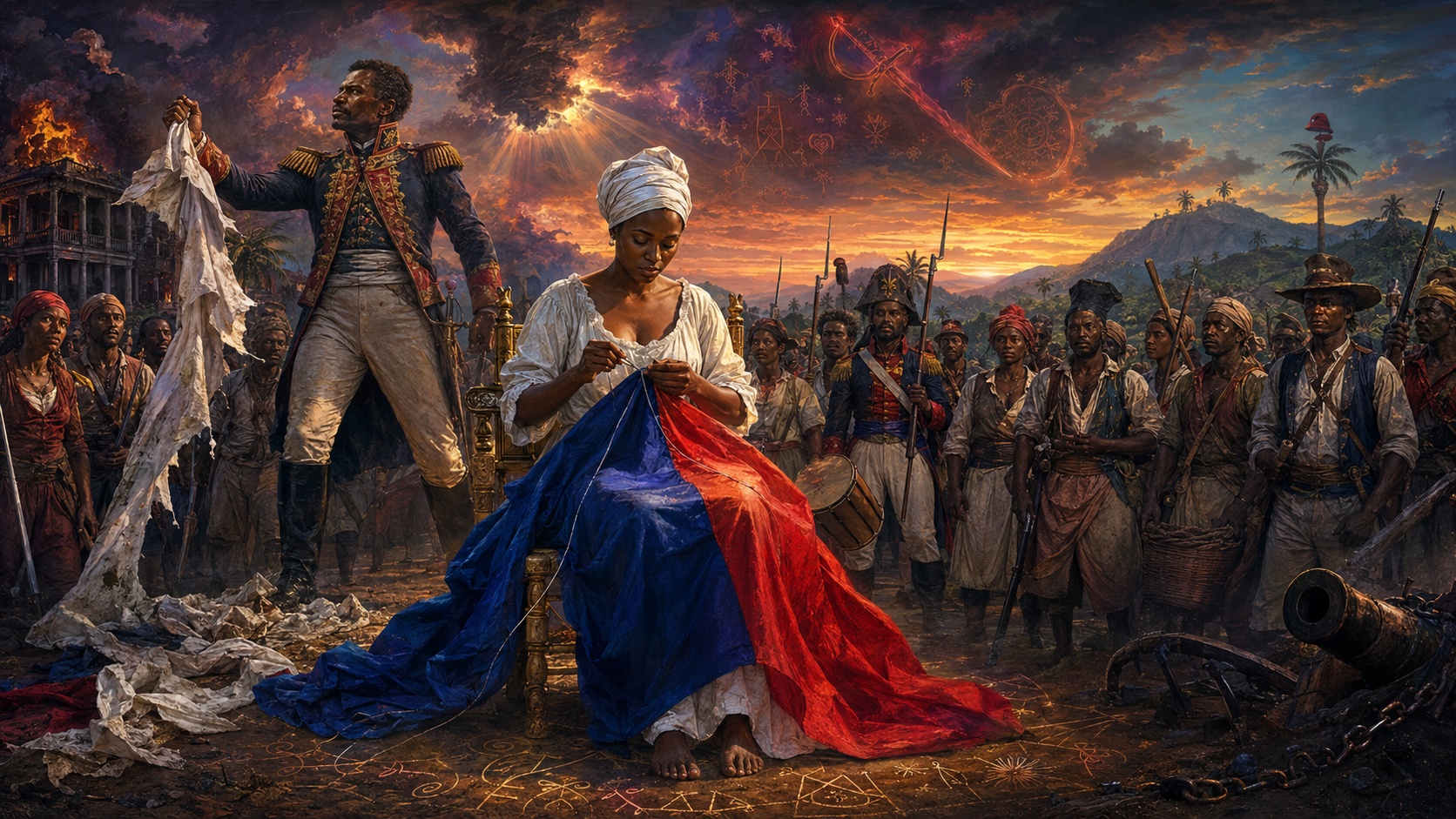
According to enduring national tradition, Dessalines took the French tricolor and tore out the white band, symbolically rejecting the racial order it represented. He handed the remaining blue and red bands to Catherine Flon, who stitched them together to create the first Haitian flag. In that moment, her needle transformed cloth into a political declaration. The blue and red came to symbolize the unity of Black and mixed-race Haitians, joined in a common struggle. Through this act, Flon became inseparable from the birth of Haiti as a sovereign nation.
Catherine Flon is recorded as having died in 1831, after witnessing the birth and early years of the nation she helped symbolize. Over time, her memory became woven into Haiti’s civic and cultural life. Arcahaie became known as the town of the flag, Haitian Flag Day on May 18 commemorates the creation of the banner associated with her name, and her image has appeared on the Haitian ten-gourde note. Schools and institutions have also been named in her honor, affirming her place in the national pantheon.
Flon’s legacy has expanded beyond nationalist remembrance to become a symbol of womanist and diasporic significance. She is celebrated as an emblem of women’s agency in Haitian history, especially because her story highlights forms of revolutionary labor that archives have often marginalized or ignored. In Haiti and across the diaspora, her name is invoked at commemorations, community events, and educational initiatives that seek to restore women to the center of the revolutionary narrative. Her story continues to resonate because it embodies the deeper truth that liberation is sustained by makers, healers, teachers, and women whose work history has too often been overlooked. In the story of Haiti, Catherine Flon endures as the seamstress of freedom and one of the quiet architects of independence.
Source:
https://clok.uclan.ac.uk/id/eprint/30592/
https://www.tandfonline.com/doi/abs/10.1080/0144039X.2019.1685254
https://enslaved.org/fullStory/16-23-126810/
https://projects.kora.matrix.msu.edu/files/16-23-126810/Catherine_Flon_DCALAB.pdf
https://www.ontheshoulders1.com/the-giants/the-woman-who-created-the-haitian-flag-katherine-flon
https://en.wikipedia.org/wiki/Flag_of_Haiti
https://creolesizzle.com/blogs/news/haiti-flag-meaning-colors-and-why-it-represents-resilience
https://nchcureca.com/la-femme-une-patrie-une-legende-issues-of-documentation-and-memorialization-of-haitian-women-revolutionari
https://icmglt.org/in-some-cases-it-was-the-women-who-were-fiercest-in-the-fight-the-female-freedom-fighters-of-the-haitian-revo