
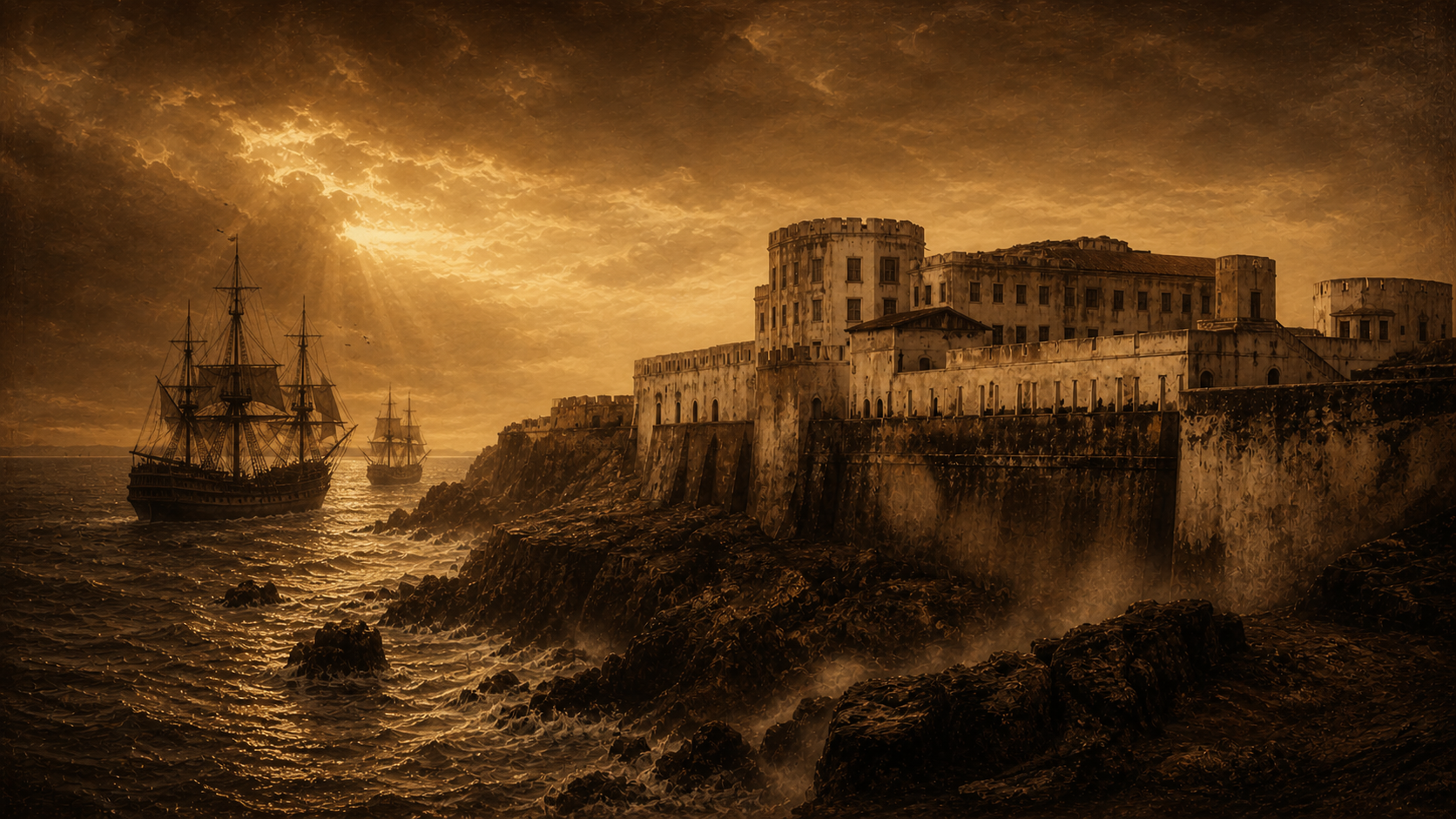
Cape Coast Fortress stands as one of the largest and best-preserved European fortifications on the West African coast, and is one of more than 30 historic military structures along Ghana’s coastline. Recognized as a UNESCO World Heritage Site, its beginnings date to 1555, when the Portuguese established a trading post called Cabo Corso (“Short Cape”). Over the centuries, the site developed into a major stronghold and remains a powerful symbol of the transatlantic displacement of Africa’s people.
The fortress was constructed over a period of 300 years, beginning with the Swedes in 1654, who erected a timber trading lodge. This structure was soon replaced by a stone fort, which changed hands frequently: the Danes seized it in 1657, the Dutch occupied it in 1660, and local Fetu rulers briefly reclaimed it in 1661. The British captured the fort during the Anglo-Dutch wars of 1664–65 and began transforming it from a modest trading post into a formidable stronghold.
Strategic Importance and Reconstruction
The fortress’s strategic position—close to the water, near Elmina Fortress, and perched on a natural promontory—made it highly coveted. In 1757, during the Seven Years’ War, a French naval squadron bombarded the castle, leaving it badly damaged. After 1760, the English rebuilt it entirely, using more durable materials, reinforcing sea defences, and expanding its fortifications.
From Trade to Trafficking
In its early decades, Cape Coast Fortress functioned primarily as a hub for the trade in gold, timber, ivory, and textiles. Local African merchants exchanged gold dust and other goods for European clothing, spices, silk, and firearms. The fortress’s agent-general distributed trading goods to surrounding forts along the Gold Coast.
The pivot to transatlantic trafficking was driven by the unrelenting demand for labour on American and Caribbean plantations. In 1672, the Royal African Company of England received an exclusive monopoly over all English trade along the West African coast, and the company expanded Cape Coast Fortress significantly to facilitate this commerce. Dungeons were constructed beneath the upper-level living quarters—vast underground chambers capable of confining as many as 1,500 individuals at a time as they awaited forced transport across the Atlantic.
The Dungeons
Men were confined in underground chambers on one side of the fortress, with women and children held on the other. Each chamber had only a single ventilation shaft, which also served as the opening for food and water. The rooms were pitch-black, suffocatingly hot, and catastrophically overcrowded—estimates suggest 50–80 people were packed into each small space at a time, held for at least six weeks and often for several months. Those detained came from diverse language groups and communities, making communication in the darkness nearly impossible.
Over time, the floors became compacted layers of excrement, blood, vomit, and sweat, and the stench was described by visitors as overpowering even centuries later. There was no meaningful sanitation—drains were cut to allow waste to flow into the sea. Those who resisted or attempted escape faced brutal punishment: some were publicly mutilated as warnings to others; the most defiant were thrown into a sealed “condemned cell”—a windowless, airless room with no food or water—and left to perish. The marks on the walls and floors of these chambers—deep scratches and gouges in the stone—remain visible today, interpreted as the final, desperate traces of those who died within.
Scale and Structure of the Trafficking
Under the Royal African Company, the scale of forced transportation was immense. By around 1700, the company is estimated to have sent approximately 70,000 people per year to the Americas. The fortress functioned as a form of vertical integration—housing not only dungeons but also trading rooms, officers’ quarters, cisterns, artillery, and a church—enabling ships to be outfitted rapidly and at greater profit than rivals.
The Company’s monopoly eventually collapsed under pressure from private traffickers, pirates, and mounting logistical losses. In 1750, Parliament dissolved the Royal African Company and transferred control to the Company of Merchants Trading to Africa, whose governing committee included representatives from the trading centres of London, Bristol, and Liverpool.
The Door of No Return
The “Door of No Return” is the low, arched gate at the base of the fortress’s courtyard, through which countless individuals were marched directly onto waiting ships bound for the Atlantic. It stands as the fortress’s most powerful symbol: the final threshold between Africa and the unknown, crossed by millions who would never see their homeland again.
Men, women, and children were led from the underground tunnel network to the beach, where they were loaded onto boats and ferried to ships anchored offshore. Today, the door has been ceremonially renamed the “Door of Return” and serves as a site for libation, remembrance, and communal reckoning.
British Administration and Transformation
Britain legally abolished the transatlantic trafficking in 1807, and Cape Coast Fortress’s commercial role shifted almost immediately. The British turned to trade in gold, ivory, corn, and pepper. From 1821, the fortress served as the seat of British administration in the Gold Coast until the capital was moved to Christianborg Fortress in Accra on 19 March 1877.
In the 18th and 19th centuries, the fortress also became a centre of European-style education in Ghana, with some of the earliest formal schools established within its walls.
Preservation and Museum
The British restored the fortress in the 1920s. Ghana gained independence in 1957, and in 1974 the fortress was officially opened as a public museum. Additional restoration work was undertaken in the early 1990s.
Today, the site is administered by the Ghana Museums and Monuments Board and houses the West African Historical Museum, which displays shackles, trade objects, ship prints, maps of historic routes, and cultural artefacts.
UNESCO Recognition and the Year of Return
Cape Coast Fort, together with Ghana’s other 27 coastal forts, was designated a UNESCO World Heritage Site as a collective testament to the era of forced migration across the Atlantic. In recent years, Ghana’s government launched the “Year of Return” initiative, inviting people of the African diaspora to reconnect with their heritage, making Cape Coast Fortress a powerful focal point.
The influx of diaspora visitors, including many African Americans, has deepened conversations around reparations, remembrance, and Britain’s ongoing reluctance to fully reckon with its central role in the Maafa.
Sources:
https://en.wikipedia.org/wiki/Cape_Coast_Castle
https://www.britannica.com/topic/Cape-Coast-Castle
https://slaveryandremembrance.org/articles/article/?id=A0103
https://gmmb.gov.gh/cape-coast-castle-cape-coast-1653/
https://whc.unesco.org/en/list/34/
https://www.smithsonianmag.com/travel/ghanas-monument-to-sorrow-and-survival-174132961/
https://www.thehistoryreader.com/us-history/cape-coast-castles-role-in-the-transatlantic-slave-trade/
https://www.independent.co.uk/news/world/out-of-ghana-the-shrine-in-a-dungeon-where-africa-lost-its-lifeblood-1534521.html
https://history.ucla.edu/wp-content/uploads/2023/09/Apter_Dungeon_ahr_1.pdf
https://www.unesco.org/en/articles/historic-visit-ghanas-unesco-heritage-castles