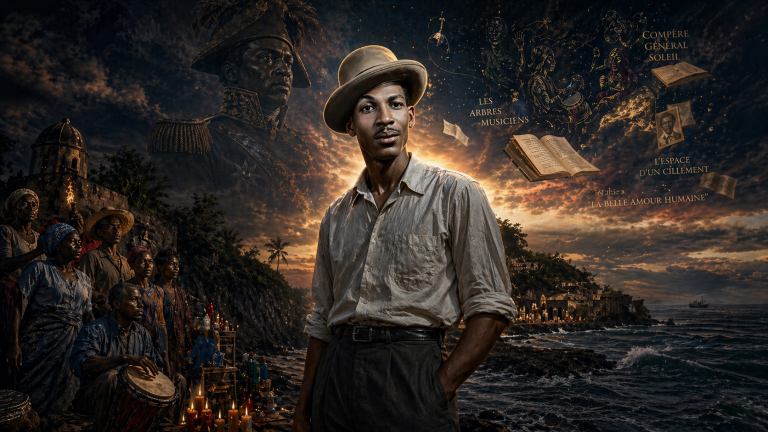

Hubert Henry Harrison (1883–1927) was a towering Caribbean-born intellectual, agitator, and educator whose life forces us to rethink the origins of Harlem radicalism, the New Negro movement, and Black internationalist thought in the early twentieth century.
Early life: from St. Croix to Harlem
Hubert Henry Harrison was born on April 27, 1883, in Estate Concordia, St. Croix, then part of the Danish West Indies, to dark-skinned plantation workers whose lives were shaped by the afterlives of slavery and colonial rule. Orphaned as a teenager, he left home around sixteen as a cabin boy and arrived in New York City in 1900, at just seventeen years old. In New York, he worked a series of menial jobs while attending school at night, embracing the discipline of the autodidact and immersing himself in everything from anthropology and sociology to philosophy, literature, and drama. His extraordinary self-education and memory led contemporaries to hail him as a “walking cyclopaedia,” the “Black Socrates,” and one of the greatest minds produced by the American working class.
Freethinker, socialist, and “race first” radical
Harrison’s break from organized Christianity was central to his intellectual formation, and he became one of the most prominent Black freethinkers and avowed atheists of his generation. He argued that any Black person who accepted the Christianity that had justified enslavement and racism “needed to have his head examined,” insisting instead on a secular, rationalist critique of religion and white supremacy. In 1907 he secured a coveted post as a special foreign-language clerk with the U.S. Postal Service, where his ability to read Hebrew, Greek, Latin, and Arabic reflected both his linguistic gifts and his global curiosity. But when he publicly criticised Booker T. Washington and the “Tuskegee Machine,” he was fired in 1911—a political reprisal that pushed him fully into socialist organising and open radicalism.
Between 1911 and 1914 Harrison emerged as the leading Black theoretician and orator in the Socialist Party of New York, founding the Colored Socialist Club and advocating class-conscious labor struggle alongside a fierce denunciation of racism. He supported the Industrial Workers of the World and was the sole Black speaker at the historic 1913 Paterson silk strike, embodying a politics that linked working-class insurgency to anti-racist struggle. Yet by 1914 he had become deeply disillusioned with a movement he judged to be “white race first and class after,” and he began to articulate a “race first” perspective that placed the fight against European oppression at the centre of any genuine radicalism.
Father of Harlem Radicalism and the New Negro
In the 1910s, Harrison became one of the earliest and clearest voices of the militant New Negro movement, advancing a program of Black political independence, self-defence, and internationalism that would shape Harlem’s emergence as an “international Negro Mecca.” In 1917, he founded the Liberty League of Negro Americans and launched its newspaper, The Voice, the first organisation and paper explicitly rooted in this militant New Negro current. Through The Voice, he promoted race consciousness, defended Black constitutional rights, and issued searing critiques of capitalism, imperialism, and the global “Color Line.”
Harrison’s poem “The Black Man’s Burden,” first published in December 1915, offered a devastating reply to Rudyard Kipling’s “The White Man’s Burden,” reversing the standpoint of empire to show that the true “burden” was the exploitation suffered by colonised peoples, not the civilising mission of white power. He argued that imperialism “mercilessly exploits the darker races for its own financial purposes,” and he used the poem and related essays as organising tools, circulating them as Liberty League leaflets to build a race-conscious, anti-imperialist movement. His editorial “The Descent of Dr. Du Bois” (1918) marked a major break between the militant New Negroes and older leadership, sharply criticising W.E.B. Du Bois’s “Close Ranks” call for Black Americans to suspend their grievances during World War I.
Labor leader A. Philip Randolph would later dub him the “Father of Harlem Radicalism,” a title that captured both his pioneering synthesis of race and class and his influence on figures from Marcus Garvey to Randolph himself. Harrison has been described as “the most class conscious of the race radicals and the most race conscious of the class radicals,” offering a coherent framework that insisted the fight against white supremacy was central to any serious socialist politics in the United States.
Soapbox schools and Harlem’s “Outdoor University”
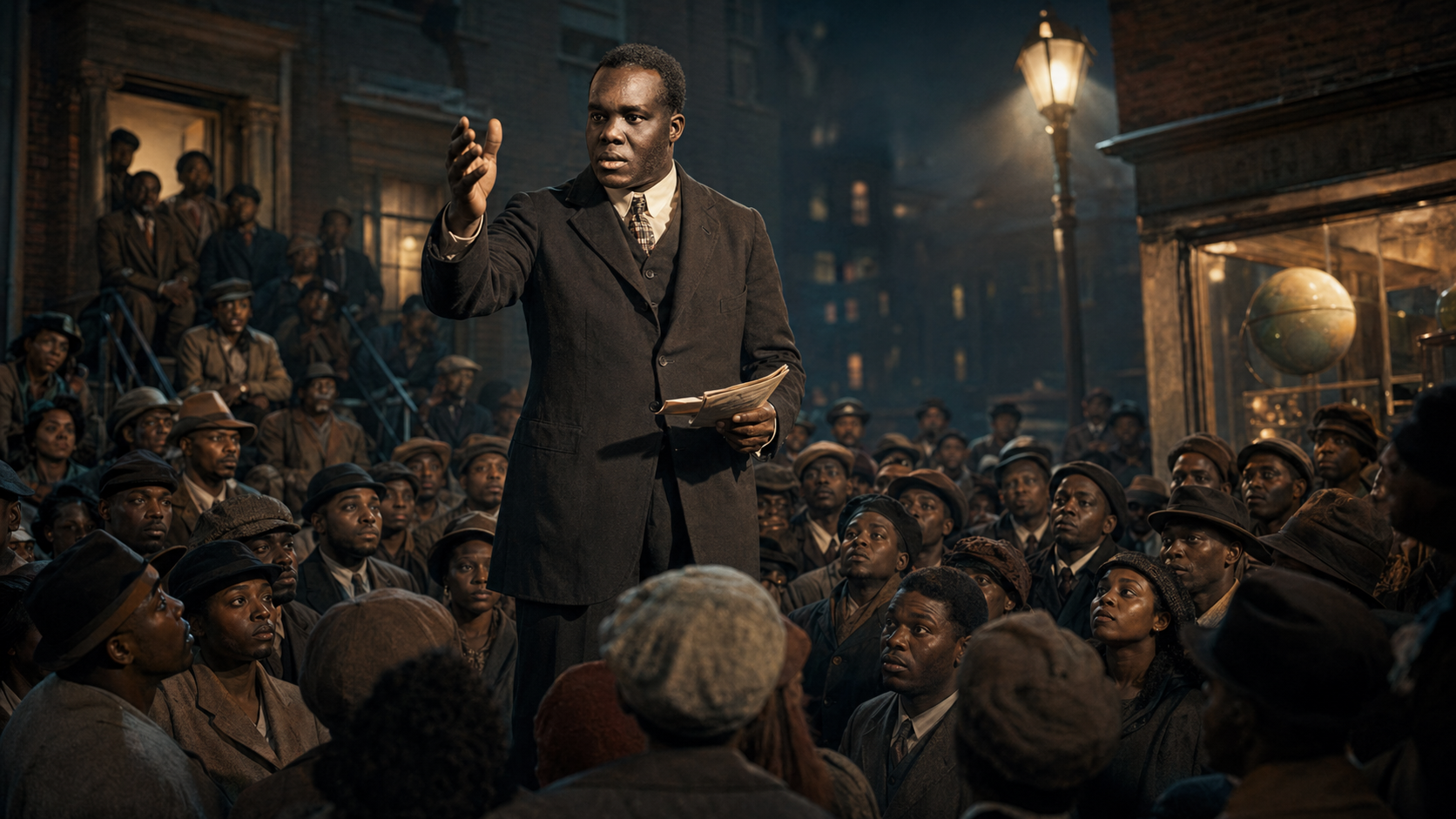
Harrison transformed Harlem’s street corners into classrooms, pioneering a new style of open-air political and intellectual education that contemporaries called the “Outdoor University.” Speaking from soapboxes at Columbus Circle, the steps of the Subtreasury near Wall Street, and in front of J.P. Morgan & Co., he drew huge crowds to lectures on history, science, psychology, astronomy, sex, birth control, literature, and current affairs. On one such occasion, the New York Times reported that he spoke to an audience of about 11,000, forcing police to rope off the streets at Wall and Broad—a striking image of Black radical thought taking over the financial heart of the city.
Harrison was equally at home in more formal settings. He lectured for the New York City Board of Education and spoke at New York University, Columbia, and City College, often without notes, quoting long passages from Charles Darwin, Aldous Huxley, and others purely from memory. He helped to establish the Harlem School of Social Science and played a key role in building the Department of Negro History, Literature, and Art at the 135th Street Public Library, an institution that would evolve into the Schomburg Center for Research in Black Culture. Through these platforms he nurtured a popular intellectual culture in Harlem long before “Harlem Renaissance” became a fashionable label.
Garvey, publishing, and internationalism
Harrison’s influence radiated through the emergent Garvey movement and the wider Black world. In 1917 he gave Marcus Garvey his first major public speaking platform in New York at a Liberty League event, helping introduce him to Harlem audiences. By 1920 Harrison served as the principal editor of Garvey’s Negro World, sharply raising its intellectual level and circulation and turning it into one of the premier radical, race-conscious newspapers in the African diaspora. He ultimately broke with Garvey over what he condemned as “megalomania,” financial irregularities, and a Back-to-Africa program he believed diverted attention from the fight for Black rights within the United States.
Alongside his organisational work, Harrison was a pioneering literary critic and prolific writer. He wrote for papers such as The Call, The Masses, The New Republic, The Truth Seeker, the New York Sun, the New York Times, and the Tribune, and he was the first Black author to establish a regular book-review section in a newspaper. His first book, The Negro and the Nation (1917), gathered key essays from the Liberty League period and laid out his early theoretical contributions to socialism and Black equality. When Africa Awakes (1920) collected many of his most important editorials and reviews, offering an “inside story” of the stirrings of the New Negro in the Western world. He also wrote the semi-autobiographical Love-Letters of Sappho and Phaon, which remained unpublished in his lifetime, and left behind a wide body of essays and speeches that underpinned what he called a “colored internationalism” linking struggles in the United States to those in Ireland, India, China, and beyond.
Death, neglect, and restoration
On December 17, 1927, Hubert Henry Harrison died suddenly at the age of forty-four from complications following an appendectomy, just as Harlem’s creative and political ferment was gaining global renown. Thousands attended his Harlem funeral, testifying to the depth of his connection to ordinary Black working people as well as to students, writers, and activists. Yet his memory was soon eclipsed in the dominant histories of the New Negro movement, Garveyism, and the Harlem Renaissance—eras he had helped to shape but from which he was largely written out.
This erasure stemmed not from a lack of achievement but from his uncompromising radicalism: his relentless opposition to European oppression, his criticism of both European and African leadership, his open atheism, and his insistence on mass, people-centred organising made him a difficult figure for later, more cautious narratives to absorb. Today, as scholars and organisers recover his writings and revisit his role, Harrison is increasingly recognised as a foundational figure of the Black radical tradition and one of the most brilliant minds produced by the modern working class.
For Kentake Page, his life stands as a testament to the power of self-education, fearless criticism, and a politics that insists that there can be no genuine democracy, no real socialism, and no true freedom without a direct confrontation with the Color Line.
Source:
Heller, Benjamin and April Holm: Hubert H. Harrison Papers, 1893-1927: Finding Aid.
Kwoba, Brian: Brian Kwoba on his new book, Hubert Harrison
Perry, Jeffrey B.: Jeffrey B. Perry – Hubert Harrison Life, Legacy & Some Writings and An Introduction to Hubert Harrison: “The Father of Harlem Radicalism”.
Phelps, Christopher: The Rediscovered Brilliance of Hubert Harrison. Published in Science & Society.