

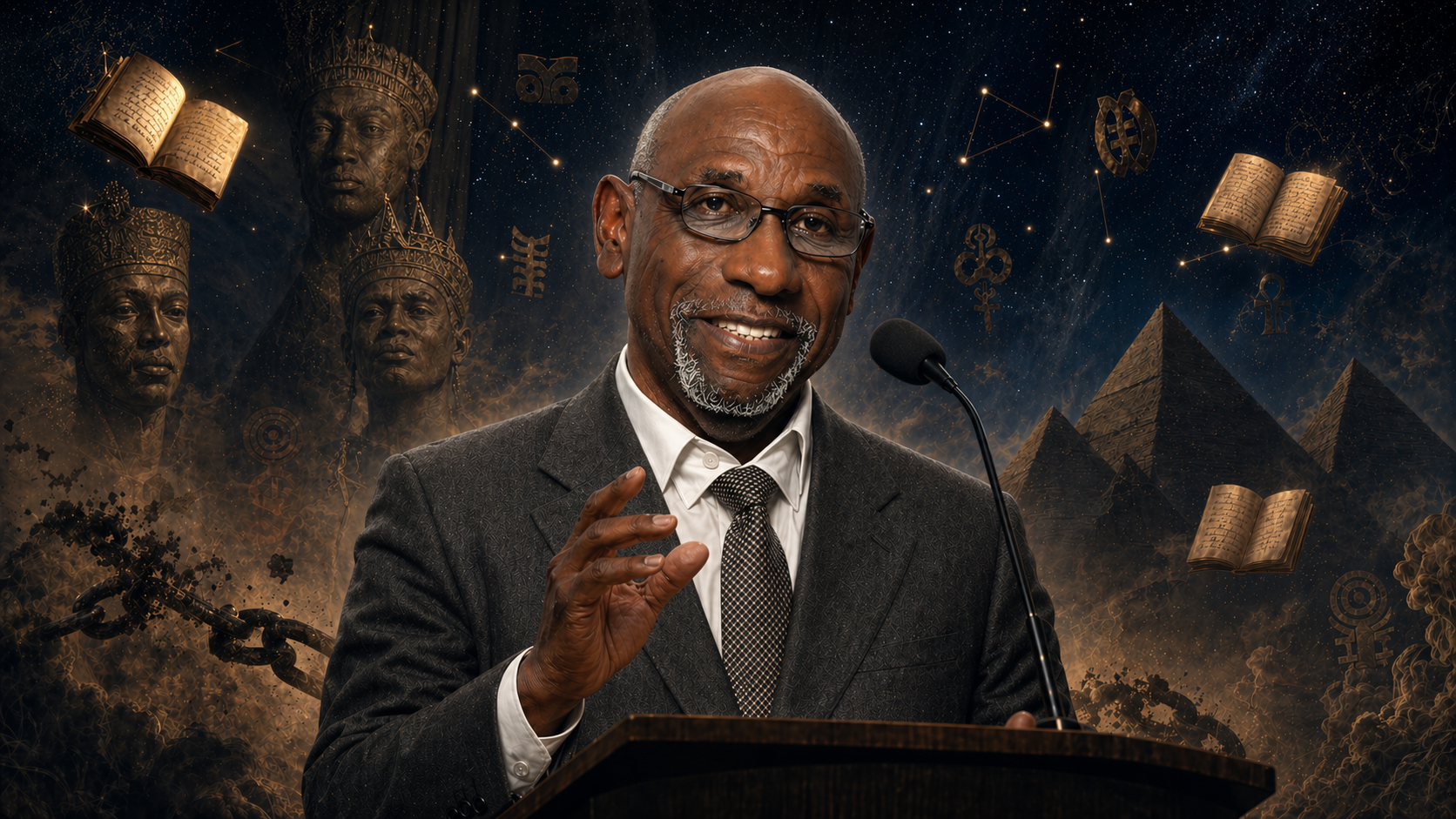
No Black history library or book collection is complete without a work by Dr. Na’im Akbar. In addition to being a critical, insightful, and authoritative writer, he is a commanding orator whose voice conveys passion, conviction, and gravitas.
I am especially in awe of his Osirian Myth series, featured on YouTube, where he draws on the myth to illuminate the historical trauma, present fragmentation, and potential resurrection of African people. As someone devoted to mythology, history, psychology, and the study of the Maafa, it is no surprise that his profound insights continually draw me back. Over the past twelve years, I have returned to this series again and again; his analysis is consistently remarkable, and his delivery unfailingly compelling.
I am grateful to have had the blessing of being in Dr. Akbar’s presence. I have three books signed by him. He signed my copy of Know Thy Self with the words, “To Meserette, ‘Our power is in knowing who we are.’ Peace, Na’im Akbar.” This is the heart of his message: we must know who we are in order to have, and to live in, peace. What I find most inspiring, is his message that our survival of the Maafa is itself a monumental act of human resilience: “African Americans—and, by extension, the wider Black historical diaspora—stand not as the broken remains of human destruction, but as living monuments to human accomplishment.”
Dr. Na’im Akbar (born Luther Benjamin Weems Jr. on April 26, 1944) is a pioneering American clinical psychologist, scholar, and author widely recognized for his Afrocentric approach to psychology. His life’s work has been devoted to the “liberation of the Black mind” through a sustained critique of Eurocentric psychological models and the construction of a framework rooted in the historical and cultural realities of African people. Born and raised in Tallahassee, Florida, in a segregated Southern community, Akbar grew up in a Black middle-class household with college-educated parents and attended the Florida A&M University Laboratory School from kindergarten through high school. In that environment, academic excellence was the norm, and despite the wider realities of segregation, he was largely protected from notions of Black inferiority. He later attended the University of Michigan, where he earned his B.A., M.A., and Ph.D. in clinical psychology. During the 1960s, he became deeply involved in the Black Action Movement, an experience that sharpened his critique of mainstream psychology and its assumptions about Black mental health. His doctoral research on power themes among paranoid and non-paranoid patients marked an important turning point in his intellectual development.
Akbar’s professional journey moved through several influential institutions and ideological spaces. He began at Morehouse College, where he became chair of the Psychology Department and is credited with designing and teaching the first Black psychology course and program at a historically Black college. In 1971, he joined the Nation of Islam, changed his name first to Luther X and later to Na’im Akbar, and moved to Chicago to direct the Office of Human Development. He later served as an associate professor at Norfolk State University, continuing to develop courses in Black psychology, before returning to his hometown in 1979 to join the faculty at Florida State University, where he taught for twenty-eight years before retiring in 2008. Across these roles, he helped pioneer Black psychology curricula and introduced culturally grounded concepts such as “alien-self” and “anti-self” disorders. A former president of the Association of Black Psychologists, Akbar is also a prolific author, best known for works such as Chains and Images of Psychological Slavery, which examine the enduring psychic effects of racial domination. Beyond academia, he founded Mind Productions to share his teachings on self-knowledge and spiritual development with a wider audience. In recognition of his lifelong commitment to health equity and Black liberation, he has received numerous honors, including a Presidential Citation from the American Psychological Association.
The following quotes are drawn from the five Akbar titles in my personal library: Akbar Papers in African Psychology, Visions for Black Men, The Community of Self, Chains and Images of Psychological Slavery (a cherished first edition gifted to me by my father-figure), and Know Thy Self.
1.
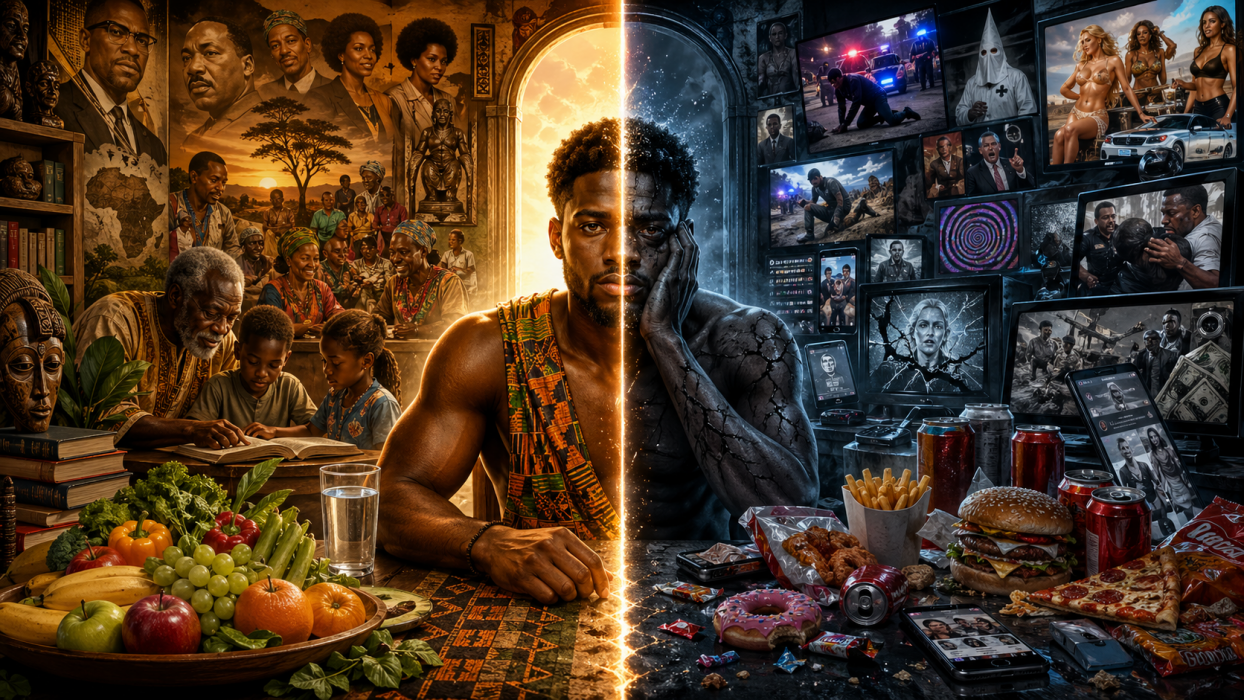
If one looks closely, many parallels can be found between providing for the physical body and providing for the mental body. Just as certain basic rules must be observed in the ingestion of food, similar rules must also be observed in the intake of thoughts into the mind. The consequence of breaking certain nutritional laws is poor physical health and considerable discomfort. Similarly, if certain laws of mental growth are violated, poor mental health follows. In the same way that food must be chosen wisely, the experiences and ideas that enter the mind must also be chosen with care. If the mind is filled with too much of the material and experience provided by European culture, the danger of mental discomfort emerges in the form of depression or confusion. This is especially evident in relation to television and other mass media, which often provide a steady diet of mentally destructive material that, when consumed excessively, leaves one uncertain about what should and should not be done.
2.
Each generation has the responsibility of maintaining the level of consciousness attained by the previous generations and of advancing the community to even higher levels through the development of its own consciousness. Education is both a sacred right and a sacred responsibility because, without it, no one born into the world could become fully human. Our humanity is defined and distinguished by the development of knowledge, and particularly self-knowledge. Therefore, it is critically necessary for each generation to learn who and what they are.
3.
We must honor and exalt our own heroes, and those heroes must be people who have done the most to dignify us as a people. We must seek to overcome the “plantation ghost” that leads us to identify with the forces of enslavement and self-abasement. We must deliberately avoid the psychologically destructive representation of God in a Caucasian form. We must build and maintain strong, clean, and safe communities, because the ability to influence our environments in even a small way is the first step toward building or restoring self-respect.
4.
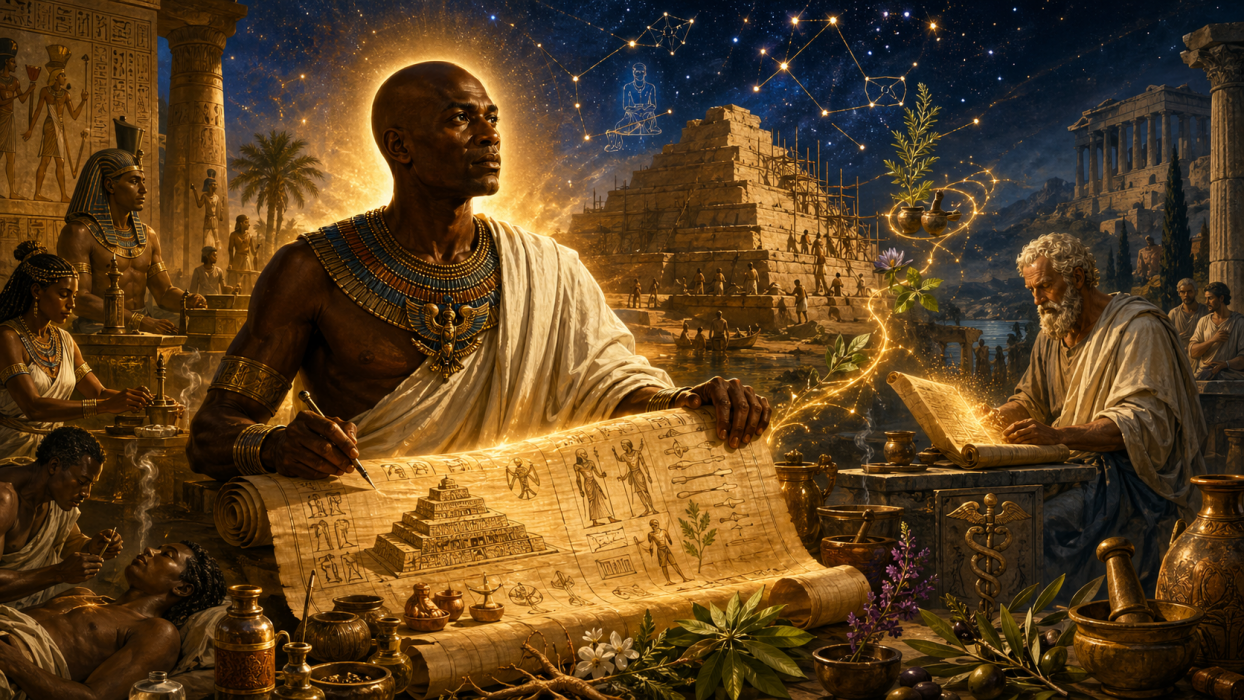
One of the best ways to gain love for oneself is to gain sound knowledge of the positive contributions of one’s own people. It is important for those of European descent to know that a Caucasian man from Europe, Hippocrates, made a significant contribution to the development of medicine and is revered in the West as the “father of medicine.” It is even more important that people of African descent know of the Black man called Imhotep from Kemet, who formulated principles of medicine and was worshipped as a deity by the Greeks, who called him Asclepius, as well as by the ancient Egyptians. Imhotep lived many centuries before Hippocrates, and the medical ethics and techniques he developed no doubt influenced Hippocrates. It is equally significant that Imhotep was a multi-genius who excelled as an architect, poet-philosopher, diplomat, and adviser to the king.
5.
One of the main problems faced by human beings in modern America is a declining sense of responsibility for our own lives. Living in a society where the external influences are so powerful, it becomes very difficult to hear the voice of our own inner power. The superior powers of the human being are all inner powers. Our muscles, our physical appearance, and even our sexuality are weak forces in comparison to the inner forces that move the muscles and interpret physical reality. These inner powers must be developed at both the individual and collective levels. With the development of these powers, greater responsibility for both individual and collective life becomes possible.
5.
Entertainers and athletes are the popular heroes of the African-American community. Physical prowess or comic performance are often the only qualities Black heroes are permitted to express. Intellectual acuity, prophetic vision, moral integrity, technological knowledge, and managerial efficiency are characteristics seldom, if ever, portrayed. Consequently, the “enslaved” images of power persist. African-American children, as a result, may aspire to throw balls or croon into microphones rather than to explore the universe, discover cures for infectious diseases, or find ways to feed starving masses in Africa or India. Such a preoccupation with impotent images was a device designed to keep our aspirations in check. The persistence of such models, to the exclusion of others, perpetuates the condition of captivity.
7.
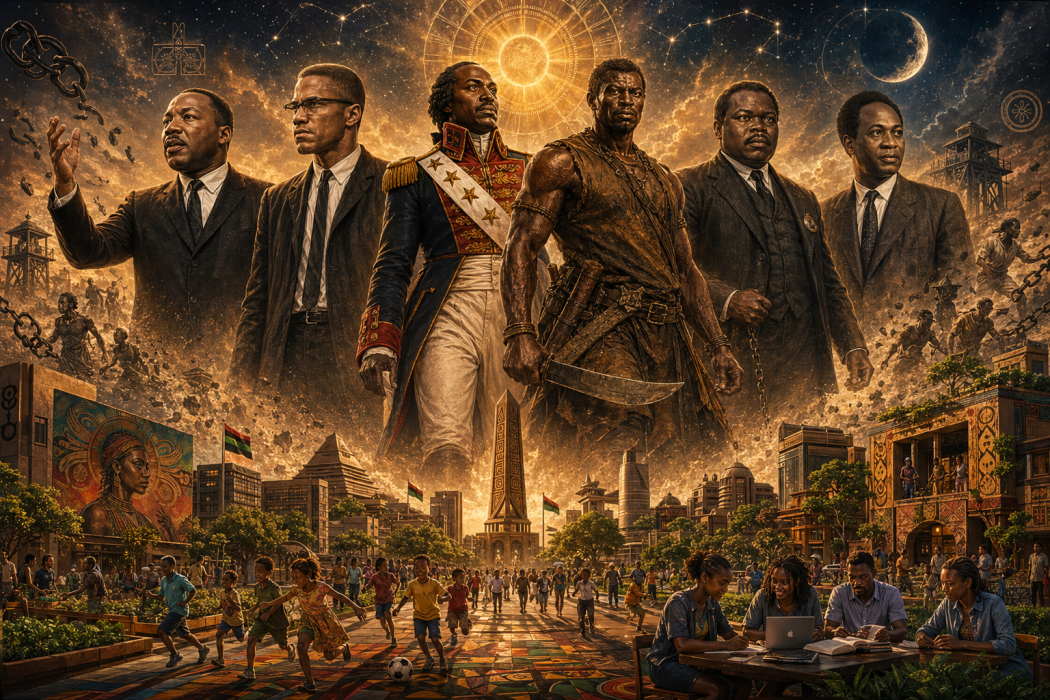
We need to understand what it means to be a man. We need to understand what it means to be an African man. We need to understand that once an African man stands up and declares himself an African man, he has automatically declared war on Euro-America. Not all wars are fought with weapons. In fact, the most sophisticated wars are fought with knowledge. As soon as an African man stands up and declares himself to be a man, he places himself in absolute and immediate opposition to the European system, which has defined him as less than a man, or as not a man at all. Furthermore, the reason it becomes a war is that the Euro-American man has defined his own masculinity on the presumed lack of manliness in the African man. He is a man, by that logic, only because the African is not. If the African becomes a man, then by that definition the Euro-American automatically loses his manhood.
8.
We all agree that racism is an American phenomenon. We all agree that it is a Euro-American pathology. We all agree that it represents a primitive psychopathic form of thought when the totality of a human being’s capability is judged on the basis of skin pigmentation. African people did not historically evaluate people in that way. That is why, in the past, when people came to Africa from all over the world, they were welcomed. Indigenous Americans also opened the door in welcome, miscalculating Europeans because they had never encountered a human phenomenon like this: people who enter your house and then stake a claim to it. Before long, Europeans had committed atrocities against Indigenous peoples and then declared them “savages,” claiming moral and religious superiority while enacting barbarism.
9.
European supremacy is not the only defining feature of the traditional Western model. It is also profoundly individualistic, assuming that a person is best understood as separate from others, and treating traits that suggest interdependence as deviant. As a result, the dominant cultural motif becomes one of individualism and defiant independence, echoing the myth of the “rugged individualist” immigrant from Europe who conquered and occupied the shores of North America.
10.
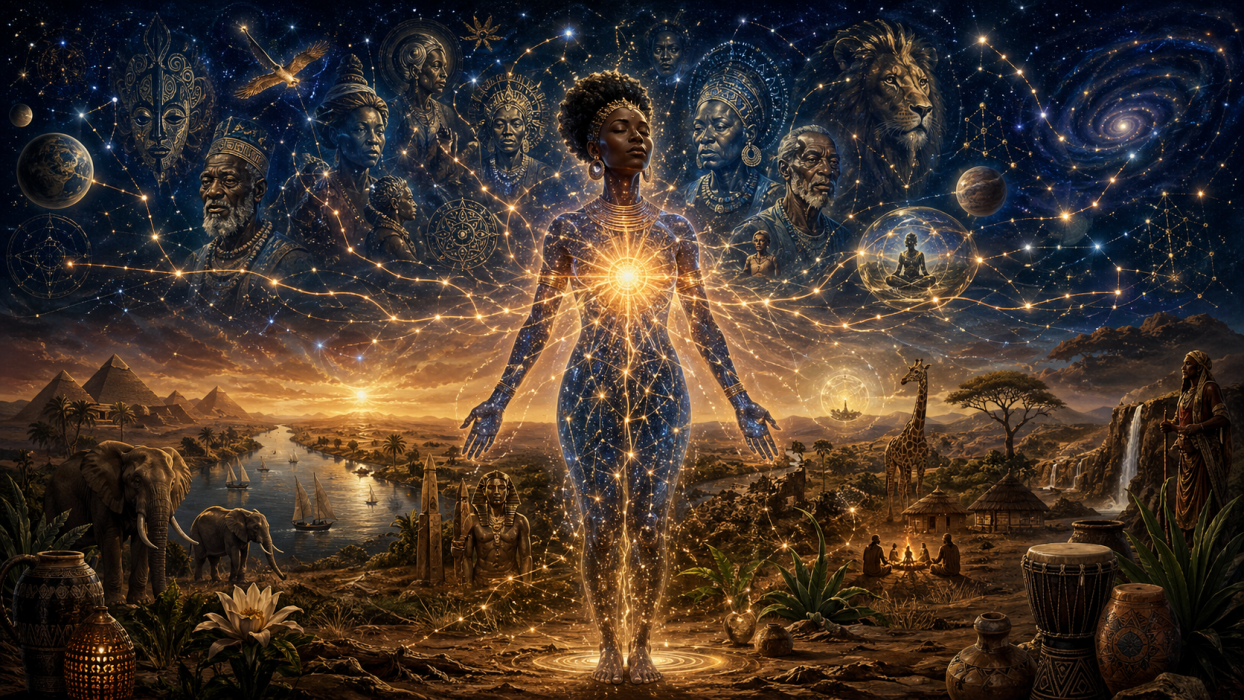
The African conception of the human being and human origin is quite different. In traditional African thought, the core of the human being is Divine. When human beings are reduced to their lowest common denominator, when one goes to the very root of what a person is, one finds a Divine substance. This substance comes from the universal, all-encompassing mind. Because of its universal origin, it unites the human being with everything else in the universe. Though physically tied to all things in the material world, our essential origin is Divine.

One Response
What a brilliant write-up. Thanks for sharing your vast knowledge on our people. Most of us are in slumber on matters of self-knowledge. Many sages have tried to rejuvenate the importance of self-knowledge, but peoples’ attention to it are always short-lived. Just as it is written in some scriptures: “people perish for the lack of knowledge”.
Well done sis.