
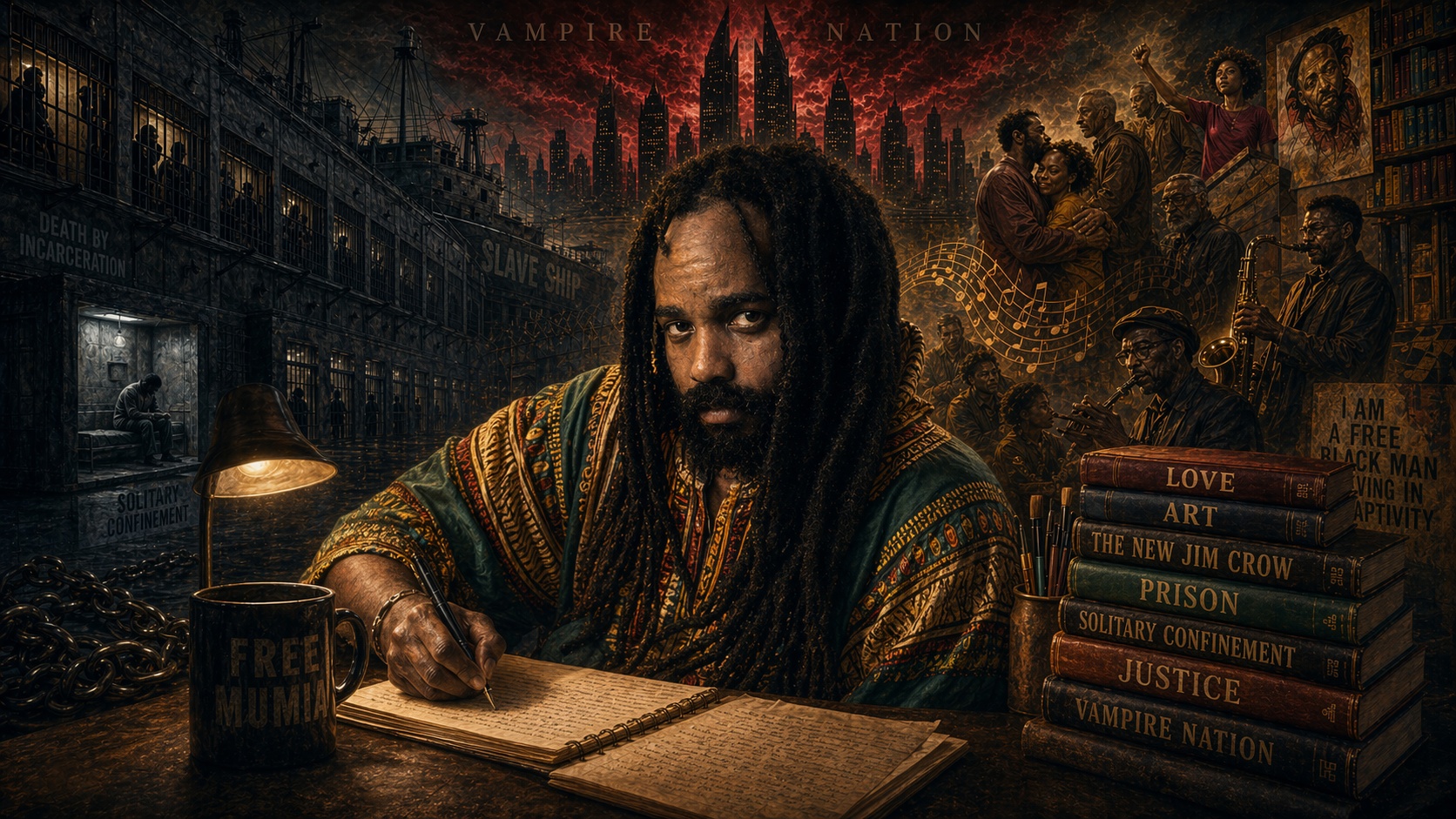
“I am a thinker, writer, activist, creative being, man, dad, husband, grandpop, and son. But just to keep it simple: I’m a free Black man living in captivity. That’s who I am.”
Mumia Abu-Jamal (born Wesley Cook in 1954) is a globally recognised Black American journalist, activist, and author who has been incarcerated since 1981. Often described as the “Voice of the Voiceless,” his case became an international cause célèbre during the nearly three decades he spent on death row, symbolising for many the entrenched racism and judicial bias of the American criminal justice system.
Raised in North Philadelphia, Abu-Jamal encountered the Black Panther Party as a teenager and became a founding member of the Party’s Philadelphia chapter, serving as its Lieutenant of Information. After leaving the Panthers in 1970, he turned to radio journalism, becoming an award‑winning broadcaster and president of the Philadelphia Association of Black Journalists, known for his fearless reporting on police brutality and his sympathetic coverage of the MOVE organisation.
On 9 December 1981, while working as a taxi driver, Abu-Jamal came upon a traffic stop involving his brother and police officer Daniel Faulkner; a shootout followed in which Faulkner was killed and Abu-Jamal was seriously wounded. In 1982 he was convicted of first‑degree murder and sentenced to death, a trial later condemned by groups such as Amnesty International for judicial bias, racially skewed jury selection, and suppressed or mishandled evidence. Abu-Jamal has consistently maintained his innocence, arguing that he was framed and “railroaded” through a political show trial.
From death row, he emerged as one of the most prominent prison intellectuals of his generation. He is the author of multiple books—including the best‑seller Live from Death Row and We Want Freedom: A Life in the Black Panther Party—and hundreds of essays that offer searing critiques of mass incarceration, police terrorism, U.S. empire, and what he calls the “Vampire Nation.” A painter and composer as well as a writer, he has produced visual art and musical works from solitary confinement, insisting that “Art is that which makes us human.”
After years of appeals, Abu-Jamal’s death sentence was ruled unconstitutional and formally vacated in 2011; in 2012 he was transferred from death row to the general prison population and is now serving life without parole in Pennsylvania—a fate he describes as “death by incarceration.” Despite serious health struggles, including a landmark legal battle for Hepatitis C treatment, he remains an active commentator, co‑hosts the podcast The Classroom and the Cell, and continues to see himself as a “long‑distance revolutionary” whose work is rooted in love, community, and the ongoing struggle against the New Jim Crow.
The following reflections summarise key themes in Abu-Jamal’s thought—on love, art, the New Jim Crow, prison, solitary confinement, justice, and the “Vampire Nation”—drawing directly from his own words and writings.
Love
Mumia Abu-Jamal views love as a “profound, revolutionary, community-building love” that serves as a dominant force for resisting dehumanisation and systemic oppression. He considers this love essential for sustaining the spirit within the “nightmare” of the carceral system, famously writing to his fellow prisoners to “love fiercely” and “radiate love to each other” regardless of what the world says of them. This concept is a core component of the Black prophetic tradition, which he identifies as an uncompromising commitment to love, justice, and community that sees the suffering of the impoverished and condemned as a call to rise up.
Art
For Mumia, “Art is that which makes us human” and serves as a vital “terrain for the re-composition of self” within the “inhuman” environment of prison. He describes the emergence of art from “shadowed cells” as “sunlight on Easter morning,” noting that incarceration can “unleash hidden talents” in those who are encaged. He believes that music, specifically Jazz, has historically affirmed Black humanity and resilience during the “darkest days” of legal apartheid and repression. Abu-Jamal insists there is no real separation between his artwork and his political work: both forge a “language for spirit” intended to help the oppressed reclaim their words, their memories, and their voices.
The New Jim Crow
Drawing on the work of Michelle Alexander, Mumia characterises the modern American criminal justice system as “The New Jim Crow,” a vast, bipartisan machinery of “oppressive containment” on an unprecedented global scale. He argues that this system represents a deliberate reconstitution of older forms of racial control, designed to warehouse and manage populations deemed “disposable” in the wake of urban deindustrialisation. Within this framework, he asserts that “Blackness is itself a crime,” and contends that the explosive growth of the prison-industrial complex was a counter‑revolutionary response to the Civil Rights and Black Liberation movements of the 1960s.
Prison
Mumia frequently characterises American prisons as “steel-and-brick slave ships” that function as tools of social control and instruments of “police terrorism.” He describes the carceral environment as a “dark netherworld” of “boxes of unlife” where humans are transformed into nonpersons and the soul is subjected to a continual “destructive onslaught.” He argues that the state has “legislated ignorance” by cutting educational resources—such as Pell Grants—for prisoners, using the prison system not for rehabilitation but to punish radicals, warehouse the poor, and maintain a permanent “mudsill” at the bottom of American society.
Solitary Confinement
After decades of personal experience in isolation, Mumia defines solitary confinement as “state torture” designed to “destroy human beings by destroying their minds.” He describes it as a regime of “soul-crushing loneliness” that kills the social essence of humanity, driving many prisoners towards madness, self-harm, or emotional collapse. He highlights the historical irony that while the U.S. Supreme Court recognised the devastating psychological impact of solitary confinement as early as 1890, the law and practice have “lurched backwards,” and isolation is now routinely imposed on hundreds of thousands of predominantly Black and Brown prisoners.
Justice
Mumia describes the American judicial process as a “fraud,” a “sham,” and a “hall of oppression” for those who are poor or of colour. He famously observes that the state provides “oceans of process, but not an iota of justice,” arguing that legal protections like the right to an impartial jury or a fair trial are in reality “privileges of the powerful and rich” that vanish when the powerless attempt to claim them. He frequently cites his trial judge’s remark that “Justice is just an emotional feeling” to illustrate his belief that the system is driven by racial and political bias rather than any genuine commitment to objective fairness or truth.
The USA as a “Vampire Nation”
Mumia characterises the United States as a “Vampire Nation” that has “bled” Indigenous and African peoples through genocide, enslavement, and exploitation since its very creation. In his writings and in compositions like Vampire Nation, he argues that the country’s wealth was “built by slavery’s hand” and that its historical expansion has always required the extraction of life, labour, and land from those it deems expendable. He extends this imagery to the present, describing the police and carceral apparatus as “blue-uniformed vampires” who sustain the status quo by feeding on the blood, time, and misery of the poor, the colonised, and the incarcerated.
Source:
Abu-Jamal, Mumia: Author of Writing on the Wall: Selected Prison Writings of Mumia Abu-Jamal, edited by Johanna Fernández.
Amnesty International: Corporate author of the report USA: A Life in the Balance – The Case of Mumia Abu-Jamal.
Bennett, Hans: Author of the biographical entry “Abu-Jamal, Mumia (b. 1954)” published in The Anarchist Library.
Dailey, Kate: Author of the BBC News article “Mumia Abu-Jamal: Man, myth and the death penalty”.
Davies, Lindy: Author of the article “Mumia Abu-Jamal: A Possibility of Hope” published in the Henry George Newsletter.
Ferdinand-King, Melaine: Curator and author of the “Curator’s Reflection” in the exhibition catalogue Art and the Freedom Struggle: The Works of Mumia Abu-Jamal for Brown University.
Maoist Internationalist Movement (MIM): Corporate author of the pamphlet “Stop the execution of Mumia Abu-Jamal!”.
Pilkington, Ed: Author of the article “‘Intoxicating freedom, gripping fear’: Mumia Abu-Jamal on life as a Black Panther” for The Guardian.
Taubman, Philip: Author of the New York Times article “U.S. Files Its Rights Suit Charging Philadelphia Police With Brutality” (found within the “About Mumia Abu-Jamal” source).
Unattributed: The pamphlet “Who is Mumia Abu-Jamal?” hosted via Riseup.net.