
Lorraine Vivian Hansberry lived only 34 years, yet she reshaped American theater, sharpened the intellectual edge of the Civil Rights Movement, and left behind a body of work that continues to ignite debate, study, and performance more than six decades after her death. She was the first Black woman to have a play produced on Broadway, the youngest American and first Black dramatist to receive the New York Drama Critics’ Circle Award for Best Play, and — in the same breath — a socialist, a feminist, a Pan‑Africanist, a proto‑Black radical, and a lesbian navigating an era in which each of those identities carried its own danger. To understand Hansberry fully is to understand not just a playwright but a comprehensive thinker whose ideas spanned theater, journalism, international politics, gender, and sexuality.
The Hansberry Family
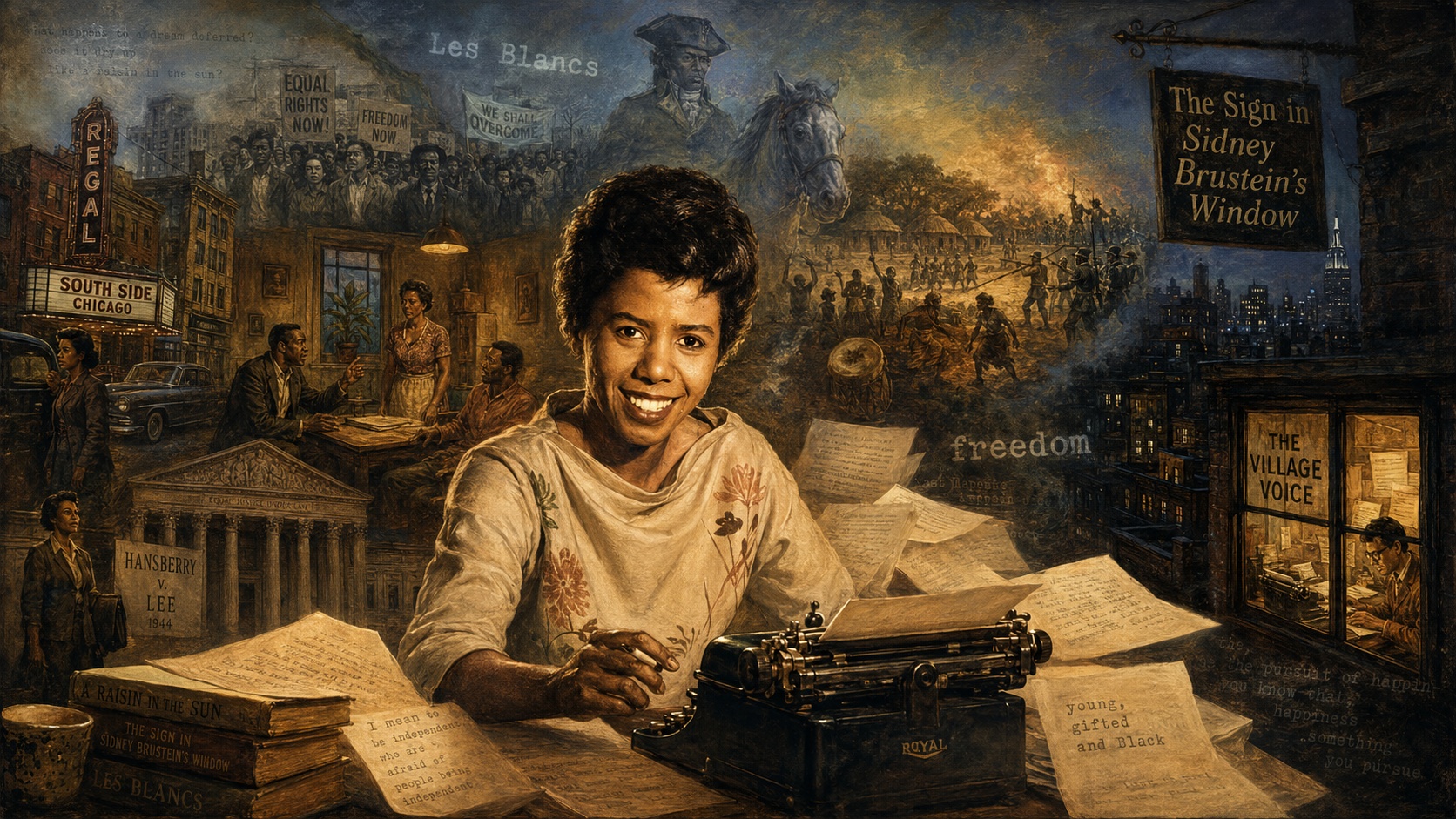
Lorraine Hansberry was born on May 19, 1930, at Provident Hospital on the South Side of Chicago, the youngest of four children of Carl Augustus Hansberry and Nannie Perry Hansberry. Her father was no ordinary man: a successful real‑estate broker who also founded Lake Street Bank, one of the first banks in Chicago established for African Americans, and a committed organizer for both the NAACP and the Urban League. Her mother, Nannie Perry Hansberry, was a driving schoolteacher and ward committeewoman, deeply involved in local politics and community uplift. Both parents were active in the Chicago Republican Party of that era, and were firmly embedded in the fight for civil rights in the 1930s and 1940s.
The Hansberry home was an intellectual crossroads of Black America. W.E.B. Du Bois, Paul Robeson, Langston Hughes, Duke Ellington, and Jesse Owens were among the figures who passed through their living room, bringing with them music, strategy, and rigorous debate. This constant exposure to Black excellence, political argument, and artistic brilliance shaped Lorraine’s sense of what a life of the mind could be. Equally formative was her uncle, William Leo Hansberry, the pioneering Howard University scholar who founded the Department of African Civilization Studies and helped lay the groundwork for Pan‑Africanist historiography. Through “Uncle Leo,” Lorraine encountered Africa not as an abstraction but as a rich, complex historical world. The seeds planted there would ripen decades later in her final, unfinished masterpiece, Les Blancs, where she turned toward the African continent as the stage on which to dramatize anti‑colonial struggle.
The defining event of Hansberry’s childhood — the moment that fused personal experience with political consciousness — arrived in 1938, when her father purchased a home in the Washington Park Subdivision on Chicago’s South Side, then an all‑European‑American neighborhood governed by a racially restrictive covenant. The family’s move was met with fury. White neighbors formed a mob around the house, and a concrete chunk hurled through the front window narrowly missed eight‑year‑old Lorraine. Through it all, Nannie Hansberry patrolled the house at night with a loaded German Luger, embodying a Black maternal militancy that would later reappear in Hansberry’s portraits of women like Lena Younger.
Carl Hansberry refused to retreat. When the Illinois Supreme Court upheld the covenant and ordered the family out, he fought the case all the way to the United States Supreme Court. In 1940, the Court ruled in Hansberry v. Lee, overturning the lower court’s decision on the technical grounds that the covenant had been fraudulently established: only 54 percent of the subdivision’s frontage owners had signed, not the 95 percent required. The ruling did not yet strike down restrictive covenants outright — that would come later in Shelley v. Kraemer — but it became a crucial breach in the architecture of residential segregation. For Lorraine, it was indelible. The humiliations and dangers of that move, the sense of a family under siege for daring to cross an invisible line, became the biographical core of A Raisin in the Sun. She would later write that “American racism helped kill” her father, who died in 1946 at fifty, worn down by the strain of fighting for a country that refused to see him as fully human.
Schooling and Early Political Awakening
Lorraine attended Englewood High School on Chicago’s South Side, where she began to find her footing as both a writer and a budding intellectual. She gravitated toward the school newspaper, drama, and debate, testing out the ideas and language that would eventually sustain her as a playwright. After graduating in 1948, she enrolled at the University of Wisconsin–Madison, a predominantly white institution where she experienced both the constraints of racism and the widening of her intellectual horizons.
Wisconsin proved transformative in an unexpected way. One day as a freshman, Hansberry slipped into an auditorium where students were rehearsing Sean O’Casey’s Juno and the Paycock. Watching the Irish working‑class mother howl in grief over a dead son, Hansberry recognized a sound and a suffering she knew from Chicago’s South Side: the wail of women whose sons had been swallowed by violence, poverty, and state indifference. She later reflected that O’Casey had done for the Irish poor what she needed to do for Black Americans — but “in a different key.” From that moment, she understood that theater could carry the weight of a people’s history and pain, and O’Casey remained her most powerful stylistic and political influence.
At Wisconsin, she was also drawn deeper into radical politics. She worked on Henry Wallace’s 1948 Progressive Party presidential campaign, wrote in defense of the Mau Mau uprising in Kenya, and followed cases in which Black defendants were railroaded by all‑white juries, including a man condemned to death after a jury deliberated for only three minutes. Increasingly impatient with the university’s limits and drawn toward direct engagement with the world, Hansberry left Madison after two years without taking a degree — but with a sharper sense of her task as both artist and revolutionary.
New York: Harlem, Freedom, and Paul Robeson
In 1950, at the age of twenty, Hansberry moved to New York City and took a room in Harlem. There, Paul Robeson and his circle offered her what she called her first “real” job: writing, and eventually serving as associate editor, for Freedom, the radical monthly newspaper Robeson co‑founded with Louis E. Burnham. Hansberry threw herself into the work, exulting to friends that Freedom would become “the journal of Negro liberation.”
At Freedom, she developed as a journalist, essayist, and political analyst. She reported on the Sojourners for Truth and Justice, a delegation of more than a hundred Black women who traveled to Washington under Mary Church Terrell’s leadership to protest racial terror and the Korean War. She went to Mississippi to cover the case of Willie McGee, a Black man sentenced to death for the alleged rape of a white woman; the horror of his execution led her to write the poem “Lynchsong,” a searing meditation on American ritualized violence.
Her articles linked Jim Crow to global imperialism, insisting that the struggle of Black sharecroppers in the South was bound to the struggles of anti‑colonial movements in Africa and Asia. She followed the victories of independence movements with particular joy, especially those led by Kwame Nkrumah, former student of her uncle Leo. Within Freedom’s pages, and through her close proximity to Robeson and W.E.B. Du Bois, Hansberry honed a worldview in which civil rights, socialism, and anti‑colonial liberation formed a single, interlocking front.
Her participation in the 1952 Montevideo Peace Conference brought her under federal surveillance. The FBI opened a file on her that would eventually swell to more than a thousand pages, monitoring her speeches, journalism, and later her plays. Agents attended A Raisin in the Sun not as theatergoers but as observers of a potentially subversive voice — a fact that only underscores how deeply Hansberry’s art was entangled with politics.
Robert Nemiroff
In 1953, Hansberry met Robert Nemiroff on a picket line outside New York University. Nemiroff, a Jewish songwriter and leftist activist, shared her political commitments and her devotion to art as a vehicle for social change. They married that same year, forming an unconventional partnership that blended romance, comradeship, and artistic collaboration.
In 1956, Nemiroff co‑wrote the popular song “Cindy, Oh Cindy,” whose royalties were substantial enough to allow Hansberry to leave wage labor and write full‑time. That economic freedom was decisive. It gave her space to complete the play that had been gestating in her mind — the play that would become A Raisin in the Sun. Yet their marriage also contained tensions. By the late 1950s, as Hansberry confronted her sexuality more directly and both partners immersed themselves in demanding political and artistic work, they quietly separated. They remained close allies and collaborators, however, and their legal divorce in 1964 did not sever the bond. In her will, Hansberry named Nemiroff executor of her literary estate, trusting him to shepherd her work into the world after her death — a trust he honored for the rest of his life.
Sexuality and The Ladder Letters
Lorraine Hansberry was a lesbian, though the risks of living openly in mid‑century America meant that her sexuality had to remain largely hidden from the public. In her private notebooks and correspondence from the 1950s, she wrestled with what she called “confusion and echoes of depression” as she tried to reconcile her desire with the constraints of marriage, respectability, and a society that criminalized same‑sex love.
After she and Nemiroff separated, Hansberry moved into a small apartment in Greenwich Village, a neighborhood that offered both anonymity and access to a nascent queer community. In 1957, she discovered The Ladder, the first subscription‑based lesbian magazine in the United States, published by the Daughters of Bilitis. She wrote at least two letters to the editors, signing only “L.H.” to shield her identity. In one, she begins, with characteristic warmth and irony, “I’m glad as heck you exist,” and then proceeds to challenge the publication’s assimilationist tendencies. Rather than urging lesbians to “blend in” with heterosexual society for safety, she argued that women — “homo or hetero” — needed their own organizations and their own platforms, where they could think and speak freely.
Alongside these letters, Hansberry drafted an essay she titled “the homosexual question” and wrote a poem, “Le Masque,” exploring desire and the tension between concealment and authenticity. Though unpublished in her lifetime, these writings reveal the depth of her engagement with sexual politics. Her queerness was not a footnote but an integral part of her critical apparatus, sharpening her critique of patriarchy, heteronormativity, and the ways in which societies police bodies and love.
A Raisin in the Sun — The Making of a Masterwork
Hansberry began drafting a play she first called The Crystal Stair, after the line in Langston Hughes’ “Mother to Son,” sometime in the mid‑1950s. As she revised, the title shifted to A Raisin in the Sun, drawn from Hughes’ poem “Harlem: A Dream Deferred”: “What happens to a dream deferred? / Does it dry up / like a raisin in the sun?” The question of the deferred dream — not only of a nation but of a single Black family — became the play’s central pulse.
Completed in 1957, the play was directed on Broadway by Lloyd Richards, himself a pioneering figure as the first Black director to helm a production on the Great White Way. The cast was a powerhouse: Sidney Poitier as Walter Lee Younger, Ruby Dee as Ruth, Claudia McNeil as Lena “Mama” Younger, and Diana Sands as Beneatha. Set on Chicago’s South Side, the narrative turns on a $10,000 life‑insurance check received after the death of the family patriarch. Each member of the Younger family has a different dream for the money: Walter wants to invest in a liquor store and step into business ownership; Mama longs to move them out of their cramped apartment into a house with a small yard; Beneatha wants to fund medical school and define herself on her own terms as a modern, intellectually uncompromising Black woman.
When the money is partly stolen and the family is approached by a representative of a white “improvement association” seeking to buy them out of the house they have placed a down payment on, the play reaches its moral crisis. In the end, the Youngers choose not to be bought off. They decide to claim the house in the white neighborhood — not because they yearn to assimilate, but because they refuse to capitulate to fear. The decision is fraught, but it is an assertion of dignity rather than a simple embrace of integration.
A Raisin in the Sun opened at the Ethel Barrymore Theatre on March 11, 1959, after electrifying out‑of‑town tryouts. It was the first play by an African American woman ever produced on Broadway. In 1959, it won the New York Drama Critics’ Circle Award for Best Play, making Hansberry the first Black playwright, the youngest dramatist, and only the fifth woman to receive the honor. At twenty‑nine, she became an overnight sensation — but the depth and complexity of her work ensured that she would not be remembered as a curiosity, but as a foundational figure in American theater.
A film adaptation followed in 1961, retaining much of the original cast. The play’s impact radiated outward. It cracked open a door through which other Black dramatists would walk: August Wilson, Amiri Baraka, Adrienne Kennedy, Suzan‑Lori Parks, Lynn Nottage, and many more. For Nina Simone, Hansberry’s insistence that her generation was “young, gifted and Black” became the seed of the song of the same name, an anthem of Black pride and aspiration. Writers such as Zadie Smith have cited Raisin as a touchstone, and the play remains one of the most frequently produced works in the American repertory, continually reinterpreted by new directors and casts across the Black Atlantic.
As A Raisin in the Sun entered the canon, it was often misread — particularly by white critics — as an integrationist fable whose ending signals a simple triumph of the American Dream. Hansberry herself was acutely aware of, and frustrated by, these flattenings. The Youngers’ move is not presented as a rosy resolution but as a risky, contested act of self‑assertion in a landscape still structured by white supremacy.
Beneatha, in particular, serves as Hansberry’s most explicitly radical mouthpiece. She questions God, flirts with atheism, experiments with African dress and natural hair, and declares her intention to become a doctor at a time when Black women’s intellectual ambitions were routinely dismissed. Later scholarship has emphasized that Raisin is less an endorsement of the American Dream than a critique of the violent conditions that make such a dream so precarious for Black families. The play exposes the psychic costs of both assimilation and revolt, and it registers the tensions between generational visions of freedom, from Mama’s more traditional faith to Beneatha’s searching, decolonial consciousness.
The Radical Intellectual
Hansberry’s politics cannot be reduced to liberal civil‑rights gradualism. Rooted in the world of Paul Robeson and W.E.B. Du Bois, she moved in radical circles influenced by socialism and communism, convinced that economic exploitation, racism, and imperialism were intertwined. She saw the Black freedom struggle in the United States as inseparable from anti‑colonial movements in Ghana, Algeria, Kenya, and beyond.
She was also an incisive feminist. Long before “intersectionality” became a formal concept, Hansberry interrogated how race, gender, class, and sexuality overlapped in the lives of Black women. She criticized the trope of “Black matriarchy” that appeared in popular discourse and government reports, arguing instead for egalitarian relationships between Black women and men grounded in mutual respect and shared struggle. Drawing on Simone de Beauvoir’s The Second Sex and her own experiences, she insisted that women had an obligation to claim their intellectual, political, and erotic agency. Scholars have since situated her in a lineage of Black left feminists, alongside figures such as Claudia Jones, whose thinking helped lay the groundwork for later Black feminist theory.
The Kennedy Meeting
On May 24, 1963, at the height of the Birmingham campaign, Attorney General Robert F. Kennedy invited a group of Black artists and activists to his Manhattan apartment to discuss the escalating racial crisis. James Baldwin convened the delegation, which included Lorraine Hansberry, Harry Belafonte, Lena Horne, Kenneth Clark, Lorraine’s close friend and SNCC ally, and CORE organizer Jerome Smith, who had been severely beaten during the Freedom Rides.
The meeting quickly became tense. When Jerome Smith spoke, he did so from the raw wound of lived experience, describing the brutality he had endured and declaring that he no longer believed in nonviolence. Kennedy, hearing rage rather than argument, responded with condescension, as though Smith’s emotional intensity disqualified him from serious political conversation.
Hansberry intervened. Gesturing toward Smith, she told Kennedy: “You have a great many very accomplished people in this room, Mr. Attorney General. The only person you should be listening to is the one over there. That is the voice of 22 million people.” In that moment, she reframed the meeting, insisting that the federal government confront not polite discourse but the accumulated fury of a people denied protection and dignity. She made clear that Black Americans had exhausted every avenue of peaceful persuasion, and that the state’s refusal to act placed it on the wrong side of history. When Kennedy continued to dodge, Hansberry joined others in leaving the meeting. Baldwin later wrote that it was the first time Kennedy truly glimpsed “the deep and seething rage of black America,” a shock that helped propel him toward stronger support for civil rights legislation.
Town Hall, June 1964
Even as illness began to erode her strength, Hansberry remained publicly engaged. On June 15, 1964, she participated in a packed Town Hall forum in New York, where she directly addressed the limits of white liberalism. Calling on white allies “to stop being a liberal and become an American radical,” she argued that mere sympathy was no longer acceptable; what was required was a wholesale rejection of the structures that produced racial inequality.
She pointedly noted that “some of the first people who have died so far in this struggle have been European men,” challenging the idea that civil‑rights activism was a “Black problem” alone and underscoring the multiracial nature of the movement’s sacrifices. Nearly a year before Malcolm X’s famous “by any means necessary” speech, Hansberry was already reminding audiences that Black people had tried every peaceful method of redress since 1619 and that the country had yet to honor its own professed ideals. Her comments at Town Hall encapsulate her insistence that genuine solidarity requires risk, self‑interrogation, and a willingness to upend the status quo.
From The Sign in Sidney Brustein’s Window to All the Dark and Beautiful Warriors*
From The Sign in Sidney Brustein’s Window to All the Dark and Beautiful Warriors we see Hansberry pushing past the fame of A Raisin in the Sun into bolder, less understood terrain. In these late works and fragments, she turns from the domestic interior of Chicago’s South Side to Greenwich Village’s fractured bohemia, to an unnamed African nation on the brink of revolution, to the streets of the Civil Rights Movement, to revolutionary Haiti, and finally inward toward her own memories. Together, The Sign in Sidney Brustein’s Window, Les Blancs, The Movement, the unfinished opera Toussaint, and the projected novel All the Dark and Beautiful Warriors chart a radical expansion of her canvas — formally, geographically, and philosophically. They reveal a writer intent on exploring the “evils of inaction,” the brutal calculus of decolonization, the costs of freedom struggles, and the intimate psychic landscape of a Black woman intellectual. Even when left incomplete, these works show Hansberry reaching for forms vast enough to hold both the shattering of old worlds and the fragile emergence of new ones.
The Sign in Sidney Brustein’s Window (1964)
Hansberry’s second produced play, The Sign in Sidney Brustein’s Window, opened on Broadway on October 15, 1964, while she was already gravely ill. Set in Greenwich Village — the neighborhood she knew intimately — the play revolves around Sidney Brustein, a disenchanted small‑business owner whose newspaper, marriage, friendships, and political hopes are all in varying states of disrepair.
Where Raisin focuses on a Black family on the South Side of Chicago, Sidney Brustein centers primarily on white bohemian characters, grappling with political corruption, homosexuality, interracial relationships, and the contradictions of countercultural life. It is a play about the “evils of inaction,” about the gulf between the ideals people profess and the compromises they accept. Audiences, expecting another Raisin, were confused by its structure and its focus, and critics were divided. Still, friends and admirers rallied to keep the production going, organizing benefit performances and fundraising drives. The play managed a run of 101 performances before closing — on January 12, 1965, the very night Hansberry died.
Les Blancs — Her Most Important Play
Hansberry considered Les Blancs (The Whites) her most important work. She began writing it in 1960 after seeing Jean Genet’s Les Nègres (The Blacks) and feeling a profound dissatisfaction with what she judged to be its stylized, romanticized approach to colonialism and Black revolt. She wanted to write a drama that centered African people as historical actors, not symbols, and that depicted the brutal realities of decolonization without exoticism or abstraction.
Set in an unnamed African country on the brink of revolution, Les Blancs follows a returned African intellectual and an American journalist as they confront the moral and political stakes of a liberation struggle. The play weaves in drumming, song, chanting, and dance — elements Hansberry saw as constitutive of a Black aesthetic, not mere “local color.” Folklore and spiritual ceremony appear alongside debates about armed struggle, collaboration, and the meaning of freedom.
Hansberry did not live to finish a definitive version of the text. After her death, Robert Nemiroff assembled a performance script from her multiple drafts and notes, and Les Blancs premiered on Broadway in 1970. It was the first major American play by a Black dramatist to place African decolonization at its center and stands as an early Black diasporic response to the complexities of armed liberation, white liberalism, and postcolonial uncertainty.
The Movement: Documentary of a Struggle for Equality (1964)
In the midst of hospital stays and treatments, Hansberry also completed the text for The Movement: Documentary of a Struggle for Equality, a photo‑documentary book published in 1964 by Simon & Schuster. The volume pairs photographs — many by Danny Lyon — with Hansberry’s captions and commentary, tracing the contours of the Civil Rights Movement from sit‑ins and freedom rides to mass marches and violent backlash.
Her prose in The Movement is compressed, lucid, and unsparing. She uses the images not simply to document events but to raise questions about courage, fear, and the price of social change. The book remains an important visual and textual record of the era, revealing Hansberry’s ability to move between the stage and the page while maintaining the same moral intensity.
Toussaint — The Unfinished Opera
Among Hansberry’s unfinished projects was an ambitious opera about Toussaint L’Ouverture, the leader of the Haitian Revolution. The choice of subject was no accident. Haiti represented, for Hansberry as for many Black radicals, the first victorious slave revolution in the Western hemisphere and the most radical assertion of Black freedom in the New World.
In turning to Toussaint, she was entering into dialogue with thinkers like C.L.R. James and W.E.B. Du Bois who had long insisted on Haiti’s centrality to modern history. Though the opera was never completed, its very conception shows how far her imagination extended: beyond the United States, beyond the conventional stage, into the operatic scope that a story of revolution demanded.
All the Dark and Beautiful Warriors
Hansberry also worked on an autobiographical novel she titled All the Dark and Beautiful Warriors. The manuscript remained unfinished and unpublished at the time of her death, but the fragments that survive point toward a sprawling, introspective project in which she was attempting to braid personal memory with collective Black experience. Even in incomplete form, the novel suggests another dimension of her artistry — prose fiction — that we can only glimpse.
“Young, Gifted and Black”
In May 1964, already seriously ill and aware that her time was short, Hansberry checked herself out of the hospital to address the winners of the United Negro College Fund’s creative writing contest. Standing before a room of young Black writers, she offered words that would echo far beyond that afternoon:
“I speak with you on this occasion because you are young, gifted and black.
I for one can think of no more dynamic combination a person might be…
Write if you will. But write about the world as it is, and as you think it ought to be…
Write about our people. Tell their story.”
The phrase “young, gifted and black” carried a charge that her friend Nina Simone immediately recognized. Simone transformed it into the song “To Be Young, Gifted and Black,” which became an anthem of Black pride during the late 1960s and beyond. After Hansberry’s death, Robert Nemiroff drew from her diaries, letters, speeches, and plays to assemble a stage piece also titled To Be Young, Gifted and Black. Premiering Off‑Broadway in 1969 and later published as a book, it remains the most intimate portrait of Hansberry from the inside out, allowing audiences and readers to hear her own voice as she narrates the joys and burdens of her life.
Illness and Death
Hansberry’s health began to fail in early 1963. In April of that year, she was diagnosed with pancreatic cancer. In a paternalistic decision that has haunted her legacy, her doctors — and, at least for a time, Nemiroff — chose not to tell her the full truth, assuring her instead that she was suffering from anemia and bleeding ulcers. Hansberry continued to live and work with characteristic intensity, revising plays, appearing at rallies, debating on public stages, and planning future projects, even as her body weakened.
Throughout 1964, she endured repeated hospitalizations. Between stays, she worked on Les Blancs, tended to The Sign in Sidney Brustein’s Window, and continued to write essays and speeches. Friends and supporters raised money not for her medical bills but to keep Sidney Brustein running on Broadway. On January 12, 1965, Lorraine Hansberry died at University Hospital in New York City. She was thirty‑four years old. That same night, The Sign in Sidney Brustein’s Window closed its curtains.
At her funeral, Martin Luther King Jr. paid tribute to her as a writer and a fighter whose work would inspire “generations yet unborn.” The loss was immeasurable; yet her compressed life, in all its brilliance and struggle, left a record that continues to nourish movements and imaginations.
Posthumous Legacy
After her death, Robert Nemiroff dedicated himself to preserving and extending Hansberry’s work. He produced Les Blancs on Broadway in 1970, completed and staged To Be Young, Gifted and Black in 1969, and oversaw the publication of her letters, essays, and unfinished manuscripts. The Lorraine Hansberry Literary Trust, emerging from that labor, continues to manage her estate and promote new productions and scholarship.
In the immediate aftermath of the 1960s, some within the Black Arts Movement criticized A Raisin in the Sun as formally conservative or politically assimilationist, favoring more overtly militant theater. For a time, this contributed to a partial eclipse of Hansberry’s standing among the avant‑garde. But beginning in the 1990s and accelerating in the twenty‑first century, scholars and artists returned to her work with fresh eyes. Her FBI file, her Ladder letters, her anti‑colonial journalism, her feminist critiques, and her queer self‑fashioning have all come into sharper relief.
Today, Hansberry is recognized not only as a pioneering playwright but as a foundational figure in Black radical thought, Black feminist theory, queer Black intellectual history, and Pan‑African cultural politics. Imani Perry’s 2018 biography, Looking for Lorraine: The Radiant and Radical Life of Lorraine Hansberry, which won the PEN/Jacqueline Bograd Weld Award for Biography, crystallized this reassessment. Perry presents Hansberry as a comprehensive intellectual whose plays are just one facet of a larger project: to think through what genuine freedom would mean for Black people, women, workers, queer subjects, and colonized nations.
A Note on Her Intellectual Stature
What ultimately distinguishes Lorraine Hansberry is the totality of her vision. She did not write plays and then, separately, hold political opinions; her politics were inseparable from her aesthetics. For her, theater was a form of moral and political education, a place where audiences could be forced to feel the humanity of those they had been taught to fear, pity, or ignore. Her artistic ambition was inseparable from her desire to transform consciousness — not only in the United States, but across the Black world.
She wrote from within multiple margins at once: as a Black woman in a white supremacist society, as a woman in a patriarchal order, as a lesbian in a heteronormative culture, and as a socialist in an aggressively anti‑communist Cold War climate. The wonder is not simply that she accomplished so much before thirty‑five, but that she did so while under state surveillance, struggling with illness, and carrying the weight of so many intersecting oppressions on her shoulders.
In her 1964 address to young Black writers, she named them as “young, gifted and Black,” insisting that this combination was the most dynamic any person could be. Lorraine Hansberry made that statement true in her own life. Her work remains a touchstone for anyone seeking to imagine a world in which art and struggle, beauty and resistance, are never allowed to drift apart.
Source:
Key Biographies and Studies
- Imani Perry, Looking for Lorraine: The Radiant and Radical Life of Lorraine Hansberry* (Beacon Press, 2018).
Superb full‑length biography that centers Hansberry as a radical Black, feminist, queer, and Pan‑African intellectual, not just the author of A Raisin in the Sun. - Soyica Diggs Colbert, Radical Vision: A Biography of Lorraine Hansberry* (Yale University Press, 2021).
Deep literary and intellectual biography that closely reads the plays, essays, and speeches, situating Hansberry within Black radical and theatrical traditions. - Lorraine Hansberry, To Be Young, Gifted and Black: Lorraine Hansberry in Her Own Words*, adapted by Robert Nemiroff (1969; various later editions).
Essential collection of letters, diary entries, speeches, and dramatic excerpts; the closest thing to Hansberry’s own autobiography.
Primary Works by Hansberry
- Lorraine Hansberry, A Raisin in the Sun* (1959).
Her landmark first play and the first by a Black woman produced on Broadway; foundational text of 20th‑century theater. - Lorraine Hansberry, The Sign in Sidney Brustein’s Window* (1964).
A more experimental, Greenwich‑Village‑set play about conscience, political disillusionment, and the “evils of inaction.” - Lorraine Hansberry, Les Blancs* (completed posthumously by Robert Nemiroff, premiered 1970).
Her most explicitly anti‑colonial work, set in an unnamed African nation on the brink of revolution. - Lorraine Hansberry, The Movement: Documentary of a Struggle for Equality* (Simon & Schuster, 1964).
Photo‑documentary of the Civil Rights Movement, with Hansberry’s terse, incisive captions and commentary.
Radical Politics, Feminism, and Sexuality
- “The Private Life of Lorraine Hansberry: Letters, Lists, and Conversations,” Lorraine Hansberry Literary Trust.
Online exhibit featuring diary pages, letters (including to The Ladder), and private writings on sexuality and politics. - Bookforum, “‘I’m Glad as Heck You Exist’: Lorraine Hansberry’s 1957 Letter to the Editors of The Ladder.”
Reprints and discusses her remarkable letter to the early lesbian magazine, revealing her thinking on lesbian politics and women’s organizations. - Jacobin, “Lorraine Hansberry Was an Unapologetic Radical” (2020).
Accessible essay foregrounding her socialist, internationalist, and Black left feminist commitments. - OAH (Organization of American Historians), “Tracking Activists: The FBI’s Surveillance of Black Women Activists Then and Now.”
Includes discussion of Hansberry’s 1,000‑page FBI file and places her under surveillance alongside other Black women radicals. - Seattle University Undergraduate Research Journal, “The Lives and Works of Claudia Jones and Lorraine Hansberry.”
Scholarly article that pairs Hansberry with Claudia Jones to trace Black left feminist traditions.
Contextual Essays and Museum Resources
- Lorraine Hansberry Literary Trust (official site).
Biographical notes, archival images, and curated galleries on Hansberry’s journalism, Freedom magazine work, and unfinished projects. - National Museum of African American History and Culture, “Lorraine Hansberry.”
Museum biography and interpretive materials, situating her within the broader history of Black theater and civil rights. - National Women’s History Museum, “Lorraine Hansberry.”
Concise, classroom‑friendly biography emphasizing her pioneering role as a Black woman playwright. - Chicago Public Library, “Lorraine Hansberry Biography.”
Short, accessible overview with a focus on her Chicago roots and A Raisin in the Sun. - Princeton AAS, “The Good of All: Lorraine Hansberry’s Radical Imagination.”
Essay exploring her global, radical vision, useful for readers interested in her Pan‑African and anti‑colonial thinking.
On A Raisin in the Sun and the Plays
- Encyclopedia Britannica, “Lorraine Hansberry” and “A Raisin in the Sun.”
Good starting point for readers new to Hansberry and her signature play. - Village Preservation, “The Sign in Sidney Brustein’s Window and Lorraine Hansberry’s Village.”
Historical essay linking the play to the actual Greenwich Village locations and political context. - Critical essays on Les Blancs (e.g., Jewish Renaissance and Yaël Farber’s production notes).
Reviews and director’s notes that foreground Les Blancs as a major anti‑colonial work in modern theater.
For Further Exploration
- American Masters (PBS), “Lorraine Hansberry: Sighted Eyes/Feeling Heart” – documentary and online timeline.
The film and accompanying web resources give a rich, visual narrative of her life and politics. - Word in Black, “Lorraine Hansberry’s Legacy: To Be Young, Gifted and Black.”
Contemporary reflection on how her words and work continue to resonate for Black youth and artists today.