
In the spring of 1963, Black Bristolians and their allies launched a four‑month bus boycott that would change race relations in Britain. Rooted in the everyday racism of a regional bus company, the Bristol Bus Boycott became one of the first major Black‑led civil rights campaigns in the UK and helped pave the way for landmark race relations legislation.
“No Coloured Bus Crews”: The Colour Bar in Bristol
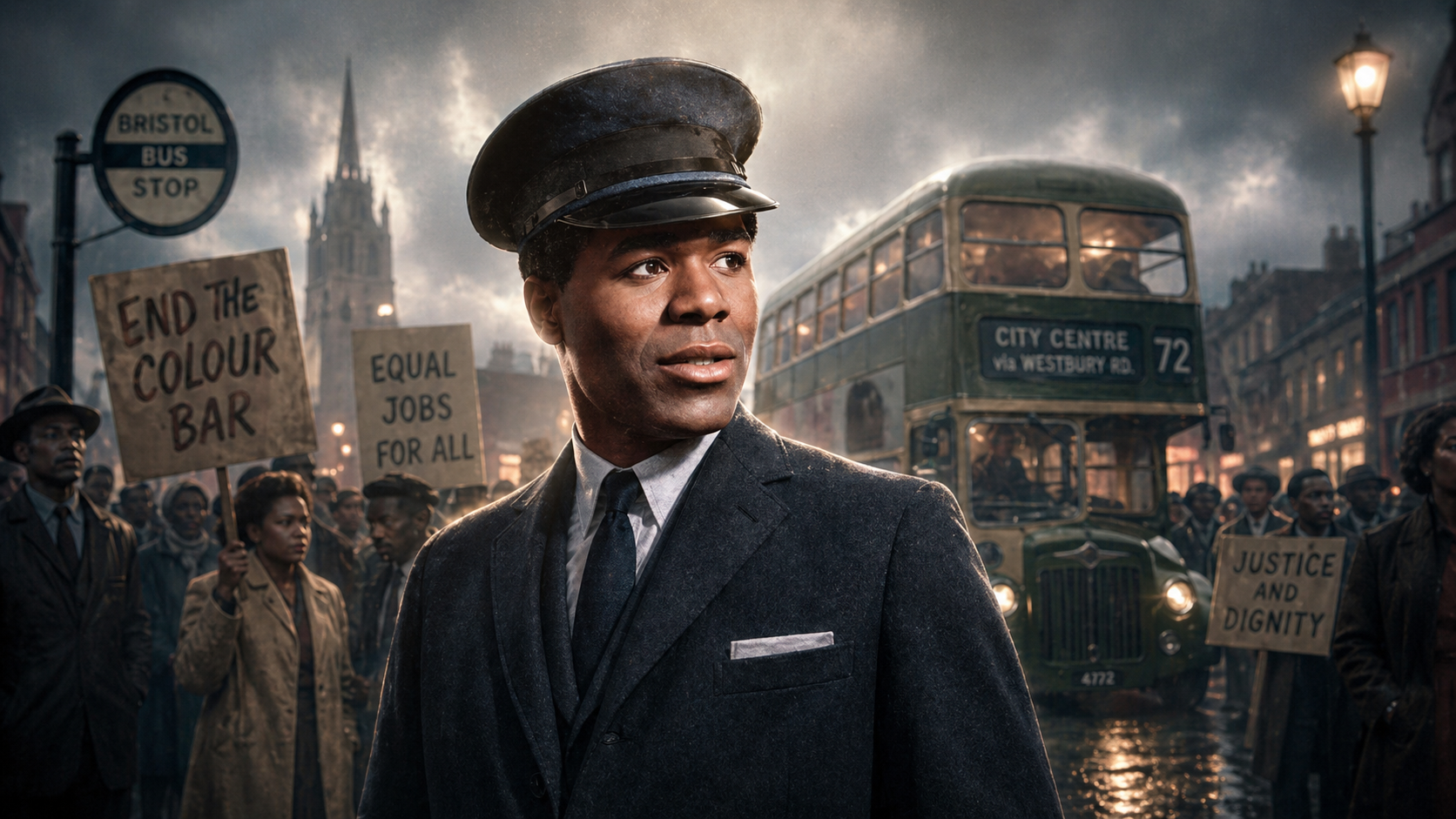
In the early 1960s, Bristol was a city transformed by post‑war migration. Caribbean and South Asian workers were recruited to rebuild Britain, yet routinely confined to the dirtiest, lowest‑paid jobs and excluded from decent housing and fair employment. The Bristol Omnibus Company, then a nationalised firm, exemplified this colour bar: non‑white workers could clean buses or work in the canteen, but were barred from becoming drivers or conductors.
This was no quiet, unspoken prejudice. In 1955 the local branch of the Transport and General Workers’ Union (TGWU) formally resolved that “coloured” workers should not be employed as bus crews, justifying this ban by claiming that white staff would refuse to work with them or lose overtime. With the company, the union, and local authorities all complicit or indifferent, conventional negotiation went nowhere, and racial discrimination remained entirely legal in Britain.
The West Indian Development Council and the Guy Bailey Test Case
Frustration with the slow pace and caution of existing community organisations led a group of Jamaican migrants—Roy Hackett, Owen Henry, Audley Evans and Prince Brown—to form the West Indian Development Council (WIDC). They wanted a more militant, visible approach to Bristol’s colour bar and chose Paul Stephenson, a young, charismatic youth worker, as their public spokesperson.
To expose the discrimination beyond denial, Stephenson organised a test case. He arranged a job interview for Guy Bailey, a well‑qualified young warehouseman and Boys’ Brigade officer, who met every requirement for the conductor position. When the company learned Bailey was West Indian, the interview was abruptly cancelled, with staff openly stating that they did not employ Black people. That refusal, so stark and unambiguous, became the spark the organisers needed.
Inspired by Montgomery: Announcing the Boycott
The WIDC drew explicit inspiration from the 1955 Montgomery Bus Boycott in the United States and the stand taken by Rosa Parks. The organisers studied the tactics of the US civil rights movement and consciously sought to “bring the civil rights movement to Britain,” in Paul Stephenson’s words, adapting non‑violent direct action to the streets of Bristol.
On 29 April 1963, they held a press conference to announce a city‑wide boycott of the Bristol Omnibus Company. From 30 April, Black residents and many white supporters refused to ride the buses, choosing instead to walk across a hilly city built on centuries of Atlantic trade and slavery. The boycott was not only a protest against one employer but a public refusal of the wider colour bar that governed British life.
Community Solidarity and National Attention
Support for the boycott quickly spread. Bristol University students organised marches to the bus station and TGWU headquarters, carrying banners and demanding an end to the ban on “coloured” bus crews. Church groups, trade unionists, and many white Bristolians joined the protests, even as some bus workers hurled abuse and threatened violence.
The campaign also attracted high‑profile political backing. Local MP Tony Benn, Labour leader Harold Wilson, and Sir Learie Constantine, the High Commissioner for Trinidad and Tobago and legendary West Indian cricketer, spoke out against the colour bar. National press coverage turned what some tried to frame as an “industrial” issue into a test of Britain’s supposed commitment to fairness and democracy in the age of decolonisation.
Victory in August 1963
After four months of sustained pressure—marches, meetings, boycotts, and ongoing scrutiny—the Bristol Omnibus Company and the local TGWU branch finally backed down. On 28 August 1963, the company announced that it would end its discriminatory hiring policy and open bus crew roles to Black and Asian applicants.
The timing was symbolically powerful: that same day, across the Atlantic, Martin Luther King Jr was delivering his “I Have a Dream” speech at the March on Washington. Within weeks, Bristol saw its first non‑white bus crews. On 17 September 1963, Raghbir Singh, a Sikh graduate, became the city’s first non‑white conductor, soon followed by others such as Norman Samuels. What had once been defended as “impossible” became everyday reality.
From Local Boycott to National Law
The Bristol Bus Boycott did more than transform one company’s hiring practices. It exposed the hollowness of Britain’s self‑image as a tolerant, post‑imperial nation and added crucial momentum to the campaign for national race relations legislation. The publicity and pressure generated by the boycott contributed to the passage of the Race Relations Act 1965, which made racial discrimination in public places unlawful, and the Race Relations Act 1968, which extended protections to employment and housing.
In that sense, the boycott functions as a hinge between empire and a new, contested vision of multiracial citizenship. It stands in a lineage that runs through subsequent legal reforms and eventually into the Equality Act 2010, which consolidated protections across multiple strands, including race. Decades later, key organisers such as Paul Stephenson, Roy Hackett, and Guy Bailey were awarded OBEs, an official recognition that arrived long after their courage reshaped the legal landscape.
Remembering Bristol’s Place in Black British History
Today the Bristol Bus Boycott is increasingly recognised in curricula, public history projects and commemorations as a watershed in Black British history. It links the streets of Bristol—once enriched by the profits of the Atlantic slave trade—to the global movements for civil rights, anti‑apartheid struggle, and decolonisation that defined the mid‑twentieth century.
To remember the boycott is to remember that Britain’s civil rights story was not simply imported from the United States, but forged by Black communities here: by Roy Hackett, Owen Henry, Prince Brown, Audley Evans, Paul Stephenson, Guy Bailey, and the many unnamed people who chose to walk rather than ride. Their refusal of the colour bar continues to resonate wherever people challenge racism not only as personal prejudice, but as a structure woven into work, housing, and law.
Source:
Madge Dresser– The Bristol Bus Boycott: A watershed moment for Black Britain https://collections.bristolmuseums.org.uk/stories/bristols-black-history/bristol-bus-boycott/
Historic England (Heritage Calling blog) – “The Story of the Bristol Bus Boycott” – https://heritagecalling.com/2023/04/20/the-story-of-the-bristol-bus-boycott/
VisitBristol – “The story of The Bristol Bus Boycott”. https://visitbristol.co.uk/blog/post/the-story-of-the-bristol-bus-boycott/
Wikipedia – “Bristol Bus Boycott” . https://en.wikipedia.org/wiki/Bristol_Bus_Boycott
Kaplan Pathways – “What happened during the Bristol Bus Boycott?” https://www.kaplanpathways.com/blog/what-happened-during-the-bristol-bus-boycott/
Bristol Museums – “The Bristol Bus Boycott: A watershed moment for Black Britain” – https://collections.bristolmuseums.org.uk/stories/bristols-black-history/bristol-bus-boycott/
Black History Month UK – “The Bristol Bus Boycott (1963)” video . https://www.blackhistorymonth.org.uk/article/video/the-bristol-bus-boycott-1963/