
When I first wrote “Identity of She,” I believed the questions I carried about the “first” mother in the poem would remain unanswered forever. Since childhood, I sensed an ancestral maternal presence speaking through me, but I assumed the archive, the ships, and the auction block had swallowed her identity forever. Many years later, my African Ancestry mtDNA result places my maternal line among the Yoruba, transforming my questions into a people, a cosmology, and a spiritual home. Rooted in this new sense of belonging, I am beginning to understand what it truly means to walk toward the seventh direction. The reflection that follows explores what it is, after a lifetime of dispossession, to receive a lineage—and to journey inward with that knowledge.
Captured
Chained
Sold.
My soul laments
because it wants to know
the identity of She
who was captured in Africa
and taken to the Americas,
and is the root of my family tree
The identity of She
the mother of all my mothers
until there was me
There is no one to tell me
because nobody knows.
What was her name?
What language did She speak?
How old was She?
When She stood on the auction block
and was remade into Black.
Was She a child?
or had She already celebrated puberty?
Did She already dance to the drums on her wedding night?
Did she already sing songs to her first child?
There is no one to tell me
because nobody knows.
Did She run
the good run
became a maroon
and fought for the freedom
of all her brothers and sisters too?
Or maybe She had no such luck.
Maybe an captive life
a cruel an unimaginable life
was my mother’s lot.
There is no one who can tell me
because nobody knows.
Did She learn to read and write by the candlelight?
Organise secret meetings because She was determined to fight?
Did She work in the field or in the big house?
Looking after children that was not her own,
and her own children?
Tell me, were they taken away from her and sold?
There is no one who can tell me
because nobody knows.
But I know her without ever knowing her
and I love her without ever loving her
and I can feel her
even though I’ve never touched her
‘cause I can feel her energy
I can feel her pain
‘cause her blood
is still running through my veins
She is who I am
She is my identity
I am the identity of She:
She who was captured
She who was chained
She who was sold
and my heart is hurtin’
because it wants to know
Did she look like me?
The woman who was taken from Africa
and brought to the Americas,
and is the root of my family tree
did she look like me?
The mother of all my mothers
until there was me.
But there is no one to tell me
because nobody,
nobody knows.
Reflection on My African Ancestry DNA Results
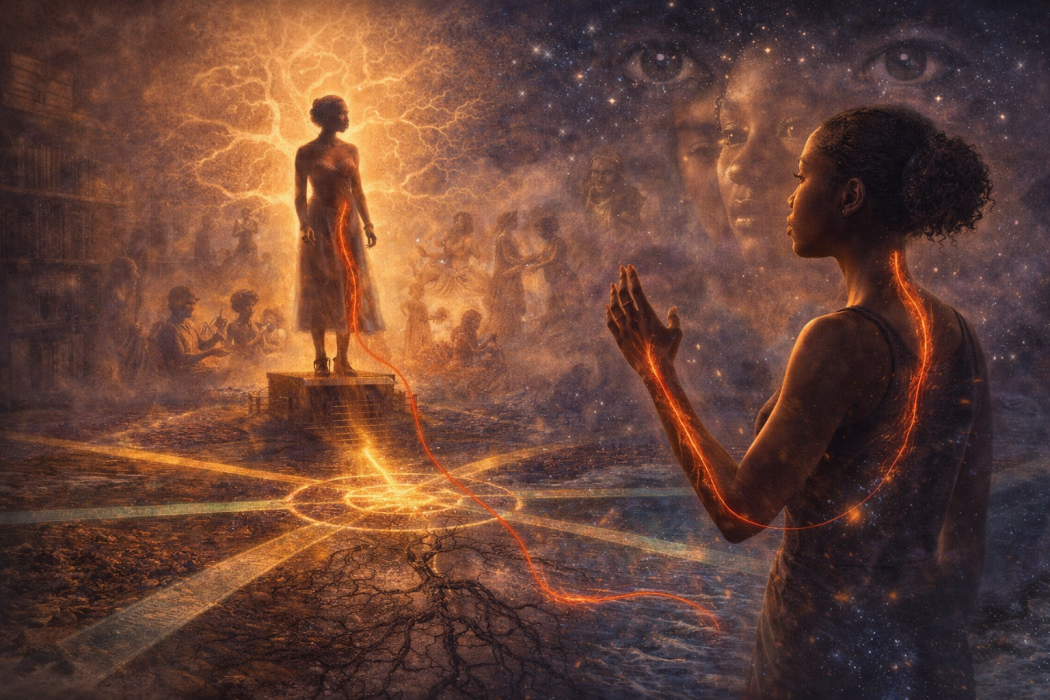
I wrote “Identity of She” in my mid-twenties, during a particularly challenging period of my life. After taking my sons to school, I returned home and, overwhelmed by self-pity, retreated to my bedroom. I drew the curtains and hid under the covers, grappling with the contrast between my self-image as a bright, confident woman and the reality of being an unemployed single mother. Yet, as I lay in that darkness, the words of the poem began to flow unbidden through my mind, repeating themselves insistently until I finally threw off the covers and rushed to write them down.
The poem arrived fully formed, as if spoken by an ancestral voice within me. I made only minor refinements. I sensed that a maternal presence from my lineage wanted me to understand: whatever I faced would never compare to the all-encompassing suffering my ancestors endured to bring me into this world. There is a Jamaican proverb: “If trouble was something you could put in a basket and take to the market to sell, when you get there, you would turn back home after seeing other people’s trouble, because you never knew that trouble could be so big.” My wounded ego could not measure up to the dehumanization my ancestors suffered. Had I gone to the market to sell my “Woe-Me” story, and seen what my mothers before me had carried in their baskets, I would have run back home.
Another ancestral experience was being summoned by the spirit world to visit my great-uncle. My grandmother—already among the ancestors—whispered to me to go see him. I ignored her urging because a past family incident had made me dislike my great-uncle. He had let down my mother, and I had carried a grudge against him ever since. Then, suddenly, she hit me. It immediately snapped me out of my stubbornness. I called my mother, who reached out to her sister in Malta, since we had cut off contact with that side of our family in London. My aunt revealed that my great-uncle was living his final days. I rushed to the hospital, sensing that my grandmother wanted me to learn something before it was too late. When my great-uncle realized I was his sister’s granddaughter, a radiant smile crossed his face. “You are the second person who has come searching for history,” he told me. Expecting him to name one of my cousins, I asked who had come before me, but he answered, “Sister Beatrice.” In that moment, I learned that my grandmother, like me, cherished history. My great-uncle recited the names of my great-grandmother, great-grandfather, and my great-aunts. He told me my great-grandmother had come from St. Ann’s and was a cousin of Marcus Garvey—a family lore, spoken from the mouth of another elder. My great uncle died the following day after my visit.
This is all I know of my family’s history. I do not know my great-grandmother’s mother’s name, nor who her grandmother was. I was aware that my great-grandfather was an Asian man from Bangladesh, but I hadn’t known he was called “Babu.” This Asian heritage manifested in my love for yoga and my affinity with Hinduism. I had already been tending an ancestral altar, and I understood then that these ancestors wanted me to remember their names, to speak them whenever I lit a candle, burned incense or poured libation. In this ritual of remembrance, I should also remember the names of others in my bloodline, beyond my grandmother, so that the deep love I held for her extends throughout a lineage that spans continents and generations. Maintaining an Afrikan spiritual connection—an altar—to my ancestors feels like my responsibility within the family, as everyone else is “christianised”.
When I wrote “Identity of She,” I could not have imagined that, years later, a genetic test would anchor me so firmly to my maternal ancestry. My father is European, or mixed—a man I have never met. He abandoned my mother before I was born. According to her, his family objected to their relationship because “Black and white were not supposed to mix,” and sent him away from the island. That chapter of my story closed before it began. If I wished to trace my grandfather’s bloodline, who journeyed from Cuba to Jamaica, I would need one of my two surviving uncles to take the Patriclan test. But I digress.
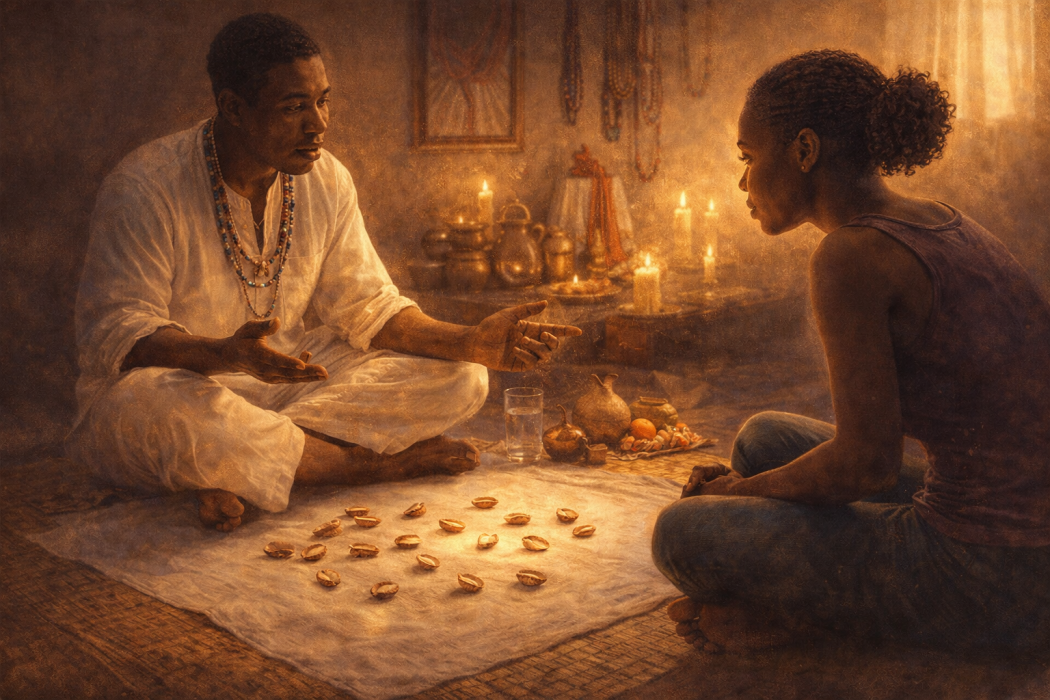
Recently, I took a matrilineal DNA test with African Ancestry and discovered that my maternal line is Yoruba. I wept tears of joy. I had always hoped to be Yoruba, Igbo, or Fante—three African peoples with whom I felt a deep, historical resonance. My spiritual world has always been rooted in Ifa. An uncle once told me, after researching our family history, that we were Akan/Asante. Yet, when I read African Spirituality: On Becoming Ancestors by Anthony Ephirim-Donkor, the Akan sacred system felt foreign to me. So too, the Adinkra symbols and the Kente cloth. In contrast, The Diloggun by Ocha’ni Lele felt instantly familiar. I recognized Elegba as the little boy who watched over me as I slept, vanishing in laughter when I awoke and tried to catch him. Since childhood, my life has been cosmologically Yoruba. My eyes adored the Gele worn by Nigerian women and their style of dress. And whenever I read a novel that I felt connected to, it was usually by a Nigerian author. I especially love Ben Okri. In countless ways, Nigeria has called to me in my adult life, always hinting that it is my ancestral home. Now, the Identity of She is certain. I may never know her face, her age when she was taken, or her experience during the Maafa, but I know the people she came from: the YORUBA. She has been with me from my first breath—a powerful maternal presence shaping my life until I finally met the spirituality from which she came.
Some moments in life do not simply add new experiences to our past—they break the past open. That is how I feel about my African Ancestry mtDNA result.
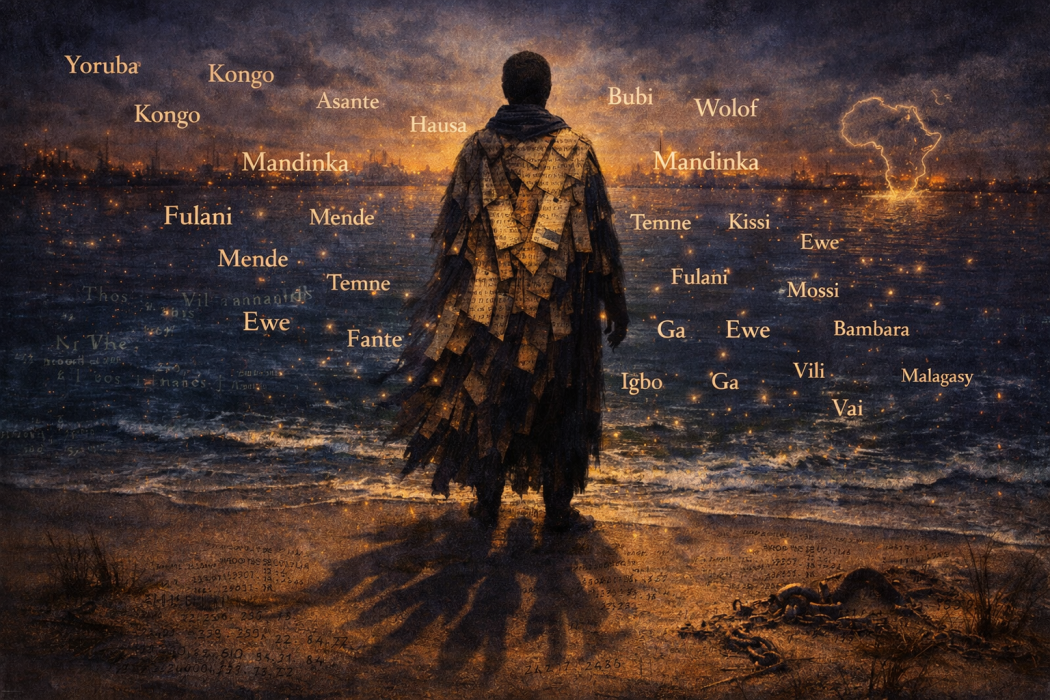
For many of us in the African diaspora, life is shaped by dispossession. We are “Black” as our oppressors have named us: a colour, a category. We inherit a wound, not a people. There is no village to point to on a map, no clan name that opens doors. Only the long shadow of plantations and the cold precision of ledgers remain, because history was not written to remember them as Yoruba, Kongo, Asante, Hausa, Bubi, Wolof, Mandinka, Fulani, Mende, Temne, Kissi, Ewe, Fante, Igbo, Ga, Fon, Ibibio, Chokwe, Bamileke, Tikar, Benga, Balanta, Mossi, Bambara, Kru, Vili, Vai, or Malagasy. History was written to erase that specificity, folding them into a faceless mass. Our names were broken, our languages scattered, our stories interrupted mid-sentence. For those of us born on this side of the Atlantic, we grow up belonging to the Maafa itself. We belong to loss, to rupture, to a history of captivity and resistance that is powerful but strangely unanchored. We may know the ships, the chains, the uprisings, but not the homesteads left behind. We can recite dates and laws, but cannot call the names of the rivers that once mirrored our reflection.
Beneath all of this lingers a quiet, insistent question: Who are my people beyond the Maafa? Not just geographically, but in story, cosmology, and obligation. What did my ancestors believe about the soul, about community, about beauty and justice before the whip redrew the horizon?
In our interview, Elliot Rivera, the Urban Shaman, offered a powerful insight: “If you are of Afrikan descent, it is important to know where you are from. Many brothers and sisters know nothing of their ancestry, but they need to connect with the spirit of their ancestors. I personally urge them to connect, even if it means doing a DNA test. Your ancestors have answers to all your questions. You must open yourself to an energy greater than yourself.”
Yet there is a world of difference between a pie chart that reads “40% West African, 20% Nigerian,” and a lineage report that whispers: “Yoruba. Kongo. Akan. Mende.” One flattens us into percentages and regions carved by oppression; the other, like the African Ancestry matriclan or patriclan test, points beyond false borders—toward languages, philosophies, deities, proverbs, foods, and rhythms.
Within this context, DNA testing—often marketed as revelation—is more of a mirror. It does not invent a people for us; it reflects what our blood has carried in silence for centuries.
The Spirit Double
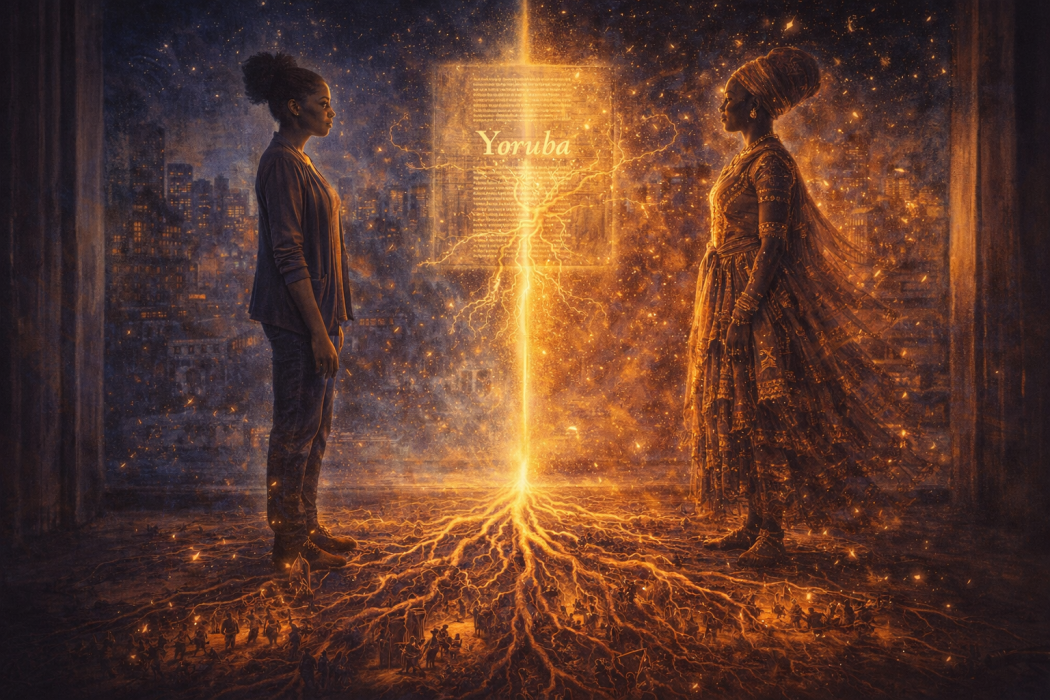
To meet our ancestral lineage is to encounter what might be called a spirit double. On one side stands the self you have always known—shaped by Britain or Brazil, Jamaica or the United States, and the daily negotiations of Black life in an anti-African world. On the other hand, illuminated by a few lines on a page, stands the ancestral self who has walked with you in dreams, in inexplicable affinities, in the way certain songs or stories stir something deep within.
The test does not create this double; it merely introduces you. It says: Here is your reflection across time. Here are the people who have been breathing through you all along. Once you have heard that name, you cannot unknow it. The question shifts from “Who am I?” to something more urgent and liberating: How will I live now that I know?
To discover that you are Yoruba, or Bubi, or Balanta is not simply to collect another fact about yourself. It is to have an entire civilization step into the room and declare: We are the root system beneath your feet. Everything you thought you knew about your “individual” journey shifts. The books you gravitated toward, the drum patterns that felt like a heartbeat, the places that called to you—these are not random preferences. They are the echoes of a people, still speaking through you.
Emancipating Ourselves from Mental Slavery
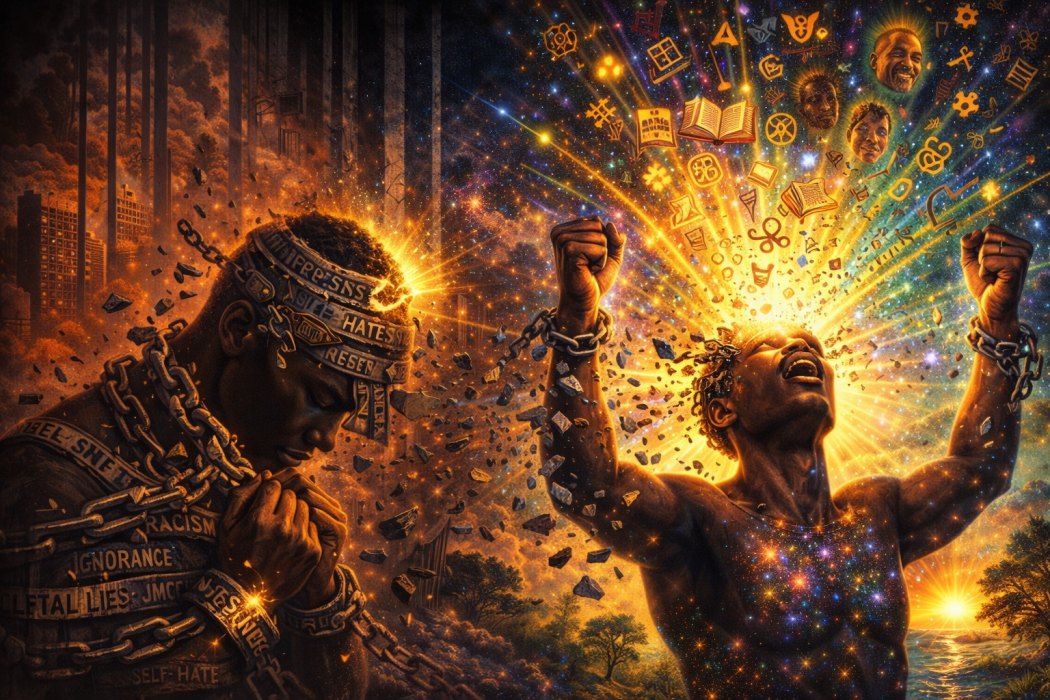
An mtDNA or Y-DNA test becomes a way to truly “emancipate yourself from mental slavery.” Belonging matters. For those of us who have fought to liberate our minds from oppression, from anti-Black narratives, and from the lie of African inferiority—through study, activism, and spiritual work—a test result offers a lineage to claim as our own. Mental freedom is no longer just an abstraction or a distant principle; it becomes a place to stand. With this cultural connection, your freedom is finally rooted. It has coordinates.
To say, “I am Yoruba” after the Maafa is a profound declaration. It is to align yourself with centuries of philosophy, artistry, spiritual science, and political history. It means: These are my people. These were our mistakes. This is our genius and our beauty. I choose to live from here. Mental bondage thrived on our anonymity to ourselves; mental freedom, anchored in lineage, ensures that even when the world tries to erase us, we cannot unknow the ground beneath our feet.
From this place, the question “How will I live now that I know?” becomes an invitation, not a burden. It does not require perfection; it asks for responsibility—to carry your people’s story with tenderness and clarity, to let their wisdom and warnings guide your choices, and to recognize your own life as a chapter in a much older, still-unfolding narrative. Now, you stand in a stream of consciousness that is truly your own. When Bob Marley sings “Coming In From The Cold,” the meaning deepens: we are no longer lost, searching for heritage outside in the cold. We stand in the warmth of belonging, inside our people’s story.
The Seventh Direction
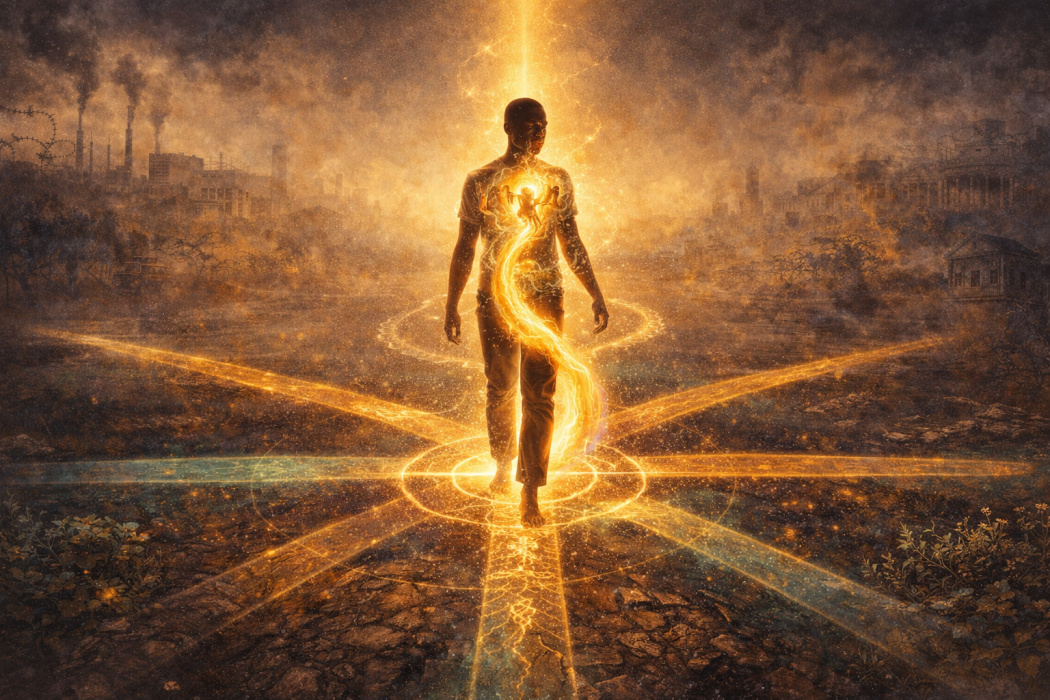
Now that we have found our mothers’ garden, we can begin to walk toward the seventh direction. Many African and Indigenous cosmologies teach about the seven directions. In Bantu-Kongo philosophy, a human is both a living-energy being and a physical being. We move in four directions—forward, backward, left, and right—motions that shape our learning and physical experience. Our “spirit” self also moves both upward and downward, but for true health, self-knowledge, and healing, we must walk inward. This mirrors Indigenous teachings: four cardinal points —above, below, and the seventh—within. The seventh direction is the soul’s journey, the inner world where our essence and our oldest ancestors reside. To walk that path is to consciously return to the place where our deepest self meets those who came before us.
The Bantu teach that much of our suffering arises from not knowing how to walk toward this seventh direction—the inward path. Without this journey, we become unanchored. When the body is oppressed, destroyed, polluted, corrupted, or violated—whether biologically, socially, institutionally, or nationally—the outer shell is rendered lifeless. The path to the core, the seventh direction, is erased. Healing cannot begin until the original state of the core is restored.
Receiving a lineage through DNA testing marks the first step on a path of restoration. To learn your mtDNA or Y-DNA cannot reverse the tides or erase the Maafa. Instead, it reveals the strength held within your core. It gives you the capacity to walk toward the seventh direction, no longer searching the horizon for your beginning. Now, we recognize that the villages, cosmograms, drum languages, rivers, and forests our ancestors once knew have already left their imprint within us. To know the name—Yoruba, Kongo, Akan, Igbo—is to reclaim a power for self-healing, a power once severed by capture, ships, dehumanization, racism, and the weight of perpetual struggle.
It also brings the joy of becoming a culture-bearer: to say, I carry a people within me—their brilliance, their courage. It allows us to honor the rupture but refuse to live solely from the wound. Now, we can say, “I choose to create, to study, to organize, to love, from the place where my spirit double and I walk side by side.”
Conclusion
The African Ancestry DNA result offers us a way to emancipate ourselves from mental slavery: to break the chains and then give our freedom a home, grounding our minds in a living heritage. Now that we stand in this space of belonging, we can begin to walk toward the seventh direction—a path that reveals itself as we move away from isolation and alienation, and dare to live from this place of knowing. Just as Bob Marley sings of “Coming In From The Cold,” for me this journey has brought me to what Lenny Kravitz calls “Stillness of Heart”: I can now find my way out of the dark and into a deeper love for myself and my people.
Within “The Continent of Black Consciousness”, I have now found the heart of who I am. May the Ancestors and Orishas continue to guide and protect me. May I continue to listen to their counsel. May I stand in the spiritual light, which was taken away from my ancestors’ sight. May I fly higher into the good sunlight! Ase.
Acknowledgement: This post was enriched by the lyricisms and writings of Bob Marley, Alice Walker, Ben Okri, Lenny Kravitz, and Erna Broder. A special gratitude to Kimbwandende K. B. Fu-Kiau, whose book, “African Cosmology of the Bantu-Kongo: Principles of Life and Living”, shaped the writing of the section on The Seventh Direction.
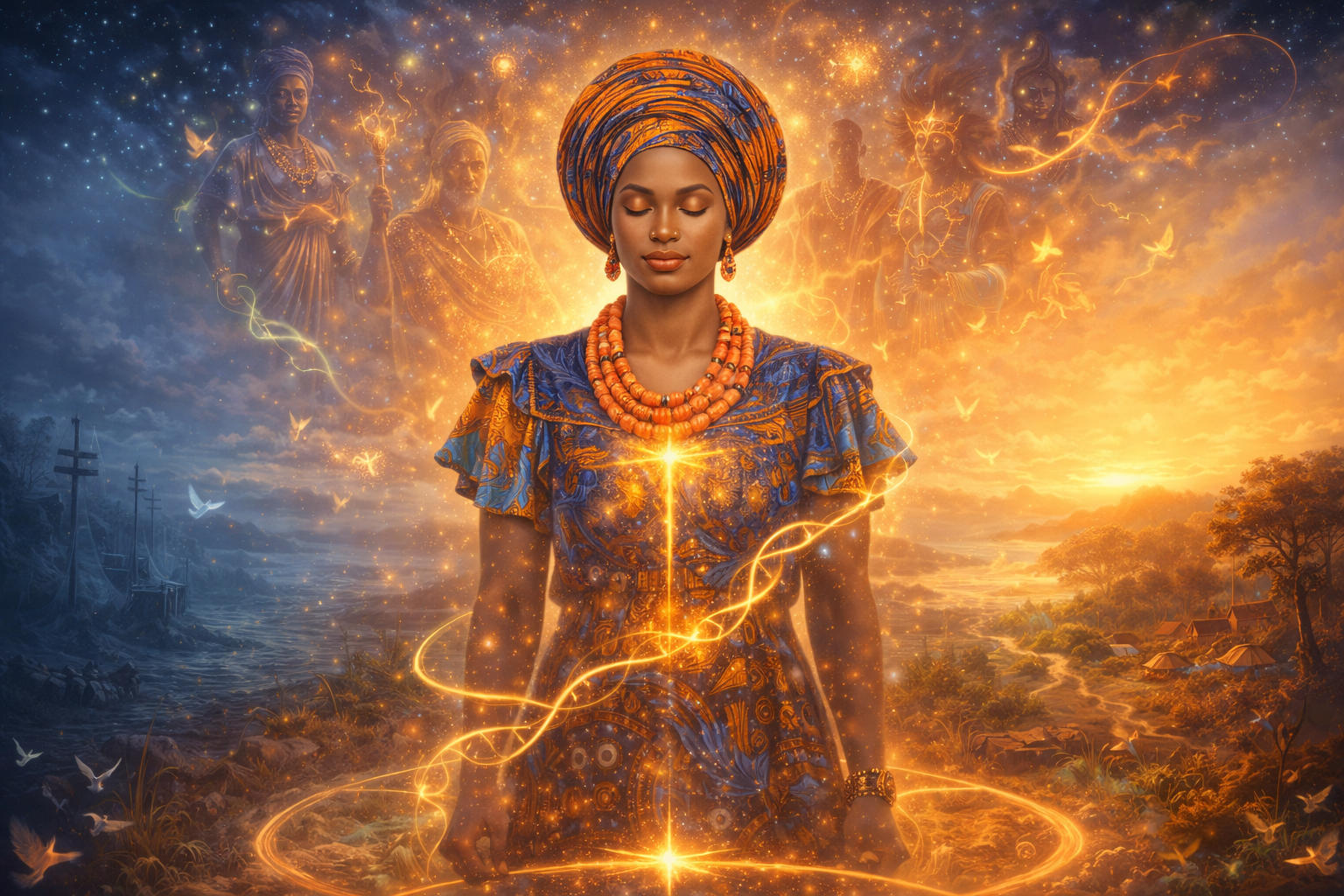
I would also like to acknowledge the support of AI tools in creating the visionary illustrations. The art prompts that accompany these reflections were developed in collaboration with Perplexity (powered by GPT‑5.1), whose generative capacities helped me translate complex ideas about ancestry, memory, and spirit into visual language. The final artworks were then brought to life by ChatGPT’s image-generation capabilities, which rendered these prompts into evocative illustrations that honor the depth and dignity of African and African diasporic experience.