
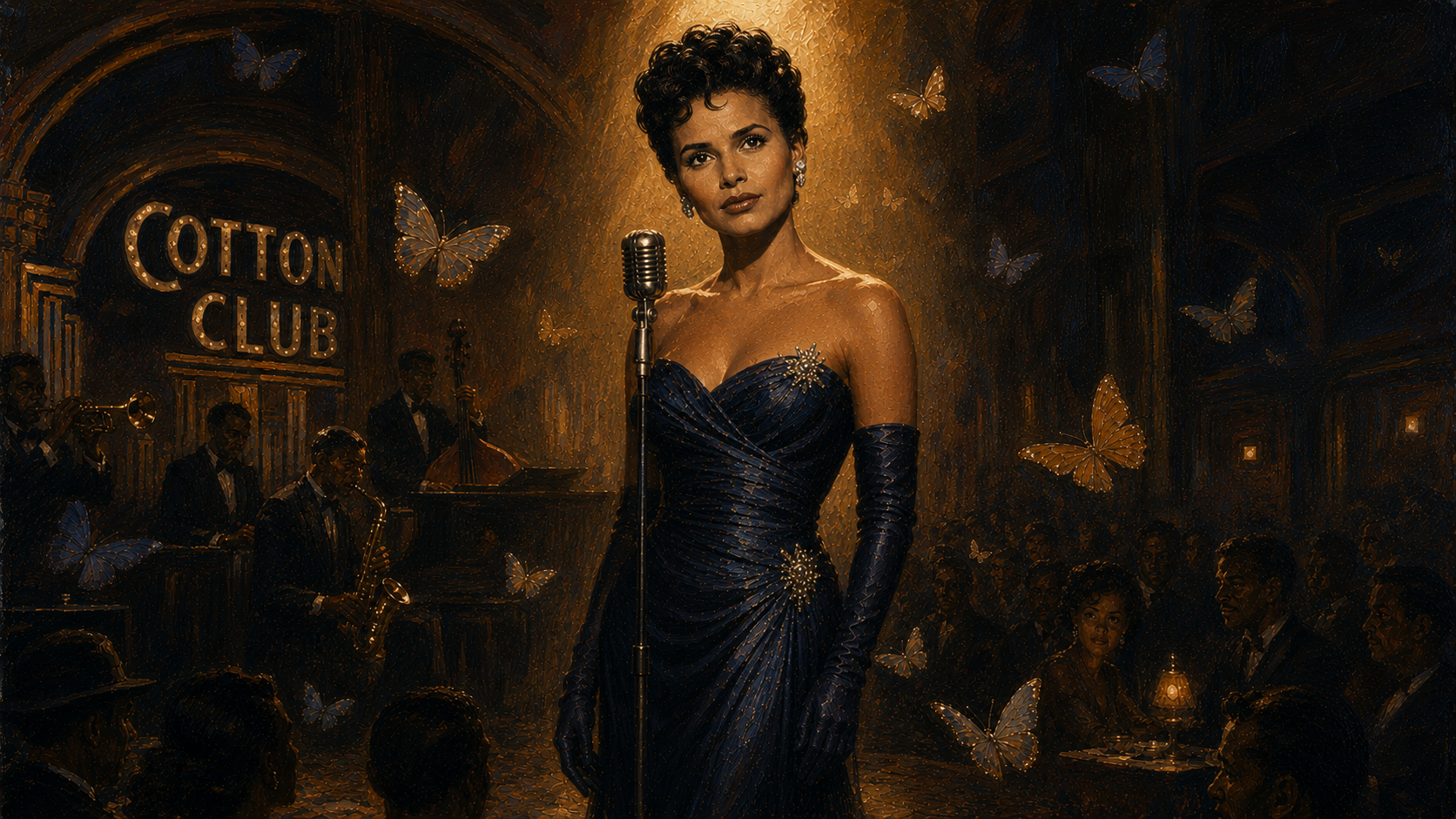
Lena Horne was a trailblazing American entertainer whose career as a singer, actress, and dancer stretched across seven decades, tracing a path from Harlem’s Cotton Club chorus line to international stages and screens. She rose from nightclub revues to the rarefied realm of MGM musicals, becoming one of the first Black women to sign a long-term contract with a major Hollywood studio and a pioneering figure for Black performers navigating an industry built on racial hierarchy and exclusion. Beyond her artistry, Horne was a fiercely committed civil rights activist: she worked closely with organizations such as the NAACP, refused to perform for segregated audiences, and used her fame to challenge discrimination in the military, in entertainment, and in public life. Her wide-ranging career encompassed starring roles in films like Cabin in the Sky and Stormy Weather, headlining premier nightclubs and concert halls, and culminating in a record‑breaking Broadway engagement with her one‑woman show Lena Horne: The Lady and Her Music. Across these years she garnered major honors, including Grammy Awards, a Tony Award, and the Kennedy Center Honors, securing an enduring cultural legacy as both an emblem of Black glamour and a symbol of uncompromising resistance. Yet behind the honors and acclaim, Horne’s life unfolds as a luminous tragedy: a woman of breathtaking beauty and formidable talent who turned glamour into a weapon against racism, yet endured decades marked by loneliness, loss, and the persistent sense of being used rather than truly seen.
Talented Tenth beginnings
Lena Mary Calhoun Horne was born on June 30, 1917, in Brooklyn’s Bedford-Stuyvesant, into a family belonging to the Black upper-middle-class stratum W.E.B. Du Bois called the “Talented Tenth.” Her father, Edwin Fletcher “Teddy” Horne Jr., a banker and gambler, abandoned the family when she was three, and her mother, Edna Louise Scottron, pursued acting with a Black troupe, often placing her own ambitions above parental care. The child Lena was thus raised primarily by her paternal grandparents, Cora Calhoun and Edwin Horne, in a home steeped in respectability politics and activism. Her grandmother Cora—civil rights activist, suffragette, and early NAACP member—enrolled Lena in the organization at age two, giving her both a lineage of dignity and a lifelong burden of representation.
Despite these middle-class roots, Horne’s childhood was marked by instability and dislocation. Between five and twelve, she shuttled between relatives and paid companions in the South and Midwest, her schooling repeatedly disrupted as she moved between segregated Southern schools and progressive institutions like the Ethical Cultural School in New York. In Fort Valley and Atlanta, Georgia, she lived with her uncle Frank Horne, an educator who later advised President Franklin D. Roosevelt, yet the constant moving made her feel what her daughter would later call a “perpetual outsider.” At sixteen, amid the economic pressures of the Great Depression, Lena dropped out of high school to help support her fractured family, stepping toward a world in which her face and voice would become both livelihood and mask.
From Cotton Club glamour to the “butterfly pinned to a column”
In 1933, Horne’s mother secured her an audition at Harlem’s Cotton Club, a venue that simultaneously showcased Black artistry and enforced Anglo oppression. Lena, earning a meagre wage, performed nightly in a room where Black performers and staff served a Anglo-only clientele and could not even use the same restrooms as patrons. Yet in this deeply racist space, she absorbed lessons in stagecraft from stars like Cab Calloway, Adelaide Hall, and Duke Ellington, and began working with songwriters Harold Arlen and Ted Koehler, whose “As Long as I Live” helped her step out of the chorus line. Even at this early stage, her beauty marked her out: a tall, poised young woman whose elegance could be admired by Anglo audiences so long as it was safely contained on stage.
By 1935 she left the Cotton Club to tour with Noble Sissle’s Society Orchestra, performing under the more glamorous name “Helena Horne,” before briefly abandoning show business to marry Louis Jordan Jones, a politically connected young man whose respectability seemed to promise security. The marriage brought two children, Gail and Teddy, but was shadowed by financial strain and reported verbal and physical abuse, forcing Lena back to the stage and into low-budget films such as The Duke Is Tops and the Broadway revue Blackbirds of 1939. After separating from Jones in 1940, she joined the Anglo Charlie Barnet Orchestra, breaking new ground as one of the first Black women to tour with an all-Anglo swing band, yet she faced nightly humiliation—denied hotel rooms, forced to sleep on the bus or passed off as a “Cuban singer” to circumvent color bars. Her growing glamour thus coexisted with a brutal awareness that, offstage, she was still a Black woman barred from the spaces where her own voice filled the air.
A turning point came in 1941 at Café Society Downtown, New York’s first integrated nightclub, where Horne’s performances brought her into the orbit of Paul Robeson, Langston Hughes, and Orson Welles. Robeson, who had known her family since her grandmother helped secure his Rutgers scholarship, became her mentor, urging her to embrace her identity as a Black woman and to see her art as a tool for social change. His insistence that “you’re [Black] and that is the whole basis of what you feel” grounded Horne’s sense of self even as Hollywood prepared to turn her into a carefully curated image.
Hollywood’s experiment and the cost of being a symbol
In 1942, Metro-Goldwyn-Mayer signed Horne to a long-term, seven-year contract, making her the first Black performer to secure such a deal with a major studio. Her father and NAACP leader Walter White helped negotiate a crucial condition: she would never play a maid, prostitute, or other demeaning stereotype. On paper, the contract looked like a triumph, yet in practice it trapped her in a narrow space: too dignified for the roles Hollywood offered Black women, yet too Black to be cast opposite Anglo leading men under Jim Crow and miscegenation codes. Studios solved this by placing her in “specialty” musical numbers—opulent scenes in which she, draped in gowns, leaned against marble columns to sing ballads that could be easily excised for Southern audiences without disturbing the plot.
Horne later described herself in this period as a “butterfly pinned to a column,” a devastating image capturing both her beauty and her imprisonment. She appeared in all-Black musicals such as Cabin in the Sky and Stormy Weather; the latter’s title song became her signature, but even these films were understood by studios as segregated showcases rather than fully integrated narratives. MGM executives wrestled with how to present her: they pressured her to “pass” as Latina, a proposal she refused, and commissioned makeup artist Max Factor to create a “Light Egyptian” foundation to darken her complexion so she would match Hollywood’s idea of a Black woman on screen. The tragic irony was that her light skin made her more acceptable to Anglo audiences, who saw her as a “kind of Black that Anglo people could accept,” even as Black colleagues sometimes accused her of trying to pass, deepening her sense of isolation.
The backlash came not only from studios but from parts of the Black acting community. Some Black performers depended on the very stereotypical roles Horne refused and saw her principled stance as a threat to their livelihoods, accusing her of being a “tool of the NAACP” or of acting superior. Hollywood responded to her refusals with suspensions, loss of salary, and a cruel form of erasure, keeping her scenes decorative and detachable rather than allowing her characters to speak, love, or drive the story. As she later reflected, they had not made her a maid, “but they hadn’t made me into anything else either,” leaving her emotionally wasted, pinned to an image that could be admired but never fully known.
Wartime glamour and militant conscience
During World War II, Lena Horne became the premier pin‑up girl for Black soldiers, her photographs and songs circulating through barracks and training camps. She toured extensively with the USO, ostensibly to boost troop morale, but quickly turned these appearances into opportunities to confront military racism. At Fort Reilly, Kansas, she discovered that German prisoners of war occupied the front seats while Black American soldiers were forced to sit behind them; horrified, she walked off the stage, moved to the back of the hall, and performed with her back turned to the prisoners, singing directly to the Black GIs. When MGM and the USO tried to silence her anger, she quit the official tours, financed her own travel, and refused to entertain segregated audiences, demonstrating that her glamour would never be divorced from her politics.
Her activism extended beyond performance spaces. She lobbied, alongside Eleanor Roosevelt, for federal anti‑lynching legislation and spoke up for Japanese Americans facing wartime discrimination. Horne’s work with the Tuskegee Airmen—posing for celebrated photographs and visiting their base—helped solidify her symbolic status as the “number‑one pin‑up girl” for Black GIs, but she consistently used that status to highlight the contradictions of a democracy that asked Black men to die for a country that refused them basic dignity. The tension between her glamorous posters and her radical interventions underscored the double bind she inhabited: adored as an image, punished whenever she insisted on justice.
Love, stigma, and the “dark cloud” of politics
Horne’s personal life mirrored the complexities of her public persona. Her first marriage to Louis Jordan Jones, begun when she was nineteen, promised conventional respectability but devolved into a troubled union marked by economic hardship and abuse, contributing to her sense that marriage offered no refuge from the precarity imposed by racism and sexism. Her second marriage, to Anglo MGM composer and conductor Lennie Hayton, challenged legal and social boundaries: because interracial marriage was illegal in California, they wed in Paris in 1947 and hid their union for nearly three years, fearing professional reprisals and violent reaction. Horne later acknowledged that she initially considered the relationship partly strategic—Hayton could secure opportunities no Black manager could—but over time she came to regard him as the man who taught her “everything I know musically,” and the marriage, despite pressures, as “perfect.”
Their union, however, did not shield Horne from political persecution. In the early 1950s, during the McCarthy era, her close friendship with Paul Robeson and involvement in liberal organizations such as the Council for African Affairs and Progressive Citizens of America led to her being named in Red Channels as a communist sympathizer. The blacklist effectively barred her from film, radio, and the emerging medium of television for roughly seven years, forcing her to rely on nightclub performances and European tours to survive. She spent extended periods in London, France, and Belgium, particularly in the 1950s, using Europe as a refuge from American suspicion and racial hostility even as the “dark cloud” of the blacklist hung over her reputation. Clearing her name required humiliating negotiations with conservative columnists, and although she ultimately re‑signed with RCA Victor, the episode deepened her awareness that her outspokenness carried a heavy, lifelong cost.
Alongside these official sanctions, Horne bore the symbolic burden imposed by the NAACP and Hollywood alike. As Walter White’s “test case” in the studios, she was told she occupied a “representative position” and must never embarrass Black women, an injunction she later described as a “heavy load.” Her light skin, Talented Tenth upbringing, and refusal to perform demeaning roles left her stranded between worlds—insufficiently “typical” for Hollywood stereotypes yet judged by some Black peers as aloof or elitist—reinforcing her sense of being always in the middle, always an outsider.
Stormy weather: grief, identity, and survival
In her fifties and sixties, Horne’s life was struck by a succession of devastating losses that revealed the tragic underside of her iconic image. Between April 1970 and April 1971, she lost three central figures: her father Teddy Horne, her son Edwin “Teddy” Jones, and her husband Lennie Hayton, all within roughly thirteen to eighteen months. Her son’s death from kidney failure at thirty, coming between the loss of a father who had abandoned her in childhood and a husband who had stood beside her through decades of struggle, plunged Horne into deep depression. She later described this period as “going underground” for nearly nine years, a delayed reaction in which she withdrew from public life and questioned whether anything remained of her beyond the image that had been projected for so long.
Other deaths also marked her trajectory. She had stood beside Medgar Evers in Jackson, Mississippi, at an NAACP rally just days before his assassination in June 1963, an experience that intensified her militancy and led her to question the morality of being “just an entertainer” amid the violence of the struggle. The loss of Billy Strayhorn, the Duke Ellington collaborator whom she regarded as her “soul mate” and primary musical mentor, cut deeply; she later emerged from semi‑retirement to perform a tribute concert and record We’ll Be Together Again, acknowledging his central role in shaping her artistry. Even the earlier death of her grandmother Cora, in 1932, had forced the teenage Lena out of the only truly stable home she had known, reinforcing the pattern of rupture that followed her throughout life.
Yet out of this storm of grief, Horne eventually crafted her most powerful act of self‑definition. In 1981, at sixty‑three, she premiered her one‑woman Broadway show Lena Horne: The Lady and Her Music at the Nederlander Theatre, intending at first a four‑week farewell engagement. The production became an “instant hit,” extended to a record‑breaking run of 333 performances—the longest solo show in Broadway history—and earning her a special Tony Award, two Grammys, and a raft of critical honors. On stage, she narrated her fifty years in show business, confronting the racism she had endured and, crucially, performing “Stormy Weather” twice: once in the glamorous style of her 1940s youth, and again at the end with the raw, searing emotion of a woman who had lived through a lifetime of love and misery.
Horne described the show as the “most rewarding event” in her career because it allowed her to shed the aloof reserve that had long served as armor. The pain of her losses, she said, “opened me up to my audience” so that she finally felt “as one” with them, not a distant idol but a survivor telling the truth. In interviews from this period and later, she articulated a hard‑won clarity: “My identity is very clear to me now. I am a Black woman. I’m free. I no longer have to be a ‘credit.’ I don’t have to be a symbol to anybody… I’m me, and I’m like nobody else.” Having spent decades as a “butterfly pinned to a column,” she had reclaimed the right to define herself—not as victim or goddess, but simply as a woman who had endured and transmuted suffering into song.
Legacy of glamour and sorrow
In her final decades, Horne continued to record acclaimed jazz‑inflected albums such as Being Myself and to receive major honors, including the Kennedy Center Honors and a Grammy Lifetime Achievement Award. She remained a figure of remarkable poise, her stage presence still commanding, her beauty undiminished even as she spoke more candidly about the racism, isolation, and grief that had shaped her. When she died of congestive heart failure on May 9, 2010, at ninety‑two, she left behind children, grandchildren, and great‑grandchildren, as well as a transformed landscape in which Black women could claim roles and stages previously closed to them. The later renaming of the Brooks Atkinson Theatre as the Lena Horne Theatre—making her the first Black woman to have a Broadway house in her name—symbolized the industry’s acknowledgment that her battle to protect her image had cleared a space for others to stand in their own.
Horne’s life is remembered as tragic not because it lacked triumph, but because triumph and pain were inseparable in her experience. The same features that made her one of the most glamorous women of the twentieth century—her beauty, her poise, her carefully cultivated image—were harnessed by an industry that refused to let her fully live on screen as a speaking, desiring Black woman. She endured childhood abandonment, abusive relationships, professional blacklisting, the suffocating burden of being a “representative” pioneer, and a cascade of personal losses that would have broken many others. Yet she repeatedly turned toward the storm, insisting on dignity, refusing stereotypes, singing for Black soldiers pushed behind enemy prisoners, and eventually standing alone on a Broadway stage to tell her story in her own voice.
In the end, Lena Horne’s tragedy lies not in defeat, but in the cost of her victories: a lifetime spent balancing the glittering surface of Hollywood glamour against the unrelenting weight of racism, sexism, and grief—and choosing, again and again, to survive.
References:
https://www.biography.com/musicians/lena-horne
https://en.wikipedia.org/wiki/Lena_Horne
https://www.theguardian.com/music/2010/may/10/lena-horne-obituary
https://www.kennedy-center.org/artists/h/ho-hz/lena-horne
https://www.pbs.org/wnet/americanmasters/lena-horne-biographical-timeline/16659/
https://www.nps.gov/features/malu/feat0002/wof/Lena_Horne.htm
https://npg.si.edu/blog/lena-horne-on-big-screen
https://www.allmusic.com/artist/lena-horne-mn0000815575
https://www.pbs.org/wnet/americanmasters/archive/interview/lena-horne-interview-1/
https://www.georgiaencyclopedia.org/articles/arts-culture/lena-horne-1917-2010
https://www.pbs.org/wnet/americanmasters/lena-horne-about-the-performer/487/
https://www.pbs.org/wnet/americanmasters/5-ways-lena-horne-revolutionized-the-entertainment-industry/16654/
https://lenahorne.com/legacy.html
https://www.theguardian.com/film/filmblog/2010/may/11/lena-horne-david-thomson
https://www.youtube.com/watch?v=4rDh4LqGujg
https://www.youtube.com/watch?v=AErWqNBhawI
https://www.bluenote.com/artist/lena-horne/
https://www.grunge.com/1226560/the-tragic-real-life-story-of-lena-horne
https://www.encyclopedia.com/people/literature-and-arts/music-popular-and-jazz-biographies/lena-horne
https://www.npr.org/transcripts/126805290