
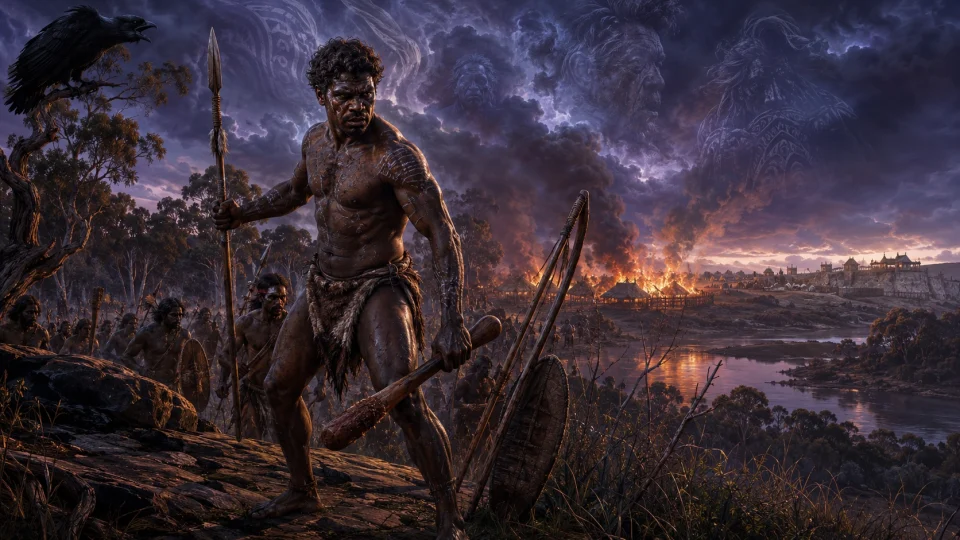
Pemulwuy (c.1750–1802) was a Bidjigal warrior of the Dharug Nation and and one of the most formidable resistance leaders against British encroachment and violence in Australia. Born near what the British would later name Botany Bay, he led a twelve-year guerrilla war against the British at Sydney Cove, transforming scattered acts of defiance into a sustained campaign of opposition to British occupation. For his people, he was not only a warrior, but a carradhy — a clever man and spiritual healer — whose very body, name, and story were bound to the earth he fought to defend.
Country and people
Pemulwuy belonged to the Bidjigal (also written Bediagal) clan, part of the wider Dharug Nation whose Country covered much of present-day western Sydney. Bidjigal lands extended from the northern shores of Botany Bay along the Georges River, reaching west to the areas later known as Bankstown, Toongabbie, and Parramatta—regions that became centers for early British farms and outstations.
The British used the term “Eora” to describe the Aboriginal peoples of the Sydney coastal region, borrowing from a word meaning “here” or “from this place.” The Bidjigal, known as “woods people” rather than coastal fishers, saw their hunting grounds, yam beds, and riverine food sources steadily diminished as the British pushed inland into their territory. For the Bidjigal, “Country” was not a passive landscape but a living spiritual matrix that shaped law, kinship, and identity.
Name, body, and the clever man
The Dharug word pemul means “earth” or “clay,” reflecting Pemulwuy’s deep-rooted connection to Country. In adulthood, he was also called Bemul Wagan or Butu Wagan—“earth and crow”—associating him with the crow, a significant ancestral being in Aboriginal cosmologies, revered for its transformative power, intelligence, and ability to traverse different realms.
Pemulwuy’s body itself carried the signs of his spiritual authority. British observers noted two striking features: a blemish, or “speck,” in his left eye and a clubbed or injured left foot. Colebee, a Cadigal man who mediated with the British, explained that this foot injury was not a birth defect but a purposeful ritual wound, signifying Pemulwuy’s status as a carradhy—a clever man, healer, and spiritual leader. In many Aboriginal traditions, such physical distinctions marked a heightened spiritual calling rather than a limitation.
As a clever man, Pemulwuy would have been responsible for healing, for mediating between the everyday world and the Dreaming, and for enforcing spiritual law, including ritual punishment. Over time, stories grew around him: that he could move between realms, that he could shape‑shift into a crow, that he was shielded from the lethality of British weapons.
First encounters and a shifting relationship
When the First Fleet arrived in January 1788, the British brought with them famine, disease, and an entirely different understanding of land and its use. In the early years, the interactions between the newcomers and local Aboriginal groups were complex and not always marked by violence. Pemulwuy is known to have hunted kangaroos and other game to help feed the British in exchange for goods. He acquired enough English to communicate with the new arrivals and, at one stage, spent two weeks staying in Bennelong’s brick hut at Sydney Cove. For Aboriginal people, the central question was whether these newcomers would act as respectful visitors, acknowledging existing law, or as a force seeking lasting possession of the land. As fences appeared, crops took root, cattle disrupted yam beds, and net fishing reduced traditional food supplies, it became evident that the newcomers intended to stay.
Law, payback, and the spearing of McIntyre
Pemulwuy first entered the British record on 9 December 1790. John McIntyre (also spelled McEntire), a convict, was part of a hunting party at Botany Bay when Pemulwuy approached and, following what seemed to be a cordial interaction, struck him with a barbed spear. McIntyre succumbed to his injuries soon after.
The British described the attack as sudden and “unprovoked,” but Aboriginal perspectives differed strongly. McIntyre was widely feared and disliked among the Eora and Dharug for shooting at Aboriginal people and killing totem animals—emu, dingo, kangaroo—revered as spirit beings. Within Aboriginal law and spirituality, Pemulwuy’s act was payback: a formal, ritualized punishment intended to show that the newcomers were also bound by existing law.
Arthur Phillip, a British headman, responded decisively and with harsh intent. He commanded a detachment of soldiers to capture two Bidjigal men and kill at least six more, with initial orders even including the beheading and public display of Aboriginal heads. These instructions were later limited to capture only, but the expedition failed: after three days, the soldiers returned empty-handed, unable to find any Bidjigal people. This unsuccessful mission foreshadowed the ongoing frustration of the settlement in pursuing a man deeply familiar with his Country.
Building a war of resistance
Beginning in 1792, Pemulwuy moved from specific acts of payback to leading a sustained campaign of guerrilla warfare aimed at disrupting the invaders’ food sources and expansion. His warriors conducted raids on farms in areas such as Prospect, Toongabbie, Georges River, Parramatta, Brickfield Hill, and along the Hawkesbury River. They targeted houses and maize crops with fire, killed livestock, and frequently harassed work parties and travelers. This strategy was designed to make permanent farming on Bidjigal land unsustainable and to push settlers back toward the coast.
Traditionally, Aboriginal conflicts were highly ritualized and localized, focused on payback or inter-clan disputes rather than territorial conquest. Under Pemulwuy’s leadership, this dynamic changed. In the aftermath of the 1789 smallpox epidemic, which devastated local communities, Pemulwuy united warriors from the Bidjigal, other Dharug clans, Eora, and Tharawal peoples, forging a broader and more coordinated resistance.
Pemulwuy also broadened the social base of the struggle by welcoming escaped convicts, who found refuge in Aboriginal communities from the harshness of British justice. The involvement of these non-Indigenous fighters under Aboriginal leadership highlighted the conflict as one grounded not only in cultural difference but in the fight between those seeking freedom and those enforcing dispossession and violence.
Battle of Parramatta and the making of a legend
The conflict reached a dramatic climax in March 1797 at what became known as the Battle of Parramatta. Following a series of raids on farms at Toongabbie and the “Northern Farms,” an armed group of occupiers and soldiers set out to pursue Pemulwuy and his followers. At dawn, they surprised a large gathering of Aboriginal people near present-day North Rocks, prompting a retreat toward Parramatta.
Later that morning, Pemulwuy returned to the town at the head of an estimated hundred warriors. Contemporary accounts portray him as fierce and defiant, threatening to spear anyone—Aboriginal or European—who attempted to restrain him. When soldiers closed in, Pemulwuy threw a spear, injuring a man and prompting a volley of musket fire. At least five Aboriginal men were killed instantly, though some reports suggest the casualties were even higher. Pemulwuy was struck by seven buckshot wounds to the head and body, collapsing and appearing to be near death.
Pemulwuy was taken to the hospital at Parramatta, chained in irons, and kept under guard. Weeks later, to the astonishment and outrage of the British, he escaped. When he was next seen near Botany Bay, he walked unaided—still wearing the leg iron and with pellets lodged in his skull. News of his survival spread swiftly among Aboriginal communities: the clever man had withstood the full force of British weapons.
This episode cemented the belief that Pemulwuy could not be killed by bullets. Oral traditions expanded on the story, with some accounts describing him transforming into a crow to escape confinement. For his people, the miracle was not merely physical but deeply spiritual—affirming that Pemulwuy’s authority and connection to Country surpassed the destructive force of the invaders.
Outlawed, hunted, unbroken
As raids persisted, the encroachers’ sense of alarm grew. In May 1801, a British headman issued an order allowing the invaders to shoot Aboriginal people on sight in the districts of Parramatta, Georges River, and Prospect—effectively granting legal cover for violence against any Aboriginal presence on their own land. Later that year, he had the audacity to declare Pemulwuy an outlaw and to announce substantial rewards for his capture, “dead or alive,” offering pardons and passages to England for convicts and rum and clothing for free encroachers.
The Bidjigal war leader now became the central target of a manhunt. Despite intense pressure, mounting injuries, and the devastating loss of his people, he continued to orchestrate raids on farms and outstations. While the conflict became less open than at Parramatta and more sporadic, the underlying purpose stayed constant: to defend Country, uphold law, and demonstrate that the invaders were neither invisible nor invincible.
Death, beheading, and the missing head
Pemulwuy’s campaign ended around 2 June 1802, when he was shot and killed. The identity of his killer remains uncertain. For years, European accounts attributed the act to a sailor and explorer, but later archival research suggests that two occupiers from the Parramatta–Prospect–Toongabbie area may have been responsible and were unable to capture him alive.
What is certain is what followed. Pemulwuy’s head was severed, preserved in spirits, and sent to London aboard the ship Speedy, along with other “specimens” such as a black swan. For a time, the skull was thought to be kept in the Hunterian Museum at the Royal College of Surgeons in London. The museum’s collections suffered heavy damage during the Second World War, and while some human remains were transferred to the Natural History Museum, no verified record of Pemulwuy’s skull has been found. Aboriginal communities in Sydney have persistently called for its return, but his head remains missing. In a profound sense, the Bidjigal clever man is still withheld from the earth that named him.
Tedbury and the afterlife of a war
After Pemulwuy’s death, his son Tedbury (Tjedboro/Tidbury), born around 1780, stepped into the role his father had held. Tedbury’s relationship with the British was more complex, yet he maintained the tradition of raids and resistance into the early nineteenth century. In 1810, he was shot at Parramatta and later died from his wounds. His possible son, Tommy Dadbury, is recorded living with the Wianamattagal at Penrith in 1837—a faint genealogical echo of a family that once commanded the British’s attention.
Crow, earth, and the meaning of resistance
Viewing Pemulwuy solely as a military leader overlooks the deeper dimensions of his life and legacy. As Bemul Wagan, he embodied a convergence of meanings: earth and crow, Country and ancestral spirit, healer and avenger. His campaign was not only a defense of land, but also a preservation of law, kinship, and spiritual order. The spearing of McIntyre was not an act of random violence, but an enactment of Aboriginal justice. The burning of maize fields and the killing of livestock were deliberate, strategic acts in response to an invasion that had uprooted yam beds, enclosed hunting grounds, and disrupted long-standing obligations of reciprocity.
Within the broader context of the Australian Frontier Wars, Pemulwuy stands as one of the earliest and most prominent figures of organized Aboriginal resistance. Later leaders from other regions—Yagan, Windradyne, Jandamarra—would each take up the same struggle in their own ways. For much of Australian history, these conflicts were minimized or erased beneath the myth of peaceful settlement. In that silence, Pemulwuy faded from the history of his own land, stolen from his people.
Remembering Pemulwuy
From the late twentieth century onward, Pemulwuy’s story has been reclaimed and retold. In a twist of history, a descendant of his people’s adversaries would go on to write a novel about him. Eric Willmot’s 1987 work, Pemulwuy: The Rainbow Warrior, introduced his life to a wider audience and highlighted his legacy as a unifier of many “colors” of people under one cause. Today, the Sydney suburb of Pemulwuy, Pemulwuy Park in Redfern, and the Pemulwuy Loop at Parramatta inscribe his name back onto the landscapes where he once fought. The Pemulwuy Project on the Block in Redfern — providing affordable Aboriginal housing and community infrastructure — carries his memory forward into ongoing struggles for urban land, dignity, and self-determination.
His image appears in sculpture, choral music, folk songs, and documentary reconstructions. A forthcoming feature film, First Warrior, guided by Dharug elders and Indigenous filmmakers, seeks to introduce his story to a new generation. Yet, the most enduring memorial is the ongoing assertion of Aboriginal sovereignty over Country, and the steadfast call for the return of his head.
Yet, these monuments and tributes can never restore what was taken from Indigenous people: their lands, their lives, their peace, and their spiritual connection to Country.
To speak his name—Pemulwuy, earth and crow—is to honor a man who, armed with spears, boomerangs, law, and the strength of his spirit, forced the British to recognize that the land they stole was already a vibrant, complete world. To remember Pemulwuy is to acknowledge that the arrival of a shipload of British convicts to “Country” brought death, theft, devastation, and profound loss to his people.
Source:
https://en.wikipedia.org/wiki/Pemulwuy
https://www.nma.gov.au/defining-moments/resources/pemulwuy
https://adb.anu.edu.au/biography/pemulwuy-13147
https://www.youtube.com/watch?v=Yaxdmq9tEuU
https://www.youtube.com/watch?v=euqzzoECwF4
https://www.bayside.nsw.gov.au/sites/default/files/2019-02/2016_HighSchool_Purvis_Cindy.pdf
https://radicalteatowel.co.uk/radical-history-blog/wanted-by-the-british-empire-pemulwuy-dead-or-alive
https://dictionaryofsydney.org/entry/pemulwuy
https://www.abc.net.au/news/2020-05-01/the-story-of-aboriginal-resistance-warrior-pemulwuy/12202782
https://australia-explained.com.au/rebels/rebels-pemulwuy-promotor-of-outrageous-acts
https://www.monumentaustralia.org/themes/people/indigenous/display/105945-pemulwuy