
Jacques Jean-Baptiste Roumain was born on 4 June 1907 in Port-au-Prince, Haiti, into an old and affluent family whose social standing placed him near the center of the country’s political and cultural establishment. His maternal grandfather, Tancrède Auguste, had served as president of Haiti from 1912 to 1913, and Roumain’s early life unfolded within a world of privilege, education, and access that few Haitians could claim. Yet the significance of Roumain’s life lies not in the advantages he inherited, but in the breadth of vision with which he moved beyond the narrow assumptions of his class and devoted himself to the cultural, political, and spiritual life of the Haitian people.
He received his early schooling in Port-au-Prince and then continued his education in Europe, studying in Switzerland and traveling through Belgium, France, Germany, and Spain. These years abroad exposed him to the intellectual currents of the interwar period and sharpened the philosophical and political sensibilities that would define his mature work. When he returned to Haiti as a young man, he entered a country still marked by the violence and humiliation of the United States occupation, which had begun in 1915 and profoundly reshaped Haitian political and cultural life.
The occupation became one of the great crucibles of Roumain’s intellectual formation. Haiti’s sovereignty had been constrained, its economy subordinated, and its African-derived culture regularly demeaned by both foreign authorities and sectors of the local elite. In response, Roumain joined a generation of young Haitian writers and thinkers determined to reclaim the dignity of the nation’s popular culture and affirm the value of the peasantry, the Creole language, and Vodou as constitutive elements of Haitian identity. In 1927 he became one of the founding figures of La Revue Indigène, the short-lived but immensely influential journal that helped define the indigéniste movement and transformed Haitian literature by bringing the country’s local realities and African inheritances to the center of artistic expression.
Roumain’s literary awakening was inseparable from political radicalization. If the indigéniste movement taught him to take Haitian culture seriously, Marxism gave him a language for understanding the structural forces of class domination, imperialism, and racial hierarchy that shaped Haitian life. In 1934, the same year the U.S. occupation formally ended, Roumain founded the Haitian Communist Party and helped draft its manifesto, arguing that Haiti’s social crisis could not be understood apart from the intertwined realities of colonial history, labor exploitation, and color prejudice. The response from the Haitian state was swift. He was jailed as a subversive, the party was later dissolved by President Sténio Vincent, and Roumain was forced into exile after repeated repression.
Exile widened rather than diminished his horizons. During the later 1930s he moved through Belgium, France, Martinique, Cuba, New York, and Mexico, remaining politically engaged and intellectually active across the Black Atlantic world. These travels deepened his transnational friendships and sharpened his sense that Haiti’s fate could not be separated from the struggles of colonized and Black peoples elsewhere. He developed important ties with Langston Hughes, whose own visit to Haiti in 1931 helped create a durable intellectual friendship, and with the Afro-Cuban poet Nicolás Guillén, another major figure of Caribbean Black radical culture. Roumain’s life thus came to embody a distinctly diasporic form of thought: rooted in Haiti, but never confined by the borders of the Haitian nation-state.
The writing produced during these years reveals the range of his gifts. Roumain worked across poetry, fiction, journalism, political essays, and ethnological study, always returning to the question of how a people broken by poverty, division, and historical violence might recover the terms of collective dignity. His early novel La Montagne ensorcelée (1931) helped establish the Haitian peasant novel as a serious literary form, exploring rural life through a prose style deeply marked by the rhythms and imagery of Haitian speech and belief. His poetry collection Bois d’ébène, composed in the late 1930s and published after his death, expanded his vision outward into the broader Black world, merging anti-colonial anger, historical memory, and a fierce sense of solidarity with the oppressed across the African diaspora.
Although Roumain remained an uncompromising Marxist, his understanding of Haiti was never mechanical or reductive. He grasped that class struggle in Haiti could not be discussed apart from language, belief, land, ritual, and history. This sensitivity became especially important after his return to Haiti in 1941. That year he helped found the Bureau d’Ethnologie and became its first director, working alongside Jean Price-Mars to create an institutional framework for the serious study of Haitian culture, archaeology, folklore, and Vodou. At a time when the Catholic Church’s anti-superstition campaign sought to destroy Vodou practices in the name of moral purification, Roumain emerged as one of the most forceful defenders of Vodou as a living archive of African-Haitian culture and a vital part of the nation’s historical identity. His defense was not a simple religious endorsement; rather, it reflected his conviction that no people can build a future by despising the cultural forms through which they have remembered, endured, and named themselves.
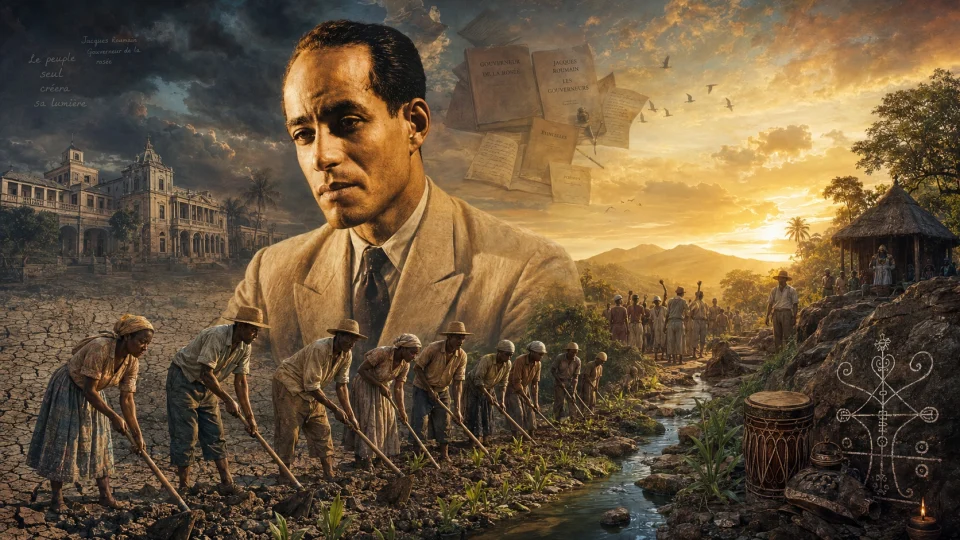
Roumain’s political and scholarly work did not prevent him from serving Haiti in an official diplomatic role. In 1942 he was appointed Haiti’s chargé d’affaires in Mexico, where he continued to write while moving in an international milieu of left-wing intellectuals and exiles. It was in this period that he completed the work for which he is most widely remembered, Gouverneurs de la rosée (Masters of the Dew), published posthumously in 1944. The novel tells the story of Manuel, a peasant who returns to a drought-stricken Haitian village divided by feud and scarcity, and who discovers that the survival of the community depends on recovering both water and solidarity. In Manuel’s struggle, Roumain brought together the central concerns of his life: the dignity of peasant labor, the tragedy of internal division, the ecological vulnerability of the land, the enduring force of communal tradition, and the necessity of collective action.
Masters of the Dew has often been read as the crowning achievement of Haitian fiction, and with good reason. The novel transforms a local struggle over drought and reconciliation into a meditation on nation, sacrifice, and rebirth. It also reveals Roumain’s rare ability to synthesize currents that are too often kept apart: Marxism and myth, ethnography and lyricism, social realism and spiritual symbolism. The English translation by Langston Hughes and Mercer Cook, published in 1947, ensured that Roumain’s vision would travel beyond Haiti and take its place in the wider canon of Black world literature.
Roumain did not live to witness the full afterlife of his masterpiece. He died suddenly in Port-au-Prince on 18 August 1944, only thirty-seven years old. Official reports cited a heart attack, though suspicions of poisoning have lingered in the historical record. One of the most enduring details associated with his death is that the manuscript of Gouverneurs de la rosée was found in his briefcase, a fitting image for a writer whose life seemed always to move between urgency and unfinished possibility.
His legacy has only deepened with time. Roumain is remembered as one of the foundational figures of modern Haitian literature, a pioneering ethnologist, a communist militant, and a Black Atlantic intellectual whose work linked Haiti’s national experience to a much wider geography of anti-colonial struggle. Writers such as Jacques-Stéphen Alexis inherited and transformed his aesthetic and political concerns, while later readers from across the Caribbean and the diaspora have continued to return to him as a thinker of land, labor, culture, and liberation. His life stands as a reminder that intellectual greatness is not measured by distance from ordinary people, but by the depth of relation one is able to forge with their history, language, grief, and hope.
Roumain’s achievement endures because it was never merely literary. He did not simply write about Haiti; he labored to understand the country in its fullness, to defend what others dismissed, and to imagine forms of collective life capacious enough to hold suffering without surrendering the possibility of renewal. In that sense, his career remains one of the most compelling examples in Caribbean intellectual history of how art, politics, and cultural scholarship can converge in the service of a people still struggling to breathe freely in the wake of oppression.
Source:
https://www.encyclopedia.com/humanities/encyclopedias-almanacs-transcripts-and-maps/roumain-jacques-1907-1944
https://en.wikipedia.org/wiki/Jacques_Roumain
https://www.visegradliterature.net/works/all-en/Roumain,_Jacques-1907
https://www.babelmatrix.org/works/fr-all/Roumain,_Jacques-1907/biography?doc_lang=fr~
https://classiques.uqam.ca/classiques/roumain_jacques/roumain_jacques_photo/roumain_jacques.html
http://www.csun.edu/~hcpas003/master.html
https://criticalflame.org/inventing-a-nation-jacques-roumain-and-haitian-kreyol/
https://islandluminous.fiu.edu/part08-slide14.html
https://read.dukeupress.edu/small-axe/article/21/2%20(53)/45/129675/Becoming-Indigenous-in-Haiti-from-Dessalines-to-La
https://cosmonautmag.com/2021/01/the-founding-of-the-haitian-communist-party/
https://www.jstor.org/stable/260289
https://www.aaihs.org/haiti-cultural-politics-and-us-occupation/
https://www.juno7.ht/31-octobre-1941-jacques-roumain-fonde-bureau-ethno/
https://www.sciencedirect.com/org/science/article/pii/S1382237323000958
https://onlinelibrary.wiley.com/doi/abs/10.1002/9781119076506.wbeps314
https://www.litencyc.com/php/sworks.php?rec=true&UID=32017
https://literariness.org/2023/08/01/analysis-of-jacques-roumains-masters-of-the-dew/
https://www.themodernnovelblog.com/2014/07/31/jacques-roumain-gouverneurs-de-la-rosee-masters-of-the-dew/
https://knowledge.lancashire.ac.uk/id/eprint/30584/
http://www.toptenbooks.net/blog/edwidge-danticat-appreciates-jacques-roumain
https://haitioutreach.org/news/black-history-month-haitian-history-is-black-history
https://histanthro.org/news/announcements/new-release-from-berose-laethier-on-guillen-and-roumain/
https://www.jstor.org/stable/j.ctv1220qc0
https://freehaiti.org/haitis-literary-legacy-black-authors/
https://www.pbs.org/newshour/arts/for-haitian-writers-identity-is-wrapped-up-in-history-and-hope
https://kreolmagazine.com/jacques-roumain-the-voice-of-the-occupation-how-haitis-favourite-hero-helped-to-define-the-troubled-country/