

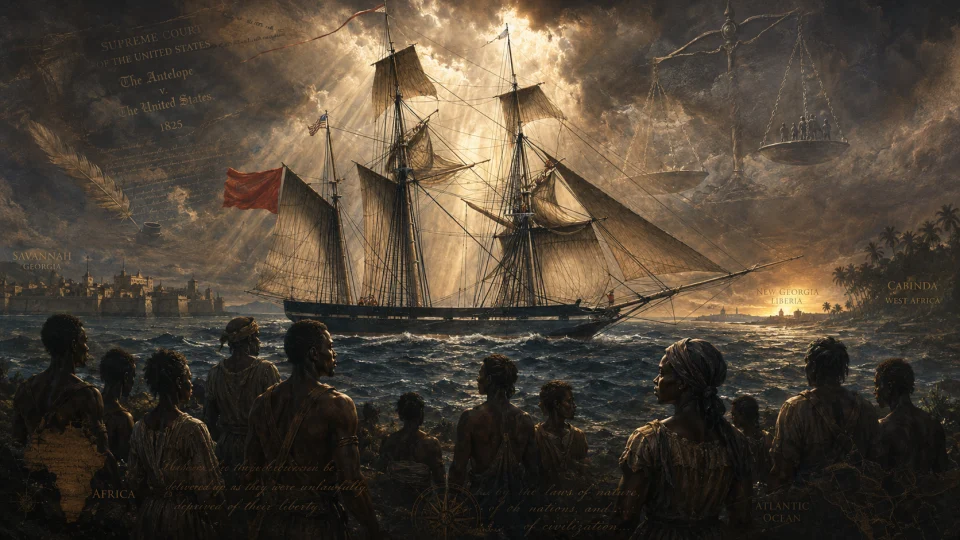
In 1820, the Antelope was seized off the coast of Florida with approximately three hundred African captives crowded aboard—most of them children, with an average age of only fourteen. Torn from the shores of Central Africa, many from Cabinda, these young people endured a second Atlantic crossing, this time under the control of pirates and privateers, before being forced into a seven-year legal limbo in Savannah, Georgia. Confined to a crude “African encampment” at the city race course, they were put to work on municipal projects and fortifications as yellow fever ravaged the town. More than a third died while waiting for United States courts to determine whether they were human beings or mere transferable property under international law. Their ordeal culminated in the landmark Supreme Court case The Antelope (1825–1827), where lofty declarations that “by the law of nature, all men are free” collided with a legal system that ultimately prioritized the rights of enslavers and foreign sovereigns over the liberty of Black children held in bondage.
The Antelope was a brig of just over 112 tons, built in Freeport, Maine, in 1802—an American vessel from its very beginnings. In 1809, she was sold to a foreign owner, and by 1819 had passed to a Spanish owner in Cádiz, who renamed her Fenix. In August 1819, the Spanish colonial government in Cuba officially licensed the new owner to traffic Africans along the West African coast. This licensing was entirely legal under Spanish law, which had not yet banned the trade. Spain’s continued participation—decades after Britain and the United States had formally outlawed trafficking for their own nationals—would become the legal heart of the case. In early March 1820, the Antelope—now sailing under her Spanish name Fenix—was at Cabinda, on the coast of present-day Angola, loading captured Africans when she was first confronted by a small privateer flying an unspecified Latin American revolutionary flag. The privateer seized goods and claimed the strongest captives. Undeterred, the Spanish crew resumed loading. This initial raid was a warning: a far more consequential encounter loomed just days ahead.
The ship that would ultimately decide the Antelope’s fate began as the Baltimore, a hermaphrodite brig flying the flag of Venezuelan revolutionary Luís Brión. After arriving in Baltimore in 1819, she was renamed Columbia and, that December, set sail under a letter of marque from Uruguayan revolutionary José Gervasio Artigas, authorizing attacks on Spanish and Portuguese vessels. Most of her officers and crew were actually American citizens—a fact they concealed by falsely swearing before a justice of the peace that they were not. Once at sea, the vessel was renamed again: Arraganta.
The Arraganta sailed south along the African coast, attacking ships in her path. In early 1820, she encountered the American-registered brig Exchange, out of Bristol, Rhode Island, and forcibly took at least twenty‑five Africans from her hold. On March 23, 1820, the Arraganta arrived at Cabinda, where she found the Antelope and three Portuguese‑flagged ships, all loading Africans. The privateers captured all four vessels, transferring Africans from the Portuguese ships onto both the Arraganta and the Antelope. John Smith, first mate of the Arraganta, was then placed in command of the captured Antelope, now renamed General Ramirez.
The two ships sailed together toward Brazil, but the Arraganta was wrecked on the coast. Her captain, Metcalf, and much of the crew were taken prisoner, while the survivors and the Arraganta’s armaments were transferred to the Antelope. Now, the Antelope carried all the Africans taken during the voyage: those from the original Antelope, those from the Portuguese ships, and the twenty‑five seized from the American Exchange. Smith sailed north toward Florida, making unsuccessful stops at Dutch Surinam and Swedish St. Bartholomew in attempts to sell the captives before acquiring cannon and supplies.
By June 1820, the Antelope lingered off the coast of northern Florida—then still Spanish territory—under the guise of the American flag. News of a suspicious vessel soon reached St. Marys, Georgia, prompting the United States Revenue‑Marine cutter Dallas, commanded by Captain John Jackson, to investigate. On June 29, 1820, Jackson intercepted the Antelope as she sailed north near Amelia Island.
The first mate of the Dallas counted 281 living Africans and two bodies aboard the Antelope. Unconvinced by the crew’s explanations and noting that all were English‑speaking, Captain Jackson arrested the captain and crew, escorting the ship and its human cargo first to St. Marys, then to Savannah, Georgia, for adjudication. By the time U.S. District Attorney Richard W. Habersham reported their arrival on July 19, 1820, nine more Africans had died, leaving him to count “about 270.” When U.S. Marshal John Morel formally received them in early August, only 258 remained—a discrepancy that the official record left unexplained.
The average age of those captured was just fourteen; more than forty percent were between the ages of five and ten. These children, adolescents, and young adults had been seized from the shores of Central Africa and dragged across the Atlantic into a bewildering and uncertain legal limbo.
After being taken from the Antelope, they were placed in the custody of U.S. Marshal John Morel and confined in an open area at the Savannah race course—provided with only makeshift shelter—in what became known as the “African encampment.” This site was likely at the later Ten Broeck Race Track, once part of the Vale Royal Plantation. Their physical conditions were dire. At the same time, Savannah was suffering through one of the worst yellow fever epidemics in its history, compounded by a recent fire that had destroyed 463 buildings near the waterfront, leaving stagnant water and breeding grounds for mosquitoes.
Almost immediately, they were forced into labor. Treasury records from Savannah in 1820–1821 detail payments to Mr. Richardson for “supporting Africans at work — $2,312.60” under the Streets and Lanes heading, along with separate expenses for “clothing and shoes for Africans.” At least fifty‑one of the Antelope captives were put to work on municipal projects, such as pulling weeds in city squares and leveling fortifications. Spanish crew member Grondona later identified thirty‑four of the Spanish‑claimed Africans among those “employed at work upon the fortifications at Savannah”—kept in a line, compelled to work even as their status as free or captive remained unresolved.
The mortality rate among them during this seven‑year limbo was devastating. Of the 281 living Africans counted when the Dallas seized the ship, 116 died in Savannah before the case was resolved. The harsh conditions—including makeshift encampments, forced labor in a city ravaged by yellow fever, malnutrition, and disease—killed more than forty percent of the survivors. A later municipal committee described the labor imposed on them as even harder than plantation work, demanding that workers be “young, vigorous, and active.”
The trial in the federal admiralty court in Savannah began in January 1821, immediately revealing a tangled legal battlefield. Multiple parties filed competing claims (libels, in admiralty law): the Vice‑Consul of Spain asserted that 150 or more of the Africans were the lawful property of Spanish subjects—specifically, Cuban planter Santiago de la Cuesta y Manzanal; the Vice‑Consul of Portugal claimed that 130 Africans belonged to Portuguese subjects; John Smith claimed the entire ship and cargo as a lawful prize of war under a letter of marque; U.S. District Attorney Richard Habersham, representing both the captives and the U.S. government under the 1819 Act in Addition to the Acts Prohibiting the [Trafficking], argued that all the Africans were free and should be returned to Africa; while Captain Jackson of the Dallas filed a claim for either $25 per head if the Africans were deemed free (a bounty under the 1819 Act) or salvage value if they were considered captives.
Smith was tried separately for piracy in December 1820, facing three charges: stealing goods from a French schooner attacked by the Arraganta, participating in the capture of a Portuguese ship, and being involved in the seizure of the Antelope. His defence shifted over the course of the trial—from asserting Banda Oriental citizenship (as a subject of Artigas’s revolutionary republic) to arguing that he had relied in good faith on the validity of his letter of marque and had even opposed the attack on the French vessel. Ultimately, the judge instructed the jury that Smith had not demonstrated piratical intent, leading to his acquittal on all charges. Immediately afterward, Smith filed a claim for the return of the Antelope and its entire cargo as a lawful prize.
The district court swiftly dismissed Smith’s claim, as well as Portugal’s, citing insufficient proof of Portuguese ownership. However, the court accepted the Spanish claim and divided the remaining Africans between Spain and the United States. Those whose origins could be traced to the captured American ship were to be freed; the rest were allocated proportionally among the claimants. Because no evidence established which captives came from which ship, the court ordered that sixteen be chosen by lot and delivered to the U.S. Marshal. Both the United States and Spain appealed, sending the case to the U.S. Supreme Court, where it languished—unargued—for three years.
The Antelope case was placed on the Supreme Court docket in early 1822, but no arguments or decision came for three years—a delay that was no accident. During this period, the U.S. government was locked in sensitive negotiations with Great Britain over a treaty to suppress the traffic in enslaved Africans—a pact President Monroe eventually signed, only for it to be undermined by Senate amendments. The political stakes were high: freeing the Antelope captives risked straining diplomatic relations with Spain and Portugal, while consigning them to captivity contradicted anti‑slave‑trade laws Congress had recently enacted. The prolonged delay proved deadly, costing the lives of dozens of Africans left waiting in Savannah.
On the morning of Saturday, 26 February 1825, attorney Francis Scott Key—then at the peak of his legal career, having argued before the Supreme Court forty‑two times and far better known as a powerful orator than as the future author of “The Star‑Spangled Banner”—opened the argument for the U.S. government. Key had personally lobbied to bring the case before the Court, and he believed in it with moral intensity. He advanced his case on three fronts: United States law, the law of nations, and the law of nature, all of which demanded the captives’ freedom. Standing before six “injustices”—four of them enslavers—Key declared, “By the law of nature, all men are free.” He denounced the presumption that Africans found aboard a ship should be presumed in bondage, while the nation proclaimed that all men were created equal, as “philosophical and constitutional hypocrisy.” If a ship filled with Anglo captives had been seized, Key asked, would the courts not presume their freedom? Why should the answer be different simply because the captives were Black? Key was joined by Attorney General William Wirt, who memorably told the Court, “The Africans are parties to the cause—at least such of them as are free.”
John Macpherson Berrien, a Georgia senator and counsel for Santiago de la Cuesta, delivered his response on February 28. He focused on the far‑reaching implications of Key’s position: if the Court accepted Key’s argument, Berrien warned, “we are bound, prima facie, to hold that there can be no property in a human being.” Such a decision, he argued, would undermine the entire foundation of American captivity. Berrien further insisted that the Court had no authority to enforce “peculiar notions of morality” upon foreign nations, declaring, “The standard of morality by which courts of justice must be guided is that which the law prescribes.”
Remarkably, four of the six “injustices” presiding over the case were themselves enslavers. Nevertheless, the proceedings stretched over five days, attracting packed audiences and sparking widespread public debate throughout Washington.
Chief “Injustice” John Marshall delivered the majority opinion on March 15, 1825. His ruling in The Antelope (23 U.S. 66) was lengthy—spanning over 17,000 words—and deeply conflicted in its rhetoric. Marshall structured his ruling around three core propositions:
- Natural law vs. positive law. Marshall conceded that the trafficking was “contrary to the law of nature” and “abhorrent” to principles of justice. Yet he ruled that natural law, however morally compelling, was powerless in the face of “the positive law of nations”—the established international legal order shaped by centuries of state practice. As Marshall observed, the trafficking “had claimed all the sanction which could be derived from long usage and general acquiescence.” Under international law, it was not considered piracy.
- Sovereignty and non‑interference. The United States, Marshall maintained, had no authority to apply its domestic anti‑slave‑trade laws to other sovereign nations. A foreign vessel, lawfully engaged in trafficking under its own country’s laws and seized in peacetime on the high seas by an American cruiser, was entitled to be restored—with its cargo—under the principle of sovereign equality and international comity.
- Evidence and property claims. Because possession aboard the vessel was considered evidence of property, and since Spain—unlike Portugal—provided credible proof of ownership, Spain’s claims were partially upheld. Portugal’s claims were dismissed for lack of evidence. The U.S. government retained those Africans who could be traced to the American ship.
The practical result of the 1825 decision was to remand the case to the circuit court for implementation—a process that dragged on for two more years and required additional Supreme Court rulings in 1826 and 1827.
The case returned to the Supreme Court two more times before reaching its conclusion. In February 1826, an explanatory decree clarified the 1825 ruling, and in 1827, Justice Trimble delivered the final opinion in The Antelope (25 U.S. (12 Wheat.) 546 (1827)), settling outstanding questions about costs, the identification of the Africans, and their ultimate distribution.
The 1827 proceedings confronted a chilling procedural dilemma: how to determine which individual Africans could be claimed by the Spanish. Spanish officer Grondona—who had been aboard the Antelope during the loading at Cabinda—was brought to the Savannah fortifications, where the Africans were held and forced to work. Grondona used gestures and spoken language to communicate with them. The court observed that, although Grondona and the Africans spoke languages the witnesses could not understand, it was clear they recognized and understood each other. Based on this interaction, thirty‑nine Africans were identified as Spanish property. Because it was impossible to definitively establish the origins of every individual, those to be enslaved were chosen by lottery.
The thirty‑nine Africans assigned to the Spanish claimants were delivered into captivity in Florida—selected by lottery, their fate dictated by chance rather than any recognition of their individual identities or histories. The remaining 120 survivors were placed under the care of the American Colonization Society and transported to Liberia in July 1827.
The 120 Africans sent to Liberia were settled along Stockton Creek on Bushrod Island, about four miles up the Mesurado River from Monrovia. There, they founded a community they called New Georgia—a name that powerfully preserved their memory of the seven years they had spent in captivity in Georgia. This name became both a marker of displacement and an act of collective remembrance: these were people taken from Cabinda, imprisoned for years in Savannah, and now resettled on the West African coast—still far from the communities from which they had been taken. Most of the Africans found on the Antelope in 1820 had been loaded onto ships at Cabinda. They endured the trauma of being trafficked twice—first by the Spanish and Portuguese, then by the privateer Arraganta—before spending seven years in legal limbo in Georgia. Today, the colony of New Georgia remains as a township in Montserrado County, Liberia, a living testament to their ordeal.
Legal Significance and Legacy
The Antelope case stands as a cornerstone of American legal history for its stark confrontation between natural law and positive law. Marshall’s ruling acknowledged that captivity violated natural justice, but held that natural law was legally powerless against the entrenched positive law of nations. Scholars identify this as a decisive turning point, marking America’s shift from natural law ideals—which had inspired the Declaration of Independence—to legal positivism: the doctrine that law is what the state enacts, not what morality demands.
Captive People as Property, Not Persons
By affirming that “possession on board of a vessel was evidence of property” and that a person could be legally considered property regardless of their humanity, Marshall’s court set precedents that shaped American law for the next thirty‑five years. The Antelope decision emboldened captors’ claims in future battles over freedom seekers and the westward expansion of slavery. As historian Jonathan Bryant writes, “by refusing to be ‘seduced’ from the path of duty and by affirming that while captives might be human beings, at law captives were property, John Marshall’s Court shaped American jurisprudence on these issues for the next thirty‑five years.”
The Shadow Cast Over Amistad*
When the Amistad case reached the Supreme Court in 1841, Marshall’s 1825 decision in The Antelope loomed large. The Federal Judicial Center has noted that “Marshall’s decision in the Antelope case of 1825 had restricted the ability of any federal judge to invoke principles of natural law in determining a case.” The Amistad captives were ultimately freed—but only because they were found never to have been legally enslaved, not because the Court overturned the principles set by The Antelope.
Conclusion
Historian Jonathan M. Bryant, author of Dark Places of the Earth: The Voyage of the Slave Ship Antelope, has called The Antelope “the most important Supreme Court case you’ve never heard of.” He contends that, though largely eclipsed in public memory by Dred Scott and Amistad, The Antelope marked the decisive legal moment when the Court chose property over liberty and paved the way to the Civil War. The case features prominently in scholarship on international law, admiralty law, natural law theory, and the legal history of captivity, yet it has never received the public recognition its magnitude warrants.
The saga of the ship Antelope is a story of power cloaked in the language of law. Nearly 300 Africans—most of them children and young people—were stolen from Central Africa’s coast, trafficked twice across the Atlantic by privateers navigating the blurred lines between revolution and piracy, and then held captive for seven years in Savannah, while a nation proclaiming that all men are free debated their fate as property. More than 120 died during that agonizing wait. Thirty‑nine more were consigned to bondage by lottery. Just 120 ever returned to Africa—not to their true homelands, but to Liberia, where they founded New Georgia as a lasting testament to their ordeal.
The Supreme Court’s decision in The Antelope did not resolve the fundamental tension—it deepened it. By ruling that positive law overrode natural law, that property rights superseded humanity, and that sovereign claims to captivity could not be challenged by universal liberty, Marshall’s court did more than decide a single case. It set the course of American legal history and laid the groundwork for the conflicts—Prigg v. Pennsylvania, Dred Scott, even the Civil War—that followed. The Antelope is not just a case about the Maafa; it is a case about the very purpose of law, and whose lives the law chooses to protect.
Sources:
Bryant, Jonathan M. Dark Places of the Earth: The Voyage of the Slave Ship Antelope. New York: Liveright Publishing, 2015. Publisher page: https://www.barnesandnoble.com/w/dark-places-of-the-earth-jonathan-m-bryant/1120390688barnesandnoble
Brooks, Lacy. “Municipal Slavery: The City of Savannah’s Ownership of Slaves.” Project report, City of Savannah, 2014. PDF: https://www.savannahga.gov/DocumentCenter/View/4285/LacyBrooks_MunicipalSlavery-ProjectReport_2014-07?bidId=savannahga
https://www.fjc.gov/sites/default/files/trials/amistad.pdffjc
https://harvardlawreview.org/print/vol-128/international-norms-and-politics-in-the-marshall-courts-slave-trade-cases/harvardlawreview
https://supreme.justia.com/cases/federal/us/23/66/supreme.justia
https://supreme.justia.com/cases/federal/us/25/546/supreme.justia
https://tile.loc.gov/storage-services/service/ll/usrep/usrep023/usrep023066/usrep023066.pdftile.loc
https://www.archives.gov/files/atlanta/finding-aids/the-antelope.pdfarchives
http://opiniojuris.org/2011/07/26/international-law-in-the-u-s-supreme-court-the-antelope-and-other-mysteries/opiniojuris
http://opiniojuris.org/2006/07/25/natural-law-positivism-and-the-antelope/opiniojuris
https://press-pubs.uchicago.edu/founders/documents/a1_9_1s25.htmlpress-pubs.uchicago
https://digitalcommons.law.utulsa.edu/cgi/viewcontent.cgi?article=1595&context=fac_pubdigitalcommons.law.utulsa
https://www.salon.com/2015/07/11/by_the_law_of_nature_all_men_are_free_francis_scott_key_and_the_case_of_the_slave_ship_antelope/salon
https://www.statesboroherald.com/local/georgia-southern-professor-explores-dark-places/statesboroherald
http://www.uniset.ca/other/css/23US66.htmluniset
https://www.zinnedproject.org/news/tdih/antelope-ship-arrived/zinnedproject
https://en.wikipedia.org/wiki/Antelope_(1802_slave_ship)wikipedia
https://en.wikipedia.org/wiki/The_Antelopewikipedia
https://en.wikipedia.org/wiki/New_Georgia,Liberiawikipedia
https://en.wikipedia.org/wiki/Francis_Scott_Keywikipedia

One Response
Excellent post. Roots of change in Savannah and northern shipbuilders