
Mansa Musa, the ninth emperor of the Mali Empire, is among the most renowned rulers in world history. Remembered for immense wealth, expansive rule, and patronage of scholarship and architecture, he presided over the Mali Empire at the height of its political and cultural power. His reign, usually dated from around 1307 or 1312 until about 1332 or 1337, transformed Mali into a state of international consequence and made his name known across Africa, the Middle East, and Europe
Born around 1280 into the Keita dynasty, Musa emerged from the ruling lineage of the empire founded by Sundiata Keita, the thirteenth-century leader who consolidated Mandinka power and established Mali as a formidable West African state. By the time Musa came to power, Mali already controlled important trade routes and gold-producing regions, but his rule elevated that inheritance to an unprecedented scale. His accession remains partly shrouded in uncertainty. According to accounts preserved through Arabic chroniclers, his predecessor, often identified as Abu Bakari II, departed on an Atlantic expedition and never returned, leaving Musa to assume the throne as deputy turned ruler.
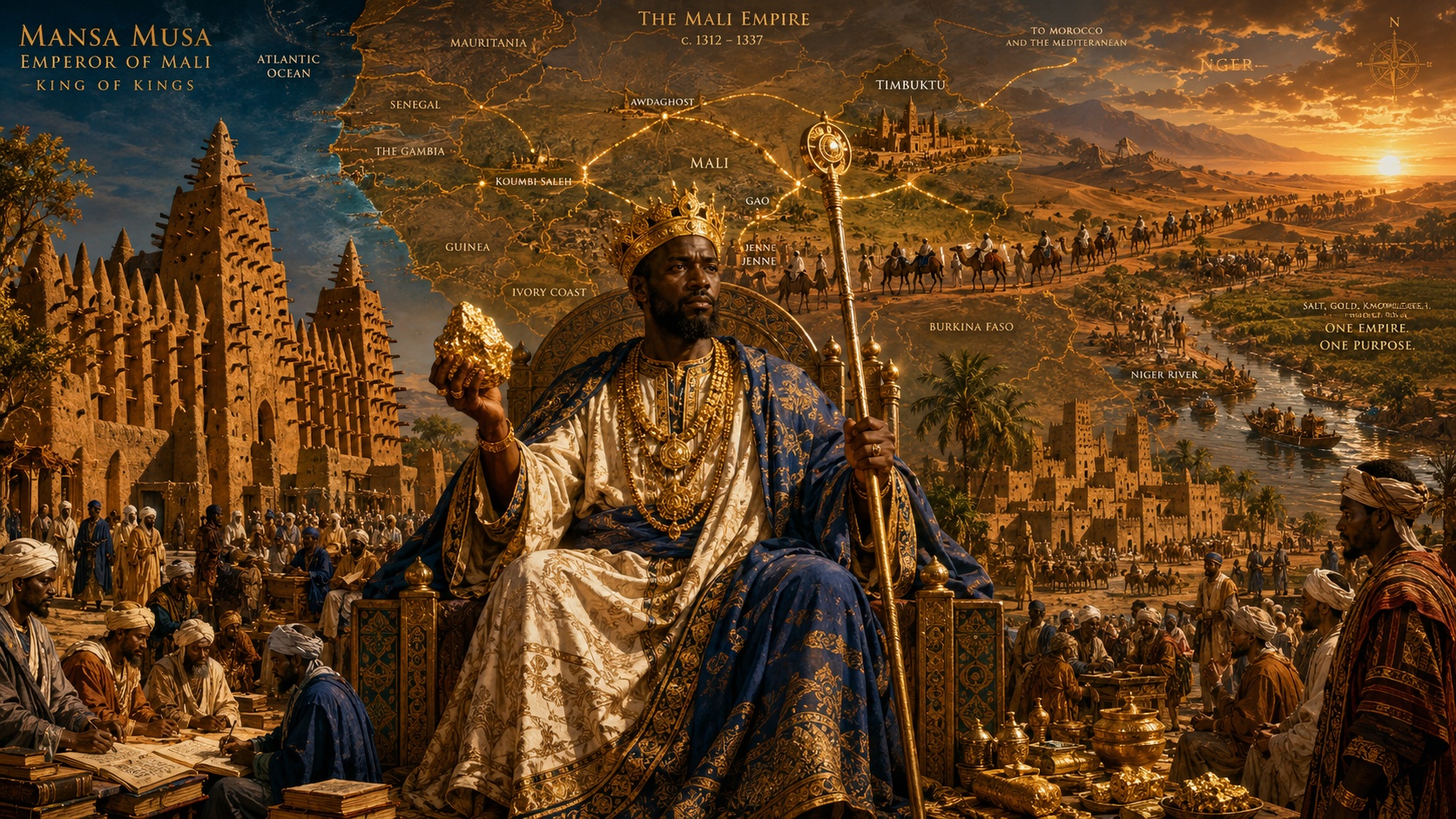
The empire Musa inherited was anchored in the wealth of the trans-Saharan trade. Gold, salt, copper, and kola nuts circulated along caravan routes linking West Africa to North Africa and the wider Mediterranean world. Mali profited from controlling strategic territory and taxing commerce that passed through its lands. Under Musa, this economic system flourished. His wealth was not simply personal extravagance but the expression of an imperial structure that drew strength from goldfields, commercial taxation, tribute, and regional dominance. Later traditions and modern estimates would celebrate him as the richest person in history, though the true scale of his fortune is best understood as the concentrated power of an empire rather than a modern private balance sheet.
Musa also proved to be an ambitious imperial ruler. During his reign, the Mali Empire reached its greatest territorial extent, absorbing key urban centers and consolidating authority across large parts of West Africa. Historical accounts credit him with annexing numerous cities and bringing strategic places such as Gao and Timbuktu under firmer imperial control. His administration combined military reach with bureaucratic organization. Governors oversaw regions, local leaders enforced authority, and the empire sustained a legal order shaped by both Islamic jurisprudence and indigenous political traditions. This synthesis helped stabilize a vast and diverse state.
Although Mansa Musa is most widely remembered for his wealth, religion was equally central to his public identity. A devout Muslim, he used Islam not only as a matter of personal faith but also as a framework for diplomacy, governance, and cultural patronage. He cultivated ties with major Muslim powers, especially in North Africa and Egypt, while remaining politically pragmatic within a multi-religious empire. His rule did not erase older Mandinka traditions; rather, it balanced Islamic statecraft with local customs, helping preserve cohesion across the empire.
The defining episode of Musa’s life was his pilgrimage to Mecca in 1324. This journey was at once a religious obligation, a declaration of prestige, and a demonstration of imperial wealth. Medieval sources describe a vast entourage of officials, servants, soldiers, scholars, and enslaved people accompanying him across the Sahara. Camels laden with gold and attendants carrying gold staffs formed part of a procession so lavish that it became legendary even in its own time. The hajj elevated Musa to global renown by bringing the splendor of Mali into the commercial and intellectual heartlands of the Islamic world.
His passage through Cairo became the most famous moment of the pilgrimage. There, according to chroniclers, he distributed so much gold in gifts and charitable donations that the local market experienced a sharp devaluation of the metal. The story of this economic disruption helped fix his image in historical memory as a ruler of staggering abundance. Yet the pilgrimage was about more than spectacle. Musa returned from the journey with books, scholars, jurists, and learned men whose presence strengthened the Islamic and intellectual institutions of his empire. In that sense, the hajj served not only as a public display but as an investment in Mali’s cultural future.
One of the clearest expressions of that investment was the development of Timbuktu. Under Musa and his successors, the city became one of the great centers of learning in Africa. He patronized mosques, supported scholarship, and helped turn the Sankore scholarly complex into a major institution of Islamic education. Timbuktu’s libraries and manuscript culture would eventually become central to its fame, preserving a long record of intellectual life in the western Sahel. Musa’s reign thus left behind not merely stories of wealth, but an enduring scholarly legacy.
Architecture also formed part of his statecraft. Musa is associated with the commissioning of important buildings, including the Djinguereber Mosque in Timbuktu. Sources connect him with the Andalusian scholar and poet Abu Ishaq al-Sahili, who is often credited with influencing or designing aspects of Mali’s monumental architecture. Whether every later attribution is precise or not, the broader significance is clear: Musa used architecture to mark imperial prestige, patronize religion, and reshape the built environment of his realm.
Mansa Musa’s fame extended far beyond the boundaries of his empire. In European cartography, he appeared in the fourteenth-century Catalan Atlas seated on a throne and holding a gold nugget, a striking visual symbol of African wealth and sovereignty. Such depictions reveal how powerfully his name traveled across continents after the hajj. He entered the imagination of foreign geographers and merchants as the ruler of a land of gold, helping to reposition West Africa in wider medieval consciousness.
Yet Musa’s life and legacy cannot be reduced to magnificence alone. His empire, like other powerful medieval states, rested in part on conquest, hierarchy, and systems of extraction. Some accounts of his hajj note the presence of unfree people in his entourage, and broader scholarship has drawn attention to the role of warfare and imperial control in sustaining Mali’s prosperity. These realities complicate the image of the benevolent golden king and place him more accurately within the political world of the fourteenth century.
Musa appears to have died around 1332, though some sources suggest he may have lived until 1337. After his death, the empire gradually entered a period of weakening under less capable successors. Although Mali did not collapse immediately, it lost the singular authority and vision that had marked Musa’s rule. Over time, internal instability and external pressures eroded the empire’s supremacy.
Mansa Musa remains one of the most significant figures in African and global history. He embodied the political sophistication, economic reach, and intellectual vitality of precolonial West Africa at a time when Mali stood among the great powers of the medieval world. His life demonstrates that Africa was deeply entangled in long-distance trade, diplomacy, religious exchange, and the production of knowledge. Remembered as emperor, pilgrim, patron, and symbol, Mansa Musa endures as the most luminous ruler of Mali’s golden age.
Source:
https://en.wikipedia.org/wiki/Mansa_Musa
https://www.britannica.com/biography/Musa-I-of-Mali
https://www.bbc.com/news/world-africa-47379458
https://thewessexmint.com/blogs/academy-articles/mansa-musa-s-gold-quantities-sources-
https://www.metmuseum.org/essays/the-trans-saharan-gold-trade-7th-14th-century
https://www.ebsco.com/research-starters/history/mansa-musas-pilgrimage-mecca
https://www.encyclopedia.com/science/encyclopedias-almanacs-transcripts-and-maps/mansa-musa-makes-his-hajj-displaying-malis-wealth-gold-and-becoming-first-sub-saharan-african-widely
https://retrospectjournal.com/2022/04/11/mansa-musa-reorienting-assumptions-of-african-development-in-mali/
https://journeys.dartmouth.edu/marcanovicoff22/the-empire-of-mali-and-its-local-sources/
https://en.wikipedia.org/wiki/University_of_Timbuktu
https://folukeafrica.com/timbuktu-site-of-1st-african-university/
https://www.baytalfann.com/post/mansa-musa-and-the-manuscripts-of-mali
https://artsandculture.google.com/story/djinguereber-mosque/_wWBhTCQ8P9hPg
https://caravans.library.northwestern.edu/works/26/
https://www.instagram.com/p/DUkeVJ7gupT/
https://en.wikipedia.org/wiki/Sundiata_Keita https://en.wikipedia.org/wiki/Kouroukan_Fouga